Comparisons
20 Sep 2026

Utility Pump vs. Sump Pump (2026) — Which Do You Need?
Utility pump vs sump pump: one is portable for occasional jobs, the other a permanent install for ongoing water. See which your basement needs.
Not sure if your home has a septic tank or a sewer connection? Learn how to tell which one you have, plus the maintenance and cost differences.
Please note: This comparison is based on our research at time of writing and is for general informational purposes only. Wastewater systems, local code, and utility billing practices vary by jurisdiction — always confirm your home’s actual setup with your local water utility, health department, or a licensed professional rather than relying on general guidance alone.
Whether your home runs on a septic system or a municipal sewer connection changes almost everything about how you maintain it, what you budget for, and who to call when something goes wrong — the two setups don’t share a maintenance schedule, a cost structure, or even the same troubleshooting steps. That would be a simple enough distinction if every homeowner already knew which one they had, but a surprising number genuinely don’t, especially after moving into a new home, inheriting a property, or relocating from a city with municipal service to a more rural area where septic is the norm. This comparison covers both: a clear way to figure out which system your home actually uses, and a plain look at how the two differ in maintenance responsibility, cost, and the signs that something needs attention.
IN THIS GUIDE
At a Glance
Septic System
Sewer Connection
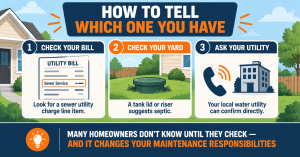
If you’re not certain which system your home uses, you’re not alone — it’s one of the most common things new homeowners overlook until something goes wrong. Here’s how to find out with confidence, using more than one check if the first one isn’t conclusive.
Check your water bill for a sewer charge. This is usually the fastest answer. If your municipal water or utility bill includes a separate line item for “sewer,” “wastewater,” or “sanitation” service, you’re on a municipal sewer connection. If your bill only covers water (or you have a private well and no water bill at all), that’s a strong sign you’re on septic — a septic system, by definition, has no utility to bill you for wastewater treatment.
Look for physical signs of a septic tank in your yard. A septic tank is buried, but it’s rarely invisible. Walk your yard and look for a round or rectangular concrete, plastic, or fiberglass lid roughly 18 to 24 inches across, sometimes sitting flush with the grass and sometimes on a raised riser that brings the access point closer to the surface. You may also notice a mound or a subtly raised, rectangular area of lawn — often greener or slower to dry than the surrounding grass — which can indicate a drain field. None of this is proof on its own, but it’s a strong indicator when combined with the other checks here.
Check your property disclosure documents. If you purchased your home, the seller’s property disclosure statement, home inspection report, or closing documents typically state whether the property is on septic or public sewer — it’s a standard disclosure item in most states specifically because it matters this much to a buyer. If you’re renting, ask your landlord or property manager directly; if you still have the original purchase paperwork, it’s worth a search before assuming you don’t have the answer already.
Call your local water utility or health department. This is the most authoritative option and it’s free. Water utilities typically know exactly which properties are connected to the municipal system, since it’s how they bill; if your utility has no record of a sewer connection at your address, that’s essentially confirmation you’re on septic. Many county health departments also keep septic system permit records, since septic installations usually require a permit and periodic inspection in most jurisdictions — a quick call or an online records search can often confirm a septic system’s presence, and sometimes even its age and tank size.
Check what your neighbors have. Septic versus sewer is very often an area-wide characteristic rather than a house-by-house one — municipal sewer lines get built out street by street or neighborhood by neighborhood, so if you’re in a subdivision with municipal water and sewer, it’s likely every home on your street shares that connection, and the reverse is just as true in a rural, unincorporated area where septic is simply how every property in the area handles wastewater. This isn’t a substitute for confirming your own home directly, but it’s a useful sanity check if the other signs feel ambiguous.
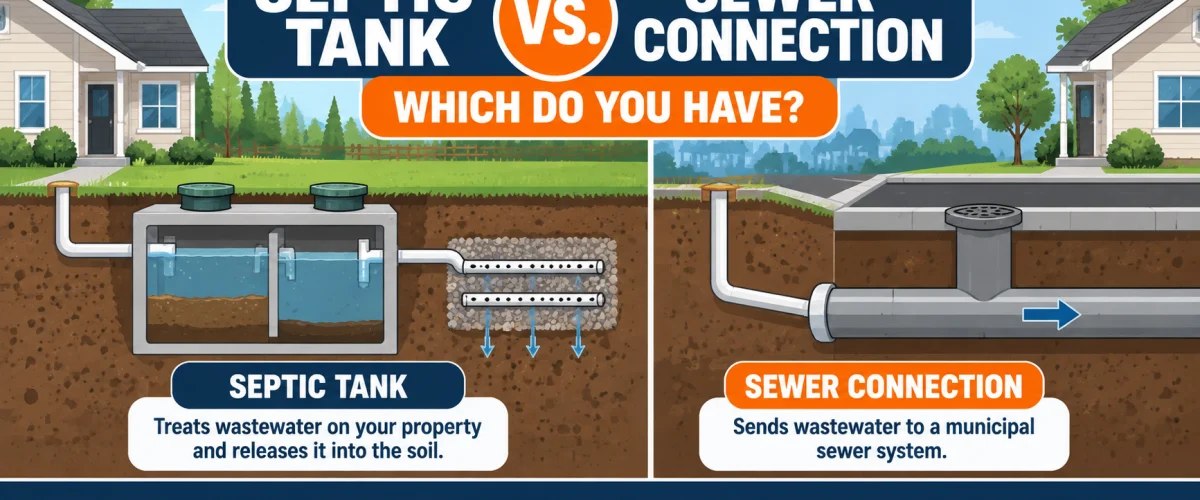
A septic system treats wastewater entirely on your own property, with no connection to a municipal system at all. Wastewater from every drain in the house flows into an underground septic tank, where it separates naturally: solids settle to the bottom as sludge, lighter fats and oils rise to form a scum layer, and the relatively clear liquid in between — the effluent — flows out to a drain field (also called a leach field), a network of perforated pipes buried in gravel-filled trenches. As the effluent seeps out of those pipes, the surrounding soil filters and further treats it naturally before it eventually rejoins the groundwater. Homes with a below-grade bathroom, laundry room, or other fixture positioned lower than the main sewer line sometimes also need a dedicated sewage ejector pump to lift that wastewater up to the level of the main line or the tank itself.
A municipal sewer connection works very differently: there’s no on-property treatment infrastructure at all. Wastewater leaves your home through a single lateral pipe that runs from your house to the municipal sewer main, usually located under or near the street. From there, it joins wastewater from every other connected property and travels through the utility’s network of mains to a centralized treatment facility, where it’s processed at a scale no individual home could replicate — treated far more thoroughly, in most cases, than a single home’s septic system, simply because of the specialized equipment and staffing a municipal plant can support. The homeowner’s only physical infrastructure in this picture is the lateral line itself; everything past the connection point belongs to the utility.
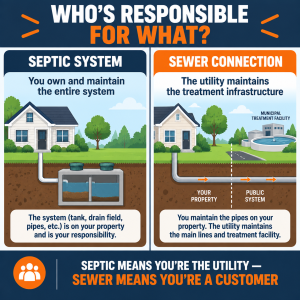
This is where the two systems diverge most in practice, and it’s the part every homeowner should understand about whichever system they have. With a septic system, you own and are fully responsible for the tank, the drain field, and every pipe on your property, with no utility involved at all. In exchange for not paying a monthly wastewater bill, you’re on the hook for periodic tank pumping — typically every three to five years, depending on household size, tank size, and usage — plus routine inspection, and the real financial exposure: a failed drain field, which can be one of the more expensive repairs a homeowner ever faces on a property, since it often means excavation and replacement of the entire leach field rather than a simple part swap.
With a sewer connection, the cost structure flips: you pay a predictable monthly or quarterly bill to your water or sewer utility, and in exchange, the utility owns the risk and expense of maintaining the treatment plant and the main line infrastructure. Your financial responsibility is generally limited to the lateral line running from your house to the connection point — if that line clogs or breaks, it’s typically your expense to fix, even though everything past the property line belongs to the city or county. Neither cost structure is objectively cheaper over the long run; a septic system with no expensive drain field failure can be less costly over decades than steady utility bills, while a sewer connection avoids the risk of a single catastrophic repair. It genuinely depends on your specific system’s condition and your utility’s rates.
For a septic system, watch for slow-draining sinks and tubs throughout the house (not just one fixture), a sewage odor near the tank, drain field, or indoors, gurgling sounds from drains or toilets, and standing water or an unusually lush, spongy patch of lawn over the drain field — all of these can indicate the tank needs pumping or, more seriously, that the drain field isn’t absorbing effluent properly. Our full guide on how to maintain a septic system covers the pumping schedule, what not to flush, and how to keep a drain field healthy in much more detail than fits here.
For a sewer connection, the most common problem homeowners encounter is a backup — wastewater draining slowly or coming back up through a fixture, often the lowest drain in the house, like a basement floor drain or a tub. It’s a common misconception that any backup automatically means a problem with the municipal main; in most cases, and in most jurisdictions, a backup traces to a clog or a break in the homeowner’s own lateral line, since that portion of the system remains your responsibility right up to the connection point, not the utility’s. A true main-line issue is possible but far less common, and it’s usually indicated by multiple homes on the same street having problems simultaneously rather than just your own.
A septic system asks more of the homeowner day to day, simply because there’s no large municipal treatment capacity buffering the occasional mistake. What goes down the drain matters more on septic: excess grease, “flushable” wipes, harsh chemical drain cleaners, and even excessive water use in a short window (a full load of laundry back-to-back with a long shower, for instance) can all stress a septic system’s tank and drain field in ways a municipal plant would simply absorb without issue. This isn’t a mark against septic systems — millions of homes run on them reliably for decades — it just means the system rewards mindful use in a way a sewer connection doesn’t require as strictly.
A sewer connection has more forgiving day-to-day capacity, but that doesn’t make it inherently “better” — it’s a different set of tradeoffs, not a superior system. Municipal treatment plants are also not infinite; heavy rainfall can overwhelm combined sewer systems in some older cities, and treatment capacity is a genuine infrastructure planning concern for growing municipalities. Both septic and sewer are legitimate, well-established ways to handle household wastewater, each well suited to the kind of area it’s typically found in — septic for lower-density rural and unincorporated land where running municipal lines isn’t practical, and sewer for the higher-density areas a municipal system is built to serve efficiently.
Switching from septic to sewer is possible and does happen, most often when a municipality extends sewer service into a previously unincorporated or rural area. It typically involves a tie-in project — connecting a new lateral line from your home to the newly available municipal main — which can be a meaningful expense, and some jurisdictions require homeowners to connect within a set timeframe once service becomes available nearby, rather than leaving it optional indefinitely. If sewer service is being extended near you, your local utility or municipality is the right place to ask about the timeline, cost-sharing programs, and any connection requirements that apply.
Going the other direction — sewer to septic — is genuinely rare, and it’s really only relevant for a property in a truly rural setting that’s losing access to municipal service, or new construction on rural land where extending a sewer main simply isn’t feasible. It’s a niche scenario for the overwhelming majority of homeowners and not something to plan around; if it applies to you, it’s a conversation for a licensed septic installer and your local health department, since new septic installations require permitting and a site evaluation to confirm the soil can support a drain field.
If you’re still not certain after reading this far, work through this checklist in order — most homeowners get a confident answer within the first two or three items:
Once you know which system you have, the maintenance responsibility that goes with it stops being a guess: septic means a pumping schedule and mindful water use are on you, and sewer means a recurring bill covers the treatment side, with the lateral line as your one ongoing responsibility.
✏️ Our Take
Neither septic nor sewer is the objectively better system — they’re just different, each well suited to the kind of area it typically serves, and each with a completely different set of responsibilities attached. The only real mistake is not knowing which one you have. Spend the ten minutes it takes to check your water bill, walk your yard, and confirm with your utility or health department if there’s any doubt, and you’ll know exactly what to budget for and what to watch for going forward.
Prices and ratings may change. Always check Amazon for current prices.
Septic inspections, drain field repairs, and sewer lateral line work all call for a licensed professional. Search PlumberArchive.com — the US plumber directory with 12,151+ verified local plumbers across all 50 states.
Get weekly plumbing tips, honest tool reviews and DIY guides delivered straight to your Facebook feed.
Septic and sewer solve the same basic problem in fundamentally different ways — one treats wastewater privately, on your own property; the other sends it to a centralized municipal plant through infrastructure you don’t own or maintain. Neither is the “right” choice in any general sense, since which one a home has is really a function of where it’s located rather than a decision anyone actively makes. What matters is knowing which one you have, since that single fact determines your maintenance schedule, your cost structure, and what to watch for when something’s wrong. If your checklist points to septic, our guide on how to maintain a septic system is the natural next read.
✍️ About This Comparison
Written by Sarah Mitchell, Home Improvement Editor at PlumbingToolsReview — specializing in helping homeowners make smart buying decisions without overspending. Learn how we test →
Utility pump vs sump pump: one is portable for occasional jobs, the other a permanent install for ongoing water. See which your basement needs.
Pipe repair clamp, tape, or epoxy — which should you use for a leaking pipe? Compare how each works, durability, and when to reach for which.
CSST vs black iron gas pipe compared: flexibility, installation time, the lightning/bonding safety consideration, cost, and code acceptance.

