
Guides
19 Oct 2026

Can’t Reach the Faucet Nut? Choose the Right Tool Before You Buy
Not sure which tool fits your faucet nut? Identify the fixing, see how it lets go and check your clearance first. Then choose a tool, or use one you own.
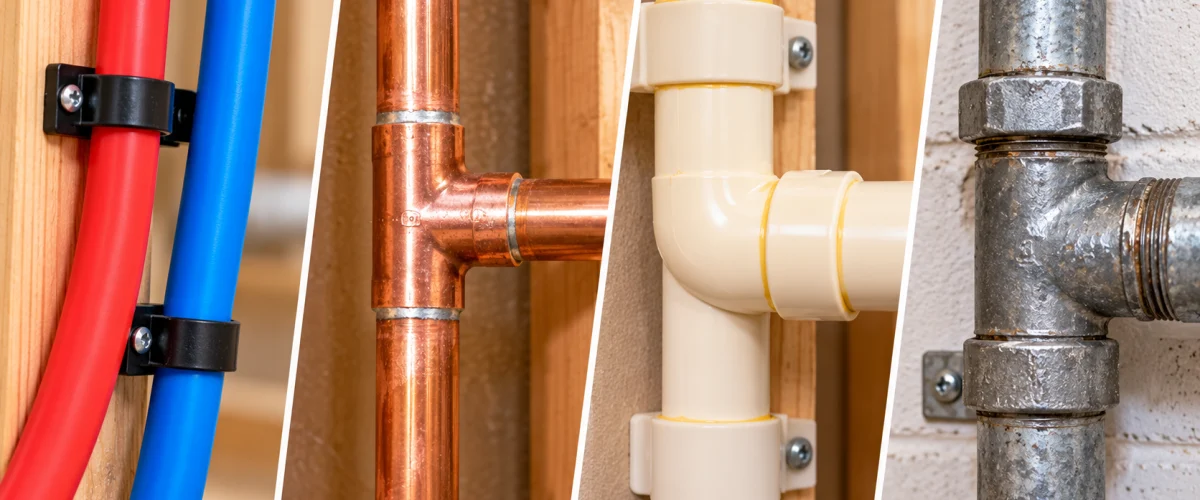
Printed markings, visible joints and appearance can help you identify PEX, copper, CPVC and galvanized steel pipe. They are clues, not proof.
Please note: Information in this guide is subject to change. If you’re uncertain about your pipe material after inspection, or you notice active leaking, corrosion, or discolored water, consult a licensed plumber before proceeding with any repair or purchase.
Nearly every plumbing repair or upgrade decision starts with a question most guides skip right past: what kind of pipe is actually running through your home? Choosing the right fitting, connector, or repair method almost always depends on knowing whether you’re working with PEX, copper, CPVC, or galvanized steel first — get that wrong and even a correctly executed repair can fail to seal or simply not fit.
This guide walks through the clues that help identify the four most common residential pipe materials: printed markings, visible joints and general appearance, using a flashlight and, optionally, a small magnet. These are clues, not proof, so if they disagree or you are unsure, have a plumber confirm before you buy parts. Once you know what you’re working with, our Best Push-to-Connect Fittings review and our PEX vs Copper Pipe comparison are natural next stops for making a repair or upgrade decision.
At a Glance
| Difficulty | Easy |
| Time | Depends on how many pipes you check |
| Cost | $ — no parts required, a visual inspection |
| Tools Needed | Flashlight, a small magnet (optional, for confirming galvanized steel), a tape measure or caliper (optional, for exact diameter) |
| Skill Level | Beginner |
✏️ Our Take
Most homeowners never need to identify their pipe material until the moment they’re standing in front of a hardware store shelf trying to figure out which fitting to buy, or reading a repair guide that assumes they already know. The good news is that the four most common residential pipe materials — PEX, copper, CPVC, and older galvanized steel — each leave visible clues (printed markings, joints, color and general appearance) that can point to the material without special tools, although clues are not conclusive on their own. The situation where it gets genuinely tricky is a home with mixed materials from different renovation eras, which is common enough that it’s worth checking more than one location in your home rather than assuming the whole house matches.
IN THIS GUIDE
Fittings, connectors, and repair methods are often material-specific. A crimp ring designed for PEX won’t seal on copper, a compression fitting rated for copper may not be the right choice for CPVC, and solvent cement made for CPVC won’t bond to metal at all. Using the wrong type doesn’t just fail to work — it can produce a connection that looks secure but leaks under pressure, or one that won’t fit together in the first place.
There’s also a longevity angle worth understanding even if you’re not planning an immediate repair. Some materials, particularly aging galvanized steel, carry water quality and pressure concerns that are worth knowing about simply so you can plan ahead, rather than discovering them only after a problem develops.
Older homes, especially those built before the 1960s, may still have original galvanized steel supply lines. Galvanized steel can corrode from the inside, which can reduce water flow and affect water quality as the pipe ages. Copper has been widely used in homes for decades, and PEX is now widely used in new construction and repiping; its flexibility lets installers use fewer fittings. If your home has had partial renovations over the years, it’s genuinely common to find two or even three different pipe materials coexisting in different parts of the same house.
Pipe diameter adds another layer worth understanding once material is confirmed. Nominal size is a label, not a measurement, and it doesn’t always match the outside diameter. PEX and CPVC tubing follow the copper tube size convention (a 1/2-inch tube has a 5/8-inch outside diameter, the same as 1/2-inch copper), but other pipe, such as PVC, is sized differently, and fittings are made for specific materials, so a matching size alone doesn’t mean a fitting suits your pipe. This is exactly why identifying material first, before assuming a fitting will simply fit based on a labeled size, saves an extra trip back to the hardware store.
A flashlight is genuinely the most useful item on this short list, since pipes are often tucked into dim basements, cramped crawl spaces, or the back corners of under-sink cabinets where daylight never reaches. Good lighting makes printed markings and joints much easier to read.
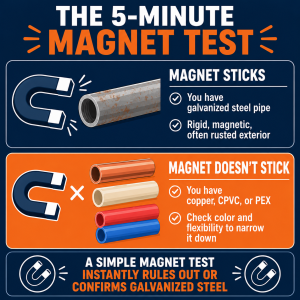
A small magnet is worth keeping in your pocket while you inspect, since it settles the one distinction that can otherwise be genuinely ambiguous at a glance: steel pipe is magnetic, while copper and plastic pipe are not. It’s an inexpensive way to separate steel from copper and plastic, but it is one clue among several: it can’t tell you which kind of copper or plastic you have.
A tape measure or calipers aren’t necessary for identifying the material itself, but they’re useful to have on hand if you’re planning ahead for a repair or purchase, since exact outer diameter is something you’ll likely need to know anyway once you’ve confirmed what the pipe is made of.
PEX is flexible plastic tubing, usually seen as long runs that curve around corners rather than rigid lengths joined at every turn (PPI notes its flexibility lets installers use fewer fittings). Look first for printed markings: PEX tubing is normally printed along its length with the maker, the size and standards such as ASTM F876 (SharkBite’s PEX is printed this way, for example), although the print can be faint or hidden under insulation. It’s often color-coded too — red for hot water lines, blue for cold, and white or other colors for lines that carry either — but color coding isn’t universal and shouldn’t be your only clue.
Don’t bend or force installed pipes to test them: PEX can kink (makers publish minimum bend radii), and other pipe can be damaged or strained at its joints. Judge from what you can see.
Visible joints are another clue. PEX is not soldered or solvent-welded. Instead, look for copper crimp rings, stainless-steel clamp bands, expansion rings or push-to-connect fittings at each joint (PPI lists these as the common PEX joining methods) — a ring or band encircling the tubing where it meets a fitting, rather than a smooth soldered joint or a solvent-welded connection.
Copper is metal tubing with a distinctive reddish-orange to pinkish color when it’s new or recently cleaned. Over time, exposure to air and moisture weathers that bright color to a duller brown, and in humid environments or with age, copper can develop a greenish or bluish patina known as verdigris.
Copper is metal, so a magnet won’t stick to it, and its color is the main visual clue. It is sold as rigid straight lengths, which are most common in exposed areas, and as soft tubing in coils, described below. Stiffness is not a reliable way to identify it, so don’t bend pipes to test them; look at the color, the joints and any lettering printed or stamped on the pipe.
Joints are another useful clue. Copper is traditionally connected with soldered joints, which show up as a visible silver-colored bead of solder wrapped around the fitting where two pieces meet. Newer copper installations, or repairs, may instead use compression fittings or push-to-connect fittings, which look mechanically distinct from a soldered joint but still connect to metal tubing. If you’re weighing which connection type makes more sense for a copper repair, our SharkBite vs Copper Fittings comparison breaks down the tradeoffs.
Copper comes in two forms that can add a little confusion. Rigid straight lengths are most common in exposed areas like basements, while soft copper tubing, sold in coils, shows up in some water heater connections and older refrigerator icemaker lines. Both are still identifiable as copper by color and the non-magnetic response to a magnet. You may also notice faint lettering printed or stamped along the pipe indicating its type (commonly Type M or Type L in residential settings); it isn’t required for identification, but it supports the other clues if the color has weathered enough to leave any doubt.
CPVC is rigid plastic pipe, typically cream, tan, or light gray in color — distinctly different from the bright white PVC most homeowners are more familiar with from drain lines. Color is a useful first clue to tell the two plastics apart, but it isn’t conclusive on its own.
Look at the surface: CPVC has a slightly dull, matte plastic look rather than the metallic sheen of copper or the rough gray finish of galvanized steel. Plastic pipe is also often printed along its length with the maker, size and material, so look for markings naming the pipe.
Joints on CPVC are solvent-welded, meaning the pieces are glued together with a chemical cement rather than soldered or crimped. Look closely at the fittings: you may see purple primer marks near the joints, but many CPVC joints are made with one-step cement that the maker says can be used without primer if code permits, so the absence of purple marks doesn’t rule CPVC out.
Galvanized steel is metal pipe with a dull gray color. In older installations it’s common to see visible rust, pitting, or a chalky white mineral crust built up on the exterior, especially near joints where moisture tends to collect.
This is the one material where the magnet in your pocket earns its keep. A small magnet will stick firmly to galvanized steel, while it won’t stick at all to copper or any plastic pipe — a useful clue when color and appearance alone leave you uncertain, although a magnet can’t tell galvanized steel from other magnetic pipe, so treat it as one clue among several.
Joints are threaded rather than soldered or glued. Look for a visibly wider coupling where two sections meet, with threading you can sometimes see at the connection — a distinctly different look from the smooth soldered joints on copper or the solvent-welded joints on CPVC.
Older homes, especially those built before the 1960s, may still have original galvanized steel supply lines. Galvanized steel can corrode from the inside, which can reduce water flow and affect water quality as the pipe ages.
Check multiple locations in your home rather than assuming the entire house matches. A basement utility area, an upstairs bathroom, and an exterior hose bib can genuinely differ from one another, especially if plumbing work has happened in stages over the years rather than all at once.
Homes with a renovation history are the most likely to have mixed materials, since older sections often weren’t fully replaced during partial updates. A kitchen remodel might introduce PEX or copper to one part of the house while an untouched basement or an older bathroom still runs on the original galvanized steel or early copper installed decades earlier.
This is exactly the situation where knowing how to identify each material pays off the most, since you can’t safely assume that what you find under one sink applies to the whole house. Confirming material at the actual location of a planned repair, rather than relying on an assumption from elsewhere in the home, avoids buying the wrong fitting entirely.
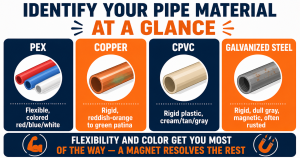
PEX is flexible plastic tubing, often red, blue or white and usually printed along its length, connected with crimp, clamp, expansion or push-to-connect joints. Check the printed markings and the joints; don’t bend installed pipe to test it.
Copper is metal tubing (rigid lengths or soft coils), ranging from reddish-orange when new to a duller brown or greenish patina with age, and connected with soldered, compression, or push-to-connect joints.
CPVC is rigid, cream, tan, or light gray in color, and connected with glued (solvent-welded) joints, sometimes with purple primer marks near the fittings.
Galvanized steel is rigid, dull gray, often visibly rusted or pitted in older installations, magnetic, and connected with threaded joints rather than soldered or glued ones.
If you’re still unsure of your pipe material after inspecting it, or you’ve discovered corrosion, active leaking, or a repair beyond a simple fitting swap, search PlumberArchive.com — the US plumber directory with 12,000+ verified local plumbers across all 50 states.
Get weekly plumbing tips and DIY guides delivered straight to your Facebook feed.
You never need to cut into a pipe to look for clues. Check the printed markings first: PEX is normally printed along its length with the maker, size and standards such as ASTM F876, and copper may show printed or stamped lettering for its type. Then look at the joints (crimp rings, clamp bands, expansion rings or push-fit bodies on PEX; solder beads, compression nuts or push-fit bodies on copper) and the color: PEX is often red, blue or white, while copper is reddish-orange to brown or green with age, and a magnet sticks to neither. These are clues rather than proof, so if they conflict, have a plumber confirm. Don’t bend installed pipe to test it.
Galvanized steel pipe itself isn’t inherently dangerous, but it corrodes from the inside out as it ages, which can restrict water flow, reduce pressure, and in some cases affect water quality as internal rust and mineral buildup accumulate. The exterior can look deceptively fine even when significant internal corrosion has developed, which is why having older galvanized lines inspected by a plumber is worthwhile even without an obvious symptom, particularly in homes with original supply lines predating the 1960s.
Not directly in most cases — joining dissimilar materials usually requires a transition fitting designed for that specific pairing, since a joint meant for one material typically won’t seal properly against another. Push-to-connect fittings are a partial exception: some are listed for several pipe materials (SharkBite Max fittings, for example, are certified for PEX, copper, CPVC, PE-RT and HDPE, and SharkBite says not to install them on galvanized tubing), so one fitting can join those materials. Check the fitting’s listed pipe types and sizes.
This is genuinely common in homes with any renovation history. Plumbing is rarely replaced all at once — a kitchen or bathroom remodel might introduce PEX or copper to one section of the house while an untouched area, like a basement utility room or an older exterior line, still runs on whatever material was originally installed decades earlier. It’s a good reason to check more than one location before assuming your whole house matches.
The four common residential pipe materials — PEX, copper, CPVC, and galvanized steel — each leave visible clues: printed markings, joints, color and general appearance, plus a magnet check for steel. These clues are not conclusive on their own, so when they conflict or you’re unsure, have a plumber confirm before you buy parts.
Checking multiple locations in your home is worthwhile if you have any renovation history, since mixed materials are common enough that one confirmed pipe elsewhere in the house shouldn’t be assumed to apply everywhere.
Knowing your material is the essential first step before any repair, fitting purchase, or upgrade decision — skip it, and even a well-executed repair can end up using the wrong parts entirely. Once you’ve confirmed what you’re working with, our Best Push-to-Connect Fittings review, PEX vs Copper Pipe comparison, and SharkBite vs Copper Fittings comparison are all good next stops for making your repair or upgrade decision. If you’re specifically weighing whether to replace old galvanized steel with copper, our copper vs galvanized steel comparison covers that decision, and our PVC vs CPVC comparison does the same for plastic pipe choices.
✍️ About This Guide
PTR Editorial Team — Plumbing Guides. We compare manufacturer specifications, installation requirements, compatibility and available product documentation to help homeowners choose suitable tools and parts. How we review →
Not sure which tool fits your faucet nut? Identify the fixing, see how it lets go and check your clearance first. Then choose a tool, or use one you own.
Check your manual and the drain route first: gravity hose, built-in pump or external pump. Then see whether you need a dehumidifier hose at all.
Explore portable bidets that need no water-line connection, from bottle caps and squeeze bottles to battery-powered handhelds.

