Comparisons
2 Oct 2026

Pop-Up Drain vs Grid Drain: Which Should You Choose?
Pop-up drains seal to hold water; grid drains never close but resist clogs better and cost less. Here's how to choose between them for your bathroom sink.
Faucet cartridge vs faucet aerator — learn what each part does, how to identify the right fix by symptom, cost differences, and which to replace first.
Please note: Information in this guide is based on our research at time of writing and is subject to change. Always consult a licensed plumber for diagnosis of serious plumbing issues before attempting repairs.
A faucet that drips after you turn it off and a faucet with weak, splashy water flow are both frustrating — but they point to entirely different parts of the faucet, and buying the wrong fix wastes both time and money. The cartridge and the aerator are both common DIY replacement parts, but they sit at completely different points in the faucet and serve completely different functions. Confusing the two is one of the most frequent mistakes homeowners make when diagnosing a faucet problem.
This guide compares both parts across every practical factor: what each one does, what symptoms it causes when it fails, how much each costs to fix, and which to check first when you’re not sure. For part-specific buying guidance, see our guides to the best faucet cartridges and the best faucet aerators.
✏️ Our Take
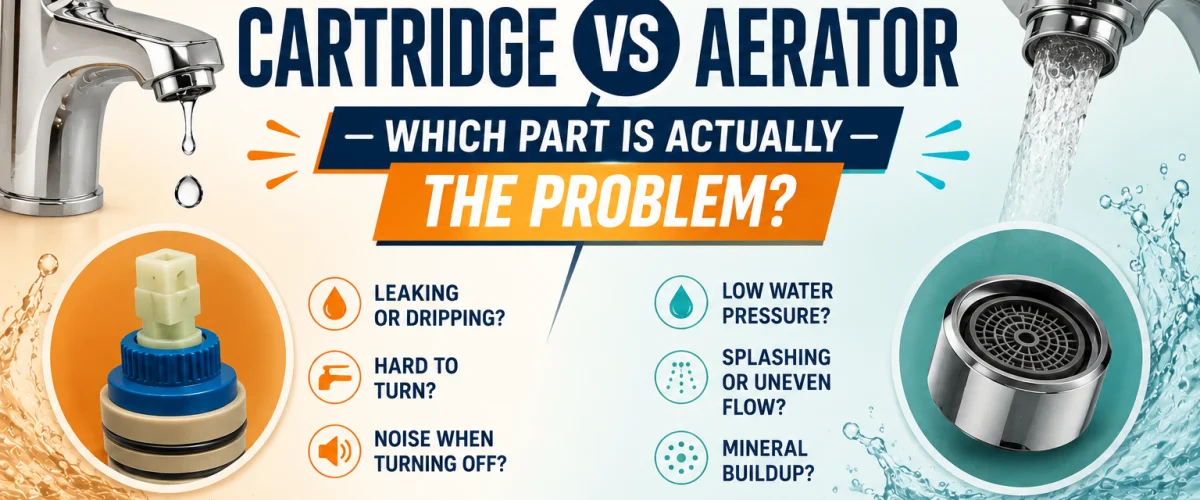
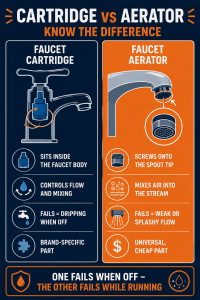
These two parts sit at completely different points in your faucet and solve completely different problems, despite both being common DIY replacement parts. A cartridge sits inside the faucet body and controls water flow and temperature mixing — when it wears out, you get a faucet that drips, won’t shut off fully, or feels loose and wobbly to operate. An aerator sits at the very tip of the spout and mixes air into the water stream — when it gets clogged or worn, you get weak, splashy, or uneven water flow even though the faucet shuts off perfectly fine. If your faucet drips after you turn it off, suspect the cartridge. If the water flow itself looks or feels wrong while running, suspect the aerator.
IN THIS GUIDE
The cartridge is a valve mechanism that lives inside the faucet body, directly behind the handle. When you turn the handle or move a lever, you’re physically repositioning the cartridge — rotating or sliding it to open and close the water passages inside the faucet. In a single-handle faucet, the cartridge also controls the ratio of hot to cold water, determining both flow rate and temperature from a single movement. In a two-handle faucet, separate cartridges control the hot and cold supplies independently.
Cartridges contain internal rubber seals and O-rings that create a watertight closure when the faucet is off. Over years of repeated use, these seals wear down, harden, or accumulate mineral deposits that prevent them from seating fully against the valve. The result is water that finds its way through even with the handle in the off position — producing a steady drip that tightening the handle further cannot stop. For replacement options matched to all major US faucet brands, see our guide to the best faucet cartridges.
The aerator is a small attachment that threads onto the very tip of the faucet spout — the last thing water passes through before reaching your sink or hands. Inside the aerator housing is a fine mesh screen that breaks the water stream into many tiny droplets and introduces air into the flow. This produces a smooth, consistent stream rather than a heavy unbroken gush, reduces splashing in the basin, and cuts the volume of water delivered per minute without reducing the perceived pressure of the stream.
Because the aerator’s mesh screen sits right at the end of the spout, it catches anything carried in the water supply — mineral deposits, pipe scale, small debris, and sediment. Over time this buildup restricts flow through the screen, reducing water volume, causing the stream to spray in multiple directions, or making the flow appear weak even at full handle pressure. Replacement aerators are standardized for most faucets and widely available — see our guide to the best faucet aerators for compatible options across faucet types.
Cartridge failure produces symptoms that are visible or felt at the handle end of the faucet, not at the spout tip. The most unambiguous sign is a drip that continues steadily after the handle has been turned fully off — water finding its way through a seal that no longer closes completely. A single-handle faucet dripping from the spout with the handle in the off position is almost always a cartridge problem, not an aerator problem.
Other symptoms include a handle that has started to feel loose, wobbly, or requires significantly more force to operate than it once did — this indicates cartridge wear that has allowed physical play to develop in the valve mechanism. Inconsistent hot and cold mixing is also a cartridge symptom: if a single-handle faucet that used to produce comfortable warm water at a mid-position now runs noticeably hotter or cooler at that same position, the cartridge’s temperature control mechanism has worn or shifted. For a complete repair walkthrough once you’ve confirmed the diagnosis, see our step-by-step guide to fix a dripping faucet.
Signs You Need a New Aerator
Aerator problems show up in the quality of the water stream while the faucet is running — not in whether it drips when off. The most common sign is a water stream that sprays unevenly in multiple directions rather than flowing in a single coherent column. Reduced flow volume at full handle pressure — where the faucet once produced a strong stream and now produces a noticeably weaker one — also points to aerator restriction rather than a pressure or valve problem.
Visible evidence on the aerator itself is the most direct confirmation: unscrew the aerator from the spout tip and examine the mesh screen inside. White or green mineral crust visible on the screen is calcium and magnesium buildup from hard water, and it directly confirms the aerator as the source of the flow problem. In many cases — particularly in areas with moderately hard water — a 30-minute soak in white vinegar dissolves the mineral buildup and fully restores flow without requiring a replacement part at all. Our step-by-step guide to cleaning a faucet aerator walks through the full process.
Aerators are among the least expensive plumbing parts available. Most standard replacement aerators fall into the $ tier, and installation is as simple as unscrewing the old one by hand and threading on the replacement. No tools are required in most cases, no water supply needs to be shut off, and the entire swap typically takes under two minutes. Aerator threads are standardized across most faucets — typically 15/16-inch or 13/16-inch male — making cross-brand replacements straightforward.
Cartridge replacement involves significantly more work. The water supply to the faucet must be shut off at the stop valve under the sink before starting. The handle must be removed — usually by locating and removing a decorative cap and set screw — and on many faucets a retaining clip or nut holds the cartridge inside the faucet body. Cartridges are brand and model specific: a Moen 1225 cartridge does not work in a Delta or Kohler faucet, and even within brands, different product lines use different cartridges. Identifying the correct replacement requires the faucet’s model number or a clear photo of the existing cartridge. Cartridge cost ranges from $ to $$ depending on brand and type.
Yes — and in older faucets this is more common than most homeowners expect. The cartridge and aerator are independent components that wear at their own rates, but both are subject to the same water conditions over the same years of use. A faucet old enough to have a worn cartridge is almost certainly old enough to have a clogged or deteriorating aerator as well. The symptoms are additive: a faucet that drips when off and also produces a weak, splashy stream when running is exhibiting simultaneous failure of both parts and needs both addressed.
US regional note: In hard water states like Arizona, Texas, Nevada and parts of California, mineral deposits affect both parts but in different ways — they clog the fine mesh inside an aerator within months, while the same minerals can cause a cartridge’s internal seals to wear out and start dripping years earlier than in soft water regions. Homeowners in these areas often need to address both parts more frequently than the rest of the country.
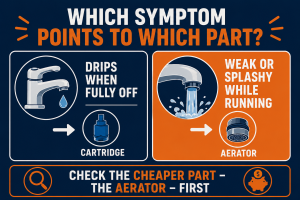
The symptom tells you which part to address. Use the table below to match what you’re seeing to the correct repair:
| Symptom | Replace |
|---|---|
| Faucet drips when handle is fully off | Cartridge |
| Weak or splashy flow while faucet is running | Aerator |
| Handle feels loose, wobbly, or hard to turn | Cartridge |
| Visible mineral crust on the spout tip | Aerator |
| Lowest cost, fastest fix to try first | Aerator |
| Hot/cold mixing feels wrong or backwards | Cartridge |
| Both symptoms present at once | Replace both |
Choose to replace the cartridge if the faucet drips with the handle fully off. Our guide to the best faucet cartridges covers the correct replacement for all major US faucet brands including Moen, Delta, Kohler and Pfister.
Choose to replace the aerator if water flow itself looks or feels wrong while the faucet is running. Our guide to the best faucet aerators covers thread sizes and compatible options across faucet types.
If replacing the cartridge or aerator doesn’t resolve your faucet problem — or if you find corrosion, a stripped valve seat, or a faucet body that needs full replacement — a licensed plumber is the right call. Getting professional eyes on a persistent problem prevents repeated part swaps that don’t address the root cause.
Find a licensed plumber in your area at PlumberArchive.com — the US plumber directory with 12,000+ verified local plumbers across all 50 states.
Get weekly plumbing tips, honest tool reviews and DIY maintenance guides delivered straight to your Facebook feed. We cover faucet repairs, drain maintenance, water heater care and everything in between — written for US homeowners who want to handle more themselves.
The symptom tells you. If your faucet drips or leaks after you turn the handle fully off, the problem is almost always the cartridge — the internal seal has worn enough to let water through even in the closed position. If the faucet shuts off completely fine but the water flow while running looks weak, splashy, or sprays unevenly, the aerator is the more likely cause. A quick visual check — unscrewing the aerator and examining the mesh screen — often confirms the aerator diagnosis immediately. Visible mineral crust on the screen means the aerator is restricted. If the screen looks clean and clear but the faucet still drips when off, the cartridge is the problem.
No. An aerator is located at the tip of the spout and plays no role in controlling whether water flows or stops — that function belongs entirely to the cartridge inside the faucet body. A clogged aerator can cause reduced flow, uneven spray, or a sputtering stream, but it cannot cause a drip when the faucet is turned off. If your faucet drips after being shut off, the aerator is not the source of that problem regardless of its condition. The cartridge’s internal seals are what control the shutoff, and a drip after closure is the clearest sign those seals have worn out.
No — and this is one of the key advantages aerator replacement has over cartridge work. The aerator sits at the very tip of the spout and is entirely separate from the water supply lines or the valve inside the faucet. You can unscrew it, clean or replace it, and thread it back on without touching the shut-off valve under the sink. Water will flow briefly when you first unscrew the aerator if the faucet handle isn’t turned off, but there’s no risk of an uncontrolled flood — just turn the handle off before starting. Cartridge replacement, by contrast, always requires shutting off the water supply first since you’re working inside the valve body.
Most faucet cartridges last anywhere from 5 to 15 years depending on water quality, use frequency, and brand quality. In soft water regions with lower mineral content, a quality cartridge may last the full 15 years or longer without issue. In hard water states like Arizona, Texas, Nevada and parts of California, the mineral load accelerates seal wear and cartridges may need replacement in the 5- to 8-year range. The most reliable signal is symptom onset rather than a set schedule: a steady drip that wasn’t there before, or a handle that has started to feel noticeably different to operate, indicates the cartridge is ready for replacement regardless of age. There’s no routine preventive replacement interval for cartridges — replace when symptoms appear.
The clearest rule for telling these two parts apart: cartridge problems show up when the faucet is off; aerator problems show up while it’s running. A drip after shutoff points to the cartridge. Weak, splashy, or uneven flow while running points to the aerator. Keeping those two failure modes separate is what prevents spending money on the wrong part and the frustration of a repair that doesn’t fix what was actually wrong.
When you’re unsure, check the aerator first — it’s free to inspect, inexpensive to replace, and takes under two minutes. If the aerator is clean but the faucet still drips, the cartridge is the diagnosis. And if your faucet is old enough to have one failed part, replacing both while you have things apart is nearly always worth the minimal extra cost. Our step-by-step guide to fix a dripping faucet covers the full cartridge replacement process once you’ve confirmed the diagnosis.
For replacement parts, see our guide to the best faucet cartridges for brand-specific options across Moen, Delta, Kohler and more, and our guide to the best faucet aerators for thread-size matched options that fit most standard US faucets.
✍️ About This Comparison
PTR Editorial Team — Product Comparisons. We compare manufacturer specifications, installation requirements, compatibility and available product documentation to help homeowners choose suitable tools and parts. How we review →
Pop-up drains seal to hold water; grid drains never close but resist clogs better and cost less. Here's how to choose between them for your bathroom sink.
Test strips, digital meters or send-to-lab testing? Match the method to your situation — screening, ongoing monitoring, or a real health concern.
25-foot vs 50-foot drain snake: compare handling, the cable diameter trade-off and the jobs that justify extra length, plus where 50 feet stops.

