Comparisons
2 Oct 2026

Pop-Up Drain vs Grid Drain: Which Should You Choose?
Pop-up drains seal to hold water; grid drains never close but resist clogs better and cost less. Here's how to choose between them for your bathroom sink.
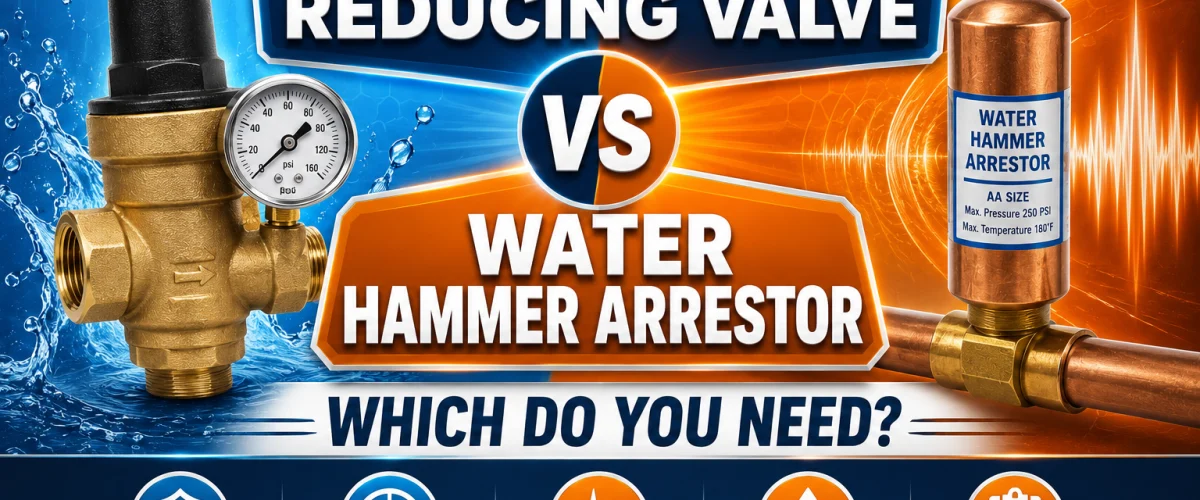
Pressure reducing valve vs water hammer arrestor — two different problems, two different solutions. Which one your home needs and when you need both.
Please note: Cost estimates and installation details are based on our research at time of writing and are subject to regional variation. Always consult a licensed plumber before undertaking changes to your main water supply line or plumbing system.
Both a pressure reducing valve and a water hammer arrestor deal with your home’s water pressure system — which is why they’re so frequently confused with each other. But they solve genuinely different problems, and buying the wrong one means spending money on a fix that doesn’t address what’s actually happening in your pipes. A homeowner who installs a pressure reducing valve to stop a banging pipe will still have a banging pipe. One who installs a water hammer arrestor to fix whole-house high pressure will still have high pressure quietly stressing every fixture and fitting.
This guide compares both devices across every practical factor — what each one does, which symptoms point to each, how each is installed, and what each costs — so you can match the right fix to the actual problem before spending anything. If you already know you have a pressure issue, our roundup of the best pressure regulator valves covers our full lineup of PRV options. And before drawing any conclusions about which device you need, our picks for the best water pressure gauges cover the inexpensive test that answers the pressure question definitively in 60 seconds — our guide to testing your water pressure walks through exactly how to run it.
✏️ Our Take
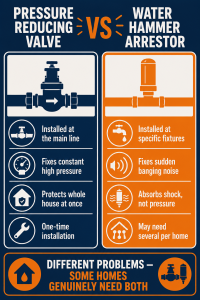
These two devices solve completely different problems despite both living somewhere in your plumbing’s pressure system. A pressure reducing valve (PRV) lowers sustained high water pressure coming from the street so it doesn’t stress every fixture and appliance in your home around the clock. A water hammer arrestor does something entirely different — it absorbs the sudden shock wave created when a valve, like a washing machine solenoid or a faucet, slams shut instantly. One protects against constant overpressure; the other protects against momentary shock. Many homes genuinely benefit from both installed at the same time.
IN THIS GUIDE
A pressure reducing valve — also called a pressure regulator valve or PRV — is installed where the main water supply line enters your home, typically near the main shutoff valve. Its job is to take whatever pressure is coming from the municipal water main and reduce it to a consistent, safe level before that water reaches any fixture, appliance, or pipe joint in the house. Municipal water systems often operate at pressures well above what residential plumbing is designed to handle long-term — a PRV is the device that enforces the correct pressure at the point of entry so everything downstream is protected around the clock.
Unlike a water hammer arrestor, a PRV acts on sustained, constant pressure — it is always working, regulating every gallon of water that flows through it at any time of day. A correctly set PRV reduces incoming pressure to a steady level and holds it there regardless of fluctuations in the municipal supply. Many homes run comfortably in the 50 to 60 psi range, and EPA WaterSense specifications cap pressure at 60 psi. Without one, high incoming pressure quietly stresses every supply line, appliance hose, faucet stem, and pipe joint in the home continuously — a form of damage that accumulates invisibly until a fitting fails or an appliance hose bursts. Our roundup of the best pressure regulator valves covers our complete picks across different home sizes and pressure ranges.
A water hammer arrestor is a completely different device that addresses a completely different problem. When a valve — particularly a fast-closing solenoid valve like the ones inside washing machines and dishwashers — shuts off water flow instantly, the momentum of the moving water column has nowhere to go. That energy creates a pressure wave that travels through the pipes at high speed, producing the loud banging or knocking sound known as water hammer. The arrestor absorbs that shock wave before it can travel through the pipe system and cause the characteristic bang.
Inside a water hammer arrestor is either a cushion of air trapped behind a sealed diaphragm, or a spring-loaded piston. When the pressure spike from a closing valve hits the arrestor, the air cushion or piston compresses to absorb the energy, then returns to its resting position ready for the next closing event. The device does nothing to the sustained water pressure in the system — it only activates at the precise moment a valve slams shut and a shock wave needs to be damped. Water hammer arrestors are installed close to the specific fixture generating the hammer, not at the main supply line.
The clearest sign you need a PRV is a gauge reading above 80 psi on your water supply. This test takes about 60 seconds with an inexpensive gauge that threads onto any outdoor hose bib — the result is definitive, and guessing from symptoms alone is not reliable enough for this decision. If your gauge confirms high pressure, a PRV is the correct fix regardless of whether you’re experiencing any other symptoms yet, because damage from sustained overpressure accumulates gradually before becoming visible.
Beyond a gauge reading, several symptom patterns point to sustained high pressure rather than water hammer: faucets that spit or spray aggressively when first turned on; running toilets that refill loudly even when no shock wave is involved; supply lines or appliance hoses that fail earlier than expected; and a general banging or hammering that isn’t tied to any one specific fixture or appliance but happens throughout the house at various times. This last point is the key distinction — diffuse, non-specific banging that occurs at many locations tends to be a pressure symptom, not a classic water hammer symptom. Our picks for the best water pressure gauges cover the inexpensive options that make this measurement accessible for any homeowner.
Water hammer has a specific, recognizable signature that distinguishes it from general high-pressure symptoms: the banging or knocking sound is tightly correlated with one particular event at one particular location. It happens the moment your washing machine ends a fill cycle. It happens right when you quickly turn off the kitchen faucet. It happens every time your dishwasher cycles through a valve change. The consistency of the trigger and the specificity of the location are the defining characteristics — if you can reliably produce the bang by operating one specific fixture, that is water hammer at that fixture, and a water hammer arrestor installed nearby is the targeted fix.
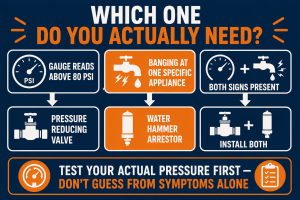
A second confirming indicator is that your pressure gauge reads at a normal level — at or below the 80 psi code ceiling, and often in the 50 to 60 psi range — and you are still getting banging at specific fixtures. Normal pressure rules out a whole-house pressure problem and points directly to a momentum-driven water hammer cause. Homes with multiple quick-closing solenoid valves — a washing machine, a dishwasher, and an ice maker, for example — may need individual arrestors at each location, as each valve generates its own shock wave independently.
A pressure reducing valve is a whole-house installation at a single point: the main water supply line where it enters the home. Because it protects the entire house from that one location, you only need one PRV regardless of how many fixtures, appliances, or stories the home has. The installation requires cutting into the main supply line and soldering or connecting the valve inline — work that involves shutting off the main water supply to the house and is typically a job for a licensed plumber, both because of the pipe work involved and because a PRV on the main supply line that is installed or adjusted incorrectly affects every faucet and appliance in the home immediately.
Water hammer arrestors, by contrast, are installed at individual fixtures — one at each location generating hammer. A single washing machine connection typically requires one arrestor on each supply stub (hot and cold), connected at the valve location. The installation is straightforward: most arrestors thread directly onto standard plumbing supply connections without soldering, making them accessible for a competent DIYer to install at accessible fixture locations. The limitation is scope — a home with a washing machine, dishwasher, ice maker, and several quick-closing faucets may need five or more arrestors installed at different locations throughout the house, each one a separate installation. For guidance on how pressure management fits into the bigger picture, our guide to how to increase water pressure at home covers the full range of pressure-related interventions.
A pressure reducing valve sits in the $$ to $$$ range for the valve itself — a meaningful purchase, but a one-time cost that protects the entire house. Professional installation adds to the total because the main supply line must be cut and the valve connected inline, which is work most homeowners leave to a plumber. The total project cost — valve plus installation — is a real expense, but it covers every fixture and appliance in the home from that point forward and typically pays for itself quickly in reduced wear on appliances, fittings, and supply hoses.
Water hammer arrestors are inexpensive individually — generally in the $ range per unit — and are simple enough for a homeowner to install at accessible locations without a plumber. The cost consideration is multiplication: a home with four fixtures requiring arrestors needs four devices, and if any are in less accessible locations like behind an appliance or in a wall, installation complexity increases. A home with a single problematic fixture can solve its water hammer for a very small outlay. A home with many quick-closing valves across multiple floors may find the total arrestor cost and effort approaching that of a single PRV install, depending on how many locations need treatment.
Yes — high incoming pressure and water hammer are entirely unrelated problems that can coexist in the same home simultaneously. A PRV does nothing to stop water hammer. An arrestor does nothing to lower sustained incoming pressure. Because they target different phenomena — one constant, one instantaneous — installing both is not redundant. A home that has 100 psi incoming from the municipal supply and a washing machine generating water hammer on every fill cycle needs both a PRV at the main line and an arrestor at the washing machine connection to resolve both problems.
The coexistence scenario is actually fairly common. High municipal pressure tends to make water hammer worse, because the greater the water pressure, the more energy is stored in a moving water column, and the larger the shock wave when that column is stopped suddenly. Installing a PRV often reduces the severity of water hammer at the same time — but it does not eliminate it entirely, because hammer is a momentum phenomenon that occurs even at normal pressures when valves close fast enough. If banging persists after a PRV installation, an arrestor at the specific fixture causing it is still the correct next step.
US regional context: Municipal water pressure varies significantly by region — homes on hillside or elevated municipal systems in parts of California, the Pacific Northwest and the Rockies often see incoming pressure well above the recommended range, making a PRV more likely to be needed. Water hammer, by contrast, is more about plumbing layout and fixture type than geography — homes with quick-closing solenoid valves on washing machines or dishwashers anywhere in the US can experience it regardless of region.
The right answer comes down to what you’re actually diagnosing. The head-to-head table below maps the most common home pressure scenarios to the correct device.
| Scenario | Best Choice | Why |
|---|---|---|
| Pressure reading above 80 psi | PRV | Sustained overpressure — a PRV is the only fix for constant high pressure at the source |
| Banging tied to one specific appliance | ARRESTOR | Classic water hammer at one valve — install an arrestor at that fixture specifically |
| Protecting the whole house at once | PRV | One PRV at the main line covers every fixture and appliance downstream |
| Lowest cost for a single noisy fixture | ARRESTOR | An arrestor at one location costs far less than a whole-house PRV installation |
| Premature appliance or fitting failure | PRV | Sustained overpressure is the cause — a PRV stops the constant stress on every component |
| Banging throughout the house, not fixture-specific | PRV | Diffuse banging not tied to one event — check pressure first, this pattern often indicates high incoming pressure |
| Both high pressure and fixture-specific banging | BOTH | Both problems are present — a PRV addresses the pressure, an arrestor addresses the hammer |
Our roundup of the best pressure regulator valves covers our top picks for US residential installations, including adjustable models and the right sizing for different supply line diameters.
Our roundup of the best water hammer arrestors covers our picks across connection types and price points.
Installing a PRV on the main water supply line involves cutting into the main line and working upstream of every fixture in the home — a job where an error affects everything, not just one fixture. A licensed plumber can confirm your pressure reading, recommend the correct PRV size and setting for your supply line, and install it to code. They can also advise on whether water hammer arrestors are needed at specific fixtures once the whole-house pressure is corrected.
Find a licensed plumber in your area at PlumberArchive.com — the US plumber directory with 12,000+ verified local plumbers across all 50 states.
Get weekly plumbing tips, honest comparisons and DIY guides delivered straight to your Facebook feed. We cover water pressure issues, pipe protection, fixture maintenance and everything in between — written for US homeowners who want to make smart decisions without overspending.
Yes — high water pressure amplifies water hammer and can make it significantly worse. The greater the pressure behind a moving water column, the more energy is stored in that column, and the larger the shock wave when a valve stops it suddenly. A home with 100 psi incoming pressure will experience much more violent water hammer than the same home at 60 psi, even with the same valves and fixtures. Reducing incoming pressure with a PRV often reduces the severity of banging noticeably — but it does not eliminate water hammer entirely, because the momentum phenomenon that causes it still occurs at normal pressures when valves close fast enough. If banging continues after a PRV installation, a water hammer arrestor at the specific fixture is the remaining fix.
Partially, but not completely. A PRV reduces the incoming pressure and therefore reduces the energy stored in a moving water column — which reduces the intensity of any water hammer that does occur. In some cases where hammer was mild and driven primarily by high pressure, a PRV alone is enough to eliminate the banging entirely. In cases where the primary cause is a fast-closing solenoid valve (a washing machine or dishwasher fill valve), the valve closes fast enough that hammer still occurs even at normal pressures, just with less intensity. A PRV and a water hammer arrestor at the offending fixture address both contributing factors together.
As close to the source of the hammer as possible — ideally within a few feet of the valve that is creating the shock wave. For a washing machine, this means at the supply stub connections immediately behind the machine, on both the hot and cold supply lines. For a dishwasher, at the supply valve under the sink where the dishwasher line connects. For a quick-closing faucet, on the supply line near that faucet. The closer the arrestor is to the closing valve, the shorter the length of pipe the shock wave has to travel before being absorbed — and the more effective the absorption. An arrestor installed far from the source valve is less effective because the shock wave has already partially propagated through the pipe network by the time it reaches the device.
A simple pressure gauge that threads onto a standard hose bib — the same fitting as an outdoor garden hose connection — gives you an accurate reading in about 60 seconds. These gauges are available at any hardware store for a few dollars and require no plumbing knowledge to use: thread it onto the hose bib, turn on the spigot fully, and read the dial. Test at an outdoor hose bib rather than an indoor faucet for the most accurate result, since some indoor fixtures have flow restrictors that affect the reading. Test when no other fixtures are running in the home — this gives you static pressure, which is what matters for determining whether a PRV is needed. A reading consistently above 80 psi confirms that a PRV is the right next step. Our picks for the best water pressure gauges cover the options that make this a quick and inexpensive test.
A pressure reducing valve and a water hammer arrestor address entirely different problems — and one does not substitute for the other. A PRV lowers sustained incoming pressure that is stressing every component in your home continuously. An arrestor absorbs the instantaneous shock wave created when a specific valve closes fast. Confusing the two means buying a fix that doesn’t match the actual cause and still living with the problem.
The fastest path to the right answer is a pressure gauge test — 60 seconds on a hose bib tells you definitively whether you have a high-pressure problem. If the reading is above 80 psi, a PRV is the correct fix for that problem regardless of anything else. If banging at a specific appliance persists even at normal pressure, a water hammer arrestor at that fixture is the targeted fix. And if both are true — which is common — both devices are the right answer, since they protect against different failure modes simultaneously.
For the best PRV options, our roundup of the best pressure regulator valves covers our top picks for US residential installs. For the gauge test that settles the pressure question definitively, our picks for the best water pressure gauges cover the inexpensive options worth having on hand. And for a broader look at the full range of pressure interventions available to homeowners, our guide to how to increase water pressure at home covers the diagnostic and repair steps from symptom to solution.
✍️ About This Comparison
PTR Editorial Team — Product Comparisons. We compare manufacturer specifications, installation requirements, compatibility and available product documentation to help homeowners choose suitable tools and parts. How we review →
Pop-up drains seal to hold water; grid drains never close but resist clogs better and cost less. Here's how to choose between them for your bathroom sink.
Test strips, digital meters or send-to-lab testing? Match the method to your situation — screening, ongoing monitoring, or a real health concern.
25-foot vs 50-foot drain snake: compare handling, the cable diameter trade-off and the jobs that justify extra length, plus where 50 feet stops.

