Please note: Information in this comparison is based on our research at time of writing and is subject to change. Gas line connections require a specifically rated, code-compliant sealant — consult a licensed plumber for any repair involving a gas fitting.
Introduction
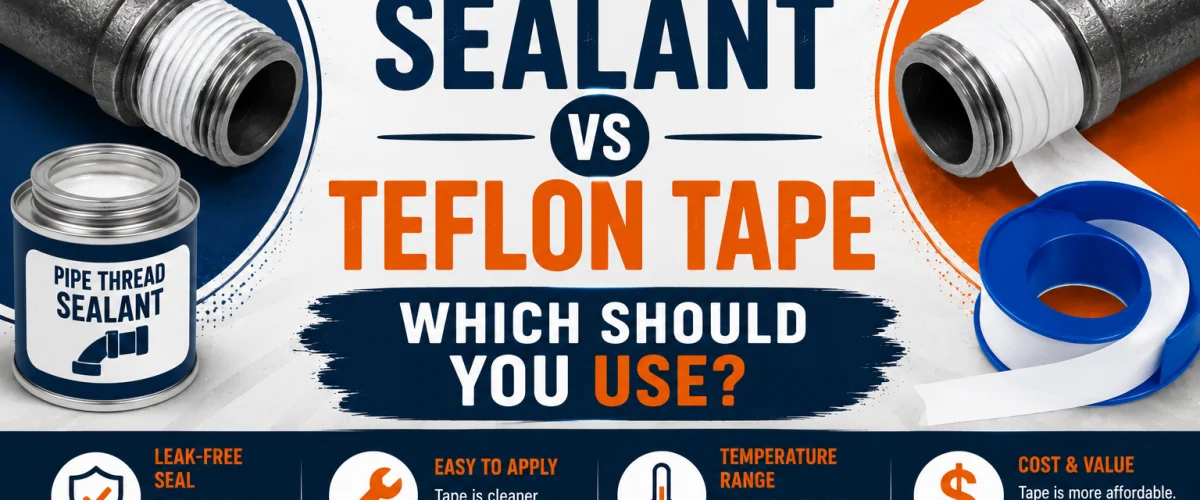
Pipe thread sealant and Teflon tape both exist to do the same basic job: seal a threaded (NPT) pipe connection so it doesn’t leak under pressure. Both sit between the male and female threads, filling the tiny gaps left by the threading process itself, since threaded fittings alone are never perfectly watertight without something in that gap. Beyond that shared purpose, though, they work in genuinely different ways — one is a brush-on paste, the other a wrapped film — and they aren’t always interchangeable depending on the fitting, the pipe material, and what’s flowing through it.
This comparison covers what each product actually is, how they’re applied, which situations favor one over the other, and where plumbers reach for both at once rather than picking a single winner. If you’re shopping for either product specifically, our pipe thread sealants and plumbing tapes reviews cover current options in more depth than fits here.
At a Glance
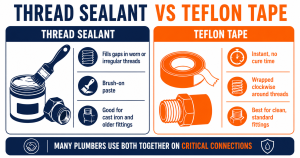
Pipe Thread Sealant / Pipe Dope
- Brush-on paste applied to threads
- Fills gaps and irregularities in worn or damaged threads
- Some formulas cure hard; others (like pipe dope) stay semi-set
- Specific formulas required for gas line connections
Teflon Tape
- Wrapped PTFE film around male threads
- Instant — no cure or set time needed
- Thin profile, minimal buildup at the joint
- Color-coded by type for different applications
✏️ Our Take
Thread sealant and Teflon tape solve the same problem — sealing a threaded pipe connection — but they aren’t strictly interchangeable, and plenty of plumbers actually use both together on connections that need extra insurance. Tape is faster, cleaner, and the right default for most standard fittings. Paste-style sealant earns its place on irregular, worn, or damaged threads where tape alone can’t fill the gaps, and on gas line connections where a specific rated sealant is required rather than tape. Knowing which one (or both) a given job calls for is a small detail that prevents a surprisingly common source of slow leaks.
Quick Comparison Table
The table below maps the most common decision factors to whichever product actually wins on that point, based on everything covered in this comparison.
| Factor |
Winner |
| Fastest, cleanest application |
TAPE |
| Best for worn or irregular threads |
SEALANT |
| Lower cost per application |
TAPE |
| Fills gaps on cast iron or galvanized fittings |
SEALANT |
| No cure or set time needed |
TAPE |
| Best added as reinforcement on critical connections |
SEALANT |
| Simplest technique for a first-time DIYer |
TAPE |
What Is Pipe Thread Sealant?
Pipe thread sealant, often called pipe dope, is a paste or liquid formula brushed directly onto the male threads of a fitting before it’s threaded into place. Unlike tape, which sits as a thin physical layer, sealant is designed to flow into and fill the actual irregularities between the threads themselves — the microscopic gaps, nicks, and slight imperfections left over from the threading process, or from years of wear on an older fitting. That gap-filling property is the entire reason sealant exists as a separate product category rather than tape simply covering every use case.
Not all sealant formulas behave the same way once applied. Some cure into a hard, permanent bond over a period of hours, effectively locking the connection in place similarly to a threadlocker. Others, including most traditional pipe dope formulas, stay semi-set indefinitely — firm enough to hold a seal under pressure, but soft enough that the connection can still be disassembled with normal wrench force months or years later if a repair calls for it. Which behavior you get depends entirely on the specific product, so it’s worth checking the label if you expect to reopen a connection down the road.
One distinction matters more than any other with sealant: formulas rated for water lines are not automatically safe or appropriate for gas lines, and the reverse is also true. Gas-rated sealants are formulated and certified specifically for that use, and local plumbing and gas codes typically require using the correct rated product rather than treating sealant as a one-size-fits-all category. Always confirm a sealant’s rating on the label before using it on any gas connection.
What Is Teflon Tape?
Teflon tape — more accurately PTFE tape, since Teflon is a brand name for the polymer — is a thin, flexible film wrapped around the male threads of a fitting before it’s threaded into the female connection. As the fitting is tightened, the tape compresses into the thread gaps and acts as both a lubricant during assembly and a filler once fully seated, creating a seal without any liquid, paste, or cure time involved.
The tape needs to be wrapped clockwise around the threads, matching the direction the fitting will be turned when tightened — wrapping the opposite direction causes the tape to unwind rather than compress as the connection is threaded together, which is one of the most common application mistakes with this product. Two to three wraps is the typical standard for most residential fittings, though thicker or heavier-duty tape may need fewer passes to achieve the same seal.
Teflon tape is color-coded by type, and matching the right color to the job matters. White tape is the general-purpose standard for most residential plumbing connections. Yellow tape is formulated and rated specifically for gas line connections, with a denser wrap designed for that application. Pink or red tape is typically a higher-density formula marketed for higher-pressure water applications. This color coding is an industry-wide convention rather than a single brand’s system, so it’s worth checking a given roll’s actual rating rather than assuming color alone guarantees the right formula for your job.
Which Materials and Fittings Each Works Best On
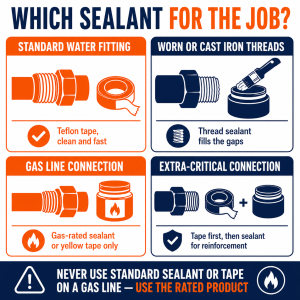
Tape performs reliably on clean, undamaged threads across most standard plumbing fittings — brass, PVC, and modern galvanized fittings that are still true to their original machined shape. Because tape is a thin, uniform layer, it depends on the threads themselves being reasonably regular to seal properly; it has little material to spare for filling an unusually wide or uneven gap.
Sealant is generally the better-suited choice for older or slightly worn threads, where years of tightening and loosening have rounded off the sharp edges that new threads have. It’s also frequently preferred on cast iron fittings, which are more prone to minor casting irregularities than machined brass or plastic, and in any situation where a connection needs real gap-filling capacity rather than just a thin barrier layer.
On connections where the stakes of a leak are especially high — a repair that’s difficult to access again, or a fitting you want extra confidence in — it’s genuinely common for plumbers to apply both tape and sealant together, wrapping the tape first and brushing a thin layer of sealant over it before threading the connection. This isn’t overkill so much as reasonable redundancy on a joint you’d rather not revisit.
Application Technique
Getting either product right comes down to a short, specific technique rather than any real skill barrier — both are genuinely approachable for a first-time DIYer.
Applying Teflon tape:
- Hold the fitting with the male threads facing you and identify the direction it will be tightened (clockwise, in nearly all standard NPT fittings).
- Starting at the second thread from the end (not the very tip), wrap the tape clockwise around the threads two to three times, pulling it snug as you go.
- Press the tape into the thread grooves with your thumb so it sits flush rather than bunching at any one point.
- Thread the connection by hand first, then finish tightening with a wrench to the manufacturer’s recommended torque or until snug and leak-free.
Applying pipe thread sealant:
- Use the applicator brush built into most sealant containers to apply a thin, even coat across the full length of the male threads.
- Avoid over-applying — a thick coat doesn’t seal any better and increases the risk of excess sealant migrating into the pipe’s interior, where it can potentially contaminate the water line or clog aerators and valves downstream.
- Thread the connection by hand, then tighten with a wrench, letting the natural tightening motion spread the sealant evenly through the threads.
- Wipe away any sealant that squeezes out at the joint before it has a chance to cure or set.
💡 Tip: Always wrap tape in the same direction the fitting will be tightened — wrapping the wrong direction unwinds the tape as you thread the connection instead of sealing it.
Reliability and Leak Risk
Both products are genuinely reliable when applied correctly, and neither is a compromise choice on paper for a standard residential connection. The failure modes for each, though, are specific and worth knowing in advance so you can check for them rather than guess at the cause after the fact.
Tape’s most common failure is under-wrapping — too few passes to fully fill the thread gaps — or wrapping in the wrong direction so it unwinds during tightening instead of compressing. Both are visible and correctable before you finish the connection if you know to look for them.
Sealant’s most common failure is under-application on threads worn enough to need real gap-filling, where a thin coat simply isn’t enough material to close the gap completely. The other common failure is using a water-rated formula on a gas connection, which is not just a leak risk but a genuine safety issue, not a performance shortfall to troubleshoot after the fact.
⚠️ Warning: Never substitute standard pipe thread sealant or tape on a gas line connection — gas fittings require a specifically rated, gas-approved sealant. Using the wrong product is a genuine safety hazard, not just a leak risk.
Which Should You Choose?
Choose tape as your default for most standard water-line repairs on fresh, clean threads — it’s faster, cheaper, and leaves nothing to clean up afterward. For a typical faucet supply connection, a showerhead fitting, or any repair on modern brass or PVC fittings in good condition, tape alone is sufficient and is genuinely the easier product to apply correctly on a first try. If you’re installing a new showerhead, our how to install a shower head guide walks through exactly where tape belongs in that specific job.
Choose sealant for worn or irregular threads, cast iron fittings, or any connection where you specifically want the gap-filling capability tape can’t offer on its own. It’s also the better choice as reinforcement alongside tape on any connection you consider especially critical — behind a wall, under a slab, or otherwise difficult to revisit if it fails.
Both products are sold side by side at hardware stores across the US, and many plumbers keep both in their kit rather than picking one over the other permanently. In older US housing stock with original cast iron or galvanized threaded fittings, thread sealant tends to be the more forgiving choice since it fills the gaps that decades of wear leave in the threads — tape alone can struggle to seal a connection that’s no longer perfectly machined.
Frequently Asked Questions
Q: Can I use both thread sealant and Teflon tape on the same connection?
Yes, and it’s a genuinely common practice on connections where extra reliability matters. Wrap the tape first, then brush a thin coat of sealant over it before threading the connection together. This combination is generally treated as reasonable reinforcement rather than overkill, particularly on joints that are hard to access again if they fail.
Q: Is Teflon tape safe to use on gas lines?
Only if it’s the specific yellow gas-rated tape, not standard white plumbing tape. Yellow tape is a denser PTFE formula certified for gas connections, and many local codes require it, sometimes alongside a gas-rated sealant, for threaded gas fittings. Never assume white tape is an acceptable substitute for a gas connection — confirm the rating on the roll before using it on any gas line.
Q: How many times should I wrap Teflon tape around a fitting?
Two to three wraps is the standard for most residential fittings and thread sizes. Too few wraps leaves gaps in the thread coverage; too many can make the fitting difficult to thread in fully or cause it to bottom out before it’s actually tight. If you’re unsure, start with two wraps, and add a third if the connection still shows a slow leak after tightening.
Q: Does pipe thread sealant expire or need to be replaced periodically in storage?
Yes, most formulas have a shelf life, typically several years when stored with the lid tightly sealed, though this varies by product and manufacturer. Signs a container has gone bad include a hardened, unworkable texture, separation that won’t remix with stirring, or a noticeably different smell than when it was fresh. If a container shows any of these signs, replace it rather than risk an incomplete seal on a repair you’re counting on.
Conclusion
Pipe thread sealant and Teflon tape both seal the same type of connection, but they aren’t a simple either-or choice. Tape is the faster, cleaner default for most standard water-line repairs on clean, undamaged threads. Sealant earns its place on worn or irregular threads, cast iron fittings, and gas connections that require a specifically rated formula — and on any connection where you want the extra insurance of using both together.
For most homeowners, keeping both on hand covers the full range of threaded connections you’re likely to encounter. If you’re ready to pick up either product, our pipe thread sealants and plumbing tapes reviews cover current options in more detail. If you land on tape, our guide to applying plumber’s tape correctly covers the technique, and our PTFE tape vs thread sealing cord comparison covers a tape-format decision some specialty jobs call for.
Prices and ratings may change. Always check Amazon for current prices.
✍️ About This Comparison
PTR Editorial Team — Product Comparisons. We compare manufacturer specifications, installation requirements, compatibility and available product documentation to help homeowners choose suitable tools and parts. How we review →