Product availability and information are based on our research at time of writing and are subject to change. Always check Amazon for the latest details before purchasing.
Introduction
A leaking threaded pipe joint is one of the most common plumbing problems in US homes, and the fix is usually straightforward if you use the right product. Pipe thread sealant, also called pipe dope or pipe compound, fills the tiny gaps between threaded fittings and can seal joints that PTFE tape alone doesn’t always manage. But the label matters more than the brand: a sealant that is fine on a water line can be the wrong choice on a gas fitting, and not every sealant is intended for drinking-water lines.
We compared five pipe thread sealants sold in the US, using each product’s Amazon listing and manufacturer description, across uses from general fittings to natural gas connections. Three questions decide most purchases: pipe dope vs PTFE tape (tape is a dry wrap, paste fills the thread valleys, and PTFE paste combines the two ideas), water-line vs gas-rated sealants (a safety question, so look for explicit gas wording on the label), and drinking-water suitability (some listings say a product is suitable for drinking water or NSF certified; others say nothing, and we note which is which below). If you’re also dealing with cracked or damaged pipes rather than just loose joints, check our guide to the best pipe repair kits. For threaded plastic fittings, our guide to the best plumbing tapes covers PTFE tape options in detail.
Quick Comparison Table
The 5 Best Pipe Thread Sealants — Full Reviews
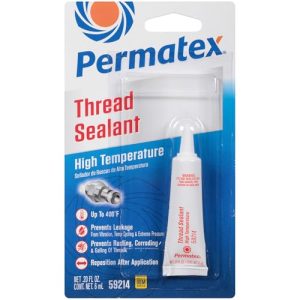
1. Permatex 59214 High Temperature Thread Sealant — Best Overall
⭐ OUR TOP PICK
★★★★
The Permatex 59214 earns the Best Overall spot as a low-cost, high-temperature thread sealant for metal fittings. Per its listing, it contains PTFE, is rated from -65°F to 400°F, and resists moisture, hydraulic fluids and diesel fuels; the listing also says it is not recommended for plastics or rubber. Two cautions: it is sold as a small 6 ml tube, and its listing is written around automotive and hydraulic fittings. It does not say the product is approved for drinking water or for gas lines, so check the label before using it on either.
Unlike PTFE tape, which wraps around threads and can bunch or gap at corners, a paste fills the thread profile, which helps on slightly worn or irregular threads. The listing describes this product as lubricating threads for easy assembly and disassembly, and says parts can be repositioned for up to 4 hours after application. It also says the product locks and seals threaded fittings, so if you may need to take a joint apart later, follow the label’s instructions for removal.
💡 Tip: Apply to the male threads only — never the female side. Work the compound into the thread roots with your finger before assembling, and hand-tighten before using a wrench for one to two additional turns.
★★★★
Permatex
Permatex 59214 High Temperature Thread Sealant
Best for: Automotive and hydraulic fittings, and general-purpose sealing on metal threads
A high-temperature thread sealant with PTFE, rated from -65°F to 400°F, for threaded metal fittings.
✓ Pros
• High-temperature rated from -65°F to 400°F
• Contains PTFE and lubricates threads for easy assembly and disassembly
• Parts can be repositioned for up to 4 hours after application
✗ Cons
• Listing doesn't mention gas line use
• Listing doesn't mention drinking water
• Listing says not recommended for plastics or rubber
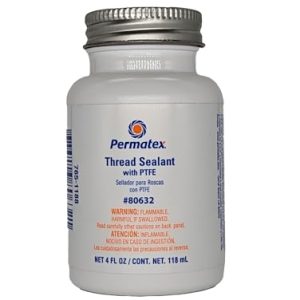
2. Permatex 80632 Thread Sealant with PTFE — Best with PTFE
🏆 EDITOR’S CHOICE
★★★★
The Permatex 80632 adds PTFE (polytetrafluoroethylene) to the paste. Per its listing, it is an economical general-purpose fitting sealant that seals and resists pressure in air, oil, diesel fuel and hydraulic systems, and it remains pliable across its temperature range. PTFE gives the paste lubricity, which can make fittings easier to assemble and can help on stainless connections, while the paste itself fills the thread valleys.
Check the limits on the listing before you buy: it is rated from -65°F to 300°F, and its suggested applications are air conditioning, temperature-sending and hydraulic fittings. The listing does not say the product is approved for drinking water or for gas, so we can’t recommend it for potable supply lines or gas fittings on the strength of the listing alone. For a PTFE paste on stainless or high-pressure fittings on non-potable, non-gas lines, it is a reasonable option.
★★★★
Permatex
Permatex 80632 Thread Sealant with PTFE
Best for: Stainless steel and high-pressure fittings
A PTFE thread sealant described as economical and general-purpose.
✓ Pros
• Contains PTFE, which lubricates during assembly
• Rated from -65°F to 300°F per its listing
• Listed for air, oil, diesel fuel and hydraulic systems
✗ Cons
• Listing doesn't mention drinking water
• Listing doesn't mention gas line use
• Lowest maximum temperature rating in this lineup (300°F)
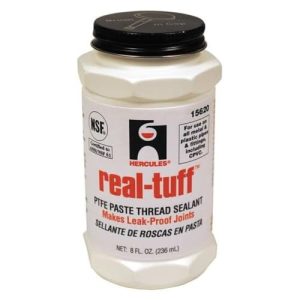
3. Hercules 15620 Real-Tuff PTFE Sealant — Best for Professionals
🔧 Pro Grade
★★★★
The Hercules Real-Tuff 15620 is a PTFE thread sealant whose listing says it is for use on all metals and on PVC, CPVC and ABS plastics. The listing also says it is suitable for lines carrying air, liquid (including drinking water) and gas, except for oxygen, and describes it as soft-set with no cure time required. It lists a working pressure of up to 12,000 PSI hydraulic and 2,600 PSI for air and steam, and temperatures up to 550°F. The listing says the sealant is suitable for drinking-water lines but does not name an NSF/ANSI 61 certification, so if your inspector or local code requires a certified product, check the label or the manufacturer’s documentation.
Plastic fittings are where sealant choice gets tricky: some pastes aren’t recommended for plastics, and Permatex says so for the 59214. Hercules lists this sealant for PVC, CPVC and ABS as well as metals, which makes it a practical choice on jobs that mix metal and plastic threads. As always, check the label and the fitting manufacturer’s guidance before you apply it.
💡 Tip: The Hercules Real-Tuff and the LA-CO Slic-Tite both list PVC, CPVC and ABS plastic threads on their Amazon listings. The Permatex listings don’t, and the 59214 listing says it isn’t recommended for plastics. If your job mixes metal and plastic fittings, choose a product whose label explicitly lists the plastic you’re working with.
★★★★
Hercules
Hercules 15620 Real-Tuff PTFE Sealant
Best for: Jobs mixing metal and plastic fittings
An 8 oz PTFE thread sealant whose listing says it is for use on all metals and on PVC, CPVC and ABS plastics, and suitable for lines carrying air, liquid (including drinking water) and gas, except oxygen.
✓ Pros
• Listed for all metals plus PVC, CPVC and ABS plastics
• Listing says suitable for lines carrying drinking water
• Listing also mentions gas lines (except oxygen)
✗ Cons
• Listing doesn't name an NSF/ANSI 61 certification
• Listing says "gas" without naming natural gas or LP specifically
4. Black Swan Pro-Grade Pipe Dope — Best for Gas Lines
🔥 Gas Line Rated
★★★★
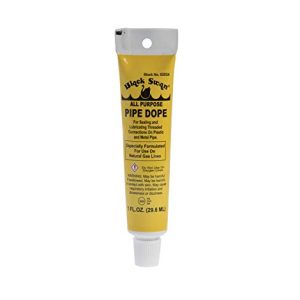
When it comes to gas line connections, the rules change. Many thread sealants are sold for general or water use, and using a product that isn’t rated for gas on a gas fitting can be dangerous. Black Swan Pro-Grade Pipe Dope is titled on its listing as “especially formulated for use on natural gas lines,” with a listed pressure range of up to 3,000 psi for gas and 6,000 psi for liquids and a temperature range of -50°F to 400°F. The listing also says it is NSF certified for food and potable water systems, without naming the specific NSF standard. It does not mention propane or LP gas, so confirm on the label before using it on LP fittings. It comes in a 1 oz tube.
Black Swan describes this as an all-purpose, soft-set, high-viscosity, low-odor pipe dope that works on all pipe joints. The listing doesn’t say which metals or appliances it is meant for, so for a gas appliance connection follow the label and your local code. Apply it to the male threads, allow the time the label specifies, and leak-test the connection before turning on the gas supply.
⚠️ Warning: Never use a water-only sealant on a gas line — not all thread sealants are gas-approved. Always confirm the product label states it is rated for gas (natural gas or LP) before applying to any gas fitting. Always pressure-test before restoring gas supply.
★★★★
Black Swan
Black Swan Pro-Grade Pipe Dope
Best for: Natural gas appliance connections
A pipe dope whose listing describes it as especially formulated for use on natural gas lines and as working on all pipe joints.
✓ Pros
• Listing says especially formulated for natural gas lines
• Listing says NSF certified for food and potable water systems
• Soft-set, high-viscosity, low-odor formula per its listing
✗ Cons
• Listing doesn't mention propane or LP gas
• Listing doesn't name the specific NSF standard
• Small 1 oz tube
5. LA-CO 42019 Slic-Tite Premium Sealant — Best Premium Pick
💎 Premium Pick
★★★★
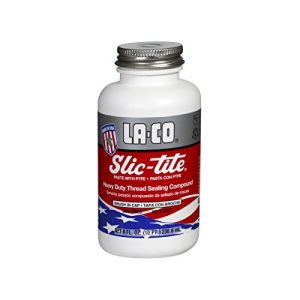
The LA-CO Slic-Tite 42019 is a PTFE thread sealant paste with the widest list of applications in this lineup. Its listing says it is for sealing water, air, steam, natural gas, LP gas, refrigerants, ammonia, gasoline, ethanol and oil, and for use on metal, PVC, CPVC and ABS plastic pipe threads. It lists pressure ratings of 3,000 PSI for gas and 10,000 PSI for liquid, and a temperature range of -50°F to 500°F.
The listing calls the paste non-hardening, says it washes off hands and clothing easily, and says it should be applied at least twice the depth of the thread root so enough gets into the joint. It comes in a half-pint jar with a brush in the cap, which is much more product than the small tubes of the Permatex 59214 and Black Swan, and the manufacturer’s description says it is made in the USA. The listing says the product “comes with several approvals” but doesn’t name them, so we can’t confirm specific NSF or UL listings from it; check the label if you need a particular certification.
💡 Tip: Follow the application depth on the label: the listing says to apply the paste at least twice the depth of the thread root. Because it is described as non-hardening, follow the label’s guidance on when to pressurize the line.
★★★★
La-Co
LA-CO 42019 Slic-Tite Premium Sealant
Best for: Professional or high-volume jobs
A PTFE thread sealant paste whose listing says it is for sealing water, air, steam, natural gas, LP gas, refrigerants, ammonia, gasoline, ethanol and oil, on metal, PVC, CPVC and ABS plastic threads.
✓ Pros
• Listing mentions natural gas and LP gas, plus water and steam
• Listed for metal, PVC, CPVC and ABS plastic threads
• Listed for -50°F to 500°F
✗ Cons
• Highest price of the five products in this lineup
• Listing says it has "several approvals" but doesn't name them
• Larger jar than a one-off job needs
Pipe Thread Sealant Buying Guide
What Is Pipe Thread Sealant and When Do You Need It?
Pipe thread sealant (also called pipe dope or pipe compound) is a paste or liquid applied to threaded pipe connections to fill the microscopic gaps between the male and female threads, preventing leaks under pressure. While PTFE tape wraps around threads to create a physical barrier, paste sealants flow into every thread valley for a more complete fill — especially valuable on worn, corroded, or slightly irregular threads where tape alone leaves gaps. Use thread sealant any time you’re making or remaking a threaded pipe connection: supply line shutoff valves, appliance hookups, union fittings, and any NPT (National Pipe Thread) joint in your home’s plumbing or gas system.
Liquid Sealant vs PTFE Tape vs Pipe Dope — What’s the Difference?
PTFE tape (plumber’s tape) is a dry wrap: it’s clean, inexpensive, and easy to redo, which makes it a common choice for simple water-line connections on clean threads. Pipe dope is the paste alternative. It fills the thread valleys instead of wrapping the threads, so it tends to suit worn, corroded, or slightly irregular threads where tape can leave gaps. PTFE paste (like the Permatex 80632, Hercules 15620 and LA-CO 42019 here) blends PTFE into the paste for lubrication and gap filling, while traditional pipe dope pastes (like Black Swan) predate PTFE formulations. Which is better depends on the job: tape works well on clean, standard threads when the tape is approved for the line, and paste is the better choice on rough threads or when you’d rather use one product that fills gaps. Some gas fittings call for a gas-rated paste or a gas-rated tape specifically, so follow the fitting manufacturer’s instructions and local code. For most DIY water-line work, a suitable paste or PTFE tape both work well.
Gas Lines vs Water Lines — Choosing the Right Sealant
The most important rule in pipe thread sealing: never use a water-only sealant on a gas line. Standard thread sealants are formulated for water and hydraulic pressure — the chemical makeup of natural gas and LP propane can degrade these compounds over time, leading to a slow gas leak. Always confirm your sealant explicitly states it is rated for gas use on the label. In this lineup, the Black Swan listing mentions natural gas, the LA-CO 42019 listing mentions natural gas and LP gas, and the Hercules 15620 listing says it is suitable for lines carrying gas (except oxygen). The Permatex 59214 and 80632 listings don’t mention gas, so don’t use those two on gas fittings. Even with a gas-rated product, check the label for your specific gas and pressure, follow local code, and leak-test every connection before restoring gas. For more complex pipe failures, see our guide to the best pipe repair kits and our full guide to fixing a leaking pipe.
Drinking Water: Potable Suitability and NSF/ANSI 61
A thread sealant on a drinking-water line touches the water, so it should be intended for potable use. NSF/ANSI 61 is the standard for materials and products that contact drinking water, and a certified product will say so on its label or in the manufacturer’s documentation. Amazon listings vary in what they say. Among the five products here, the Hercules 15620 listing says the sealant is suitable for lines carrying drinking water, and the Black Swan listing says it is NSF certified for food and potable water systems. The LA-CO listing says only that it carries several approvals without naming them, and the Permatex 59214 and 80632 listings say nothing about drinking water. None of the five listings names NSF/ANSI 61 specifically. For a drinking-water supply line, choose a product whose label or manufacturer documentation clearly says it is approved for potable water, and check your local code.
How to Apply Pipe Thread Sealant Correctly
Apply sealant to the male threads only — never the female socket. Use enough to coat all thread surfaces without leaving a heavy excess that could break off inside the pipe and clog downstream valves or fixtures. Work the paste into the thread roots with your fingertip or the brush applicator provided with some products. Hand-tighten the fitting first, then use a wrench for one to two additional turns — overtightening is a common cause of cracked fittings, especially on plastic. Cure or set time varies by product (for example, the Hercules 15620 listing says no cure time is required), so follow the label before pressurizing the line.
When to Call a Plumber Instead
Thread sealant addresses leaking joints — but if your pipe is cracked, corroded through, or if a fitting has stripped threads, sealant alone won’t hold long-term. Similarly, any work on your main gas supply line, meter connections, or buried gas piping should be done by a licensed plumber or gas fitter. If you’re unsure whether a leak is coming from the thread joint or from the pipe body itself, apply soapy water around the fitting: bubbles at the joint indicate a thread leak; bubbles along the pipe body indicate a pipe failure that needs a repair kit or replacement.
Frequently Asked Questions
Q: What is the best pipe thread sealant for water lines?
For general water-line fittings, start with the product label: look for a sealant that states it is suitable for the line you’re working on. In this lineup, the Hercules 15620 Real-Tuff listing says it is suitable for lines carrying drinking water and lists PVC, CPVC and ABS as well as metals, and the Black Swan listing says it is NSF certified for potable water systems. The Permatex 59214 and 80632 listings don’t mention drinking water, so we wouldn’t choose them for potable supply lines on the listings alone. Prefer tape to paste? Our best plumbing tapes roundup covers PTFE tape for the same joints.
Q: Is pipe dope safe for drinking water?
Only if the product is intended for potable use. Check the label or manufacturer documentation for a statement that it is approved for drinking water; NSF/ANSI 61 certification is the usual mark. In this lineup, the Hercules 15620 listing says it is suitable for lines carrying drinking water and the Black Swan listing says it is NSF certified, but none of the listings names NSF/ANSI 61, and the Permatex 59214 and 80632 listings don’t mention drinking water.
Q: Can you use pipe thread sealant on gas lines?
Only if the sealant is explicitly rated for gas use. Standard water-rated thread sealants should never be used on gas fittings — natural gas and propane can degrade the compound over time and cause a slow leak. In this lineup, the Black Swan listing says it is especially formulated for natural gas lines, the LA-CO 42019 Slic-Tite listing lists natural gas and LP gas, and the Hercules 15620 listing says it is suitable for lines carrying gas except oxygen. The Permatex 59214 and 80632 listings don’t mention gas. Always confirm the label for your specific gas and pressure, leak-test before restoring the gas supply, and call a licensed plumber if in any doubt.
Q: Is pipe thread sealant better than PTFE tape?
For most applications, they’re complementary rather than competing. PTFE tape works well on clean, standard-dimension threads where a simple dry barrier is sufficient. Paste thread sealant fills the thread valleys more completely — making it more reliable on worn, corroded, or slightly out-of-spec threads — and PTFE pastes also lubricate the joint during assembly. Some plumbers use both, but gas fittings and potable lines can have specific requirements for the sealant or tape, so follow the fitting manufacturer’s instructions and local code.
Q: How long does pipe thread sealant take to cure?
Cure time depends on the product. Some pastes are described as soft-set with no cure time (the Hercules 15620 listing says so), while others specify a wait before you pressurize the line, so follow the label. Cold temperatures can slow curing, so allow extra time in an unheated garage or basement in winter. For gas lines, don’t restore the gas until the label’s wait time has passed and you’ve leak-tested the connection.
Conclusion — Which Pipe Thread Sealant Should You Buy?
For general-purpose metal fittings, the Permatex 59214 High Temperature Thread Sealant is our Best Overall pick in this lineup, with two caveats: it is a small tube whose listing focuses on automotive and hydraulic uses, and it does not say it is approved for drinking water or gas. For potable-water lines or jobs with plastic fittings, look at the Hercules 15620 or Black Swan listings, and for gas, choose a sealant whose label explicitly says it is rated for gas.
- Best Overall: Permatex 59214 — high-temp rated (-65°F to 400°F), small tube, for metal fittings
- Best with PTFE: Permatex 80632 — PTFE-enhanced, -65°F to 300°F, not listed for drinking water or gas
- Best for Professionals: Hercules 15620 — lists PVC/CPVC/ABS, drinking water and gas, no cure time
- Best for Gas Lines: Black Swan Pipe Dope — formulated for natural gas lines, NSF certified per its listing
- Best Premium Pick: LA-CO 42019 Slic-Tite — lists water, steam, natural gas and LP gas, up to 500°F
Once your threaded joints are sealed, it’s worth having the right tools on hand for the next repair. See our picks for the best pipe repair kits for burst or cracked pipes, and our full guide on how to fix a leaking pipe for step-by-step repair instructions.
✍️ About This Review
PTR Editorial Team — Product Reviews. We compare manufacturer specifications, installation requirements, compatibility and available product documentation to help homeowners choose suitable tools and parts. How we review →