
Comparisons
2 Nov 2026

Shower Filter vs Water Softener: What Each Can—and Cannot—Do
Softening reduces hardness; shower filters target specific substances. Compare what each is documented to do, check claims and test your water first.
Foam pipe insulation and heat cable compared: how each works, what each involves to install and run, and what to check in a cable's manual before choosing.
Please note: Information in this guide is based on our research at time of writing and is subject to change. Always consult a licensed plumber for diagnosis of serious plumbing issues before attempting repairs.
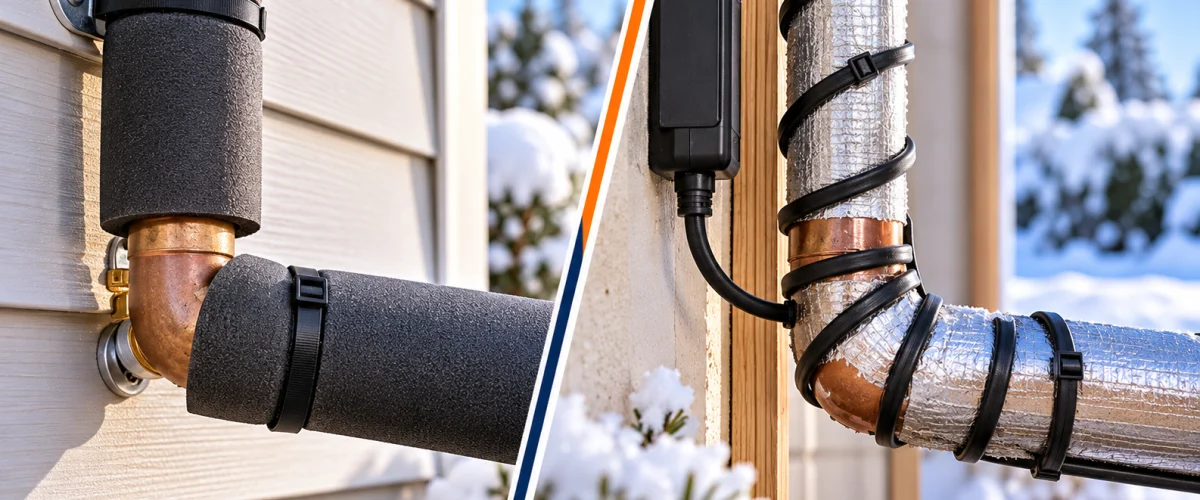
Foam pipe insulation and heat tape both protect pipes from freezing, but they solve the problem in fundamentally different ways — and choosing the wrong one for your situation means either overspending on protection you don’t need or under-protecting the pipes most likely to freeze. Foam sleeves are passive: they slow the rate at which a pipe loses heat to the surrounding cold air, which buys time in moderate freezes. Heat tape (heat cable) is active: it adds heat to the pipe while it is powered, within the limits stated in the manual for the exact cable you own. This guide compares both products on how each works, how each installs, what each costs to buy and run, and what limits apply in severe cold, and lists the checks that decide which fits your pipes. Our roundup of the best pipe insulation covers product options once you’ve decided which approach fits your situation.
The starting point for both decisions is the vulnerability of the specific pipe you’re protecting: where it runs, what surrounds it, what temperatures it’s exposed to, and whether it has a documented history of freezing. A pipe running through a heated interior wall in a mild climate has fundamentally different needs than a pipe exposed in an unheated crawl space in a cold-climate state. Our step-by-step guide to insulating pipes for winter covers the practical installation process for both foam and heat tape once you know which to use.
✏️ Our Take
Foam pipe insulation and heat tape solve the same underlying problem — protecting pipes from freezing — but they work in completely different ways. Foam insulation is passive: it slows heat loss from the pipe, buying time before the surrounding temperature catches up. Heat tape is active: it adds heat along the pipe while it is powered, within the limits the maker states. Whether foam alone is enough depends on where the pipe runs, how cold and how long it gets, and whether it has frozen before. A freezing history calls for assessing why the pipe froze, not automatically adding a cable. If you consider heat cable, follow the current manual for the exact cable: different products permit or prohibit different pipe materials, insulation and arrangements.
IN THIS GUIDE
Foam pipe insulation works by surrounding the pipe with a layer of low-conductivity material — typically closed-cell polyethylene or rubber foam — that slows the rate at which heat transfers from the warm pipe to the cold surrounding air. The pipe retains heat from any flowing water inside it and from the ambient temperature of the space it runs through; the foam sleeve keeps that heat from escaping quickly. In moderate cold, the result is a pipe that stays above freezing for longer than it would bare, which can help bridge a brief cold spell, though how long it holds depends on the conditions.
The critical word is “slows.” Foam insulation is a time-buying measure rather than an absolute barrier. The sleeve’s effectiveness depends on its wall thickness — thicker foam slows heat loss more than thin foam — and on using the right size. Pipe is described by a nominal size, which is not the same as its actual outside diameter, and insulation makers publish their own sizing charts matching their sleeves to pipe materials and sizes. Armacell’s guide, for example, says pipe is sold by nominal size while the outside diameter is the part you insulate, and its chart applies to its own products. Use the insulation manufacturer’s chart for your pipe material and size. In sustained extreme cold, even well-fitted, thick foam eventually yields to the continued extraction of heat by the surrounding air, which is where its fundamental limitation lies. Foam is passive protection; once the surrounding air temperature has stayed below freezing long enough, the pipe’s stored heat runs out. Our roundup of the best pipe insulation covers the specific products worth buying, including their thickness ratings.
Heat tape — more accurately called heat cable or pipe heating cable — is an electrical resistance cable that runs along the length of a pipe and generates heat when plugged into a power outlet. Unlike foam insulation, heat tape doesn’t slow heat loss from the pipe; it adds heat to the pipe directly. That heat has limits stated in the manual for the exact cable you own: a product’s manual states the limits that apply to it, which can include pipe sizes, maximum cable length, the lowest temperature it is designed to protect and insulation requirements. Whether a cable is suitable depends on the checks listed later in this guide and on the cable’s own manual; a pipe that has frozen despite insulation first calls for finding out why.
The most important distinction within the heat tape category is between fixed-wattage cables and self-regulating cables. A fixed-wattage (constant-wattage) cable outputs the same level of heat whenever it is powered, so it normally needs a thermostat or other control, while a self-regulating cable varies its output with temperature, so some products can run without a separate thermostat. Whether your cable needs a separate control, and its limits for pipe type, length, insulation and electrical protection, are in the manual for the exact cable you own.
Foam pipe insulation has no electrical connection to make. Pre-slit foam sleeves are pressed onto the pipe by parting the slit and snapping the sleeve around the pipe, then sealed along the slit edge with manufacturer’s tape or compatible foam tape. Sections butt end-to-end along straight runs; elbows, tees, and valves require pre-formed fitting covers or mitre cuts from straight sleeve sections. Standard straight runs need few tools. Follow the insulation maker’s installation instructions. The Department of Energy’s weatherization job aid for hot-water pipes says to keep insulation continuous with no gaps, to secure seams with tape rather than relying only on the adhesive strip, and, near a water heater, to keep insulation back at least 6 inches from a draft diverter or single-wall flue. Our step-by-step guide to insulating pipes for winter covers the installation process in full detail, including how to handle fittings and corners cleanly.
Heat tape installation means following the current instructions for the exact cable you own, and they differ by product. Different products permit or prohibit different pipe materials, locations, overlap, insulation and fastening. In the manual for your cable, check the pipe material, location, spacing, overlap, fastening, insulation, thermostat or control, and electrical protection, follow local electrical code, and have an electrician add a protected outlet if one isn’t available near the pipe.
Foam pipe insulation is sold by the linear foot, so material cost depends on the length of pipe, its size and the thickness and type you choose. The cost is materials and installation time. It draws no electricity, and it may need replacing if the foam deteriorates or is disturbed by rodents or moisture.
Heat cable costs include the cable itself, any control, insulation or protected outlet its manual requires, and the electricity it uses while powered. Self-regulating cables vary their output with temperature rather than running at full wattage continuously, which can lower running cost, but electricity consumption remains a factor. To compare costs, use the cable maker’s wattage and the length you need, add any required parts and installation, and compare the total with foam for the same pipe. We have not priced either here.
This is the central practical divide between the two options. Foam insulation can help a pipe get through a brief cold period, because it slows heat loss from the pipe. It cannot add heat. In a long, hard cold spell the surrounding air keeps drawing heat from the pipe, and without a heat source the pipe temperature can eventually reach freezing however well it is insulated. How long that takes depends on the foam thickness, the air temperature, wind and whether water is moving in the pipe; we cannot give a temperature or time that applies to every pipe.
Heat cable adds heat while it has power, within the limits stated for the product: its manual states the limits that apply, which can include the lowest temperature it is designed to protect for a given pipe size, cable length and insulation. Sustained severe cold can overwhelm foam alone on vulnerable pipe runs, and heat cable is one option to assess for those runs if its manual allows the pipe and location. Regional climate matters, but it does not replace checking your own pipes’ exposure, their freezing history and whether the cause of an earlier freeze can be addressed.
Foam pipe insulation has no electrical component, so it avoids the electrical hazards of heat cable. Check the product’s own temperature and fire ratings, and keep it clear of water heater flues and vents as your heater’s instructions and the Department of Energy’s job aid direct (the job aid says to keep insulation back at least 6 inches from a draft diverter or single-wall flue). It needs little maintenance beyond a periodic visual check to confirm the foam hasn’t physically deteriorated, separated at the slit seams, or been disturbed by pests over the years. Where electrical safety is a concern, such as uncertain wiring, damp locations or limited access for inspection, check whether a cable is appropriate there at all, and consider asking an electrician. Our guide to preventing frozen pipes covers the complete layered protection approach, including where each product fits within a multi-measure strategy.
Heat tape safety depends entirely on using the right product, installing it correctly, and inspecting it before each winter season. Only use heat tape rated specifically for the pipe material it will contact — cables approved for metal pipe are a different product from cables approved for plastic or PEX, and using the wrong type can damage the pipe or create a fire risk at the contact point. Inspect the full length of cable each autumn before plugging it in: look for cracks, fraying, pinching, or any visible damage to the outer insulation jacket. A damaged cable should be replaced entirely, not repaired with electrical tape. Whether a cable may touch, cross or overlap itself depends on the cable; follow the current manual for yours.
Only if the manual for your exact cable allows it. Different products require or prohibit insulation over the cable, and where it is allowed the manual says which type to use and how, so the foam must be one the cable maker approves. Where insulation is allowed, the usual sequence is to apply the cable first, fasten it as the maker specifies, then cover it with the insulation the maker names. How much insulation helps cannot be stated for every cable and installation.
Some arrangements are not permitted at all: some cables must not be installed in walls, floors or ceilings, so check the manual for your cable before putting any cable in an exterior wall. A pipe that has frozen despite insulation first calls for assessing why it froze; a cable is one possible result of that assessment, not an automatic fix. The upfront cost of using both is higher than either alone; whether the running cost falls depends on the product.
The right choice depends on your pipes and on the exact cable, not on climate alone. Check these before choosing:
| Factor | What to check |
|---|---|
| Pipe material and size | The cable’s manual must list your pipe material (metal, plastic or PEX) and size; for foam, use the insulation maker’s sizing chart |
| Exposure | Where the pipe runs, how cold it gets there and for how long, and whether it has frozen before and why |
| Available heat | Whether the space or the pipe receives any heat from the building; foam slows heat loss but adds none |
| Approved location | Whether the cable’s manual allows the location, for example indoors or outdoors, or in or near walls, floors or ceilings |
| Power and controls | Whether a protected outlet is within reach, whether the cable needs a separate thermostat or control, and what happens in an outage; having no outlet does not show that foam is sufficient |
| Insulation requirements | Whether the cable’s manual requires or prohibits insulation over it, and which type |
Your pipes’ exposure and history suggest that slowing heat loss may be enough, for example pipes that run through spaces that receive some heat from the building and have not frozen before, and you want an option with no electricity use. Foam adds no heat, so confirm that for your pipes. Our roundup of the best pipe insulation covers products by type and thickness.
You have assessed a pipe that needs added heat, for example one that runs through an unheated space, is exposed to sustained severe cold, or froze despite insulation for a reason you have worked out, and you have found a cable whose manual lists your pipe material, size and location and whose power and control needs you can meet. Our roundup of the best heat tape and pipe heating cables covers the specific products worth buying, including the fixed-wattage versus self-regulating distinction covered above.
You have assessed a pipe that needs both added heat and heat retention, and the manual for your exact cable allows insulation over it. If the manual for your cable allows insulation, the combination pairs active heat with passive heat retention; if it prohibits insulation, use the cable as the maker directs. Our guide to preventing frozen pipes covers the complete winter protection strategy, including where combining both products fits within a layered approach.
How much you can do yourself depends on the product’s instructions and on your own pipes and wiring. If your pipes are in difficult-access locations like inside finished walls or under a concrete slab, if you need a protected outlet installed before a cable can be used, or if you’re dealing with the aftermath of a frozen or burst pipe, a licensed plumber can assess the full situation and recommend the right protection approach for your specific home layout and climate.
Find a licensed plumber in your area at PlumberArchive.com — the US plumber directory with 12,000+ verified local plumbers across all 50 states.
Get weekly plumbing tips, honest tool reviews and DIY maintenance guides delivered straight to your Facebook feed. We cover pipe protection, winter maintenance, freeze prevention and everything in between — written for US homeowners who want to handle more themselves.
Sometimes, but it depends on the pipe, not just the climate. Foam slows heat loss and adds none, so whether it is enough depends on where the pipe runs, how cold and for how long it gets there, and whether the pipe has frozen before. A pipe that froze despite foam insulation calls for assessing why, such as its exposure, gaps in coverage or the sleeve’s size and fit, before deciding on added heat, which may or may not mean a heat cable.
That depends entirely on the exact cable. Follow its current manual on whether it may stay powered, whether it needs a thermostat or other control, and when to switch it off. Self-regulating cables vary their output with temperature, but that does not make every product suitable for winter-long operation, and fixed-wattage cables usually need a control. At the end of the season, follow the manual for shutting the cable off and inspecting it.
Only if the manual for the exact cable lists your pipe material. A general “plastic pipe” label is not enough: PVC, CPVC and PEX are different materials. Approval for one pipe material does not establish approval for another; check the exact cable’s listed applications. If the specification doesn’t list your pipe material, don’t assume the cable is approved for it, and don’t assume it is approved for metal either; check with the maker before use. A cable used on a pipe it isn’t approved for can damage the pipe or a fitting and cause a leak in the very pipe you were trying to protect.
It depends on the pipe and its history, not on climate alone. If foam-insulated pipes have never frozen, you may have no reason to add anything. If a pipe has frozen despite foam, the first step is to assess why: its exposure, gaps in coverage, how cold and for how long, and whether the foam is the right size and properly fitted. If you then consider a heat cable, it must be approved for that pipe material and location, and any insulation over it must be a type and use the cable maker approves; putting a new foam sleeve over a cable is not automatically permitted.
Foam pipe insulation has no electrical parts and can help a pipe through a brief cold spell; it adds no heat, so whether it is enough depends on your pipes’ exposure and history. Our roundup of the best pipe insulation covers the specific products worth buying, and our step-by-step guide to insulating pipes for winter walks through the installation process from foam sizing to fitting covers.
Heat cable adds heat, but only within the limits of the exact cable’s current manual: pipe material, location, controls, power and insulation requirements all have to match. It is not a universal upgrade, and a pipe that has frozen calls for assessing why before any cable is added. Its cost, electricity use and inspection needs have to be weighed for the specific pipe.
Some owners combine heat cable and insulation on vulnerable runs, but only where the manual for their cable allows it and names the insulation to use. Insulation can slow heat loss, and the cable adds heat that foam alone cannot, within the product’s stated limits. Our guide to preventing frozen pipes covers the complete winter protection strategy, including where each of these products fits within a layered whole-home approach.
✍️ About This Comparison
PTR Editorial Team — Product Comparisons. We compare manufacturer specifications, installation requirements, compatibility and available product documentation to help homeowners choose suitable tools and parts. How we review →
Softening reduces hardness; shower filters target specific substances. Compare what each is documented to do, check claims and test your water first.
A recirculation pump needs a path back to the water heater. Compare a dedicated return line with an under-sink bypass, and check your heater model first.
Compare PEX expansion, crimp and press connections system by system: the tubing, fittings, rings or sleeves, tools, inspection and temperature limits each maker documents.

