Please note: Product availability and information are based on our research at time of writing and are subject to change. Always check Amazon for the latest details before purchasing.
Introduction
Heat tape — more precisely called pipe heating cable — earns its place on pipes that foam insulation alone cannot protect: exposed runs in unheated crawlspaces, garages, and vented basements; pipes on exterior walls in hard-freeze climates; and any line with a history of freezing. Foam only slows how fast a pipe loses heat, which buys time in a moderate cold snap but loses to a sustained deep freeze. Heat cable adds warmth of its own, so the pipe never reaches freezing at all. If you are still deciding whether you need cable versus foam, our comparison of pipe insulation foam vs heat tape lays out the full decision framework, and our guide to how to prevent frozen pipes covers the broader winterizing strategy this fits into. This roundup assumes you have made that call and stays focused on which cable to buy rather than how heat tape works.
✏️ Our Take
There is no single “best” heat cable for every situation — the right pick depends on your climate severity, how long a run you need to protect, and whether the pipe geometry forces you to overlap or coil the cable. Self-regulating cable adjusts its output along its length and can safely cross itself, which makes it the more forgiving choice for most homeowners; fixed-wattage cable is cheaper and widely stocked but demands a careful, no-overlap installation. Match wattage per foot to how cold your winters get, buy a length slightly longer than you measured, and never substitute a roof or gutter de-icing cable for one rated for water pipes. Any of the five below will protect a correctly sized run — the differences are cost, run length, and how much installation latitude you want.
Quick Comparison Table
Full Reviews — 5 Best Heat Tape & Pipe Heating Cables
1. Frost King HC-Series — Best Overall
🏆 Best Overall
★★★★★
Fixed-Wattage · ~7 W/ft · Pre-Set Thermostat · UL Listed
The Frost King HC series is the cable most people picture when they hear “heat tape,” and it has held that spot for a reason: decades in North American hardware stores, a low price, and almost no learning curve to install. Each length comes pre-terminated with a grounded plug and an integral thermostat near the plug end that switches the cable on as the pipe approaches freezing and off again once it warms, so there is nothing to wire and no separate controller to mount. Lengths run from a few feet up to around 100 feet, sized to common pipe runs, and the cable is UL listed for use on both metal and plastic water pipes.
It is a fixed-wattage design, meaning it puts out a constant level of heat — roughly 7 watts per foot — whenever the thermostat calls for it; our comparison of pipe insulation foam vs heat tape covers how that differs from self-regulating cable. In practice the main consequence is installation discipline: fixed-wattage cable must run in a single pass along the pipe without crossing or overlapping itself, and it cannot be cut to length, so you buy the size that matches your run. For a straightforward crawlspace or basement pipe within reach of an outlet, that trade is easy to accept for the low price and the near-certainty of finding a replacement locally.
✓ Pros
Decades on the market and stocked almost everywhere, so replacements are easy to source
Pre-attached grounded plug and built-in thermostat mean no wiring and no separate controller
Lowest price tier here for protecting a typical short-to-medium pipe run
✗ Cons
Fixed-wattage cable cannot overlap itself or be cut to length, so installation has to be planned
Thermostat sits at the plug end and senses temperature there rather than along the whole run
🛒 Check Price on Amazon — $ →
2. HEATIT Self-Regulating (30 ft) — Best Self-Regulating
⚙️ Best Self-Regulating
★★★★☆
Self-Regulating · ~5 W/ft · Plug-In · CSA Certified
HEATIT’s self-regulating plug-in cable is the mainstream upgrade path from a basic fixed-wattage tape. The conductive core changes its output continuously along the length of the cable, putting out more heat where the pipe is coldest and easing off where it is warmer, which trims running cost over a season and — more importantly for installation — lets the cable safely touch or cross itself. That means you can spiral it around a valve or double it back at an elbow without the hot-spot risk that rules out the same move with fixed-wattage cable. It ships pre-assembled with a grounded plug, a built-in thermostat that energizes in the high 30s Fahrenheit, foil application tape, and instructions.
The 30-foot version reviewed here sits in the middle of a range that runs from about 3 feet to 100 feet, it is CSA certified for potable water lines, and it is rated at roughly 5 watts per foot at 50°F. Because it is a sealed plug-in assembly it cannot be shortened — like the Frost King, you pick the length that fits — but it can be safely wrapped, so a 30-foot cable covers well over 30 feet of straight pipe once you spiral around fittings. It costs more per foot than fixed-wattage cable; the self-regulating behavior and the installation latitude are what you are paying for.
✓ Pros
Self-regulating core can safely overlap, coil, and spiral around valves and fittings
Lower seasonal running cost than a constant-output fixed-wattage cable
Wide length range and CSA certification for potable water pipes
✗ Cons
Higher price per foot than a comparable fixed-wattage cable
Sealed plug-in assembly cannot be cut down if you buy a length that runs too long
🛒 Check Price on Amazon — $$ →
3. MAXKOSKO Self-Regulating with Thermostat — Best Value
💰 Best Value
★★★★☆
Self-Regulating · ~5 W/ft · Thermostat + Indicator Light · ETL Listed
MAXKOSKO builds the same style of self-regulating cable as the mainstream brands but prices it lower, which is why it lands as the value pick. You still get the conductive polymer core that varies output along the run and tolerates overlap, a grounded plug with a built-in thermostat, and — a genuinely useful touch at this price — an LED indicator on the plug that shows whether the cable has power and whether it is actively heating, so you are not left guessing on a cold night.
Output is in the same roughly 5-watt-per-foot class as other standard self-regulating cable, it is ETL listed for water pipe use, and lengths span the usual 3-to-100-foot range. The compromises are modest: the thermostat housing sits more prominently near the outlet than a fully integrated plug, and the jacket feels less rugged than a premium cable. For a homeowner protecting a crawlspace run who wants self-regulating behavior without paying the premium-brand markup, it is the sensible middle option.
✓ Pros
Self-regulating performance and overlap tolerance at a lower price than name-brand cable
LED power and heating indicator makes it easy to confirm the cable is working on a cold night
ETL listed for potable water pipes, with the same broad length range as pricier options
✗ Cons
Thermostat housing is bulkier near the outlet than a fully integrated plug
Jacket and fittings feel less rugged than a premium cable built for permanent installs
🛒 Check Price on Amazon — $ →
4. Radiant Solutions HeatTapePro — Best Premium
💎 Best Premium
★★★★☆
Self-Regulating · ~6 W/ft · 10-Year Warranty · Braided Ground
The HeatTapePro is the pick for a permanent installation you would rather not revisit. It is a heavier-gauge self-regulating cable with a thicker outer jacket, a full tinned-copper braided ground for mechanical protection, and a build aimed at multi-season outdoor exposure rather than a quick seasonal fix. Radiant Solutions backs it with a 10-year warranty, well beyond the norm for this category.
It runs around 6 watts per foot, starts reliably in deep cold, and is offered in longer lengths and, in some configurations, a 240-volt option for runs that would overload a standard 120-volt circuit. All of that is more cable than a short indoor crawlspace pipe needs, and the price reflects it. But for an exposed well line, a long exterior run, or any pipe where replacing a failed cable would mean excavating or crawling under a deck, paying once for the rugged option is the economical choice over the life of the install.
✓ Pros
Thick jacket, braided ground, and a 10-year warranty built for permanent, multi-season use
Reliable cold-weather starting and long-length availability, including 240-volt configurations
Lower lifetime cost where replacing a failed cable would be difficult or expensive
✗ Cons
Highest price tier here, and more cable than a short indoor pipe run requires
240-volt configurations need an appropriate circuit and are not a simple plug-in
🛒 Check Price on Amazon — $$$ →
5. HEATIT HISD (7 W/ft) — Best for Longer/Colder Runs
❄️ Best for Longer/Colder Runs
★★★★☆
Self-Regulating · ~7 W/ft · For Long Runs · Rated to −40°F Ambient
The HISD is HEATIT’s higher-output self-regulating cable, putting out roughly 7 watts per foot against the 5 watts per foot of standard self-regulating tape. That extra output is the whole point: it is meant for larger-diameter metal pipe, longer runs, and climates where sustained sub-zero spells make a 5-watt cable marginal. It keeps the self-regulating advantages — overlap tolerance, variable output, no fixed hot spots — while giving a bigger thermal margin on the nights that actually matter.
It carries an ambient rating to around −40°F, is certified for potable water pipe, and comes in lengths from a few feet up to long runs; the link here is a short 6-foot length, but the same cable scales up for a whole well line or a long crawlspace main. The catch is power draw: at 7 watts per foot, a long run adds up quickly, so check the circuit it will share and factor in the higher seasonal running cost. In a mild climate or on a short indoor pipe, the standard 5-watt cable is the more sensible buy.
✓ Pros
Higher ~7 W/ft output gives a real thermal margin in severe cold and on larger pipe
Keeps self-regulating overlap tolerance while protecting longer runs than a 5-watt cable
Wide length range and a cold ambient rating suited to hard-freeze climates
✗ Cons
Higher wattage means meaningfully more power draw and running cost on long runs
Overkill for mild climates or short indoor pipes, where a 5-watt cable is cheaper to run
🛒 Check Price on Amazon — $$ →
Buying Guide
Measure the length of pipe you need to protect, then add a margin. You want a cable slightly longer than the straight-line run so you can spiral it around valves, unions, and the underside of the pipe where cold settles — never stretch it tight to reach. With self-regulating cable, plan on wrapping rather than a single straight pass. Fixed-wattage cable is the exception: it must run in one pass with no overlap, and it cannot be cut, so buy the size that matches.
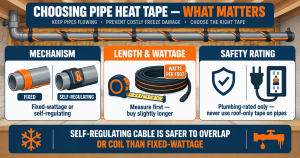
Match wattage per foot to your climate. Roughly 5 watts per foot is standard for typical winters and indoor or crawlspace pipe; step up to around 7 watts per foot for larger metal pipe, long exterior runs, or regions with sustained sub-zero cold. More wattage is not automatically better — it draws more power all season. Self-regulating cable is the more forgiving choice because it tolerates the overlap and coiling that real pipe geometry forces on you; fixed-wattage cable is cheaper but unforgiving of mistakes. Our comparison of pipe insulation foam vs heat tape covers that distinction and the underlying mechanism in full.
One safety rule has no exceptions: use only cable specifically rated for water pipes. Roof and gutter de-icing cables look similar and are sold on the same shelf, but they are not interchangeable, and a gutter-only product on a water line is a fire risk. Finally, cover the finished cable with foam pipe insulation — our roundup of the 5 best pipe insulation products covers pairing the two, which lets the cable cycle less and run at a lower wattage.
Need a Professional Plumber?
Running a plug-in heat cable is a reasonable DIY job, but a hard-wired cable, a 240-volt run, or a pipe that has already frozen and may be cracked is worth a professional’s eyes. Search PlumberArchive.com — the US plumber directory with 12,151+ verified local plumbers across all 50 states.
Find a trusted plumber near you → PlumberArchive.com
Frequently Asked Questions
Q: Can I leave heat tape plugged in all winter?
Yes — that is how it is designed to work. Every cable in this roundup has a thermostat, built into the plug or inline, that keeps it off until the pipe approaches freezing, so leaving it plugged in for the season does not mean it heats continuously. What you should not do is leave it energized year-round: unplug it in spring, inspect the jacket for cracks each fall before plugging it back in, and never run a cable that is cut, cracked, or “repaired” with tape.
Q: Is self-regulating heat tape safer than fixed-wattage?
Self-regulating cable is more forgiving. Because its output drops as it warms and it has no fixed hot spots, it can safely touch or cross itself, which removes the most common fixed-wattage mistake — overlapping the cable and creating a spot that overheats. Fixed-wattage cable is not unsafe when it is installed correctly in a single, non-overlapping pass, and it costs less, but it leaves less room for error. Our foam vs heat tape comparison goes deeper on how the two designs differ.
Q: Can heat tape be used with pipe insulation together?
Not only can you, you generally should. The standard method is to run the heat cable along the pipe, secure it with the supplied foil tape, then cover the pipe and cable with foam insulation. The foam holds the cable’s heat against the pipe instead of letting it escape into the air, so the cable cycles less and can run at a lower wattage. Use foam sleeves one size larger than the pipe so they fit over the added thickness of the cable — our 5 best pipe insulation products roundup covers sizing.
Q: What size and wattage do I need for my climate?
Measure the pipe run and buy a cable a little longer so you can spiral it rather than stretch it. For wattage: in a temperate-winter region protecting indoor, basement, or crawlspace pipe, roughly 5 watts per foot of self-regulating cable is enough. For larger metal pipe, long exterior or well-line runs, or areas that see sustained sub-zero temperatures, step up to around 7 watts per foot. If you are not sure you need cable at all rather than foam insulation alone, our pipe insulation foam vs heat tape comparison walks through that decision.
Conclusion — Which Heat Cable Should You Buy?
For most homeowners protecting a reachable pipe in a crawlspace, basement, or garage, the Frost King HC series is the one to buy: it is inexpensive, stocked nearly everywhere, and its pre-attached plug and built-in thermostat make installation genuinely plug-and-play. It is the only cable here carrying our Best Overall badge.
Step up to the HEATIT self-regulating cable if your pipe geometry forces you to coil or overlap it, or you want lower seasonal running cost. The MAXKOSKO self-regulating cable delivers most of that benefit, plus a handy power indicator light, at a lower price. For a permanent install you would rather not revisit, the Radiant Solutions HeatTapePro and its 10-year warranty justify the premium, and for long runs or severe-cold climates the higher-output HEATIT HISD gives the extra thermal margin. Whichever you choose, pair it with foam insulation and confirm the cable is rated for water pipes — our foam vs heat tape comparison and frozen pipe prevention guide cover fitting it into a complete winterizing plan.
Prices and ratings may change. Always check Amazon for current prices.
✍️ About This Review
PTR Editorial Team — Product Reviews. We compare manufacturer specifications, installation requirements, compatibility and available product documentation to help homeowners choose suitable tools and parts. How we review →