Please note: Information in this comparison is based on our research at time of writing and is general in nature. Sink performance varies by brand, gauge, and specific model — always check the manufacturer’s care and warranty guidance for the exact sink you are considering before buying.
Introduction
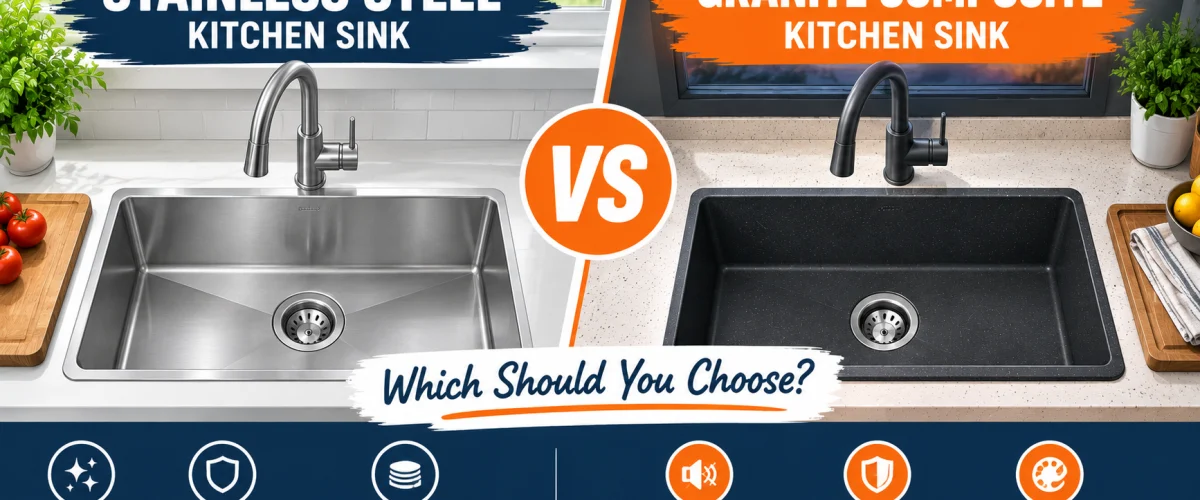
Stainless steel and granite composite are the two materials that dominate the modern kitchen sink market, and between them they account for the large majority of drop-in and undermount sinks sold today. Both are genuinely good choices, which is what makes the decision hard: there is no version of this comparison where one material turns out to be a mistake. Instead, the two trade strengths across the factors that matter day to day — how well the surface resists dents and scratches, how it handles a hot pan off the burner, how loud it is when water and dishes hit it, how much attention it needs to look clean, and how many color options you get to pick from. Price matters too, though the ranges overlap more than most buyers expect. This guide works through each factor so you can match the material to how you actually use your kitchen, rather than treating one as objectively better. Once you’ve settled on a material, our how to measure and choose a replacement kitchen sink guide covers fitting the new sink to your existing countertop cutout.
At a Glance
Stainless Steel
- Material composition: rolled sheet steel alloyed with chromium and nickel (often labeled 304 or 18/10), typically 16- to 18-gauge — the lower the gauge number, the thicker the steel
- Durability / scratch resistance: extremely tough and effectively unbreakable, but the brushed finish shows fine scratches and can dent under a hard, direct impact
- Heat resistance: very good in normal use; discoloration or warping is possible only under rare, extreme direct heat, such as a pan left glowing from an empty burner
- Noise level: naturally the louder of the two; quality sinks counter this with thick sound-dampening pads and a spray-on undercoating, without which water and dishes ring noticeably
- Maintenance / cleaning: wipes clean quickly and never stains, but shows water spots, fingerprints, and streaks, especially on a mirror or bright finish
- Color / finish options: silver and steel tones only — brushed, satin, or (less commonly) a dark PVD coating; no true color choice
- Typical price range: $ to $$, with premium heavy-gauge and workstation models reaching higher
Granite Composite
- Material composition: roughly 80% crushed natural quartz or granite stone blended with an acrylic resin binder, then molded into a solid, single-piece bowl with color running all the way through
- Durability / scratch resistance: resists surface scratches and abrasion very well and will not dent, but a hard strike on a corner or rim can chip the material
- Heat resistance: generally handles hot pots and pans better in everyday use; most makers still rate it to a specific temperature and advise against sustained extreme heat
- Noise level: naturally quiet thanks to the material’s mass and density; dishes and running water land with a dull thud rather than a ring, even without added pads
- Maintenance / cleaning: hides water spots and crumbs well between cleanings, but lighter colors can stain or develop a dull film over time without occasional deeper care
- Color / finish options: a real differentiator — black, white, several grays, beige, and brand-specific tones, all with a consistent matte look
- Typical price range: $$ for most sizes, broadly comparable to a mid-grade stainless sink; large or designer colors run higher
What Each Material Actually Is
A stainless steel sink is formed from a single rolled sheet of steel alloyed with chromium and nickel — the chromium makes it “stainless” by forming an invisible, self-repairing oxide layer that resists rust, and the nickel adds corrosion resistance and a warmer tone. Most quality sinks are marketed as 304-grade or 18/10. The number that matters more in use is the gauge, or thickness: 16-gauge is thicker and more rigid than 18-gauge, and thicker steel flexes less underfoot, resonates less, and shrugs off dents more readily. Thinner steel than that starts to feel tinny and oil-cans when you press on the bottom. The surface is almost always a brushed or satin finish, which scatters light, hides minor marks better than a mirror polish, and is easy to blend if it gets scratched.
Granite composite — sometimes sold as quartz composite or simply “granite” — is not natural stone at all. It is an engineered material: crushed quartz or granite particles, usually around 80% of the mix by weight, bound in an acrylic or polyester resin. The blend is molded under heat and pressure into one seamless piece, so the color runs all the way through rather than sitting on the surface as a coating — which is why a deep scratch on composite is far less visible than a chip in an enameled sink. The stone content also gives the material its heft, its muted acoustics, and its resistance to everyday abrasion.
Durability and Scratch Resistance
Both materials last for decades, but they wear in different ways — each resists the kind of damage the other is prone to. Stainless steel is close to indestructible structurally: you cannot crack it, chip it, or break a corner off, and it tolerates thermal shock, dropped cast iron, and heavy daily use without any risk of catastrophic failure. Its weakness is cosmetic. The brushed finish picks up fine swirl marks from pots, cutlery, cleaning pads, and grit in the bowl, and over years those blend into a soft patina that many owners stop noticing and some actively like. A hard, concentrated impact can also leave a small dent in thinner gauges. Neither affects function, and light scratches can often be minimized by rubbing along the grain with a non-abrasive stainless cleaner.
Granite composite takes the opposite trade. Its surface is genuinely hard and resists the scratching and scuffing stainless shows, so it looks newer for longer under normal dish duty, and it will never dent. What it can do — rarely, but this is the failure mode to know about — is chip if a heavy, hard object like a cast iron pan is dropped squarely onto an edge or the rim. A chip on solid-color composite is less conspicuous than one in a coated finish, since the material is the same color underneath, but it is still permanent. The most effective protection for either material is a bottom grid that keeps cookware off the sink floor; our roundup of the 5 best kitchen sink bottom grids & protectors covers sizing one to your bowl and drain position so it actually shields the high-wear zones.
Heat Resistance
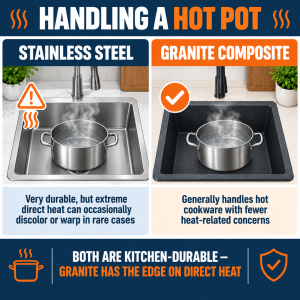
This is one of the few factors with a fairly clear edge, and it goes to granite composite. Because the material is mostly stone bound in a heat-cured resin, it absorbs and dissipates the heat from a hot pot or a stream of boiling pasta water without drama, and most manufacturers publish a temperature rating — commonly a few hundred degrees Fahrenheit — that comfortably covers anything off a normal stovetop. Setting a pan of just-drained potatoes in the bowl for a minute is a non-issue.
Stainless steel is also fine for the vast majority of real-world heat — hot water, hot pans off a burner, and draining boiling liquids will not hurt it. The rare failure case is extreme, sustained direct heat: a pan left on the sink base still glowing from a dry burner. Thin stainless can then discolor into a bluish or straw-colored heat tint and, in severe cases, warp slightly, because the steel conducts heat rapidly into a small area. Neither material is meant as a landing pad for cookware still actively hot from a high flame, so the advice is the same for both: use a trivet or the bottom grid for anything above warm to the touch.
Noise and Vibration
Noise is where the two materials feel most different in a showroom, and where a lot of buyers form a first impression. Stainless steel is a thin, rigid membrane, so by nature it rings: water from the faucet drums on the bottom, a dropped fork clatters, and the garbage disposal transmits a metallic buzz through the whole bowl. Manufacturers have gotten very good at managing this. A quality stainless sink today comes with thick rubberized sound-dampening pads over most of each bowl’s underside and, on better models, a full spray-on undercoat that fills the gaps — the combination some brands market as NoiseDefend. With generous pads plus an undercoat, a modern 16-gauge stainless sink is far quieter than the bare bargain sinks that gave the material its reputation, though it still will not match composite. Our roundup of the 4 best kitchen sinks notes which stainless models pair heavy pads with a complete undercoat rather than a few thin patches, which is the detail that separates a quiet stainless sink from a noisy one.
Granite composite starts quiet and needs no help to get there. The material is dense and massive — a composite sink weighs noticeably more than a stainless one of the same size — and that mass absorbs vibration instead of transmitting it. Running water lands with a soft, low thud, dropped utensils do not ring, and disposal noise is muffled by the thick walls. If a near-silent sink is high on your list and you would rather not depend on how well a particular stainless model is padded, composite gives you that for free.
Maintenance and Cleaning
Day-to-day cleaning is easy on both, but they ask for slightly different habits. Stainless steel never stains or absorbs anything and wipes down in seconds with dish soap or a stainless spray. Its quirk is showing everything in the moment: water spots as droplets dry, fingerprints and streaks around the rim, a hazy film from hard water. None of it is damage and all of it wipes away, but a stainless sink looks its best only just after it is dried, so a quick towel pass after the last wash of the night makes a visible difference. Avoid leaving steel wool, cast iron, or steel cans sitting wet in the bowl — they can leave rust specks that transferred from the other metal rather than the sink itself.
Granite composite is more forgiving between cleanings — its matte, mottled surface hides water spots, crumbs, and coffee splashes, so it looks tidy with less attention. The trade-off is longer term, especially on white and light gray sinks: hard water, tea, wine, and tomato sauces can gradually leave a dull film or faint staining if left to sit and dry repeatedly. The fix is routine — a periodic scrub with a mild abrasive or baking soda paste, and an occasional wipe of mineral oil on a dark sink to even the finish. Darker colors are very low maintenance; the lightest ones reward more diligence. On either material, the drain basket strainer is a wear item worth matching properly, since a poor fit traps grime and can mark the opening; our guide to the 5 best kitchen sink strainers & baskets covers fitting one to a standard opening in either material.
Color and Aesthetic Options
If the look of the sink is part of the decision, this factor may settle it, because only one of the two gives you a real choice. Stainless steel comes in stainless steel. Finish varies — near-mirror polish, soft satin, coarser brushed grain, and a growing number of matte black or gunmetal sinks with a PVD coating over the steel — but the palette is silver and gray metal tones, and the dark coated options are a smaller, pricier niche. For many kitchens that is exactly right: stainless is visually neutral, pairs with any countertop and cabinet, and reads as clean and professional.
Granite composite is where color becomes a design tool. Black is the signature and by far the most common — striking against light quartz or butcher block — but white, several grays, tan, and brown are all standard options, and some brands offer their own named tones. The finish is a consistent matte across every color, which suits contemporary and transitional kitchens. A black or white composite sink can be a deliberate accent that ties into cabinet hardware or a range, whereas a stainless sink is almost always meant to recede. If you want the sink to make a statement, or simply to not be silver, composite is the only one of the two that can do it.
Cost Comparison
The pricing surprises people who assume composite is the luxury option; in practice the two overlap heavily. Stainless steel spans the widest range of any sink material: genuinely cheap thin-gauge drop-ins at the bottom, a large competitive middle band of well-built 16- to 18-gauge undermounts, and a premium tier of heavy-gauge workstation sinks that sits well above most composite pricing. Granite composite has a narrower spread. It rarely gets as cheap as budget stainless, but a standard-size composite sink in a common color typically lands in the same mid-range territory as a good mid-grade stainless sink, not above it.
Composite creeps up with oversized models, designer colors, and certain premium brands; stainless creeps up with thick gauge, large radius-corner bowls, and full workstation setups with cutting boards and racks. For a typical remodel — a 30- or 33-inch bowl in a mainstream configuration — you can budget roughly the same either way and choose on the other factors in this guide. Neither material forces a price compromise at the sizes most kitchens actually use.
Which Should You Choose?
There is no universal winner — the right pick depends on which factors you weight most heavily and how you work in your kitchen. The table below maps the most common situations to the material that tends to serve each one better.
| Your Situation |
Better Choice |
| You want the quietest sink possible and would rather not depend on how well a particular model is padded |
Granite composite — quiet as a property of the material, no undercoating required |
| You cook with heavy cast iron and frequently set hot pans and drain boiling water in the sink |
Granite composite for the higher everyday heat tolerance — but still use a trivet or grid for anything stovetop-hot |
| You want a sink color other than silver — black, white, or gray to match the kitchen |
Granite composite — the only one of the two with a real color range |
| You want the fastest, lowest-effort cleaning and don’t mind wiping the bowl dry after use |
Stainless steel — wipes clean in seconds and nothing can stain it |
| Budget-conscious standard remodel and you want a proven, easy-to-source workhorse |
Stainless steel — widest range of well-priced options and the most replacement choices later |
| You want maximum long-term durability with no visible wear |
Either — decide by the failure you’d rather avoid: fine scratches and a soft patina (stainless) or a rare edge chip from a hard drop (composite) |
✏️ Our Take
This is a genuine preference-and-use-case decision, not a case of one material being universally superior. Stainless steel is the structurally tougher choice, cleans fastest, offers the widest price range, and never stains — at the cost of showing scratches and water spots and needing good sound-dampening to stay quiet. Granite composite is naturally quiet, handles everyday heat a little better, hides marks between cleanings, and comes in real colors — at the cost of a small chip risk on a hard impact and more care on light bowls. Pick the one whose weak points you can live with, buy a heavy gauge or a reputable composite brand either way, and add a bottom grid. Both will still be in service in twenty years.
Prices and ratings may change. Always check Amazon for current prices.
Need a Professional Plumber?
If a sink swap also means moving the drain, reworking the disposal connection, or cutting a countertop for a different bowl size, and you would rather not tackle it yourself, search PlumberArchive.com — the US plumber directory with 12,151+ verified local plumbers across all 50 states.
Find a trusted plumber near you → PlumberArchive.com
Conclusion
Stainless steel and granite composite are the two default kitchen sink materials because both are, genuinely, hard to go wrong with. Stainless is the structurally tougher, faster-cleaning, more price-flexible option that shows its age as scratches and spots; granite composite is the quieter, more heat-tolerant, color-flexible option that hides wear but carries a small chip risk and needs more care on light colors. Match the material to your own priorities — noise, heat, cleaning habits, color, budget — rather than looking for a verdict that one is better in the abstract, because there isn’t one. To see how specific models stack up in each material, our roundup of the 4 best kitchen sinks compares gauge, sound-dampening, bowl configuration, and finish across stainless and composite picks.
✍️ About This Comparison
PTR Editorial Team — Product Comparisons. We compare manufacturer specifications, installation requirements, compatibility and available product documentation to help homeowners choose suitable tools and parts. How we review →