Comparisons
20 Sep 2026

Utility Pump vs. Sump Pump (2026) — Which Do You Need?
Utility pump vs sump pump: one is portable for occasional jobs, the other a permanent install for ongoing water. See which your basement needs.
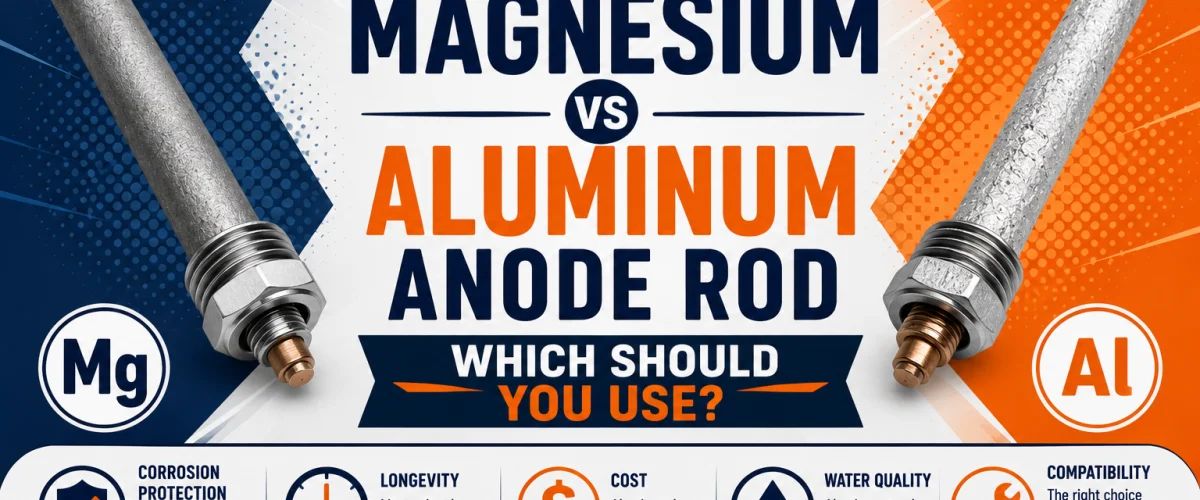
Magnesium or aluminum — which anode rod material actually protects your water heater tank longer? We compare lifespan, water compatibility, and cost.
Please note: Information in this comparison is based on our research at time of writing and is subject to change. Always confirm your specific tank’s anode rod specifications before purchasing a replacement.
Magnesium and aluminum anode rods do the exact same fundamental job inside a water heater tank: they sacrifice themselves to corrosion through electrolysis so the tank’s steel lining doesn’t have to. Both materials are more reactive than steel, which means they corrode first and protect the tank as a byproduct. On paper, that makes them interchangeable — but in practice, the right choice depends heavily on your home’s specific water chemistry, not a simple “which is better” answer that applies to every household equally.
This comparison covers how each material behaves differently once installed, why one is far more likely than the other to cause a rotten-egg smell in certain homes, and how lifespan and cost factor into the decision. If you haven’t yet picked a specific rod to install, our water heater anode rods review covers current options in more depth than fits here.
At a Glance
Magnesium Anode Rod
Aluminum Anode Rod
✏️ Our Take
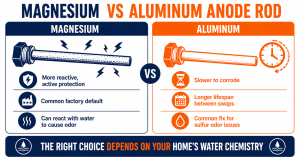
Both magnesium and aluminum anode rods do the same job — sacrificing themselves to corrosion so your water heater’s steel tank doesn’t have to — but they behave differently in the process, and your home’s specific water chemistry matters more here than a generic recommendation. Magnesium is the more common factory-installed default and tends to protect the tank more actively, but it’s also the material most likely to react with certain water conditions and produce a sulfur-like odor. Aluminum corrodes more slowly, lasts longer between replacements, and is often the better choice specifically when odor has been a recurring problem — but it isn’t automatically the superior choice for every home.
IN THIS GUIDE
The table below maps the most common decision factors to whichever material actually wins on that point, based on everything covered in this comparison.
| Factor | Winner |
|---|---|
| Most active tank protection | MAGNESIUM |
| Longer lifespan between replacements | ALUMINUM |
| Better for sulfur/rotten-egg odor issues | ALUMINUM |
| Lower material cost | ALUMINUM |
| Standard factory-installed default | MAGNESIUM |
| Better fit for hard water conditions | ALUMINUM |
| Reasonable default with no known odor issues | MAGNESIUM |
Every standard tank-style water heater relies on a principle called sacrificial anode protection to keep its steel tank from corroding. The anode rod is a metal rod, more reactive than steel, that’s suspended inside the tank and submerged in the same water the tank holds. Through a process called electrolysis, the more reactive metal — magnesium or aluminum — corrodes preferentially, essentially sacrificing itself so that the steel lining of the tank stays intact instead.
Without an anode rod at all, or with one that’s fully corroded away, the tank’s own steel becomes the next most reactive metal in the water, and it begins corroding in the rod’s place. This is why every standard tank water heater ships with one installed from the factory — it’s not an optional accessory, it’s a core part of how the tank is designed to survive years of holding water without rusting through from the inside.
Because the rod is designed to be consumed over time, it needs periodic inspection and eventual replacement — typically every few years, though the exact interval depends heavily on water usage, water chemistry, and which material is installed. A rod that’s mostly or fully dissolved has stopped protecting the tank, even though the water heater itself will keep running normally with no obvious symptom until the tank itself starts corroding.
Magnesium is the material most water heater manufacturers install as the factory default, and for most households it remains the reasonable starting point. Magnesium is more electrochemically reactive than aluminum, which means it corrodes more readily and, as a direct result, provides more active protection to the tank’s steel lining. In water conditions without any complicating factors, this makes magnesium the more effective protector on a straightforward, apples-to-apples basis.
That same reactivity is also magnesium’s tradeoff. Because it corrodes faster than aluminum, a magnesium rod typically has a shorter usable lifespan before it needs replacing — it’s doing more active work, so it’s consumed more quickly in the process. For most homes, that simply means checking and replacing the rod somewhat more often than an aluminum rod would require, which isn’t a major downside on its own.
The more significant consideration is that magnesium can react with certain water conditions — particularly water containing sulfate-reducing bacteria — to produce a distinct rotten-egg odor in the hot water supply. This reaction doesn’t happen in every home; it depends on the specific bacteria and mineral content present in the water supply, which varies widely by location and water source. When it does happen, though, it’s a well-documented and specifically identifiable cause, and switching away from magnesium is the standard fix, covered in more detail in the sections below.
Aluminum anode rods trade some of magnesium’s active protection for a notably slower corrosion rate. Because aluminum is less reactive, it dissolves more gradually inside the tank, which generally translates to a longer usable lifespan between replacements compared to magnesium under similar water conditions. For homeowners who’d rather check and swap the rod less frequently, that slower corrosion rate is a genuine practical advantage.
Aluminum’s more common role, though, is as a direct fix rather than a first choice. When a magnesium rod has caused a sulfur-like odor in a home’s hot water, swapping it for an aluminum rod is the standard, widely recommended solution, since aluminum is far less likely to trigger the same bacterial reaction. It’s a like-for-like physical swap in most tanks, requiring no other changes to the water heater itself.
Aluminum rods are also generally the lower-cost material of the two, which adds a modest cost advantage on top of the longer replacement interval. One point worth a brief mention for reassurance: older guidance sometimes raised concerns about lead content in aluminum anode rods, but modern aluminum anode rods sold in the US are lead-free and manufactured to current plumbing and water-safety standards. This isn’t a meaningful concern with any current product on the market, just a historical footnote worth clearing up.
The rotten-egg smell associated with some water heaters isn’t caused by the water heater malfunctioning — it’s a specific chemical reaction between the anode rod material, naturally occurring sulfate-reducing bacteria, and sulfate present in the water supply. These bacteria convert sulfate into hydrogen sulfide gas, which is what produces the distinctive rotten-egg odor, and the reaction is significantly more likely to occur with a magnesium anode rod than with aluminum because of magnesium’s higher reactivity.
This issue shows up disproportionately in homes on private well water rather than municipal water supply, since well water is more likely to naturally contain the specific bacteria responsible for the reaction. It’s also more common in water with higher sulfate content generally, regardless of the water source. Importantly, the smell typically shows up only in hot water — if cold water from the same tap doesn’t have the same odor, that’s a strong indicator the anode rod, not a broader water quality issue, is the cause.
Switching from magnesium to aluminum is the standard, well-established fix for this specific problem, and it resolves the odor for the large majority of affected households. If the smell persists even after switching to aluminum, a zinc-alloy rod is sometimes used as a further step, discussed briefly in the decision section below.
Magnesium’s faster corrosion rate means it typically needs replacement somewhat more frequently than aluminum under comparable water conditions and usage patterns. Exactly how often either material needs replacing varies significantly based on water hardness, household water usage, and tank size, which is why periodic inspection matters more than following a fixed calendar interval blindly.
Aluminum’s slower corrosion generally means longer stretches between replacements, which combined with its typically lower material cost makes it the more budget-friendly option over the tank’s lifetime in households where odor isn’t a factor either way. That said, both materials are genuinely inexpensive parts — priced at the $ tier in nearly every case — relative to the cost of a full tank replacement caused by years of unprotected corrosion.
Given how inexpensive either material is compared to a premature tank failure, the anode rod is one of the lowest-cost, highest-value maintenance items on the entire water heater. If it’s been several years since your tank was last serviced, our how to flush a water heater guide is a natural companion task to check the anode rod’s condition at the same time, since both involve accessing the top of the tank.
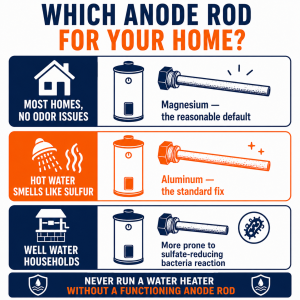
For most homes with no history of odor problems, magnesium remains the reasonable default. It provides more active protection, it’s what most tanks ship with from the factory, and there’s no reason to switch away from it preemptively if your water hasn’t caused any issues. If you’re installing a replacement rod in a tank that’s never had an odor problem, sticking with magnesium is a perfectly sound choice.
Choose aluminum as the direct fix if you already have a sulfur or rotten-egg odor problem, or if your household is on well water and you’d rather avoid the risk of that reaction altogether from the start. Aluminum’s slower corrosion and lower likelihood of triggering the bacterial reaction make it the more defensive choice specifically for households where water chemistry is a known or likely concern.
For the smaller number of households where an aluminum rod alone doesn’t fully resolve a persistent odor, some homeowners switch further to a zinc-alloy anode rod, which combines aluminum with a small amount of zinc specifically to further suppress the bacterial reaction responsible for the smell. This is a reasonable next step rather than a starting recommendation, and it’s worth trying aluminum first in nearly every case before considering it.
Anode rod material choice is especially relevant for the large share of US households on private well water rather than municipal supply, since well water is more likely to contain the sulfate-reducing bacteria responsible for the classic rotten-egg smell. Homeowners on municipal water in most US cities are less likely to encounter this issue with a standard magnesium rod, but it can still occur depending on local water treatment and mineral content.
If you’re not sure which anode rod material is currently installed, or your tank shows signs of corrosion beyond a simple rod swap, search PlumberArchive.com — the US plumber directory with 12,000+ verified local plumbers across all 50 states.
Get weekly plumbing tips and DIY guides delivered straight to your Facebook feed.
Check your water heater’s manual or the manufacturer’s specification sheet, which typically lists the anode rod material installed from the factory — usually magnesium unless the manufacturer specifically notes otherwise. If you don’t have the documentation, the rod itself is usually accessible from a hex-head fitting on top of the tank and can be visually inspected once removed, though this does require briefly draining water below the fitting first.
In the large majority of cases, yes. Switching from a magnesium rod to an aluminum rod resolves the odor for most affected households, since aluminum is significantly less likely to trigger the bacterial reaction responsible for the smell. If the odor persists after switching to aluminum, a zinc-alloy rod is a reasonable next step, though this is less commonly needed.
Most manufacturers recommend inspecting the rod every couple of years, though the actual replacement interval depends heavily on water usage and water hardness. A rod that’s more than 50 percent consumed, visibly reduced to a thin wire core, or coated in heavy calcium buildup should be replaced regardless of how long it’s been installed, rather than waiting for a fixed interval to pass.
Yes. Modern aluminum anode rods sold in the US are manufactured to current plumbing and water-safety standards and are lead-free, addressing an older concern that doesn’t apply to current products. Aluminum anode rods are a standard, widely used option in residential water heaters across the country with no meaningful safety concern for drinking water use.
Magnesium and aluminum anode rods protect your water heater the same fundamental way, but they’re not interchangeable defaults — magnesium offers more active protection and remains the reasonable starting point for most homes, while aluminum trades some of that active protection for a longer lifespan and a far lower chance of causing a sulfur odor. The right choice comes down to your household’s water chemistry more than a generic recommendation either way.
If you’ve never had an odor issue, stick with magnesium. If you’re on well water or already dealing with a rotten-egg smell, switch to aluminum as your first step. For a closer look at specific replacement rods, see our water heater anode rods review, and if you’re shopping for a new tank altogether, our water heater sizing guide covers how to choose the right capacity for your home.
Prices and ratings may change. Always check Amazon for current prices.
✍️ About This Comparison
Written by Sarah Mitchell, Home Improvement Editor at PlumbingToolsReview — specializing in helping homeowners make smart buying decisions without overspending. Learn how we test →
Utility pump vs sump pump: one is portable for occasional jobs, the other a permanent install for ongoing water. See which your basement needs.
Pipe repair clamp, tape, or epoxy — which should you use for a leaking pipe? Compare how each works, durability, and when to reach for which.
Not sure if your home has a septic tank or a sewer connection? Learn how to tell which one you have, plus the maintenance and cost differences.

