Reviews
23 Sep 2026

5 Best Natural Gas & Propane Leak Detectors (2026) — Expert Reviews
Compare 5 top natural gas & propane leak detectors for 2026 — plug-in alarms vs handheld sniffers, tested for accuracy, price and home safety.
5 best water heater anode rods (2026) — expert reviews covering magnesium, aluminum zinc and powered titanium rods for US tank water heaters.

Please note: Product availability and information are based on our research at time of writing and are subject to change. Always check Amazon for the latest details before purchasing.
The anode rod is the single most important component most water heater owners never think about. It’s a metal rod suspended inside your tank that slowly corrodes over time — by design — so the tank walls don’t. When the rod is fully consumed, corrosion shifts to the tank itself and the clock starts on an early failure. Most manufacturers recommend checking it every two to three years, but the majority of US homeowners never inspect theirs until the tank is already leaking and beyond saving.
This review covers five of the best water heater anode rods available in 2026 — from straightforward magnesium replacements for standard tanks through to a powered titanium option that eliminates the replacement cycle entirely. If you’re also looking to extend your water heater’s life through sediment removal, our guide to the best water heater flush tools covers that side of the maintenance picture. And if you’re unsure whether your current tank is worth maintaining or nearing the end of its life, our guide to the signs your water heater is failing is worth reviewing alongside this one.
✏️ Our Take
An anode rod is the cheapest insurance policy your water heater has — it sacrifices itself to corrosion so your tank doesn’t have to. Most homeowners never check theirs until the tank starts leaking, by which point it’s too late. A magnesium rod works for most homes, but if your hot water smells like sulfur, switching to an aluminum zinc rod often solves it completely. Check yours every 2–3 years — it’s a 20-minute job that can add years to your tank’s life.
IN THIS GUIDE
| Product | Rating | Best For | Price |
|---|---|---|---|
| 44″ Flexible Magnesium Anode Rod (Universal) BEST OVERALL |
★★★★★ | Most US tank water heaters — complete kit | $ |
| Ozek 44″ Magnesium Flexible Anode Rod | ★★★★☆ | Standard tank replacement, budget option | $ |
| Aluminum Zinc Anode Rod Plus Removal Kit | ★★★★☆ | Sulfur smell / rotten egg odor fix | $ |
| Eastman 42″ Flexible Magnesium Anode Rod | ★★★★★ | Premium magnesium, established brand | $$ |
| Briidea Powered Anode Rod (Titanium) | ★★★★☆ | Long-term no-replacement protection | $$$ |
🏆 Best Overall
This 44-inch flexible magnesium anode rod stands out from the field by being genuinely universal — compatible with GE, Rheem, Reliance, Richmond, and Kenmore water heaters, which together cover a large share of the residential tank water heater market in the US. The flexible design is a practical advantage in the real world: most water heater tanks sit in tight spaces where clearance above the unit is limited, and a rigid rod often can’t be removed or installed without tilting the tank or working in an impossibly confined space. The flexible construction bends to allow installation through a low overhead gap without that problem.
What elevates this to best overall is that it arrives as a complete package — the 1-1/16″ hex socket installation tool and Teflon tape are included, which means no extra trip to the hardware store before you can start. If you’re unsure whether your tank is still worth protecting, our guide to the signs your water heater is failing covers what to look for before investing in a replacement rod.
✓ Pros
Flexible design allows installation in tight overhead spaces common in basements and closets
Compatible with 5 major US brands removes guesswork at point of purchase
Includes installation tool and tape — no extra purchases needed before starting
✗ Cons
Magnesium rods wear faster in softened water — check compatibility if you have a water softener
Standard 44-inch length may need cutting for shorter tank installations
⭐ Top Pick
The Ozek 44-inch flexible magnesium anode rod earns its top pick position through solid build quality and a no-frills approach to the job. The flexible magnesium construction handles the real-world challenge of tight installation spaces just as well as the best overall option, making it a strong alternative for homeowners who already own the necessary hex socket tool and don’t need the bundled kit of the number one pick.
Where this rod fits best is as a straightforward like-for-like replacement for homeowners who are on a regular inspection and maintenance schedule and simply need a reliable magnesium rod at the $ price tier without paying for included accessories they don’t need. The single-rod design with no extra components to track keeps the job simple — insert the rod, apply Teflon tape to the threads, torque to spec, and you’re done.
✓ Pros
Flexible magnesium construction handles tight installation spaces well
Straightforward single-rod design with no extra parts to track
Reliable option for standard residential tank replacement at the $ price tier
✗ Cons
Does not include installation tools — budget for a separate hex socket if you don’t already own one
Magnesium only — no aluminum zinc option for homeowners dealing with sulfur smell issues
🎯 Staff Pick
Odor Solution
If your hot water smells like sulfur or rotten eggs, this is the rod to reach for first. That odor is produced by a chemical reaction between sulfur compounds in the water and a magnesium anode rod — switching to an aluminum zinc rod interrupts that reaction at the source and is the correct fix recommended by most water heater manufacturers.
What distinguishes this option beyond the rod material is the included removal and installation kit — stainless steel connectors, flexible design, and all the hardware needed to remove the old rod and fit the new one without separate purchases. For a homeowner dealing with both the odor problem and a first-time anode rod replacement, having a complete kit removes all the guesswork about what tools and tape are needed.
✓ Pros
Aluminum zinc composition directly targets the sulfur smell that magnesium rods can worsen
Includes full removal and installation kit — no extra purchases needed
Stainless steel connectors add durability beyond the rod itself
✗ Cons
Aluminum zinc rods may not last as long as magnesium in some water conditions
Higher price point than basic magnesium-only options at the same $ tier
💰 Premium Pick
Established Brand
Eastman is one of the most established names in US residential plumbing supply — their products are stocked in major hardware chains nationwide and carry a brand reputation built over decades of professional and consumer use. The 42-inch flexible magnesium rod with stainless steel nipple and chrome finish reflects that quality focus: the stainless nipple adds corrosion resistance at the connection point that outlasts a standard zinc or steel nipple, and the chrome finish signals the premium tier this product occupies.
The 42-inch length rather than the standard 44-inch is a practical advantage for tanks where the full 44 inches would require modification — it fits a wider range of tank heights cleanly without needing to cut the rod down before installation. This is the anode rod for homeowners who want the confidence of a well-known brand and are willing to pay a modest premium for it.
✓ Pros
Eastman is an established and trusted plumbing brand with a proven reputation for quality
Stainless steel nipple with chrome finish adds corrosion resistance beyond the rod itself
42-inch length fits a wider range of tank heights without modification
✗ Cons
Premium pricing compared to the generic magnesium alternatives in this roundup
No installation tool included at this price point — hex socket must be sourced separately
🛒 Check Price on Amazon — $$ →
👷 Pro Choice
Professional Grade
The Briidea powered anode rod represents a fundamentally different approach to tank corrosion protection. Where every other rod in this roundup is a sacrificial anode — a material that physically corrodes over time and must eventually be replaced — a powered titanium rod uses a small electrical current to provide corrosion protection without any physical wear on the rod itself. Titanium doesn’t sacrifice; it actively generates the protective current. The result is a rod that never needs physical replacement for the life of the water heater.
The practical case for powered over sacrificial comes down to long-term cost and maintenance. Over a 10-15 year tank lifespan, a traditional anode rod typically needs replacing two or more times — each time requiring the inspection, purchase, and installation cycle. A powered rod eliminates all of that recurring work and cost beyond the initial installation. With a compatible range of 40 to 89 gallon tanks covering the full span of standard US residential water heaters, and the added benefit of active limescale reduction alongside corrosion protection, this is the pro-grade long-term solution for homeowners who want to set and forget their tank protection.
✓ Pros
Titanium powered design never needs physical replacement like traditional sacrificial rods
Actively reduces limescale buildup in addition to standard corrosion protection
Fits 40–89 gallon tanks — covers the full range of US residential water heaters
Eliminates recurring cost and effort of replacement rods over the tank’s lifetime
✗ Cons
Significantly higher upfront cost than traditional sacrificial anode rods
Requires a power source and ongoing electricity rather than passive protection
🛒 Check Price on Amazon — $$$ →
What Does an Anode Rod Actually Do?
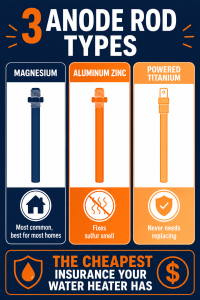
A water heater tank is a large vessel of steel in constant contact with water — a combination that would corrode rapidly without intervention. The anode rod is a long metal rod threaded into the top of the tank that uses a process called galvanic corrosion to its advantage: by placing a more reactive metal (magnesium or aluminum zinc) in the same water as the steel tank, corrosion preferentially attacks the rod rather than the tank walls. The rod corrodes slowly over time; the tank stays protected.
When the rod is fully consumed — which takes roughly four to six years under normal conditions, though this varies significantly by water chemistry — there’s nothing left to sacrifice and corrosion shifts to the tank itself. A failed anode rod is rarely the visible cause of a water heater failure; the rust and pitting it allows is the invisible cause that appears months or years later as a leak at the base of the tank. Checking the rod every two to three years and replacing it when it’s reduced to its steel core wire is the standard maintenance recommendation.
For a deeper side-by-side comparison of the two most common rod materials, see our full magnesium vs aluminum anode rod guide. Magnesium anode rods are the most common choice for standard US municipal water supplies. Magnesium is more reactive than aluminum, which means it provides more aggressive corrosion protection — particularly effective in cold or low-mineral water. The tradeoff is that magnesium rods wear faster than aluminum zinc alternatives, and in homes with a water softener the accelerated wear is significant enough to warrant annual rather than biennial inspection.
Aluminum zinc anode rods are the correct choice when hot water smells like sulfur or rotten eggs. The odor is produced by a reaction between sulfur-reducing bacteria, sulfur compounds in the water, and a magnesium rod. Aluminum zinc doesn’t trigger the same reaction and typically resolves the odor issue entirely when used as a replacement. Aluminum zinc rods also tend to last slightly longer than magnesium in many water conditions, though the protection level is somewhat less aggressive.
Powered titanium rods operate on a fundamentally different principle — they use impressed current from an electrical source to generate the protective charge continuously, without any physical wear on the titanium rod itself. Titanium doesn’t sacrifice; it generates. This eliminates the replacement cycle entirely but requires a power source near the water heater and carries a significantly higher upfront cost. For a new tank in a permanent home, the long-term economics can work in favor of powered protection over multiple sacrificial rod replacements.
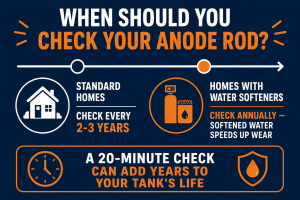
The standard recommendation is to inspect your anode rod every two to three years and replace it when it has corroded to within half an inch of its steel core wire, or when significant calcium buildup has coated the surface. A rod that’s been fully consumed — reduced to bare wire — should be replaced immediately. Most tanks that fail from internal corrosion do so because the anode rod was never checked or replaced during the tank’s operational life.
Inspection requires removing the rod, which takes a 1-1/16″ hex socket and some torque — the rod is torqued tightly at the factory and may require significant effort to break free the first time. Our step-by-step how to replace a water heater anode rod guide walks through the full process. Pairing an anode rod check with an annual sediment flush (our guide to the best water heater flush tools covers that process) makes the most of having the maintenance mindset in place for one visit rather than two.
In homes with water softeners — common in hard water states like Arizona, Texas, Nevada and parts of California — softened water accelerates magnesium anode rod consumption significantly. The ion exchange process that softens water creates conditions that are more corrosive to the rod, consuming it faster than the standard two-to-three year inspection interval assumes. Homeowners with a water softener should check their anode rod annually rather than every two to three years, or consider a powered titanium rod that doesn’t rely on sacrificial wear and is therefore unaffected by water softener chemistry.
Some water heater manufacturers specifically warn against using magnesium rods with softened water and recommend aluminum zinc instead as a slower-consuming alternative. Check your water heater manufacturer’s guidance if you have a softener — the correct rod material may already be specified in your unit’s documentation. For more on water heater sizing, maintenance intervals, and long-term planning, our water heater sizing guide covers the broader picture.
Anode rod inspection and replacement is a manageable DIY task for most homeowners, but if your tank shows signs of active corrosion, a base leak, or significant rust in the hot water, those are symptoms worth a professional assessment before investing in maintenance on a tank that may be beyond recovery. A plumber can inspect the tank condition, advise on whether maintenance makes sense, and carry out the work if needed.
Find a licensed plumber in your area at PlumberArchive.com — the US plumber directory with 12,000+ verified local plumbers across all 50 states.
Get weekly plumbing tips, honest tool reviews and DIY maintenance guides delivered straight to your Facebook feed. We cover water heater maintenance, pipe repairs, drain cleaning and everything in between — written for US homeowners who want to handle more themselves.
Inspect every two to three years and replace when the rod has corroded to within half an inch of the steel core wire, or when significant calcium deposits coat the surface. In homes with a water softener, inspect annually — softened water accelerates rod consumption significantly beyond the standard interval. In hard water states like Arizona, Texas and Nevada without a softener, the high mineral content can also wear a rod faster than average, so lean toward the two-year end of the inspection range rather than three. A rod that’s already reduced to bare wire needs immediate replacement — at that point the tank itself is unprotected and corrosion has already begun.
If only the hot water smells and the cold water does not, the source is almost certainly the anode rod reacting with sulfur-reducing bacteria and sulfur compounds in the water — a reaction that magnesium rods are particularly prone to triggering. The fix is to switch from a magnesium rod to an aluminum zinc rod, which doesn’t produce the same reaction. This is a common and well-documented problem across US water supplies, and the aluminum zinc rod swap resolves it in the large majority of cases. If both hot and cold water smell, the source is in the water supply itself and a rod change won’t help — contact your water utility.
Yes — for most homeowners this is a manageable DIY job. The process requires shutting off power or gas to the water heater, turning off the cold water supply, relieving pressure through a hot tap, and removing the old rod with a 1-1/16″ hex socket and breaker bar. The most common challenge is breaking the rod free on the first removal — factory-torqued rods can be very tight after years in place, and penetrating oil plus a long-handled breaker bar are usually enough to free them. The replacement installation is straightforward: apply Teflon tape to the new rod’s threads, thread in by hand, and torque to spec. Allow the tank to return to operating pressure and temperature before restoring power.
Once the anode rod is fully consumed, corrosion shifts directly to the steel tank walls. The process is invisible from the outside but progresses steadily — pitting and rust inside the tank weakens the wall, accumulates rust sediment at the base, and eventually produces a leak, usually at a weld point or fitting near the bottom of the tank. By the time external symptoms appear, the damage is typically too extensive to repair and a full tank replacement is required. A water heater that receives no anode rod maintenance will reliably fail earlier than a maintained unit — often by several years. The rod itself costs a fraction of a percent of the tank replacement cost; the inspection takes 20 minutes.
For most US homeowners with a standard gas or electric tank water heater, the 44″ Flexible Magnesium Anode Rod is the clear best overall choice — it covers the five most common US water heater brands, arrives with the installation tool and Teflon tape included, and does everything a standard anode rod replacement needs to do at the $ price tier.
If your hot water smells like sulfur or rotten eggs, go straight to the Aluminum Zinc Anode Rod Plus Removal Kit — the material change is the correct fix for that specific problem, and the complete kit removes the guesswork from a first-time replacement. For homeowners who want the brand reassurance of an established plumbing name, the Eastman 42″ Rod is the premium choice. And for a new tank where long-term maintenance reduction is the priority, the Briidea Powered Titanium Rod offers the most compelling set-and-forget argument once the higher upfront cost is accepted.
Whichever rod you choose, the most important step is actually checking and replacing it on schedule — the maintenance that’s never done is the one that shortens a tank’s life. Pair anode rod checks with annual sediment flushes for a complete maintenance routine: our guide to the best water heater flush tools covers that side of the work. For broader assessment of your current tank’s condition and remaining lifespan, our guide to the signs your water heater is failing covers what to watch for, and our water heater sizing guide helps with replacement planning when the time comes.
✍️ About This Review
Reviewed by James Carter, Senior Tool Reviewer at PlumbingToolsReview — 15 years of hands-on experience in residential plumbing and tool testing. Learn how we test →
Compare 5 top natural gas & propane leak detectors for 2026 — plug-in alarms vs handheld sniffers, tested for accuracy, price and home safety.
5 septic tank riser kits compared for 2026 — Tuf-Tite and Polylok risers by diameter and height, so you can bring tank access to grade level.
The 5 best sewage and effluent ejector pumps for 2026, expert-reviewed: grinder, standard solids-handling and light-duty effluent pumps compared.

