Comparisons
2 Oct 2026

Pop-Up Drain vs Grid Drain: Which Should You Choose?
Pop-up drains seal to hold water; grid drains never close but resist clogs better and cost less. Here's how to choose between them for your bathroom sink.
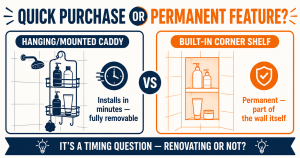
One is a quick purchase you can move whenever you like, the other is a permanent built-in feature — here's how a hanging shower caddy compares to a recessed corner shelf.

Please note: Information in this comparison is based on our research at time of writing and is general in nature. Always check specific product packaging and manufacturer claims before purchasing, and consult a contractor for renovation-specific cost estimates.
Shower storage usually gets framed as a shopping decision — which caddy to buy — but there’s actually a bigger fork in the road worth considering first. A hanging or mounted shower caddy is a low-commitment purchase: you install it today using adhesive, a tension pole, or a showerhead hook, and you can remove, replace, or reposition it anytime without touching your shower walls. A built-in corner shelf, often called a niche, is a completely different kind of decision — it’s a permanent feature framed and tiled directly into the shower wall itself, typically added during a renovation or new construction rather than dropped in on its own.
This comparison isn’t about which specific product to buy — it’s about which category of solution actually fits your situation. If you’re comparing purchasable caddy products themselves, our shower caddy reviews cover adhesive, hanging, tension pole, and suction cup options in detail — a different, narrower question from the one this article addresses, since that roundup assumes you’ve already decided on a caddy and compares specific products within that category.
At a Glance
Hanging / Mounted Caddy
Built-In Corner Shelf
✏️ Our Take
For most households, a hanging or mounted shower caddy is the practical choice — it’s inexpensive, installs in minutes, and can be replaced or repositioned anytime without any renovation work. A built-in corner shelf is worth considering specifically if you’re already renovating the shower or building new, since adding one after the fact means opening up tile work that isn’t worth doing for storage alone. This isn’t really a head-to-head of which is better — it’s a question of timing: if you’re renovating, build it in; if you’re not, a quality caddy solves the same storage need without the cost or disruption.
IN THIS GUIDE
Here’s how a hanging or mounted caddy stacks up against a built-in corner shelf on the factors that actually matter when deciding between them.
| Factor | Hanging / Mounted Caddy | Built-In Corner Shelf |
|---|---|---|
| Upfront cost | Generally low ($–$$) | Renovation-level cost |
| Installation time | Minutes, no contractor needed | Days, typically requires a contractor |
| Permanence | Fully removable or replaceable | Permanent, part of the wall structure |
| Reliability over time | Depends on mounting mechanism | No mounting mechanism to fail |
| Appearance | Visible, standalone accessory | Seamless, integrated into the wall |
| Renovation required | No | Yes, or must be part of new construction |
| Best suited for | Most households, renters, anyone not renovating | Households already renovating or building new |
A hanging or mounted caddy is a standalone product. It attaches to your shower using adhesive, a tension pole wedged between the floor and ceiling, or a hook that loops over the showerhead arm, and in every case it remains entirely separate from the shower’s actual wall structure. Nothing about installing one changes the wall itself — remove the caddy, and the wall underneath is exactly as it was before, aside from a possible adhesive residue mark that cleans off easily.
A built-in corner shelf, sometimes called a niche or recessed shelf, is a genuinely different thing. It’s constructed into the wall itself during a renovation, typically framed out between wall studs and then tiled to match the surrounding shower walls, so the finished shelf reads as part of the shower rather than something added afterward. This requires opening the wall, installing a waterproof niche box or framing the recess, and tiling the interior to blend with the rest of the surround.
This distinction matters more than it might first appear, because it means this comparison isn’t really a style preference between two similar products — it’s a purchase decision versus a construction decision. A caddy is something you pick up at a hardware store or order online and have installed by dinner. A built-in shelf is a line item in a renovation project, planned alongside tile layout, waterproofing, and framing work well before anything gets installed.
A hanging or mounted caddy typically costs relatively little, generally falling in the $ to $$ price tier depending on material and size, and it installs in minutes without any contractor involvement. Whether you’re using adhesive, a tension pole, or a showerhead hook, the entire process from unboxing to a usable shelf is something almost anyone can do alone, the same afternoon it arrives.
A built-in corner shelf is a fundamentally different cost category. If you’re retrofitting an existing shower, adding one means opening up the wall — demolishing existing tile in that section, framing or installing a waterproof niche box, then retiling to match the surrounding surface, which often means sourcing tile that matches your existing installation closely enough not to look mismatched. If you’re building new or already planning a full renovation, the niche gets planned into the tile layout from the start, which is considerably more cost-effective than retrofitting one in isolation.
Either way, a built-in shelf means genuinely higher cost and, in most cases, professional labor rather than a weekend DIY project — tile work, waterproofing details around the niche’s edges, and matching existing surfaces are not tasks most homeowners take on themselves without prior experience. The gap between these two options isn’t marginal; it’s the difference between a same-day purchase and a multi-day construction task.
A caddy’s long-term reliability is entirely tied to whatever mechanism holds it in place, and each mounting type carries its own wear pattern. Adhesive mounts can eventually lose their grip, particularly if the surface wasn’t cleaned thoroughly before installation or if it’s exposed to constant direct water spray. Tension poles can loosen gradually over time as the spring mechanism inside relaxes, occasionally needing a re-tightening adjustment. Suction cups are the least reliable of the common mounting types and can lose grip unexpectedly, especially on textured surfaces or with temperature fluctuations from hot showers.
A built-in shelf sidesteps this entire category of concern, because there’s no separate mounting mechanism involved at all — the shelf is structurally part of the wall itself, built during construction rather than attached afterward. There’s nothing to loosen, lose grip, or fail over time in the way a caddy’s hardware can, which is precisely why a built-in shelf is inherently more permanent and effectively maintenance-free once the installation and any grout sealing is complete.
That reliability comes with a tradeoff, though, and it’s the mirror image of a caddy’s flexibility: a built-in shelf that turns out to be the wrong size, in the wrong spot, or simply not useful enough for your storage needs is a genuinely expensive thing to fix, while a caddy that isn’t working out can just be swapped for a different one at little cost.
Appearance and Bathroom Style
A built-in corner shelf offers a seamless, integrated look that a lot of homeowners genuinely prefer, particularly in a fully renovated or newly built bathroom. Because it’s tiled to match the surrounding shower walls, it reads as a designed-in feature rather than an added accessory — there’s no visible hardware, no separate product silhouette breaking up the wall, just a clean recessed opening that looks like it was always part of the shower.
A hanging or mounted caddy is, by contrast, visibly a separate product attached to the shower rather than built into it. That said, this doesn’t automatically mean it looks out of place. Modern caddies made from rustproof stainless steel or finished in matte black, matte white, or brushed metal tones can look intentional and coordinated with the rest of the bathroom’s hardware, rather than purely utilitarian. A caddy chosen to match your existing fixtures often blends in far better than the word “accessory” might suggest.
Which of these two looks matters more really comes down to how much visual weight you’re comfortable adding to the shower wall. A minimalist glass-enclosed shower with little else on the walls tends to show off a caddy more prominently than a busier bathroom with multiple fixtures and accessories already in view, where one more coordinated piece of hardware barely registers. A built-in shelf sidesteps this consideration entirely, since there’s simply nothing extra to visually account for once the tile work is finished.
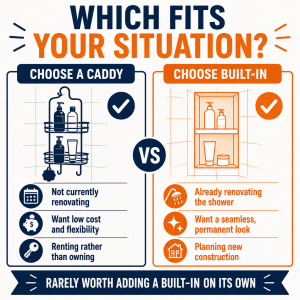
Choose a hanging or mounted caddy for most households, especially if you’re not currently renovating your bathroom, want a low-cost and flexible storage solution, or rent rather than own your home. A caddy solves the same fundamental storage problem as a built-in shelf — somewhere to keep shampoo, soap, and razors within reach — without the cost, disruption, or commitment of construction work. If you’re leaning toward an adhesive-mounted option specifically, our adhesive shower caddy installation guide walks through the full process, including the surface prep and cure time steps that determine whether it actually holds long-term.
Choose a built-in corner shelf specifically if you’re already renovating or building the shower and want a permanent, seamless storage solution as part of that larger project. Trying to justify a built-in shelf as a standalone project, separate from any other renovation work, rarely makes financial sense given the cost of opening and retiling a wall section for storage alone.
If you’re weighing other shower-area accessories at the same time, our shower squeegee reviews cover another low-cost, no-renovation addition worth considering alongside whichever storage option you land on.
Choosing between a caddy and a built-in shelf isn’t a plumbing decision on its own, but if a shower renovation you’re planning also involves relocating fixtures, addressing a leak behind existing tile, or other plumbing work, search PlumberArchive.com — the US plumber directory with 12,000+ verified local plumbers across all 50 states.
Get weekly plumbing tips, honest tool reviews and DIY guides delivered straight to your Facebook feed.
Not really, in any practical sense. A built-in shelf requires opening the existing wall, framing or installing a waterproof niche box, and retiling the surrounding area to match, which is genuinely renovation-level work even if you’re not touching anything else in the bathroom. It’s technically possible to do this as an isolated project, but the cost and disruption involved rarely make sense unless it’s bundled into a broader renovation you’re already planning.
In terms of long-term reliability, yes — a caddy’s durability is tied to its specific mounting mechanism, whether that’s adhesive, a tension pole, or a suction cup, and each of those can eventually loosen or fail. A built-in shelf has no separate mounting mechanism to fail since it’s structurally part of the wall itself, making it inherently more permanent. That said, a caddy’s lower durability is offset by how easily and cheaply it can be replaced compared to fixing a failed built-in installation.
This varies significantly based on your local labor rates, the tile you’re matching, and whether it’s planned into new construction versus retrofitted into an existing shower. Adding one to new construction or a full renovation already in progress is considerably more cost-effective than retrofitting one into an otherwise-finished shower, since a retrofit requires demolishing and replacing tile specifically for the niche rather than folding that work into a larger project already underway. Get quotes from a licensed contractor for an accurate estimate specific to your bathroom.
Generally, no. The cost and disruption of opening tile work solely to add a storage shelf is difficult to justify when a quality hanging or mounted caddy solves the same practical need for a fraction of the cost and effort, with no wall work required at all. A built-in shelf makes the most sense as part of a renovation or new construction project you’re already undertaking for other reasons, where the niche becomes a relatively small addition to work that’s happening regardless.
A hanging or mounted shower caddy and a built-in corner shelf both solve the same basic problem — somewhere to keep shampoo, soap, and razors within easy reach — but they come from genuinely different categories of decision. A caddy is a low-cost, flexible purchase you can install today and change your mind about tomorrow. A built-in shelf is a permanent construction feature that only makes practical sense as part of a renovation or new build you’re already undertaking.
For most households, that makes the caddy the more sensible choice by default, simply because most people aren’t mid-renovation when they’re solving a shower storage problem. If you are renovating, though, a built-in niche is well worth planning into your tile layout from the start, since retrofitting one later costs far more than including it the first time around.
Prices and ratings may change. Always check Amazon for current prices.
✍️ About This Comparison
PTR Editorial Team — Product Comparisons. We compare manufacturer specifications, installation requirements, compatibility and available product documentation to help homeowners choose suitable tools and parts. How we review →
Pop-up drains seal to hold water; grid drains never close but resist clogs better and cost less. Here's how to choose between them for your bathroom sink.
Test strips, digital meters or send-to-lab testing? Match the method to your situation — screening, ongoing monitoring, or a real health concern.
25-foot vs 50-foot drain snake: compare handling, the cable diameter trade-off and the jobs that justify extra length, plus where 50 feet stops.

