
Reviews
18 Nov 2026

5 Radiant Floor Heating Manifolds for PEX Loops
Compare five radiant floor heating manifolds for PEX loops, from a 3-loop to an 8-loop option, and what to check before you order.
Five potable-water expansion tanks from Watts, Eastman, Flexcon and Amtrol: sizes, documented volumes and what to check before you buy.
Please note: Product availability and information are based on our research at time of writing and are subject to change. Always check Amazon for the latest details before purchasing. Reviews remain editorially independent.
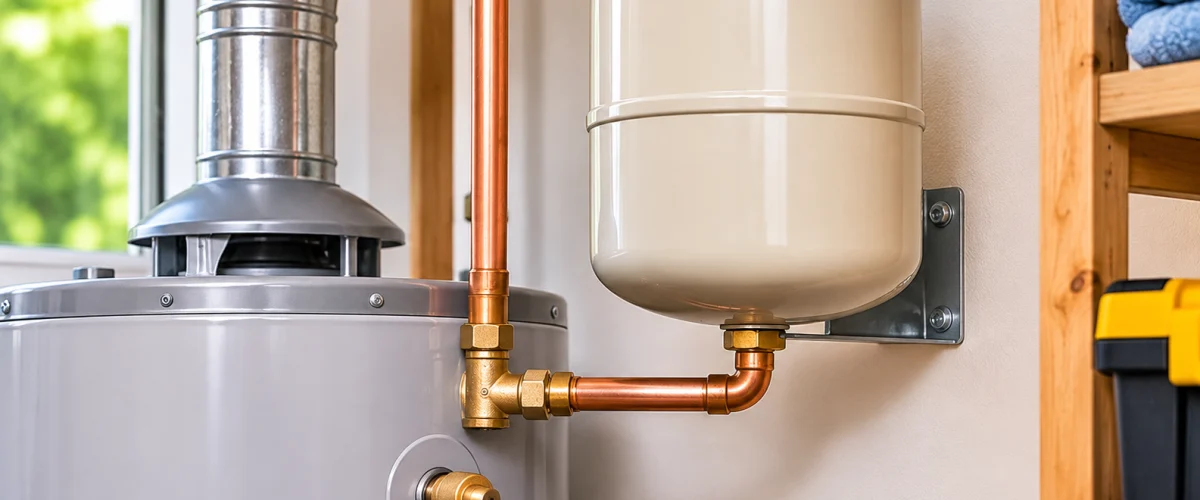
When water is heated in a closed plumbing system, it expands and the pressure rises. With nowhere to go, that extra water can push out through the relief valve. A thermal expansion tank gives it somewhere to go, then hands it back when you use hot water.
This guide compares five potable-water expansion tanks from Watts, Eastman, Flexcon and Amtrol. Two are smaller tanks of about 2 gallons and three are larger tanks of 4.4 to 4.8 gallons. They are not interchangeable: the right size depends on your water pressure and your heater, and installing one is a job for a qualified installer. We read each maker’s documents and the Amazon listings. We have not tested the tanks, and where a document is silent we say it is not stated.
✏️ Our Take
Pick the size first, then the tank. Your water pressure, heater size and water temperature all feed into the size, and your installer can work it out and confirm it. Within a size class, the tanks differ in what their makers publish. Watts prints acceptance volume for four pre-pressures, Flexcon and Amtrol print one figure, and Eastman’s sheet prints none in the sources reviewed. Warranty terms differ, and the Eastman instructions state none. Read the notes under each tank before you click, and settle the Amtrol T-12A’s open question first.
IN THIS GUIDE
Smaller tanks first, then larger. This is not a ranking. “Not stated” means we did not find it in the sources reviewed, and acceptance volumes are shown as each maker prints them because the makers do not use the same basis.
Wide table: this table is wider than the page on small screens — swipe or scroll it sideways to see every column →
| Tank | Size class | Tank volume | Diameter x height | Acceptance volume, as the maker prints it | Warranty as stated | Buying link |
|---|---|---|---|---|---|---|
| Watts PLT-5 | Smaller | 2.1 gal | 8 x 11 in | 1.48 to 0.8 gal, by pre-pressure from 20 to 80 psi (water side at 150 psi) | 1 year (Watts Standard Limited Warranty, 2018) | View on Amazon |
| Eastman 60022 | Smaller | 2 gal (Amazon listing) | About 8.3 x 12.4 in (Amazon listing) | Not stated in the sources reviewed | Not stated in the manufacturer instructions reviewed | View on Amazon |
| Watts PLT-12 | Larger | 4.5 gal | 10.5 x 13.5 in | 3.42 to 1.85 gal, by pre-pressure from 20 to 80 psi (water side at 150 psi) | 1 year (Watts Standard Limited Warranty, 2018) | View on Amazon |
| Flexcon PH-12 | Larger | 4.8 gal (Flexcon) | 11 x 14.5 in | 2.5 gal (conditions not stated) | 1 year limited (Flexcon brochure) | View on Amazon |
| Amtrol T-12A (see the note in its review) | Larger | 4.4 gal | 11 x 15 in | 2.6 gal (conditions not stated) | Documented 5-year limited term (Amtrol); confirm the coverage for your purchase | View on Amazon |
The first two tanks are in the 2-gallon class. The last three are in the 4.4 to 4.8-gallon class. Within each group the order is not a ranking.
Size and connection: 2.1 gallons tank volume; 8 in across and 11 in long (Watts lists 5.5 lb); 3/4 in male stainless steel inlet; 20 psi factory air charge.
The PLT-5 is the smaller of Watts’s two potable tanks in this guide. It is a pre-pressurized steel tank with a butyl-rubber diaphragm that keeps the water apart from the air in the tank. Watts prints its acceptance volume for four air-side pre-pressures, so you can see how the figure changes with your set-up: 1.48 gallons at 20 psi down to 0.8 gallons at 80 psi (water-side volume at 150 psi). Watts’s installation instructions state that the PLT-5, PLT-12 and PLT-20 are certified to ANSI/NSF 61 and listed by IAPMO.
You might consider it if your installer’s sizing result points to a tank in the 2-gallon class and you like having the acceptance figures printed for several pre-pressures.
Advantages
Limitations
Before you click: choose Style: Potable and Size: 2.1 Gallons, because the same listing family also offers a non-potable style and other sizes. The listing’s first bullet mentions hydronic heating; Watts’s documents describe the PLT-5 as a potable-water tank.
Watts
Best for: A 2-gallon-class tank with acceptance figures printed by pre-pressure
A 2.1-gallon potable-water expansion tank with a butyl-rubber diaphragm and a 3/4 in male stainless steel inlet.
Size and connection: 2 gallons and 3/4 in male pipe thread, about 8.3 in wide and 12.4 in high, all as shown on the Amazon listing (Eastman’s instruction sheet gives none of these). The listing shows Eastman as the brand and EZ-FLO International as the manufacturer.
The Eastman 60022 is a simple 2-gallon option with its own instruction sheet, written for models 60022 and 60023. The sheet says the tank is for potable water only, rated for no more than 150 psi and 200 F, and it walks through checking your system pressure and setting the air pre-charge to match. The listing describes a butyl rubber diaphragm and stainless steel fittings, and says the tank is made in the USA; those are listing statements, not points from Eastman’s sheet.
You might consider it if you want a 2-gallon tank and are happy to take the sizing from your installer, since no acceptance volume is published in the sources reviewed.
Advantages
Limitations
Before you click: choose the 2 Gal. size. The 4.5-gallon tank in the same listing family is a separate model, the 60023. The listing’s temperature line says 210 F, while Eastman’s sheet says 200 F; we use the sheet.
Eastman
Best for: A 2-gallon tank when your installer provides the sizing
A 2-gallon expansion tank with its own Eastman instruction sheet, written for models 60022 and 60023.
Size and connection: 4.5 gallons tank volume; 10.5 in across and 13.5 in long (Watts lists 10 lb); 3/4 in male stainless steel inlet; 20 psi factory air charge.
The PLT-12 is the larger of the two Watts tanks and uses the same design as the PLT-5. Watts prints its acceptance volume for four air-side pre-pressures: 3.42 gallons at 20 psi down to 1.85 gallons at 80 psi (water-side volume at 150 psi). The same installation instructions that cover the PLT-5 state the ANSI/NSF 61 certification and IAPMO listing for this model too.
You might consider it if your installer’s sizing result points to a larger tank and you want acceptance figures printed for several pre-pressures.
Advantages
Limitations
Before you click: choose Style: Potable and Size: 4.5 Gallon. The listing’s manufacturer field says Wilo, but its model (PLT-12), part number (67371) and UPC match Watts’s own PLT-12 page (order number 0067371), so we treat it as the Watts PLT-12. Its “From the manufacturer” section is about backflow preventers, not expansion tanks, so go by Watts’s documents rather than that text.
Watts
Best for: A larger tank with acceptance figures printed by pre-pressure
A 4.5-gallon potable-water expansion tank using the same design as the PLT-5.
Size and connection: 4.8 gallons tank volume in Flexcon’s current documents (the Amazon title says 4.5); 11 in across and 14.5 in high (Flexcon lists 10 lb); 3/4 in MNPT stainless steel connection.
Flexcon’s PH series is its potable-water tank for water heaters. Its factory air charge is 40 psi. Flexcon lists the PH-12’s acceptance volume as 2.5 gallons without stating the conditions, and its submittal sheet lists the PH series as IAPMO and NSF 61 listed. Its manual says the tank is supported by the system piping and must not be installed horizontally.
You might consider it if your installer’s sizing result points to a larger tank and your installation suits a tank that stays upright.
Advantages
Limitations
Before you click: the listing’s title and capacity line say 4.5 gallons, while its size selector, bullet and included-components line say 4.8, which matches Flexcon’s current documents (an older distributor copy of Flexcon’s sheet shows 4.5). The listing’s part and model number is PH12. Make sure PH12 is the size selected, because the listing family also offers a 2.1-gallon tank and a 9-gallon tank.
Flexcon
Best for: A larger tank for an upright installation
Flexcon's potable-water expansion tank, listed at 4.8 gallons in Flexcon's current documents, with a 2.5-gallon acceptance figure, a 40 psi factory air charge and IAPMO and NSF 61 listing on its submittal sheet.
Size and connection: 4.4 gallons tank volume; 11 in across and 15 in high (Amtrol lists 9 lb shipping weight); 3/4 in male stainless steel connection.
Confirm with Amtrol before you buy: Amtrol’s own documents for this tank disagree. The spec sheet and brochure give 200 F as the maximum operating temperature, while the installation manual’s warnings say not to expose the tank to temperatures above 130 F. The manual also says to mount it “vertically beneath piping only” in one place and says other positions are permissible with full support in another. We could not find a newer manual that settles either point, so ask Amtrol which applies to your installation.
The T-12A has its own Amtrol spec sheet, installation manual and warranty listing. Amtrol describes it for closed potable water systems, with a steel shell, a heavy-duty butyl diaphragm, a polypropylene liner and a 40 psig factory charge, and its brochure lists a maximum acceptance of 2.6 gallons without stating the conditions. Amtrol’s warranty page lists the T-5A and T-12A at five years, limited.
You might consider it if your installer’s sizing result points to a larger tank and you want a model-specific manual and a documented five-year term, once the open points above are answered.
Advantages
Limitations
Before you click: the listing’s Capacity line shows 2.6 gallons. That is Amtrol’s maximum acceptance; the tank volume is 4.4 gallons.
Amtrol
Best for: A larger tank, once Amtrol confirms the temperature and mounting points
A 4.4-gallon tank for closed potable water systems with its own Amtrol spec sheet, installation manual and warranty listing.
Sizing depends on your water pressure, your water heater’s size and how hot the water gets, and each maker’s method uses these differently. Watts’s selection guide takes your supply pressure and heater gallons, and assumes a 150 psi relief valve and a maximum 50 F temperature rise. Flexcon’s quick sizing chart takes your heater size and its maximum water temperature (130 to 180 F), and assumes heating from 40 F, a 60 psig supply pressure and a 150 psig relief valve. The Amtrol and Eastman documents we read for these tanks include no sizing method. The same house can point to different tanks under different methods, so ask your installer to size the tank and confirm the result. A 2-gallon tank and a 4.5-gallon tank are not substitutes for each other.
Tank volume is the size of the tank. Acceptance volume is how much expanded water it can take up, and it is smaller. Watts prints acceptance for four pre-pressures at 150 psi. Flexcon and Amtrol print one figure each, and Eastman prints none in the sources reviewed, so do not compare one maker’s acceptance number with another’s.
Every maker says to set the air charge to match your supply pressure. Watts, Eastman and Flexcon say never to go above 80 psi, and Flexcon says a pressure reducing valve must be used if your supply pressure is higher. The factory charges differ: Watts ships at 20 psi, Flexcon and Amtrol at 40 psi, and Eastman’s sheet gives 20 psi as normal.
The instructions packed with your exact tank come first. Everything here is general, and it never overrides a model-specific restriction. Watts and Eastman say only qualified personnel may install or service their tanks, Flexcon says a qualified professional should check the tank and system every year, and Amtrol says to call a qualified professional if the tank seems to be malfunctioning. Watts, Flexcon and Amtrol put the tank on the cold-water line to the water heater. The makers also call for a relief valve, and our guide to testing a water heater’s pressure relief valve covers that part. Pick a spot where a leak will not cause damage, and plan for support: Watts, Eastman and Flexcon say the piping carries the tank’s weight, so it needs bracing where appropriate.
Mounting rules differ by tank. Flexcon says not to install the PH tank horizontally. Watts and Eastman prefer vertical and allow horizontal with support. Amtrol’s T-12A documents need clarification (see its review). Whether you need a tank at all depends on local rules and your heater’s instructions, and our tankless vs tank water heater guide explains the two heater types.
Several of these listings sit in families that include other sizes or styles, so confirm the model name and the size on the page before you buy.
Sometimes a job is too big for DIY. To find local plumbers, you can search PlumberArchive.com, a plumber directory.
Documents and listings read between 9 and 10 November 2026. Each document is listed with its date or revision. Amazon listing details are used only where attributed to the listing.
✍️ About This Review
PTR Editorial Team — Product Reviews. We compare manufacturer specifications, installation requirements, compatibility and available product documentation to help homeowners choose suitable tools and parts. How we review →
Compare five radiant floor heating manifolds for PEX loops, from a 3-loop to an 8-loop option, and what to check before you order.
Compare four boiler point vents and one inline air separator: what to match before you buy, from thread and mounting to pressure ratings.
Compare five hydronic zone valves for hot-water baseboard heating, with quick tips on matching the model, pipe connection and controls.

