
Reviews
18 Nov 2026

5 Radiant Floor Heating Manifolds for PEX Loops
Compare five radiant floor heating manifolds for PEX loops, from a 3-loop to an 8-loop option, and what to check before you order.
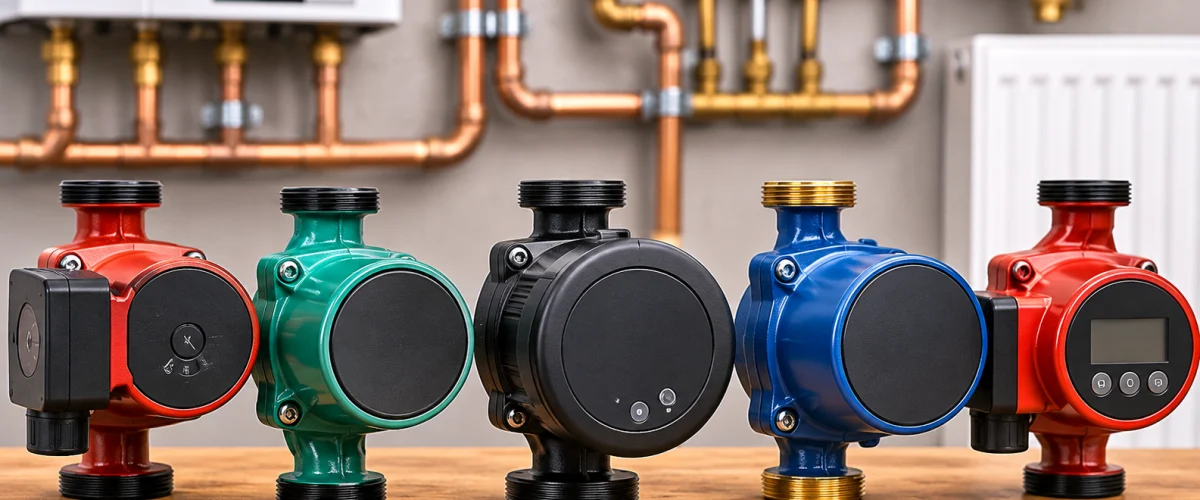
Five circulator pumps for closed-loop home heating compared from the makers' documents: flow, head, flange and controls, plus what to check first.
Please note: Product availability and information are based on our research at time of writing and are subject to change. Always check Amazon for the latest details before purchasing. Reviews remain editorially independent.
If the circulator on your heating system has died, or you’d rather swap an old one before it does, “which pump is best?” isn’t really the question. The one that matters is: which circulator fits my existing heating loop, and what should I check before ordering?
This guide compares five cast-iron circulators for closed-loop hot-water heating (baseboard, radiant or fan-coil zones) from Taco, Bell & Gossett and Armstrong. They aren’t interchangeable, and nobody can pick one for you without knowing how much flow and head your loop needs. We read each maker’s documents and checked the Amazon listings against them. We have not tested the pumps. Where a maker only prints a curve and no number, we read the chart and say so.
Looking for a pump to keep hot water coming to a faucet instead? That’s a different job. See our guides to hot-water recirculation pumps for homes with a dedicated return line and recirculation systems for homes without a return line.
✏️ Our Take
Match first, shop second. Read the label on your old pump for voltage and flange style, check whether you need a check valve, and know what flow and head your loop needs. In this group the Taco 007-F5 is the plain single-speed swap, the Taco 0015-MSF3-IFC and Armstrong Astro 230CI are three-speed pumps with a check valve built in, the B&G NRF-22 is a single-speed pump with a modest head, and the Taco 0015e3-2F4 is the low-power ECM option. None of that replaces sizing. If you can’t work out your loop’s flow and head, ask your installer.
IN THIS GUIDE
Most of the work is done on the old pump’s label and the piping around it. Take a photo of the label before you shut anything off, then go through this list.
Maximum flow and maximum head are separate maximums, not a single operating point. A pump can’t deliver both at once. Values with “about” are our readings of the maker’s printed curve, because that sheet gives no number.
Wide table: this table is wider than the page on small screens, so swipe or scroll it sideways to see every column →
| Pump | Control | Max flow | Max head | Electrical | Connection | Buying link |
|---|---|---|---|---|---|---|
| Taco 007-F5 | Single speed | 23 gpm | 10 ft | 115 V, 0.74 A | Flanged, standard orientation | View on Amazon |
| Taco 0015-MSF3-IFC | 3-speed; flow check built in | 18 gpm | 17 ft | 115 V, 0.54 to 0.85 A | Flanged, standard orientation | View on Amazon |
| Bell & Gossett NRF-22 (103251) | Single speed | About 22 gpm | About 15 ft | 115 V, 0.80 A (92 W) | Flanged; companion flanges listed as an accessory | View on Amazon |
| Armstrong Astro 230CI (110223-305) | 3-speed; removable check valve | About 18 gpm | About 19 ft | 115 V, 0.45 to 0.81 A | Flanged, two 1/2 in bolt holes | View on Amazon |
| Taco 0015e3-2F4 | ECM; three constant-pressure settings | 16 gpm | 18 ft (shut-off) | 120 V, up to 44 W (0.54 A max) | Universal flange | View on Amazon |
Where a figure is shown without “about,” it is printed on the maker’s sheet. The curves are linked in each review and in the Sources list.
The order below isn’t a ranking. Each review ends with what to check on the listing before you click.
What Taco prints: single speed; up to 23 gpm of flow and up to 10 ft of head (two separate maximums); 115 V, 0.74 A, 1/25 hp, 3250 rpm; cast iron, flanged for 3/4 to 1-1/2 in pipe; 125 psi; 40 to 230 F. The pump’s own label, shown in the listing’s photos, reads 007-F5 and 230 F.
The 007 is Taco’s long-running cartridge circulator. Taco says the pump’s moving parts sit in a replaceable cartridge, so it can be serviced instead of replaced. The -F5 is the cast-iron version with Taco’s standard flange orientation. It runs at one speed and has no check valve built in; the flow-check models carry -IFC in the name.
You might consider it if you’re replacing a plain fixed-speed circulator on a small baseboard or radiant loop and want the simplest like-for-like swap, with no speed switch to set.
Advantages
Limitations
Before you click: this listing is a bundle: the 007-F5 pump plus two universal flange gaskets and a wire gland, according to the listing. Taco’s sheet describes the pump alone. The listing doesn’t say whether flanges are included, so check what you need. Taco also makes a rotated-flange version (007-F5-5), and this listing doesn’t state the orientation; the plain 007-F5 is Taco’s standard orientation. The curve is on page 2 of Taco’s 007 sheet, but it’s a chart shared with several 00-series pumps, so go by the printed 23 gpm and 10 ft.
What Taco prints: three-speed switch; up to 18 gpm of flow and up to 17 ft of head (two separate maximums); 115 V, 0.54, 0.74 and 0.85 A at speeds 1 to 3, 1/20 hp, 3250 rpm; cast iron, standard flange orientation, flanged for 3/4 to 1-1/2 in pipe; 125 psi; 40 to 230 F; removable integral flow check (IFC). The label in the listing’s photos reads 0015-MSF3-IFC.
Taco’s sheet describes the 0015 3-speed as a direct replacement for the Grundfos UPS 15-58 3-speed, which is worth knowing if that’s what you’re pulling out. The built-in flow check can save adding a separate check valve to the piping.
You might consider it if your loop needs more head than a 007-class pump, or you want to adjust speed to match the system, and you like having the check valve built in.
Advantages
Limitations
Before you click: similar listings exist for the rotated version, the stainless version and the version without the flow check. This one says 0015-MSF3-IFC in the title and the model number. The curve is on Taco’s 3-speed sheet (page 1).
What B&G prints: single speed; 92 W, 115 V, 0.80 A, 2940 rpm; cast iron body; 150 psi; 40 to 240 F; impedance-protected motor; companion flanges listed as available for 3/4 to 1-1/2 in pipe; 9.3 lb. B&G’s sheet prints a curve but no flow or head numbers. Reading it, the NRF-22 curve starts at about 15 ft of head and runs out at about 22 gpm (approximate).
B&G describes the NRF series as a flanged in-line circulator designed for quiet operation in a closed hydronic heating system. The NRF-22 is one of the single-speed models in the family; the three-speed pumps in the same sheet are the NRF-25, NRF-36 and NRF-45.
You might consider it if you’re replacing an NRF-22 or a similar small single-speed circulator and your loop is modest, so the pump’s smaller head suits it.
Advantages
Limitations
Before you click: the title is “Bell & Gossett HVAC Circulator Pump 103251” and the model number field says 103251. The label in the listing’s photo reads “NRF-22 103251,” 115 V, .80 A, 92 W, 240 F. Other listings for 103251 call it a three-speed pump. B&G’s sheet lists the NRF-22 as single-speed, and this listing makes no speed claim. The curve is on page 2 of B&G’s submittal (single-speed chart).
What Armstrong prints: three speeds; 115 V, 60 Hz; 0.45, 0.58 and 0.81 A at speeds 1 to 3 (nominal 97 W); cast iron for closed systems; removable check valve at the pump outlet; two-bolt flange with 1/2 in bolt holes; up to 230 F and 150 psi; ETL listed; 8.0 lb. The label in the listing’s photo reads Astro 230CI, part 110223-305. Armstrong’s submittal prints a curve, not flow and head numbers. Reading the speed-3 curve, it starts at about 19 ft of head and the plotted line runs to about 18 gpm (approximate).
Armstrong’s Astro 2 catalog says the line is built for flange-to-flange compatibility with competing models, and that the cast-iron volutes are e-coated on the inside. It also lists a 30-month warranty.
You might consider it if you want a three-speed circulator with a built-in check valve and a longer documented warranty than Taco’s sheets show, or you simply prefer Armstrong.
Advantages
Limitations
Before you click: choose 110223-305. The rotated-flange version is the 230CI-R (110223-315), and the stainless Astro 230SS is a different pump; Armstrong’s submittal lists the cast-iron models for closed systems and the stainless ones for open systems. The curve is on page 4 of Armstrong’s submittal.
What Taco prints: ECM (electronically commutated) motor; three constant-pressure settings of 5, 10 and 18 ft; up to 16 gpm of flow and 18 ft of shut-off head (two separate maximums); 120 V, up to 44 W, 0.54 A maximum; cast-iron casing for closed-loop systems only; 125 psi; 36 to 230 F; water or up to 50% water/glycol; indoor use only. The 2F4 is the cast-iron model with Taco’s universal flange. The listing’s model number field says 0015e3-2F4.
Taco says the 0015e3’s performance is equivalent to its 0015 3-speed circulator. Its heating selection guide pairs the settings with the longest circuit in the system: low for 85 ft of 3/4 in copper, medium for 165 ft, high for 245 ft.
You might consider it if you want a low-power ECM pump and your system is zoned with zone valves or circulators. Whether it can replace your current pump depends on four things: the flow and head your loop needs, the voltage (this pump is 120 V), the flange (universal here) and the controls.
Advantages
Limitations
Before you click: make sure the page shows 0015e3-2F4. The 0015e3-2F2 has a standard flange, and the SF4 and SU models are stainless steel. The curve and settings are on page 2 of Taco’s 0015e3 sheet.
These two are close cousins. Both are cast iron, both run on 115 V, both have three speeds and a removable check valve. Here’s where the documents show a difference.
Wide table: this table is wider than the page on small screens, so swipe or scroll it sideways to see every column →
| Taco 0015-MSF3-IFC | Armstrong Astro 230CI | |
|---|---|---|
| Speeds | 3 | 3 |
| Max flow / max head | 18 gpm / 17 ft (printed) | About 18 gpm / about 19 ft (chart reading) |
| Electrical | 115 V; 0.54, 0.74, 0.85 A | 115 V; 0.45, 0.58, 0.81 A |
| Check valve | Integral flow check, removable | Removable check valve at the pump outlet |
| Flange fit | Standard orientation; the rotated version is the 0015-MSF3-1IFC | The rotated version is the 230CI-R (110223-315); two 1/2 in bolt holes |
| Warranty as documented | None stated on the 2015 sheet we read | 30 months (2017 Astro 2 catalog) |
| Limits | 125 psi; 40 to 230 F | 150 psi; up to 230 F |
| Weight on the maker’s sheet | 8 lb (ship weight) | 8.0 lb |
What it comes down to: if you’re matching an existing pump’s flange, the real question is whether your old pump has a standard or rotated flange. Each maker has a standard and a rotated model, so you have to pick the right one in either brand. On the check valve, both makers describe one that can be removed; Taco calls its design an integral flow check, and Armstrong’s sheet says a removable check valve is installed at the pump outlet. Neither document gives enough detail to separate them. The clearer difference is warranty: Armstrong’s catalog lists 30 months, and the Taco sheet we read lists none. The head figures differ too, but Taco’s is a printed number and Armstrong’s is our chart reading, so treat them as roughly similar.
If you’re swapping like for like, the old pump’s label tells you most of what you need: voltage, size, and sometimes the model. Match the voltage and the flange first. Then decide whether you want the same speed behavior or an upgrade.
A fixed-speed pump (the 007-F5 and NRF-22) is the simplest: it runs at one speed. A three-speed pump (the Taco 0015-MSF3-IFC and Armstrong Astro 230CI) lets you pick a speed to fit the loop. An ECM pump (the Taco 0015e3-2F4) is built to use less power. Its three settings hold a constant pressure, so check how that fits your zones.
The maximum flow and head on a sheet are limits, not what you’ll get in your system. Flow and head together decide what a pump will do in a particular loop, which is why Taco’s guide says to run the calculations. If you can’t, your installer can.
The instructions packed with your exact pump come first, and what’s here is general. Circulators involve electrical power, hot water and pressurized piping, so if you aren’t comfortable draining the system and wiring the pump, hire a qualified installer.
Sometimes a job is too big for DIY. To find local plumbers, you can search PlumberArchive.com, a plumber directory.
We started from the maker’s own documents for each exact model: Taco’s catalog and submittal sheets, the Bell & Gossett submittal, and the Armstrong submittal and catalog. Where we couldn’t open the maker’s own site, we relied on a distributor’s copy of the same document and label it as a hosted copy in the Sources list. For each pump we then opened the Amazon listing and checked that its title, model number and, where the listing’s photos show one, the label match the maker’s model. Our affiliate links were each opened and confirmed to land on that same listing.
We have not tested these pumps. The sheets are different ages, and some are several years old, so confirm current details with the maker or your installer. Figures labelled “about” are our readings of a printed curve. Buying advice here is general: it isn’t a sizing calculation for your system.
Documents and listings read on 12 November 2026. Each document is listed with its date or revision. A “hosted copy” is a distributor’s or retailer’s copy of the maker’s document.
✍️ About This Review
PTR Editorial Team — Product Reviews. We compare manufacturer specifications, installation requirements, compatibility and available product documentation to help homeowners choose suitable tools and parts. How we review →
Compare five radiant floor heating manifolds for PEX loops, from a 3-loop to an 8-loop option, and what to check before you order.
Compare four boiler point vents and one inline air separator: what to match before you buy, from thread and mounting to pressure ratings.
Compare five hydronic zone valves for hot-water baseboard heating, with quick tips on matching the model, pipe connection and controls.

