
Guides
19 Oct 2026

Can’t Reach the Faucet Nut? Choose the Right Tool Before You Buy
Not sure which tool fits your faucet nut? Identify the fixing, see how it lets go and check your clearance first. Then choose a tool, or use one you own.
A strap wrench grips round parts with a strap, not teeth. See where makers call for one, how to size it, and when you can skip it.
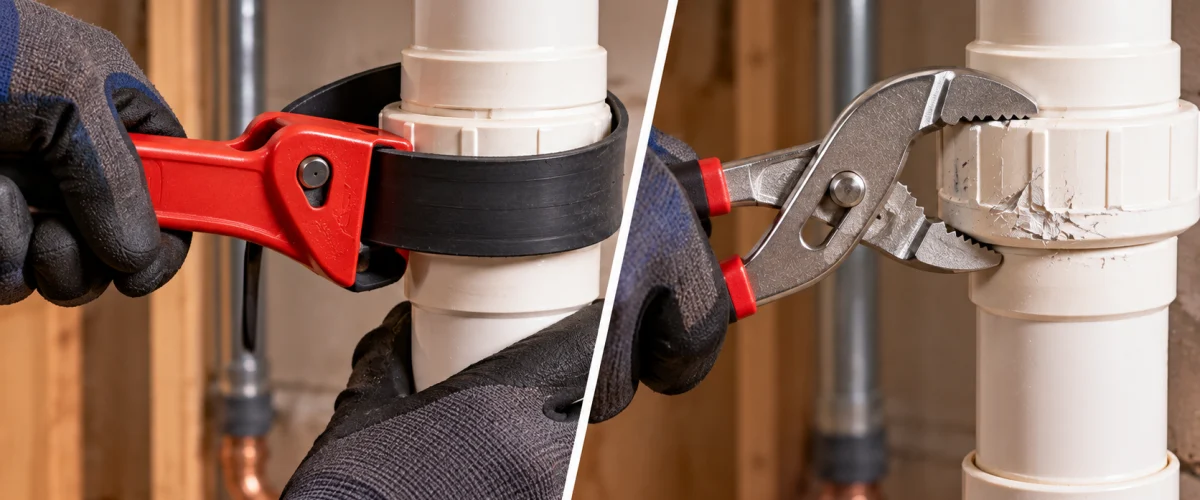
Say a polished chrome shower head will not turn by hand. Toothed jaws, on pliers or a pipe wrench, can mark a polished finish or a plastic fitting, which is why some fixture makers tell you to protect the finish or call for a strap wrench. A strap wrench turns a round part with a flexible strap wrapped around it instead of teeth. This guide covers what that changes, where manufacturers’ own instructions call for one, when another tool may suit better, and how to size one. For the removal steps themselves, see our guide to installing a shower head.
✏️ The Short Answer
A strap wrench grips by friction around a round part, so it suits surfaces you do not want to mark. It needs room to wrap and only works up to the capacity the maker states. For a one-off job you may not need one: several fixture makers say to tighten new connections by hand, and one says to wrap wrench jaws in tape or a rag.
IN THIS GUIDE
A strap wrench has a handle and a flexible strap. You loop the strap around a round part, feed the free end through the handle, and pull, and the strap tightens as you turn. The grip comes from friction spread around the part rather than from teeth or hard jaws pressing at two points. Klein Tools says its Grip-It wrenches use a cam action to apply uniform, high torque, and RIDGID describes a strong woven nylon strap that grips tightly.
The same design sets its limits. The strap has to fit all the way around the part, and the strap and handle need room to move. Makers state capacity in different ways, as the sizing section shows.
Follow the manuals for your own fixture and your own tool. These are examples from specific product sheets, not rules for every fixture.
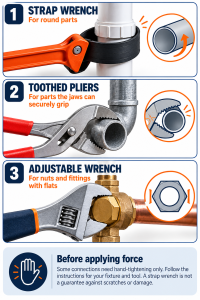
Try a new connection by hand first. For taking an old head off, Delta’s shower mount sheet describes an adjustable wrench or pliers, with the shower arm held so it does not unscrew. The Kallista sheet’s tape-or-rag instruction is for tightening its ball joint, not for removing an old showerhead, but it shows the same idea of protecting the finish when a wrench is used. A strap wrench starts to make sense if you work on polished or plastic pipe and fittings often, if a finish would be costly to replace, or if your fixture’s instructions call for one.
Measure the outside diameter of the part, or wrap a string around it, mark the length and divide by 3.14, then compare with the maker’s stated capacity. Where a minimum is given, check it as well as the maximum: Klein’s page lists Grip-It models from 1-1/2 to 4 inches (6-inch handle) up to 3 to 10 inches (18-inch handle), and the S12HB covers 1-1/2 to 5 inches, so the current models listed there start at 1-1/2 inches or more.
RIDGID lists two capacity figures for each strap wrench, and they mean different things. RIDGID’s strap wrench page (archived copy) defines rated pipe capacity as the nominal diameter that can be correctly tightened, and actual O.D. capacity as the actual outside diameter the strap can accommodate. The second figure is larger. Do not choose on the larger figure alone: for pipe, stay within the rated capacity, and for other round parts the outside-diameter figure only shows that the strap fits, since RIDGID does not say how well the wrench grips at the top of that range.
On clearance, the makers publish handle and strap lengths but we found no figures for how much free space a wrench needs. You need room for the strap to go around the part and for the handle to swing a useful arc.
This is not a ranking. It shows what each maker states for pipe and fitting work.
| Model | Strap (length × width) | Diameter the maker lists | Strap material |
|---|---|---|---|
| Klein Grip-It S12HB | 22-1/4 in × 1 in | 1-1/2 to 5 in | TPU-coated polyester |
| RIDGID No. 2 (31340) | 17 in × 1-1/8 in | Rated pipe capacity 2 in; actual O.D. capacity 3-1/2 in | Woven nylon |
| RIDGID No. 5 (31360) | 29-1/4 in × 1-3/4 in | Rated pipe capacity 5 in; actual O.D. capacity 7 in | Woven nylon |
| Pittsburgh 2-piece rubber set (Harbor Freight 69373) | Large 24 in × 3/4 in; medium 20 in × 1/2 in | Large up to 6 in; medium up to 4 in | Rubber |
What the documentation does not say. None of the three makers states a torque limit that we found, and none names chrome. Klein and RIDGID name polished pipe, and Klein names plastic pipe and fittings. Harbor Freight does not address polished, chrome or plastic surfaces, handle material or load rating, and notes that its specifications are approximate. RIDGID also lists P versions of the No. 2 and No. 5 with a strap for plastic pipe, and sells replacement straps. Availability changes, so check each maker’s current listing.
None of Klein, RIDGID or Harbor Freight names chrome. Klein lists polished pipe and fittings among surfaces it will not scratch under normal conditions, and Kohler’s Rain showerhead and Kallista sheets specify a clean strap wrench for tightening.
The sources we read do not say. Kohler’s instructions cited above cover installing and tightening a new shower arm and showerhead with a clean strap wrench, not freeing a seized one; for removing the showerhead to clean its screen washer, Kohler’s guide says to use a clean wrench and be careful not to mar the finish. For removing an old head, Delta’s shower mount sheet describes an adjustable wrench or pliers while the shower arm is held. If a head will not move, do not add leverage, since Klein warns against extending its handle.
Not on RIDGID’s figures alone. Compare the part’s measured outside diameter with the maker’s stated capacity, and for RIDGID keep within the rated pipe capacity when turning pipe.
Manufacturer documents read at the time of writing:
✍️ About This Guide
PTR Editorial Team — Plumbing Guides. We compare manufacturer specifications, installation requirements, compatibility and available product documentation to help homeowners choose suitable tools and parts. How we review →
Not sure which tool fits your faucet nut? Identify the fixing, see how it lets go and check your clearance first. Then choose a tool, or use one you own.
Check your manual and the drain route first: gravity hose, built-in pump or external pump. Then see whether you need a dehumidifier hose at all.
Explore portable bidets that need no water-line connection, from bottle caps and squeeze bottles to battery-powered handhelds.

