Please note: Information in this comparison is based on our research at time of writing and is subject to change. Always confirm the actual clearance under your own sink before deciding which tool to use.
Introduction
Every faucet install or replacement eventually comes down to the same awkward moment: lying on your back under the sink, reaching up into a narrow gap between the basin and the cabinet wall, trying to loosen or tighten the mounting nuts that actually hold the faucet in place. That space is cramped by design — sinks and cabinets aren’t built with a plumber’s tool clearance in mind — and it’s exactly the problem a basin wrench exists to solve.
Most homeowners already own an adjustable wrench, and the natural question is whether that’s enough, or whether it’s worth buying a specialty tool for what might be a once-a-decade job. This comparison looks at what each tool is actually built to do, where a standard adjustable wrench genuinely struggles, and when the extra cost of a basin wrench pays for itself in avoided frustration.
At a Glance
Basin Wrench
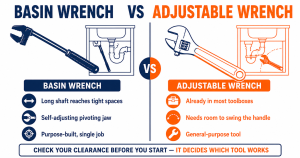
- Long shaft with a spring-loaded, pivoting jaw
- Purpose-built for confined under-sink spaces
- Single-purpose specialty tool
- Operates one-handed, largely by feel
Adjustable Wrench
- Standard household tool, already owned by most people
- Struggles in tight vertical clearance
- Works fine when there’s enough room to swing it
- General-purpose — useful well beyond this one job
✏️ Our Take
A basin wrench exists to solve one specific, genuinely annoying problem: reaching a faucet mounting nut that sits in a space too tight and too vertical for almost any standard tool to grip properly. If you already own an adjustable wrench and you’re facing typical clearance under your sink, it’s worth trying first — plenty of faucet installs have just enough room to make it work. But the moment you’re working blind, one-handed, in a space where a standard wrench can’t get a full turn, a basin wrench stops being a nice-to-have and starts being the difference between finishing the job and giving up and calling a plumber.
Quick Comparison Table
The table below maps the most common decision factors to whichever tool actually wins on that point, based on everything covered in this comparison.
| Factor |
Winner |
| Reach into tight, deep spaces |
BASIN WRENCH |
| One-handed operation in low visibility |
BASIN WRENCH |
| Working in open spaces with room to swing |
ADJUSTABLE WRENCH |
| Usefulness beyond this one job |
ADJUSTABLE WRENCH |
| Already owned by most households |
ADJUSTABLE WRENCH |
| Self-adjusting grip without a full swing radius |
BASIN WRENCH |
| Lower cost if you already own one |
ADJUSTABLE WRENCH |
What a Basin Wrench Does
A basin wrench is a long-shafted tool, typically somewhere between 10 and 16 inches, with a spring-loaded, pivoting jaw mounted at the end. That jaw is the key design feature: rather than needing to be manually opened and positioned around a nut the way a conventional wrench does, it swivels and self-adjusts to clamp onto the nut as you push the shaft toward it, then locks its grip as you turn.
The long shaft is what gives the tool its reach, letting you extend up past the basin and into the narrow gap where mounting nuts sit, often against the back wall of the cabinet where a shorter tool simply can’t reach at all. Most basin wrenches also include a T-shaped handle at the opposite end, positioned to let you apply real turning force even though your hand is nowhere near the nut itself and you likely can’t see what you’re doing.
That last point matters more than it might seem. Basin wrenches are designed to be operated largely by feel, since visibility under a sink is almost always poor — you’re working in a shadowed cabinet, often with your head turned away or your view blocked by the basin itself. The pivoting jaw’s self-adjusting grip is what makes one-handed, by-feel operation actually practical, since you don’t need a clear sightline to seat it correctly on the nut. This is a purpose-built tool for exactly one job, and it does that one job well; it’s not designed to be a general-purpose wrench for anything else in your toolbox.
What an Adjustable Wrench Does
An adjustable wrench is one of the most common tools in any household toolbox, useful across a huge range of jobs well beyond plumbing — from tightening bolts on furniture to working on a bike or a car. Its defining feature is the movable jaw, adjusted with a small worm screw, that lets a single tool fit a wide range of nut and bolt sizes instead of needing a full set of fixed wrenches.
In open, accessible spaces, an adjustable wrench works exactly as well as any other wrench — you position the jaw around the nut, get a solid grip, and rotate the handle through as much of a turn as the space allows. The problem isn’t the tool’s gripping ability; it’s that using it effectively requires enough room to actually swing the handle through a meaningful arc, repositioning and re-gripping as needed to complete a full rotation.
That’s the fundamental mismatch when it comes to faucet mounting nuts. An adjustable wrench is a general-purpose tool, engineered around flexibility in jaw size rather than flexibility in the physical space it needs to operate — and the space under a sink rarely offers much of either.
Reach and Maneuverability in Tight Spaces
This is the core differentiator between the two tools, and it’s the entire reason basin wrenches exist as a separate product category in the first place. A basin wrench’s long shaft is purpose-built to reach nuts positioned deep against the back wall of a cabinet, well beyond where your hand or a short-handled tool could ever physically get. That reach alone solves half the problem most people run into.
The other half is the pivoting jaw’s self-adjusting grip, which matters because it doesn’t require a full swing radius to work. Once the jaw locks onto the nut, turning the T-handle at the bottom of the shaft applies torque without needing to reposition the tool between strokes, since the jaw stays engaged through the turning motion. That’s a meaningful advantage in a space where there’s barely enough clearance to move your hand at all, let alone swing a wrench handle through a full rotation.
An adjustable wrench, by contrast, genuinely needs clearance to rotate — every partial turn requires releasing the jaw, repositioning it, and re-gripping, and each of those repositioning movements needs physical space that many under-sink cabinets simply don’t offer. In a cabinet with a shallow basin overhang, a garbage disposal or plumbing taking up floor space, or nuts set close to the back wall, that repositioning space often doesn’t exist, and the wrench ends up stuck making tiny, frustrating partial turns — or not turning at all.
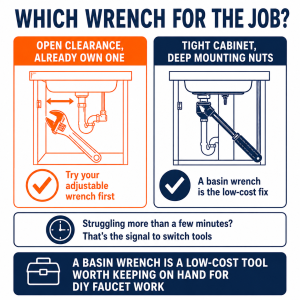
💡 Tip: Before starting, open the cabinet doors fully and use a flashlight to actually look at the clearance around the mounting nuts — that quick check tells you immediately whether an adjustable wrench has a realistic chance of working.
When an Adjustable Wrench Is Enough
Not every under-sink setup is a cramped nightmare, and there are real situations where an adjustable wrench handles the job just fine. Newer sink and cabinet configurations sometimes offer noticeably more clearance than older installs, either because of more generous cabinet design or because the basin itself sits with more room underneath it — checking your specific setup before assuming you need a specialty tool is always worth the two minutes it takes.
Some faucets are also designed to be mounted largely from above, with the bulk of the hardware accessible at deck level rather than requiring under-sink access for every connection point. In those cases, an adjustable wrench — or sometimes no wrench at all — may be all that’s needed, since the design sidesteps the confined-space problem entirely rather than solving it.
There are also workarounds that can buy extra room even in a tight cabinet. Removing a sink’s storage drawer, if the cabinet has one, or partially pulling the sink basin itself away from the wall during an installation (rather than a like-for-like replacement) can open up enough additional clearance for a standard wrench to work where it otherwise wouldn’t. These aren’t always practical, but they’re worth considering before assuming a basin wrench is the only path forward. Our how to replace a kitchen faucet guide covers what typical mounting nut access looks like during a real install, if you want a clearer picture before you start.
Cost Considerations
Basin wrenches are inexpensive, single-purpose tools, typically landing in the $ price tier. That low cost is worth weighing against how often you’ll realistically use one — for most homeowners, a basin wrench sits in a drawer for years between faucet jobs, which is a fine trade for a tool that costs relatively little and solves a genuinely frustrating problem the few times you do need it.
Adjustable wrenches, meanwhile, are already sitting in most households’ toolboxes, purchased for reasons that have nothing to do with faucets. If you already own one, trying it first costs nothing extra — there’s no reason to buy a basin wrench preemptively if there’s a reasonable chance your existing tool will do the job. The calculation only shifts once you’ve actually confirmed tight clearance, at which point the basin wrench’s low price tier makes it an easy addition rather than a significant expense.
⚠️ Warning: Forcing an adjustable wrench into a space it doesn’t fit risks rounding off the nut or scraping your knuckles against the cabinet walls repeatedly. If you’re struggling more than a few minutes, that’s the signal to switch tools rather than push through.
Which Should You Choose?
Try the adjustable wrench first if you already own one and your under-sink clearance looks reasonable after a flashlight check. There’s no cost or downside to attempting the job with a tool you already have, and a meaningful share of installs have just enough room to make it work without ever needing anything else.
Buy a basin wrench if you’re doing a faucet install or replacement in a typical cramped cabinet, if you’ve already tried and struggled with a standard wrench, or if you’re planning ahead and know from experience that your particular sink setup is tight. Given how low the cost is relative to the frustration it prevents, there’s little reason to hesitate once you suspect you’ll need it — better to have it on hand before you’re already halfway through the job and stuck.
If cost alone were the deciding factor, most people would default to the tool they already own. But the actual deciding factor is clearance, not cost, and clearance is something you often can’t fully judge until you’re already under the sink looking at it directly.
US Regional Context: Under-sink clearance varies significantly across US housing stock — older homes and budget-tier cabinetry tend to have noticeably tighter mounting nut access than modern custom cabinetry, which sometimes accounts for this specifically. A basin wrench is a low-cost tool to keep on hand for anyone doing occasional DIY faucet work, since it’s hard to predict clearance until you’re already under the sink.
It’s also worth being clear about what this comparison isn’t. A basin wrench is a different tool from a pipe wrench, which is built for gripping and rotating round pipe rather than reaching a recessed mounting nut — our pipe wrench vs adjustable wrench comparison covers that separate decision if a pipe-turning job is what actually brought you here. If you’ve confirmed a basin wrench is what you need, our basin wrench reviews cover current options across price tiers.
Frequently Asked Questions
Q: Can I use pliers instead of a basin wrench or adjustable wrench?
Pliers can work in a pinch on a nut you can reach directly, but they generally grip less securely than either wrench type and offer none of the reach a basin wrench provides. They’re a reasonable backup if a nut is only lightly tightened and easily accessible, but for a properly torqued mounting nut in a tight, deep space, pliers are usually the least effective of the three options.
Q: Is a basin wrench only useful for faucet installation?
It’s mainly built around faucet mounting nuts, but the same long-reach, self-adjusting design is genuinely useful for any nut in a tight, recessed space, not strictly faucets alone. Some drain assemblies and other under-sink hardware sit in similarly awkward positions, and a basin wrench can handle those too. That said, it’s still a specialty tool with a narrower range of use than an adjustable wrench, so don’t expect to reach for it as often.
Q: What size nuts do basin wrenches typically fit?
Most basin wrenches have a pivoting jaw that opens to accommodate a range of common faucet mounting nut sizes, generally covering what you’d find on standard kitchen and bathroom faucet installations without needing to swap parts. It’s still worth checking a specific product’s stated jaw range against your faucet’s hardware before buying, particularly for unusual or older fixtures where nut sizing can vary more than expected.
Q: How is a basin wrench different from a pipe wrench?
They’re built for entirely different jobs. A pipe wrench uses serrated, self-tightening jaws designed to grip and rotate round pipe, and it’s not intended for the delicate, recessed nut-turning task a basin wrench handles. A basin wrench’s long shaft and pivoting jaw are specifically shaped to reach into a tight vertical space and grip a hex nut, not a pipe. Our pipe wrench vs adjustable wrench comparison covers that separate tool decision in full if pipe-turning is actually your task.
Conclusion
For most faucet jobs, the honest answer is to try the adjustable wrench you already own first — a real share of under-sink setups have enough clearance to make it work, and there’s no cost in attempting it before buying anything else. But once you’ve confirmed the space is genuinely too tight, or you’ve already fought with a standard wrench and lost, a basin wrench is a low-cost tool that solves the problem directly, reaching where a conventional wrench simply can’t turn.
Given how inexpensive basin wrenches are relative to the frustration they prevent, there’s a reasonable case for keeping one on hand before you’re already stuck under the sink. It’s not a tool you’ll reach for often, but when you need it, nothing else does the job as well.
Prices and ratings may change. Always check Amazon for current prices.
✍️ About This Comparison
PTR Editorial Team — Product Comparisons. We compare manufacturer specifications, installation requirements, compatibility and available product documentation to help homeowners choose suitable tools and parts. How we review →