Guides
4 Oct 2026

How to Make a PEX Crimp or Clamp Connection (2026) — Step-by-Step Guide
Make a PEX crimp or clamp connection step by step: ring and clamp placement, gauge checks, failed joints and code notes from maker sheets.
How to choose a water pressure regulator: when you need one (above 80 psi), matching pipe size, sizing for demand, and the required expansion tank.
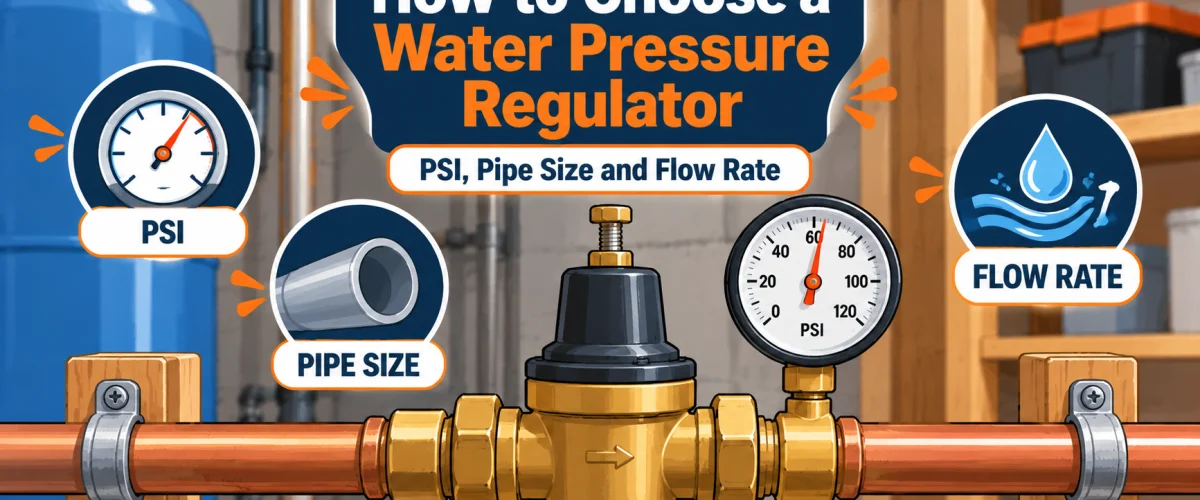
Please note: This guide covers choosing a pressure regulator for a typical home on a municipal water supply. Codes, incoming pressure, and plumbing layouts vary by location and by home — if anything about your setup doesn’t match what’s described here, a licensed plumber is the safer next step.
A pressure regulator does one job: it lowers the pressure entering your home’s plumbing to a level your pipes, fixtures, and appliances are built to handle. Choosing the right one comes down to a handful of practical questions. Do you need one at all? Which size fits your supply line? Can it keep up with your household’s water use? And what else does the installation require?
That last question is the one most people miss. Once a regulator is in, the plumbing behaves differently, and building codes address it directly. This guide works through those four questions in order. It doesn’t compare specific products; for that, see the roundup we point to at the end.
IN THIS GUIDE
At a Glance
| Code Ceiling | 80 psi of static pressure (UPC Section 608.2 and IPC Section 604.8). Above that, an approved regulator with a strainer is required. |
| Comfortable Range | Most homes run comfortably in the 50 to 60 psi range. |
| WaterSense Cap | EPA WaterSense specifications cap recommended pressure at 60 psi. |
| Regulator Standard | Regulators for potable water systems must comply with ASSE 1003. |
| Don’t Forget | An expansion tank is required downstream of the regulator (UPC), because a regulator can turn your plumbing into a closed system. |
The trigger is a number, not a symptom. Plumbing codes cap static water pressure at 80 psi (UPC Section 608.2 and IPC Section 604.8), and where the static pressure in your supply piping is higher than that, an approved regulator with a strainer is required. Static pressure is the reading with no water running. Above 80 psi, you need a regulator; at or below it, the code doesn’t require one.
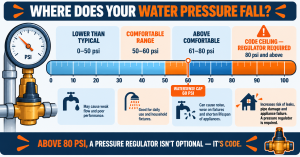
Most homes run comfortably in the 50 to 60 psi range, and EPA WaterSense specifications cap recommended pressure at 60 psi. If your reading lands above 60 psi but at or below 80 psi, you’re under the code ceiling but above what WaterSense recommends, so adding a regulator becomes a judgment call rather than a requirement.
Symptoms can be a reason to check, but they can’t tell you the pressure. Banging pipes, fixtures and appliances that wear out early, and toilets that keep running can all be associated with high pressure, and each has other possible causes. Banging in particular is often water hammer, which is a different problem; our comparison of pressure reducing valves and water hammer arrestors explains how to tell them apart. Don’t diagnose from symptoms alone. Measure first, and our guide to testing your water pressure walks through it.
A regulator only ever lowers pressure. If your real problem is weak flow, a regulator will not help; our roundup of water pressure booster pumps covers the opposite fix.
Many homes already have a regulator, often near where the main line enters the house. If yours does and your readings have crept up, it may be worn or out of adjustment, which is a different job from choosing a new one. Pressure reducing valves are often said to last roughly 10 to 15 years, but real service life varies with water quality, pressure and maintenance, and many can be repaired with a service kit instead of being replaced.
A regulator is installed in line with your supply pipe, so its connection size has to fit that pipe. Residential regulators are commonly made in sizes from about ½ inch up to 2 inches, and the right one is the size of the line where you’ll install it. Find that size before you shop:
Match the size to the line rather than going up or down by habit. A regulator smaller than the line can restrict flow, and adapters to make a different size fit add extra joints, so where possible choose the size that matches your pipe.
Size is only part of the fit. The connection style (threaded, soldered, push-fit, or crimp) has to suit your pipe material, and the regulator’s adjustable range and maximum inlet rating matter too. Look for one whose range comfortably includes the 50 to 60 psi you’re aiming for, ideally toward the middle of that range rather than at one end, and whose inlet rating is above your supply pressure. Connection styles and specific options are covered in our best pressure regulator valves roundup.
Pipe size sets the connection; demand tells you whether the regulator will hold up in daily use. A regulator holds its setting best when little water is moving. When many fixtures run at once, the pressure it delivers can sag below the setting, so a regulator that suits a small household can struggle in a busy one.
Think in terms of your household’s peak, not its average day:
Manufacturers publish flow-capacity information for their regulators. Rather than guessing, compare it against your own busiest scenario, such as two showers, a dishwasher, and a washing machine at once, and choose a regulator with comfortable headroom. If you’re between two options, the higher-capacity one is the safer choice for a busy home.
After installation, a simple real-world check helps: run a shower while flushing a toilet or starting an appliance. If the shower pressure drops noticeably, the regulator may be undersized for your demand or set too low.
Installing a regulator can change how your plumbing behaves. It can turn the plumbing into a closed system, where water that expands has nowhere to go.
Water expands when it’s heated. In an open system, the extra volume can ease back toward the supply. In a closed system it can’t, so each time the water heater runs, pressure can climb, sometimes above the regulator’s setting, because a regulator controls the pressure coming in, not pressure that builds up inside the house.
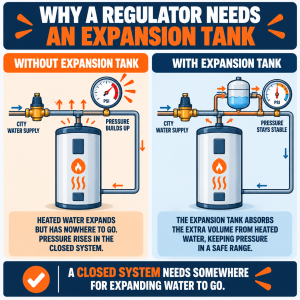
That’s why the UPC (Section 608.2) requires an approved expansion tank on the cold water piping downstream of each regulator, to keep expansion from creating excessive pressure and to maintain the regulator’s pressure setting. Where that code applies, this is a requirement, not an optional upgrade. Local codes and amendments differ, so confirm what your area requires.
Without a tank, pressure can spike every time water heats. Signs can include a relief valve on the water heater that drips or discharges, banging or creaking pipes, faucets or toilet fill valves that leak or run, and extra wear on hoses, fixtures, and appliances.
If you already have a regulator and no expansion tank, or you’re not sure, ask a plumber to check. A gauge left on a hose bib can also help: pressure that climbs while the water heater runs, with no water in use, can point to expansion.
Some regulator swaps are within reach of a careful DIYer, but bring in a licensed plumber when:
Some areas require a permit or a licensed installer for work on the main supply, so check with your local building department before you start.
✏️ Our Take
Choosing a regulator is mostly about confirming a number and a size. Measure static pressure first: above 80 psi you need one, and 50 to 60 psi is where most homes run comfortably. Match the size to your supply line, leave headroom for a busy household, and don’t skip the expansion tank. It’s the part most likely to be forgotten, and it’s the one the code specifically requires.
If the job means cutting into your main supply line, your pressure reads above 80 psi, or you aren’t sure your setup will meet code, find a licensed professional in your area at PlumberArchive.com — the US plumber directory with 12,151+ verified local plumbers across all 50 states.
Get weekly plumbing tips, honest tool reviews and DIY guides delivered to your Facebook feed.
Measure static pressure with a gauge on a hose bib while all water in the house is off. Above 80 psi, the plumbing codes require a regulator. Between 60 and 80 psi you’re under the code ceiling but above the WaterSense cap, so it’s a judgment call. Symptoms like banging pipes or short-lived fixtures are reasons to test, not proof of high pressure.
Pressure can spike each time the water heater heats, because expanding water has nowhere to go in a closed system. That can show up as a dripping relief valve, banging pipes, leaking fixtures, and extra wear on hoses and appliances. The UPC requires an expansion tank downstream of the regulator, so skipping it can also mean a code problem.
Yes. The regulator’s connection size has to match the supply line where it’s installed, so measure or read the pipe markings first. Remember that nominal size and actual outside diameter differ, and check your pipe material too, since it affects which connection style will work.
Sometimes, such as replacing an existing regulator with a compatible one. A new installation usually means shutting off and cutting into the main supply line, adding a strainer where required, and adding an expansion tank, and some areas require a permit or a licensed installer. If you’re unsure about any of that, hire a plumber.
They’re often said to last roughly 10 to 15 years, but real service life varies with water quality, pressure and maintenance, and many can be repaired with a service kit instead of being replaced.
Start with the number: static pressure above 80 psi is what makes a regulator a requirement, and most homes run comfortably at 50 to 60 psi. Then match the size to your supply line, check that it can keep up with your household’s busiest moments, and plan for the expansion tank that goes with it. Once you know your specs, our best pressure regulator valves roundup has our picks, and after installation our guide to adjusting a pressure regulator valve covers setting and checking it.
✍️ About This Guide
PTR Editorial Team — Plumbing Guides. We compare manufacturer specifications, installation requirements, compatibility and available product documentation to help homeowners choose suitable tools and parts. How we review →
Make a PEX crimp or clamp connection step by step: ring and clamp placement, gauge checks, failed joints and code notes from maker sheets.
Install a bathroom sink pop-up drain assembly step by step: remove the old stopper, seat the flange, connect the pivot rod, and adjust the lift rod strap.
Replace or install a submersible sump pump in an existing pit: disconnect power, set the pump, connect the discharge pipe and check valve, then test.

