Comparisons
2 Oct 2026

Pop-Up Drain vs Grid Drain: Which Should You Choose?
Pop-up drains seal to hold water; grid drains never close but resist clogs better and cost less. Here's how to choose between them for your bathroom sink.
A few inches of bowl length changes more than you'd expect — here's how round and elongated toilets actually compare on space, comfort, and fit.
Please note: Information in this comparison is based on our research at time of writing and is general in nature. Always confirm a specific toilet model’s bowl dimensions before purchasing.
Shop for a new toilet and one of the first choices you’ll run into has nothing to do with flush power, water efficiency, or how the toilet is built — it’s bowl shape. Round and elongated toilets differ primarily in bowl length, and that difference in length is what actually matters here: how much floor space the toilet occupies, how comfortable it is to sit on for different body types, and even which add-on accessories, like elevated or raised toilet seats, will fit it later on.
This isn’t a question of which shape performs better. Both round and elongated bowls are available across the same range of flush technology, height options, and construction styles, so bowl shape is a space-and-comfort decision that can be made independently of everything else on your toilet shopping list. This guide breaks down exactly what separates the two shapes, where each one makes practical sense, and how to decide which fits your bathroom.
At a Glance
Round Bowl
Elongated Bowl
✏️ Our Take
Elongated bowls have become the default in most new US homes for good reason — the extra couple of inches genuinely improves seated comfort and support for most adults, and it’s now the shape most manufacturers design their accessories and replacement parts around. Round bowls haven’t disappeared, though, and they remain a practical choice specifically for smaller bathrooms or powder rooms where a few inches of floor space actually matters. This isn’t a decision about which toilet performs better — it’s about matching the bowl shape to your bathroom’s space and who’s using it.
IN THIS GUIDE
Here’s how round and elongated bowls stack up on the factors that actually matter when deciding between them.
| Factor | Round Bowl | Elongated Bowl |
|---|---|---|
| Bolt-to-front measurement | Roughly 16.5 inches | Roughly 18–19 inches |
| Footprint | More compact, saves floor space | Larger, needs more clearance |
| Seated comfort | Adequate, less surface area | More support for most adults |
| Best suited for | Small bathrooms, powder rooms, tight layouts | Standard and larger bathrooms |
| Common in new US construction | Less common | The current default |
| Accessory and parts availability | Narrower selection | Widest selection |
| Flush technology, water efficiency | Same range as elongated | Same range as round |
The distinction between round and elongated toilets comes down to a single measurement: the distance from the two mounting bolts at the back of the bowl to its front edge. A round bowl typically measures roughly 16.5 inches over that distance, with a more circular, compact front edge. An elongated bowl typically measures roughly 18 to 19 inches, with a more oval, egg-like shape that extends further forward. That extra couple of inches is the entire distinction between the two shapes.
What this measurement doesn’t dictate is anything about how the toilet actually performs. Both round and elongated bowls are manufactured across the same range of flush technology — gravity-fed, pressure-assisted, dual flush, and more — the same range of seat heights, including standard and comfort height options, and the same range of construction styles, whether one-piece or two-piece. Bowl shape is simply one more spec on the list, and it can be decided independently of all of those other choices rather than treated as a package deal.
This also means the decision isn’t really about “better” or “worse” — it’s about which length actually fits your bathroom and suits the people using it. A few inches sounds trivial on paper, but in a small bathroom or for someone who spends real time seated, it’s a genuinely noticeable difference in daily use.
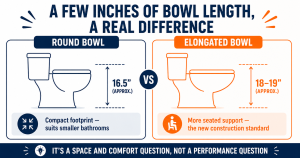
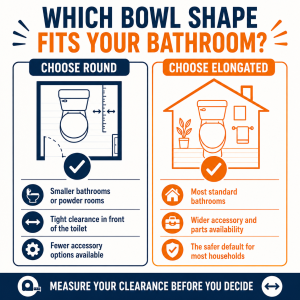
This is where a round bowl’s more compact footprint genuinely earns its keep. In a smaller bathroom, a powder room, or any layout where floor space in front of the toilet is already tight, those couple of inches of bowl length can be the difference between a comfortable amount of clearance and a bathroom that feels cramped every time you walk in. It’s a small measurement that has an outsized effect on how usable a tight space actually feels.
Most US building codes specify a minimum clearance requirement in front of a toilet, along with minimum side clearances from walls or other fixtures. In a spacious bathroom, meeting these requirements is rarely a concern regardless of bowl shape. In a cramped layout — a powder room tucked under a staircase, a small half-bath, or an older home with a narrower original footprint — a round bowl can make the difference between a layout that comfortably clears code and one that requires a redesign to fit an elongated bowl.
If your bathroom has generous floor space, this consideration mostly disappears, and the choice comes down to comfort and accessory compatibility instead. But it’s worth actually measuring before assuming space isn’t a factor, since a few inches is easy to underestimate until you’re standing in the room with a tape measure.
Elongated bowls offer more seated surface area, and most adults find that extra length noticeably more comfortable and supportive for everyday use. This is the primary reason elongated has become the standard shape in new US construction and remodels — it’s simply a more comfortable default for the average adult body, and manufacturers have shifted their lineups accordingly.
Round bowls can still be perfectly comfortable, though, and the comfort gap matters less in some households than others. Families with young children sometimes find a round bowl’s smaller size easier for kids to use confidently, and in bathrooms where space constraints make an elongated bowl impractical, a round bowl’s comfort tradeoff is often a reasonable one to accept in exchange for a workable layout.
Comfort here is somewhat individual, tied to a person’s own body size and proportions as much as it is to bowl length on paper. Someone who’s never found a round bowl uncomfortable may not notice much difference switching to elongated, while someone else might find the extra support immediately obvious. It’s worth factoring in who actually uses the bathroom most, not just the general trend toward elongated.
Because elongated has become the more common bowl shape in new construction, a large share of toilet seats, replacement hardware, and accessories are manufactured with elongated as the primary — and sometimes only — option. Walk down the toilet seat aisle at most hardware stores and elongated models will typically outnumber round ones by a wide margin, and the same pattern shows up online.
This is especially relevant if you anticipate needing an accessibility product like an elevated or raised toilet seat down the road, whether for yourself or a family member. Our elevated toilet seat reviews cover this in more detail, but the short version is that round-bowl-compatible options do exist — they’re just a narrower selection than what’s available for elongated bowls. If you’re buying a new toilet today and want to keep every future accessory option open, elongated gives you more choices later. If you’re simply replacing a standard seat rather than adding height, our general toilet seat reviews cover options across both bowl shapes.
None of this makes a round bowl impractical — plenty of accessories and replacement parts are made for round toilets, and manufacturers aren’t discontinuing round-bowl support anytime soon. It’s simply a narrower selection to shop from, which is worth knowing before you commit to a bowl shape rather than discovering it later when you’re specifically looking for a round-compatible product.
No, not meaningfully. Bowl shape alone doesn’t determine flush power, water efficiency, or how resistant a toilet is to clogging. Those characteristics come down to the specific model’s flush engineering — the trapway design, the flush valve, and the overall mechanism — which is a separate set of decisions manufacturers make independently of whether the bowl is round or elongated.
Both round and elongated toilets are available across the full range of flush technology and water-efficiency ratings on the market today, from standard gravity-fed models to high-efficiency and dual-flush designs. You can find a strong-flushing round toilet and a weak-flushing elongated one just as easily as the reverse, so flush performance should be evaluated by reading reviews and specs for the specific model you’re considering, not assumed based on bowl shape.
In practice, this means you’re free to prioritize bowl shape based on space and comfort, and separately shop for flush performance based on the individual toilet model’s own track record, without worrying that one shape is quietly giving up flushing power to the other.
For most standard bathrooms and households, elongated is the safer default. It offers more seated comfort for most adults, it’s the shape most new toilets are designed around, and it gives you the widest selection of seats, accessories, and replacement parts if your needs change down the road. If your bathroom has reasonably generous floor space, there’s rarely a strong reason to choose round instead.
Choose round specifically when you have a genuine space constraint — a small bathroom, a powder room, or a tight layout where a few inches of clearance in front of the toilet actually changes whether the room feels usable. In those situations, the compact footprint solves a real problem, and it’s worth accepting a smaller accessory selection and a slightly less supportive seat in exchange for a layout that actually works.
If you’re replacing a toilet without a strong space constraint pushing you toward round, elongated is generally the safer long-term choice given its wider part and accessory availability. Measure your available clearance first, though — that single number should drive the decision more than general trends or personal preference alone.
If you’re replacing a toilet and want help confirming clearances or handling the installation itself, search PlumberArchive.com — the US plumber directory with 12,000+ verified local plumbers across all 50 states.
Get weekly plumbing tips, honest tool reviews and DIY guides delivered straight to your Facebook feed.
The difference comes down to roughly 2 to 2.5 inches, measured from the mounting bolts at the back of the bowl to its front edge. A round bowl typically measures around 16.5 inches over that distance, while an elongated bowl typically measures 18 to 19 inches. It sounds like a small gap on paper, but in a tight bathroom layout, that difference in how far the bowl extends into the room can meaningfully change how much clearance you have to work with.
Often, yes, but it depends on your specific layout. Measure the available clearance in front of where the toilet will sit and compare it against your local building code’s minimum clearance requirement plus the extra couple of inches an elongated bowl needs versus round. Some small bathrooms have enough room to spare that the difference doesn’t matter; others are tight enough that a round bowl is genuinely the more practical choice. When in doubt, measure before you buy rather than assuming either shape will fit.
Yes, though the selection is narrower than what’s available for elongated bowls. Because elongated has become the more common shape in new construction, most manufacturers design their elevated and raised toilet seat products around elongated bowls first, with round-bowl-compatible versions as a smaller subset of the lineup. Our elevated toilet seat reviews include round-compatible options if this is a factor in your decision, and our installation guide walks through fitting one once you’ve confirmed compatibility.
No. Flush power, water efficiency, and clogging resistance come down to the specific toilet model’s flush engineering, not whether the bowl is round or elongated. Both shapes are manufactured across the same range of flush technology, so a strong or weak flushing toilet can come in either bowl shape. Evaluate flush performance by researching the specific model you’re considering rather than assuming one bowl shape flushes better than the other.
Round and elongated toilets aren’t competing on performance — bowl shape is a space-and-comfort decision, not a quality one. Elongated has become the practical default for most US households thanks to better seated support and wider accessory availability, and it’s the safer choice whenever your bathroom has the room for it. Round remains genuinely useful specifically where floor space is tight, letting a compact footprint solve a real layout problem that comfort alone can’t fix. Measure your bathroom, think about who’s using it, and the right bowl shape becomes a straightforward call.
Prices and ratings may change. Always check Amazon for current prices.
✍️ About This Comparison
PTR Editorial Team — Product Comparisons. We compare manufacturer specifications, installation requirements, compatibility and available product documentation to help homeowners choose suitable tools and parts. How we review →
Pop-up drains seal to hold water; grid drains never close but resist clogs better and cost less. Here's how to choose between them for your bathroom sink.
Test strips, digital meters or send-to-lab testing? Match the method to your situation — screening, ongoing monitoring, or a real health concern.
25-foot vs 50-foot drain snake: compare handling, the cable diameter trade-off and the jobs that justify extra length, plus where 50 feet stops.

