Comparisons
20 Sep 2026

Utility Pump vs. Sump Pump (2026) — Which Do You Need?
Utility pump vs sump pump: one is portable for occasional jobs, the other a permanent install for ongoing water. See which your basement needs.
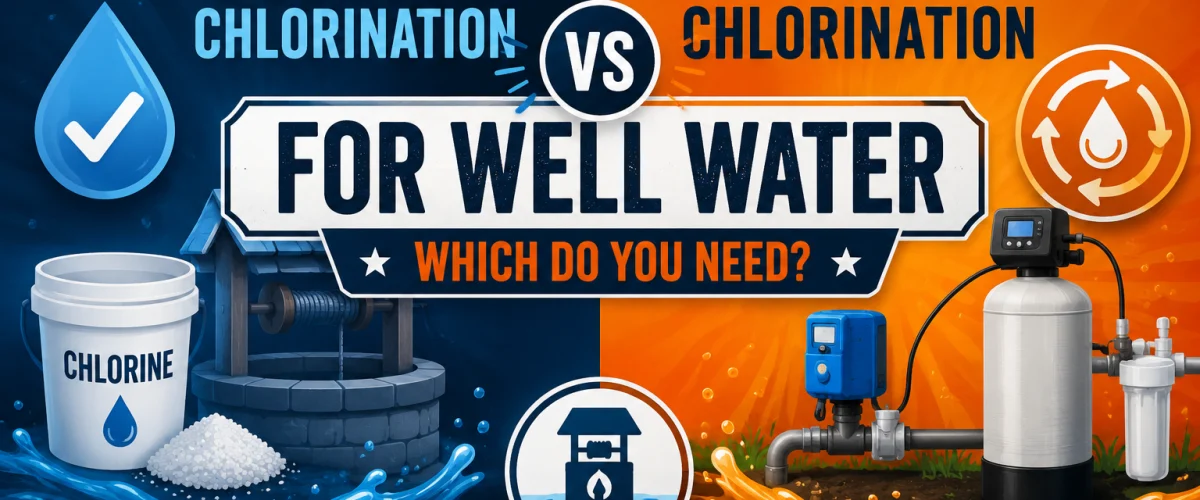
A one-time contamination event and a recurring bacteria problem call for different fixes — here's how shock chlorination and continuous chlorination actually compare.
Please note: Water treatment details referenced here are based on our research at time of writing and are general in nature. Always work with a certified lab and a qualified water treatment professional for testing and treatment decisions specific to your well.
A positive bacteria test on a private well doesn’t have just one standard fix — the right response depends on why the test came back positive in the first place. If a single test comes back positive after something that looks like an isolated event — recent well servicing, nearby flooding, or a well cap that turned out to be compromised — shock chlorination is typically the appropriate starting point. It’s a one-time treatment designed to disinfect the well and plumbing after a specific contamination event, not an ongoing system.
A recurring or persistent positive result is a different situation entirely, and it’s what points toward considering continuous chlorination instead: an installed treatment system that doses chlorine into the water supply on an ongoing basis rather than as a one-time response. This comparison walks through how each treatment actually works, how to tell which situation you’re in, what it costs to maintain each one, and when a well contractor should get involved. If you’re new to private well ownership generally, our well water vs municipal water comparison covers the broader testing and maintenance responsibilities that come with being on a well.
At a Glance
Shock Chlorination
Continuous Chlorination
✏️ Our Take
These two treatments solve different problems, and the test results that led you here are usually the best guide to which one applies. Shock chlorination is the standard first response to a single positive bacteria test, especially after a clear cause like flooding, well servicing, or a compromised well cap — it’s a one-time disinfection, not an ongoing system. Continuous chlorination is a different category entirely: an installed treatment system for wells with a persistent or recurring contamination source that shock chlorination alone hasn’t resolved. Most well owners will only ever need shock chlorination, and jumping straight to a continuous system without first confirming the problem is actually recurring is usually more than necessary.
IN THIS GUIDE
Before going section by section, here’s how the two treatments stack up on the factors well owners care about most.
| Factor | Shock Chlorination | Continuous Chlorination |
|---|---|---|
| Treatment type | One-time disinfection | Ongoing installed system |
| Best for | A single positive test tied to an isolated event | A confirmed, recurring contamination source |
| Equipment required | None left installed afterward | Feed pump, contact tank, typically a carbon filter |
| Upfront cost | $ | $$$ |
| Ongoing maintenance | None — treatment is complete once flushed and retested | Chlorine refills, pump servicing, filter replacement |
| Who typically performs it | DIY with guidance, or a well contractor | A licensed water treatment professional |
| Follow-up required | Retest to confirm the issue is resolved | Periodic monitoring of chlorine residual |
Shock chlorination starts with introducing a concentrated chlorine solution directly into the well itself. From there, the solution is circulated through the home’s entire plumbing system — every faucet, showerhead, and fixture is run briefly so the chlorinated water reaches every branch of the system, not just the well and the main line. This step matters because bacteria can be present anywhere water sits, not only in the well itself.
Once circulated, the chlorine solution is left to sit in the well and plumbing for a specified contact period, typically several hours and often overnight, to give it enough time to disinfect thoroughly. After that contact period, the system is flushed — first outdoors where the chlorinated water won’t affect landscaping or a septic system, and then through indoor fixtures — until the chlorine odor clears completely and the water runs clean.
The process isn’t considered finished at that point, though. A retest through a certified lab is the step that actually confirms the treatment worked — flushing away the chlorine smell only means the chemical has cleared, not that the bacteria issue is resolved. That retest, typically done a week or two after treatment, is what tells you whether the contamination was addressed or whether something else is going on.
Continuous chlorination works on a completely different principle than shock chlorination — instead of a single strong treatment, it’s a permanently installed system that doses a small, precisely controlled amount of chlorine into the water supply every time water is used. The goal isn’t a one-time disinfection event; it’s maintaining a low, consistent chlorine residual in the water at all times to keep bacteria from re-establishing itself.
A dedicated chlorine feed pump injects the chlorine solution into the water line as water flows from the well, typically triggered by a flow switch or the well pump’s own cycling. From there, the water passes into a contact tank, sometimes called a retention tank, sized to hold the water long enough for the chlorine to fully disinfect it before it reaches any fixture in the home — this contact time is essential to the system actually working as intended.
Because a continuous low-level chlorine residual affects taste and odor, most continuous chlorination setups include a carbon filter installed after the contact tank, positioned to remove the chlorine taste and smell before water reaches the home’s fixtures without undoing the disinfection that already happened upstream. The combination of feed pump, contact tank, and carbon filter is what makes continuous chlorination a genuine system rather than a single piece of equipment — for homeowners comparing carbon filtration options for this stage, our whole-house water filter reviews covers standalone systems built around the same filtration technology.
A single positive bacteria test is the most common trigger for shock chlorination, particularly when there’s a clear or likely one-time cause behind it. Recent well servicing — anything from a pump replacement to routine maintenance that involved opening up the well — can introduce bacteria that a shock treatment clears out. Nearby flooding is another common trigger, since surface water can temporarily reach a wellhead or casing during heavy rain or runoff. A well cap that turned out to be cracked, loose, or otherwise compromised, and that’s since been repaired or resealed, is a third typical scenario.
In all of these situations, the contamination event has an identifiable cause and, importantly, that cause has already been addressed or has passed. That combination — a specific trigger plus a fixed or resolved cause — is what makes shock chlorination the appropriate starting point rather than a continuous system. This is also the situation the vast majority of well owners find themselves in: a first-time positive result rather than a documented pattern of recurring contamination.
Shock chlorination is worth treating as the default first response for any first-time positive test, even when the cause isn’t perfectly clear. It’s a modest, well-established process, and in most cases it resolves the issue on its own without needing to escalate to anything more involved.
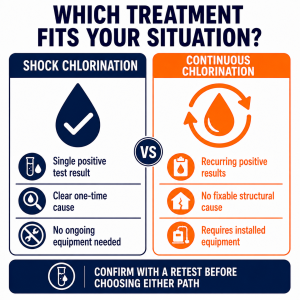
Continuous chlorination becomes worth considering when bacteria contamination returns repeatedly even after shock chlorination and a clean retest — in other words, when the pattern itself, not a single result, is what’s pointing toward an ongoing rather than isolated problem. A well that tests positive again a few months after a successful shock treatment and retest, with no new servicing or flooding event to explain it, is showing signs of a recurring source rather than a one-time fluke.
A well with an identified ongoing contamination source that can’t be physically fixed is another scenario where continuous chlorination fits. This might include unavoidable proximity to a contamination source — a septic system, agricultural runoff, or livestock area situated closely enough to the well that no amount of one-time disinfection will keep bacteria from re-entering. In these cases, the source itself is a fixture of the property rather than something a repair can eliminate.
A third scenario is when a full well inspection has already ruled out a fixable structural cause — no cracked casing, no failed cap, nothing a repair would resolve — yet contamination keeps showing up on retests. When a well contractor or inspector has confirmed there’s no structural fix available, continuous chlorination becomes the practical path forward rather than repeating shock treatments indefinitely.
A persistent positive result after shock chlorination and a proper retest is the point to bring in a well contractor for a full inspection rather than repeating the shock treatment on your own again. A licensed contractor can check for a damaged well cap or casing that wasn’t obvious during a visual check, evaluate the well’s overall physical construction for gaps that could be letting surface water or contaminants in, and assess whether the property has a genuine, ongoing proximity to a contamination source.
This inspection is what typically determines the actual next step. If the contractor finds a fixable structural issue — a cracked casing, a compromised seal, a cap that isn’t sealing correctly — repairing that issue followed by another round of shock chlorination and a retest is usually the appropriate path. If the inspection instead confirms there’s no fixable structural cause and the contamination keeps returning, that’s the scenario where a continuous chlorination system becomes the appropriate next step rather than an unnecessary escalation.
Shock chlorination is a modest, largely one-time cost. The chlorine solution itself is inexpensive, and the only other cost is either your own time if you’re comfortable handling it yourself with guidance from your state health department, or a service call if you’d rather hire a well contractor to perform it. Either way, price tier $ covers the typical range, and there’s no ongoing cost afterward beyond an occasional retest if you want to confirm water quality periodically going forward.
Continuous chlorination carries a meaningfully higher cost profile on both ends. The upfront equipment cost — the feed pump, contact tank, and carbon filter, plus professional installation — typically falls in the $$$ to $$$$ range depending on the well’s flow rate and the specific equipment selected. Beyond installation, ongoing costs continue indefinitely: periodic chlorine solution refills for the feed pump, regular servicing to keep the pump and tank functioning correctly, and carbon filter replacement on a schedule to keep chlorine taste and odor under control at the tap.
That gap in cost and ongoing commitment is exactly why confirming a genuinely recurring issue before installing continuous chlorination matters — it’s not a decision to make based on a single test result alone.
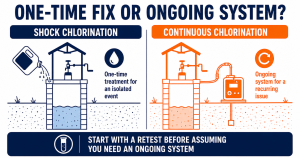
The decision framework here is fairly straightforward once you look at it through the lens of test results rather than personal preference. Start with shock chlorination and a retest for any first-time positive result — this is the correct starting point for virtually every well owner, regardless of how the contamination happened, as long as there’s no already-documented history of recurring issues. Most wells that test positive once, and are treated and retested properly, never test positive again.
Continuous chlorination only becomes worth considering after a documented recurring issue — meaning the contamination has returned despite proper shock treatment and retesting — and after a well inspection has specifically ruled out a fixable structural cause. Skipping either of those steps means installing a permanent system to solve a problem that might have had a simpler, one-time fix.
If you’re at the very start of this process and haven’t yet tested your well, our guide on how to test for bacteria in well water walks through sample collection and lab testing before any treatment decision is relevant at all.
Whether you need help performing a shock chlorination treatment, want a well inspection after a recurring positive test, or are considering a continuous chlorination system, search PlumberArchive.com — the US plumber directory with 12,000+ verified local plumbers across all 50 states.
Get weekly plumbing tips, honest tool reviews and DIY guides delivered straight to your Facebook feed. We cover water quality, water treatment, and everything in between — written for US homeowners who want to make smart decisions without overspending.
Many well owners perform shock chlorination themselves using guidance from their state health department or extension office, and it’s a well-documented, routine process rather than a specialized one. That said, if you’re not comfortable handling concentrated chlorine solution, unsure about your well’s specific setup, or would simply rather not do it yourself, hiring a licensed well contractor to perform the treatment is a perfectly reasonable option. Either way, the follow-up retest through a certified lab is the step that actually confirms the treatment worked, so don’t skip it regardless of who performs the chlorination itself.
The active treatment — introducing the chlorine solution, circulating it through the plumbing, and letting it sit for the contact period — typically takes the better part of a day, since the contact period alone is usually several hours and often left overnight. Flushing the system afterward until the chlorine odor clears can take another few hours. The full process isn’t considered complete until the follow-up retest comes back, which is usually sent to a certified lab and can take about a week to ten days to return results.
It can, since the system is designed to maintain a small, ongoing chlorine residual in the water at all times, and chlorine taste and odor are noticeable to many people even at low levels. This is exactly why most continuous chlorination systems include a carbon filter installed after the contact tank — its job is specifically to remove that taste and odor before the water reaches household fixtures, without undoing the disinfection that already happened upstream in the contact tank.
It’s standard practice on virtually every residential continuous chlorination installation, because without it, the household water supply would carry a noticeable chlorine taste and smell at every fixture indefinitely. The carbon filter is positioned after the contact tank specifically so the required disinfection contact time happens first, and only then is the chlorine taste and odor filtered out before water is actually used. A water treatment professional can confirm the right filter sizing and replacement schedule for your specific system and household water usage.
Shock chlorination and continuous chlorination solve genuinely different problems, and the path between them runs through your test results rather than personal preference. A first-time positive bacteria test, especially one with a plausible one-time cause, calls for shock chlorination and a retest — that combination resolves the issue for the vast majority of well owners. Continuous chlorination is a separate category reserved for a documented recurring problem that a well inspection has confirmed can’t be fixed structurally.
If you’re dealing with a positive test result right now, the calm and practical next step is the same regardless of which treatment you eventually need: confirm the result with a certified lab, treat with shock chlorination if it’s a first occurrence, and retest before assuming anything more is required. From there, a qualified water treatment professional or well contractor can guide the specific decision for your well.
Prices and ratings may change. Always check Amazon for current prices.
✍️ About This Comparison
Written by Sarah Mitchell, Home Improvement Editor at PlumbingToolsReview — specializing in helping homeowners make smart buying decisions without overspending. Learn how we test →
Utility pump vs sump pump: one is portable for occasional jobs, the other a permanent install for ongoing water. See which your basement needs.
Pipe repair clamp, tape, or epoxy — which should you use for a leaking pipe? Compare how each works, durability, and when to reach for which.
Not sure if your home has a septic tank or a sewer connection? Learn how to tell which one you have, plus the maintenance and cost differences.

