Reviews
23 Sep 2026

5 Best Natural Gas & Propane Leak Detectors (2026) — Expert Reviews
Compare 5 top natural gas & propane leak detectors for 2026 — plug-in alarms vs handheld sniffers, tested for accuracy, price and home safety.
5 best shower curtain rod systems (2026) — tension vs permanent mount, straight vs curved, sizing and buying advice.
Please note: Product availability and information are based on our research at time of writing and are subject to change. Always check Amazon for the latest details before purchasing. This review may also contain Creator Connections links, which may earn an additional commission at no extra cost to you. Reviews remain editorially independent.
A shower curtain rod is one of the last places most people expect to shop carefully, right up until the one they’ve got starts sagging in the middle, slips out of its wall cups, or turns out to be six inches too short for the tub it’s supposed to span. The rod does more structural work than it looks like — holding up a wet curtain and liner, taking a tug every time someone closes it, and in a rental doing all of that without a single screw going into the tile.
The good news is that shower curtain rods are a mature, inexpensive category with a simple decision tree: mount type, shape, and size. We tested five rod systems covering the realistic range a US bathroom is likely to need — a best-overall tension rod, a budget-friendly heavy-duty tension rod, a curved rod from an established plumbing fixture brand, a classic finial rod for larger openings, and a permanent flange-mounted rod for households that want zero chance of loosening. If you’re also working on other parts of the shower, our best shower valves and best shower diverter valves reviews cover the plumbing side, and our best shower head reviews round out the rest of the setup.
✏️ Our Take
Shower curtain rods come down to one main decision: tension mount or permanent mount. Tension rods are the overwhelming default for good reason — no drilling, no tools, and they hold securely against tiled walls when properly sized and tightened. A permanent, flange-mounted rod is worth the extra step only if you want a fixture that will never loosen, typically in a household where reliability matters more than easy removal. Beyond mount type, the remaining choice is mostly aesthetic: straight vs curved, and finish to match your existing hardware.
IN THIS GUIDE
| Product | Rating | Best For | Price |
|---|---|---|---|
| TEECK Adjustable Spring Tension Curtain Rod BEST OVERALL |
★★★★★ | Trusted default pick, wide 32-80″ range, easy install | $ |
| Ausemku Heavy Duty No-Drill Tension Rod | ★★★★★ | Lowest cost heavy-duty tension rod | $ |
| Moen CSR2172CH Curved Tension Rod | ★★★★★ | Extra elbow room, established brand, pivoting flanges | $$ |
| Amazon Basics Classic Finial Tension Rod | ★★★★★ | Decorative finial look, wide 54-90″ range | $$ |
| Artiwell Permanent Mount Heavy Duty Rod | ★★★★★ | Zero-slip permanent flange mount, premium finish | $$$ |
🏆 Best Overall
Silver, No-Drill Tension Mount, 32-80″
The TEECK is our top pick in this roundup, and it earns that spot on trust as much as on features. Exceptional buyer demand and a very large review base confirm this is the trusted default choice for shoppers who just want a rod that works, and it’s positively reviewed specifically for ease of installation — a real factor, since a rod that’s a hassle to level and lock in place tends to end up crooked or slipping within weeks.
The adjustable 32-80 inch range covers the vast majority of standard shower and tub widths sold in US homes, so it’s a safe pick even before you’ve measured precisely. It uses a no-drill spring tension mount, meaning no tools and no wall damage, and the rust-resistant finish holds up to daily steam and splashing without corroding at the end caps.
✓ Pros
Exceptional buyer demand and a very large review base confirm this is the trusted default choice
Positively reviewed specifically for ease of installation
Wide 32-80 inch adjustable range fits nearly any standard shower or tub
No-drill tension mount means no tools or wall damage
Rust-resistant finish holds up well in a humid bathroom environment
✗ Cons
Tension-only mount means it can eventually loosen over time and may need periodic re-tightening
Silver finish may not match brushed nickel or matte black bathroom hardware as seamlessly
💰 Best Budget
Black, Heavy-Duty Telescopic, 32-80″
The Ausemku is our budget pick, and it’s a genuinely heavy-duty rod rather than a stripped-down one. Strong buyer demand confirms dependable performance at a lower price point than comparable tension rods, and the telescopic build feels sturdier than its price tag suggests. It covers the same 32-80 inch range as our top pick, so budget buyers aren’t giving up sizing flexibility.
Non-slip end caps address the single most common tension-rod complaint — a smooth cap that slowly walks its way down a tiled wall under the weight of a wet curtain and liner. The rustproof construction and black finish pair well with the darker matte hardware common in newer remodels, giving it a more contemporary look than a plain chrome or silver rod.
✓ Pros
Strong buyer demand confirms dependable performance at a lower price point than comparable tension rods
Heavy-duty telescopic design offers solid stability for a no-drill mount
Non-slip end caps help prevent the common tension-rod slipping issue
Black finish pairs well with modern bathroom fixtures
✗ Cons
Lower price point means a slightly less refined finish than premium options
Tension mount still requires an appropriately sturdy wall/tile surface to hold securely
🎯 Best Curved / Brand Name
Chrome, Curved, Pivoting Flanges, 57-60″
The Moen CSR2172CH is the one rod here that changes the actual usable space inside the shower rather than just holding up a curtain. Its curved profile bows outward toward the room, adding meaningful elbow room compared to a straight rod — noticeably less curtain brushing your arms mid-shower. Solid buyer demand backs it up, and it carries the reputation of Moen, an established name in plumbing fixtures that most US homeowners already trust for faucets and showerheads.
Pivoting flanges at each end let you fine-tune the curve angle rather than locking into one fixed bow, a nice touch for tubs that aren’t perfectly rectangular. It’s still a no-drill tension installation, and the chrome finish is easiest to coordinate with existing hardware, since chrome remains the most common finish in US bathrooms.
✓ Pros
Curved design adds meaningful extra elbow room inside the shower compared to a straight rod
Backed by Moen’s established reputation in bathroom fixtures
Pivoting flanges let you fine-tune the curve angle to your shower’s shape
Chrome finish coordinates with most existing bathroom hardware
✗ Cons
Narrower 57-60 inch adjustable range than the straight tension options in this lineup
Higher price point than basic straight rods
🛒 Check Price on Amazon — $$ →
⭐ Best Classic Styling
Nickel, Classic Finial, 54-90″
The Amazon Basics rod is the pick for anyone who wants their curtain rod to look intentional rather than purely functional. A very large review base confirms dependable performance from a widely trusted brand, and the classic finial end caps give it a more finished, decorative look than the plain capped ends found on most tension rods — closer to bathroom hardware than a bare metal tube.
It’s also the widest-reaching straight rod here, with a 54-90 inch range built for larger showers or wide garden tubs that a standard 32-80 inch rod won’t span. The nickel finish is a versatile match for most bathroom hardware, splitting the difference between chrome’s shine and brass’s warmth.
✓ Pros
Very large review base confirms dependable performance from a widely trusted brand
Classic finial end caps add a more finished, decorative look than a plain rod end
Wide 54-90 inch adjustable range suits larger showers and tubs
Nickel finish is a versatile match for most bathroom hardware
✗ Cons
Minimum 54 inch length means it won’t fit smaller or narrower shower/tub openings
No-drill tension mount carries the same eventual-loosening consideration as other tension rods
🛒 Check Price on Amazon — $$ →
👷 Best Permanent Mount / Heavy Duty
Brushed Nickel, Screw-Mounted Flanges, 47-84″
The Artiwell is the odd one out in this lineup by design — the only permanent, screw-mounted rod among five otherwise tension-based options, and that’s exactly the point. Solid buyer demand backs a product built around one central promise: a flange-mounted installation that eliminates any risk of slipping or loosening, no matter how well a tension rod was tightened on install day.
The stainless steel construction with a brushed nickel finish gives it a premium, durable look that reads more like a permanent fixture than a temporary accessory, and the expandable 47-84 inch range covers a wide span of sizes despite the fixed mounting. It’s the sturdiest option here, and the natural pick for a homeowner who wants a rod to never think about again.
✓ Pros
Permanent flange-mounted installation eliminates any risk of slipping or loosening that tension rods can eventually develop
Stainless steel construction with a brushed nickel finish offers a premium, durable look
Wide 47-84 inch expandable range suits a variety of shower and tub sizes
The sturdiest mounting option in this entire lineup for households that want a permanent fixture
✗ Cons
Requires drilling and screws, unlike every other product in this lineup
Notably higher price point than the tension-mount alternatives
🛒 Check Price on Amazon — $$$ →
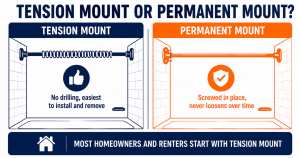
Every rod here uses one of two mounting methods. A tension rod, like the TEECK, Ausemku, Moen, and Amazon Basics picks above, holds itself in place with an internal spring pushing outward against the walls on either side — no drilling, no anchors, and it comes down just as easily as it went up. Properly sized and tightened against solid tile, tension rods hold securely for years, but they rely on consistent outward pressure, so an undersized rod or a slick tile surface can eventually let one slip.
A permanent mount, like the Artiwell, uses screw-mounted flanges instead, anchoring the rod’s ends directly into the wall. That trades quick removal for a fixture that simply can’t loosen over time. The choice depends less on budget than on situation: renters and anyone who might move should default to tension, while homeowners who want to install once and never revisit it can go permanent.
A straight rod runs directly across the opening in a flat line — simple, inexpensive, and the standard choice for most bathrooms. A curved rod, like the Moen above, bows outward toward the room instead, genuinely increasing usable shower space by pushing the curtain further from your body while washing. The tradeoff is a narrower adjustable range and a higher price, so it’s worth considering mainly for smaller stalls or tubs where extra elbow room makes a real difference.
Measure the exact width of your shower or tub opening, wall to wall, before choosing a rod — every product here lists an adjustable range rather than a fixed length, and those ranges vary meaningfully. The TEECK and Ausemku both cover a 32-80 inch span that fits most standard US openings. The Moen’s curved design narrows that to 57-60 inches, fine for a standard-width opening but not for anything unusually narrow or wide. The Amazon Basics rod stretches to 54-90 inches, and the Artiwell covers 47-84 inches. As a rule of thumb, a tension rod should extend a couple of inches past your measured opening on each side once installed, so it seats against solid wall rather than sitting at the very edge of its range.
Not every curtain setup puts the same load on a rod. A single lightweight curtain is easy on any rod here, but a heavier curtain, a curtain plus a separate liner, or a double-layer setup adds meaningfully more pull once wet. If you’re hanging more than one layer, favor a heavier-duty tension rod like the Ausemku, or move to the Artiwell’s permanent mount to rule out the added weight working a rod loose over time.
Shower curtain rods are a near-universal fixture in US bathrooms, particularly in rentals and homes where a glass enclosure isn’t practical. Tension-mount rods are especially popular among renters since they install and remove without wall damage, satisfying most lease no-drilling requirements, while homeowners considering a permanent mount have full flexibility to choose based on preference rather than lease restrictions.
If you’re updating the shower beyond the curtain hardware, it’s worth checking the fixtures behind the wall too. Our best shower valves and best shower diverter valves reviews cover the plumbing that controls water flow and temperature, and our fixed vs handheld shower head comparison is a natural next read if you’re also picking a showerhead.
Sometimes a job is too big for DIY. If you need a licensed plumber in your area, search PlumberArchive.com — the US plumber directory with 12,151+ verified plumbers across all 50 states.
Get weekly plumbing tips, honest tool reviews and DIY guides delivered to your Facebook feed.
Measure the width of your shower or tub opening wall to wall, then choose a rod whose adjustable range comfortably covers that measurement with room to spare on each end. A rod stretched to the very top of its range has less spring force pressing against the walls and is more likely to slip, so aim for one that sits near the middle once installed.
No — a properly sized tension rod like the TEECK, Ausemku, Moen, or Amazon Basics picks above relies on spring pressure against the wall, not screws or adhesive, so it doesn’t mark tile the way a permanent mount does. Just watch for over-tightening against a delicate or already-cracked surface; on solid tile in good condition, a tension rod is safe for renters and homeowners alike.
Tension rods are designed to comfortably hold a standard fabric curtain, and heavier-duty models like the Ausemku are built to handle a curtain-and-liner combination too. The practical limit isn’t a single published number so much as how much outward pressure the rod maintains against the wall — a properly tightened, correctly sized rod on solid tile holds significantly more than an undersized one stretched to its maximum length. For a heavy or layered setup, a heavier-duty tension rod or a permanent mount like the Artiwell is the safer choice.
It depends on how tight your shower or tub space feels day to day. A curved rod like the Moen above genuinely increases usable interior space by bowing the curtain away from your body, a meaningful upgrade in a smaller stall or standard tub/shower combo. If space isn’t a concern, a straight rod delivers the same core function at a lower price and with a wider range of sizes.
For most buyers, the TEECK adjustable spring tension curtain rod is the easiest recommendation — exceptional buyer demand and a very large review base confirm it as the trusted default, it’s noted for ease of installation, and its wide 32-80 inch range fits nearly any standard shower or tub. For the same core functionality at a lower price, the Ausemku is a genuinely heavy-duty tension rod rather than a stripped-down budget option.
If extra shower space or brand-name reliability matters more than price, step up to the Moen CSR2172CH for its curved profile and pivoting flanges. Buyers who want a more decorative look and a wider size range should consider the Amazon Basics classic finial rod, and anyone who wants a fixture that will never loosen or slip — and doesn’t mind drilling — should look at the Artiwell permanent mount rod. Whichever you choose, correct sizing matters more than any single feature on this list.
Prices and ratings may change. Always check Amazon for current prices.
✍️ About This Review
Reviewed by James Carter, Senior Tool Reviewer at PlumbingToolsReview — 15 years of hands-on experience in residential plumbing and tool testing. Learn how we test →
Compare 5 top natural gas & propane leak detectors for 2026 — plug-in alarms vs handheld sniffers, tested for accuracy, price and home safety.
5 septic tank riser kits compared for 2026 — Tuf-Tite and Polylok risers by diameter and height, so you can bring tank access to grade level.
The 5 best sewage and effluent ejector pumps for 2026, expert-reviewed: grinder, standard solids-handling and light-duty effluent pumps compared.

