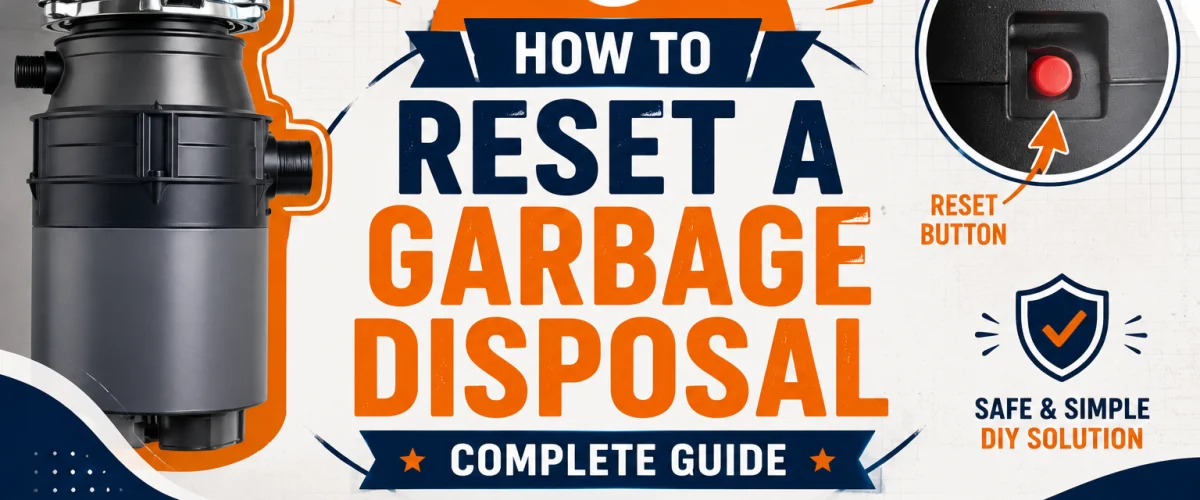
Please note: Information in this guide is subject to change. If your disposal still won’t run after these steps, or you’re uncomfortable working near the unit, consult a licensed plumber before proceeding.
Introduction
A garbage disposal that suddenly stops working almost always fails in one of two ways. Either it’s completely silent when you flip the switch — no sound at all, as if it’s not receiving power — or it hums with a low mechanical buzz but the blades don’t spin. Both symptoms feel alarming the first time they happen, and both send homeowners straight to a search engine wondering if the unit is dead for good.
In the vast majority of cases, neither symptom means the disposal needs replacing. Silence usually points to a tripped breaker or tripped internal safety switch, and humming without spinning almost always means something physical — a bit of food, a bone fragment, a stray utensil — is jamming the flywheel. Both are things you can typically resolve yourself in well under ten minutes, using nothing more than a flashlight and the small hex wrench that likely came packaged with the unit. This guide walks through exactly how to diagnose which symptom you’re dealing with and reset or unjam the disposal safely.
At a Glance
| Symptom 1: Total Silence |
No sound at all when switched on — check power and the breaker first |
| Symptom 2: Humming, No Spin |
A jam — needs manual clearing with a hex wrench before it will run again |
| Tools Needed |
Allen wrench (1/4″ hex key) — usually included with the unit, plus a flashlight and tongs |
| Time Needed |
5–10 Minutes |
✏️ Our Take
A garbage disposal that hums but won’t spin, or goes completely silent, is one of the most common kitchen plumbing complaints — and in the vast majority of cases, it’s not broken. It’s jammed, overheated, or tripped its internal safety switch, and all three of those are things you can fix yourself in under ten minutes with a flashlight and the hex wrench that likely came with the unit. Reaching for the phone before trying a reset is almost always premature.
Why Garbage Disposals Jam or Trip
A garbage disposal’s flywheel spins fast enough to shred most food waste without resistance, but certain materials interrupt that motion. Fibrous foods like celery stalks, corn husks, or onion skins can wrap around the flywheel rather than getting cut apart. Bones and other hard fragments can wedge between the flywheel and the grind chamber wall. Utensils, bottle caps, or other small objects dropped down the drain do the same thing, and any of these can physically stop the flywheel from turning even though the motor is still trying to drive it.
When the motor keeps trying to turn a jammed flywheel, it draws more current than normal and generates more heat than it’s designed to handle continuously. Extended use — grinding a large load at once, or running the unit longer than necessary — can push the motor toward that same overheated state even without a physical jam. The disposal has a built-in thermal overload switch specifically to protect the motor, and that switch is exactly what the small reset button on the underside of the unit controls.
Understanding this distinction matters because it explains why the fix is almost never complicated. A tripped thermal switch just needs resetting once the unit has cooled. A physical jam needs clearing before the flywheel can turn freely again. Neither points to a failed motor or a disposal that’s reached the end of its life — they’re the two most common, most easily resolved reasons a disposal stops responding.
Safety First
This is the single most important section in this guide, and it’s worth reading before you touch the disposal. The blades and flywheel don’t need power flowing to them to cause a serious injury — a manual turn of the flywheel, an unexpected jolt, or simply not being certain the power is actually off is enough to make reaching inside a real risk.
Never put a hand into the disposal chamber, at any point, regardless of how confident you are that the power is off. If you can see an object lodged inside — a spoon, glass, a bottle cap — retrieve it with tongs or needle-nose pliers, never your fingers. Before doing any manual work near the flywheel, confirm power is actually disconnected at the source, not just assumed off because the disposal has stopped responding.
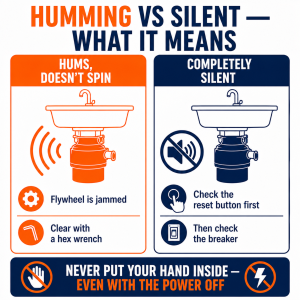
⚠️ Warning: Never put your hand inside a garbage disposal, even when you’re certain the power is off. Use needle-nose pliers or tongs to retrieve anything visible, and always verify power is off at the switch or breaker before reaching toward the unit with any tool.
Every step below is written with that rule in mind. The hex wrench used to clear a jam turns the flywheel from below, outside the grind chamber, without ever putting a hand near the blades — that’s why it’s the recommended tool rather than reaching in directly, even with the power confirmed off.
This is a short list, and most of it either came with your disposal or is already in a kitchen drawer. No specialized plumbing tools are required for a standard reset or unjam.
- A flashlight, for checking inside the grind chamber from above once the flywheel turns freely
- An Allen wrench or hex key — 1/4″ is standard on most residential disposals, and it’s often included with the unit, sometimes taped to the mounting bracket
- Tongs or needle-nose pliers, for retrieving any visible debris without reaching in by hand
- Optional: a wooden broom handle or dowel, as a backup way to turn the flywheel from above if the hex wrench is misplaced
If you can’t locate the hex wrench that came with your disposal, most manufacturers sell a direct replacement, and any standard 1/4″ hex key from a hardware store will also fit the reset hole on most residential models.
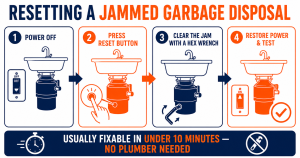
Step 1: Turn Off Power to the Disposal
Cutting power completely before doing anything else is the foundation of every other step, and it takes only a moment.
- Locate the wall switch that controls the disposal — typically near the sink, sometimes paired with the switch for a light or outlet — and switch it firmly to off.
- Open the cabinet doors under the sink and check how the disposal is powered. If it’s plugged into a standard outlet rather than hardwired, unplug it for extra certainty beyond the wall switch alone.
- If the disposal is hardwired with no accessible plug, the wall switch is your primary control — double-check it’s fully off rather than partway.
Unplugging the unit whenever possible is worth the extra few seconds it takes. A wall switch can occasionally be wired incorrectly or fail internally, and physically disconnecting the plug removes any doubt about whether power could reach the motor while you’re working underneath it.
Step 2: Try the Reset Button
With power confirmed off, the next move is the simplest possible fix — one that resolves a tripped thermal switch without clearing anything physically at all.
- Open the cabinet doors below the sink and look at the underside of the disposal — the bottom of the cylindrical body facing into the cabinet.
- Locate the small red or black reset button, typically a raised circular button roughly the size of a pencil eraser, on the bottom or lower side of the unit.
- Press the button firmly with one finger until you feel or hear a distinct click. It may take a moment of steady pressure to reset.
- If the button clicks and stays flush with the housing, the thermal switch has been reset. If it pops back out immediately, move on to the next step first.
💡 Tip: If the reset button pops back out immediately after pressing it, or won’t click in at all, that usually means the disposal is still jammed — move on to manually clearing it before trying the reset button again.
This single step resolves a surprising number of “dead” disposals, particularly when the unit went silent after grinding a heavy load or running continuously for an extended stretch. If pressing the reset button restores power and the disposal runs normally, you’re done. If it won’t stay in, or the unit still hums instead of spinning, that’s a strong signal you’re dealing with an actual jam.
Step 3: Clear the Jam Manually
If the reset button alone didn’t solve it, the flywheel likely has something lodged against it. This step works the jam loose from outside the grind chamber, without ever requiring you to reach inside.
- With power still confirmed off, look at the underside of the disposal for a small hexagonal hole in the center of the housing — this connects directly to the flywheel above.
- Insert the short end of your Allen wrench fully into that center hole until it seats against the flywheel’s internal fitting.
- Turn the wrench firmly in one direction, then the other, working it back and forth rather than forcing it in a single direction. A jam often frees up gradually rather than all at once.
- Continue until the wrench turns through a complete, unobstructed rotation in both directions — this confirms the flywheel is spinning freely with nothing blocking it.
- Once it turns freely, remove the wrench and use a flashlight to look down into the grind chamber from the sink drain opening above, with the power still off.
- If you can see any visible debris — food fragments, a utensil, a bone, or anything else — retrieve it with tongs or needle-nose pliers. Never use your fingers, even briefly.
If the wrench won’t turn at all, don’t force it hard enough to risk stripping the fitting. Instead, try the broom-handle alternative: insert one end down into the grind chamber from above, wedge it against an impeller blade, and use it as a lever to rock the flywheel back and forth. Combining turns from above with the hex wrench from below often frees a stubborn jam that resists either method alone.
Once the flywheel spins freely and the chamber is clear of debris, you’ve addressed the physical cause of the jam. The next steps confirm power can safely be restored and the fix holds up when the disposal runs again.
Step 4: Check the Breaker
If you’ve reset the thermal switch and confirmed the flywheel spins freely but the unit still shows no power at all, the issue may be upstream at your home’s electrical panel.
- Locate your home’s breaker panel and find the breaker labeled for the kitchen, disposal, or relevant circuit — check any unmarked ones if needed.
- Look for a breaker switch sitting in a middle position rather than fully on, which indicates it has tripped.
- If a breaker has tripped, switch it firmly to fully off first, then back to on — flipping it directly to “on” without fully switching off first can fail to reset it properly.
- If the breaker trips again immediately, stop and treat that as an electrical issue rather than continuing to test the disposal.
A tripped breaker is less common than a tripped thermal switch or a physical jam, but it’s worth checking whenever the unit shows absolutely no response — not even the faint hum that usually indicates the motor is receiving some power.
Step 5: Restore Power and Test
With the reset button pressed, the jam cleared, and the breaker confirmed on, it’s time to restore power and confirm the fix worked under normal running conditions.
- Plug the disposal back in if you unplugged it earlier, then flip the wall switch back to on.
- Run cold water into the sink — never hot water — for a few seconds before switching the disposal on, since cold water helps residue grind more cleanly.
- Switch the disposal on briefly, for a few seconds, while standing clear of the sink opening.
- Listen closely for normal operation: a steady, even grinding tone without unusual rattling, persistent humming, or repeated clicking.
- Switch it off, then run it once more with the water still flowing to confirm the result is consistent.
If the disposal runs smoothly both times with no unusual noise, the reset and unjam were successful and you’re finished. If it hums again, trips the reset button repeatedly, or makes a grinding or rattling sound that wasn’t there before, move on to the next section.
When to Call a Professional
Most humming, silent, or jammed disposals are resolved by the steps above, but a few outcomes are worth recognizing as signs of something beyond a simple jam. If the unit still won’t run after pressing the reset button, clearing the flywheel, and confirming the breaker is on, that combination points toward a genuine internal issue — a burned-out motor, a failed capacitor, or wiring damage — rather than something a hex wrench can fix.
A disposal that runs but produces a persistent grinding, rattling, or metal-on-metal sound even after the chamber is clear is another signal worth taking seriously. That kind of noise, especially across multiple uses, often means something is bent, loose, or damaged internally in a way manual unjamming won’t fix. Similarly, if the reset button keeps tripping repeatedly, that pattern suggests the motor is drawing more current than normal — an internal fault rather than an external jam.
Garbage disposals are standard kitchen equipment in most US homes, and jamming or tripping is one of the most common service calls plumbers receive — even though it’s usually resolvable without a technician. If a unit is more than 8-10 years old and jamming has become a frequent, repeated issue rather than a one-off event, replacement is often more cost-effective nationwide than continued repair calls.
If you’re evaluating repair versus replacement, our garbage disposal reviews cover current models worth considering, and if the underlying issue is clog-related rather than the disposal itself, our how to unclog a kitchen sink guide covers that scenario directly.
Frequently Asked Questions
Q: Why does my garbage disposal hum but not spin?
Humming without spinning almost always means the flywheel is physically jammed — the motor is receiving power and trying to turn, but something is blocking it mechanically. This differs from total silence, which more often points to a tripped thermal switch or breaker. Turn off power, then use the hex wrench in the center hole on the underside of the unit to work the flywheel free, as covered in Step 3.
Q: Is it normal for a garbage disposal to trip its reset button occasionally?
An occasional trip after grinding an unusually large or tough load isn’t cause for concern — the thermal switch is doing exactly what it’s designed to do. What’s not normal is the reset button tripping repeatedly across routine, everyday use. That pattern suggests the motor is working harder than it should, which is worth having evaluated rather than resetting as a routine habit.
Q: Can I use a broom handle instead of a hex wrench to clear a jam?
Yes, a wooden broom handle or dowel is a reasonable backup if the hex wrench is missing. Insert it down through the sink drain opening with the power off, wedge the end against one of the flywheel’s impeller blades, and rock it back and forth to work the jam loose from above. Many people find combining both methods clears a stubborn jam faster than either alone.
Q: How do I know if my garbage disposal needs to be replaced instead of reset?
If the unit still won’t run after resetting the thermal switch, clearing the flywheel, and confirming the breaker is on — or if it runs but makes a persistent grinding or rattling noise, or the reset button keeps tripping repeatedly — those point to a genuine internal issue rather than a simple jam. Combined with a unit’s age, especially past 8 to 10 years, repeated problems like these usually make replacement the more practical choice.
Conclusion
A humming or silent garbage disposal is one of the most common kitchen plumbing problems, and it’s also one of the quickest to fix yourself. Cut the power completely, try the reset button first, and if that doesn’t do it, clear the flywheel manually with a hex wrench before checking the breaker. In most cases, the process takes well under ten minutes and requires nothing more than tools you likely already have on hand.
Save a call to a plumber for cases that genuinely warrant it — a unit that still won’t run after all these steps, persistent grinding or rattling, or a reset button that keeps tripping no matter what you clear. For routine upkeep going forward, our how to clean a garbage disposal guide is the natural next step to prevent the next jam before it starts.
Prices and ratings may change. Always check Amazon for current prices.
✍️ About This Guide
Written by Mike Reynolds, DIY Home Improvement Writer at PlumbingToolsReview — former residential contractor helping US homeowners tackle plumbing repairs with confidence. Learn how we test →