Comparisons
2 Oct 2026

Pop-Up Drain vs Grid Drain: Which Should You Choose?
Pop-up drains seal to hold water; grid drains never close but resist clogs better and cost less. Here's how to choose between them for your bathroom sink.
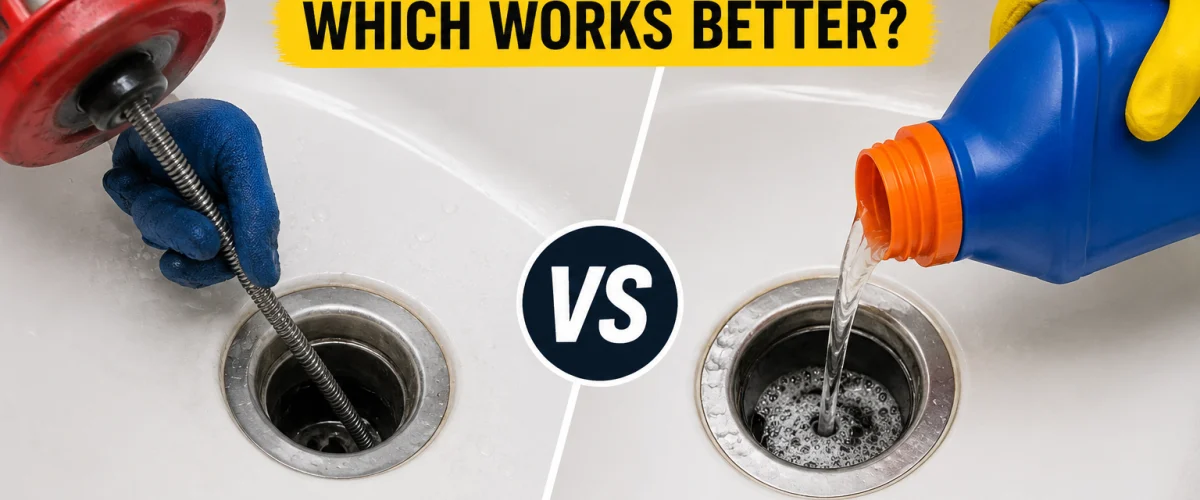
Blocked drain? This guide compares drain snakes vs chemical drain unblockers head to head — effectiveness, cost, and when to use each one — so you pick the right tool every time.
Product availability and information are based on our research at time of writing and are subject to change. Always check Amazon for the latest details before purchasing.
Last updated: May 2026 · 7 min read
Blocked drain? You have two main options — a drain snake or a chemical drain unblocker. Most people reach straight for the chemical bottle first, and it is easy to see why: pour, wait, done. But is that actually the right call for your clog? The answer depends entirely on what kind of blockage you are dealing with. This guide breaks down exactly how each method works, when to use each one, how they compare head to head, and which delivers better long-term value. For product recommendations, see our guides to the best drain snakes and the best drain unblockers.
A drain snake — also called a drain auger — is a flexible metal cable with an auger tip or hook at the end. You feed it down the drain, rotate it manually or with an electric motor, and it either breaks up the clog or hooks into it so you can pull it out whole. Unlike chemicals, a drain snake physically removes the blockage rather than attempting to dissolve it.
See our full round-up of the best drain snakes for tested recommendations across manual and electric models.
PROS
CONS
A chemical drain unblocker is a gel, liquid, or powder that dissolves organic matter in the drain. The active chemicals — typically sodium hydroxide (caustic soda) or sulfuric acid — break down hair, grease, and soap scum on contact. You pour it in, wait 15–30 minutes, and flush with water. Zero effort, no tools required.
For tested product options, see our guide to the best drain unblockers.
PROS
CONS
| Factor | Drain Snake | Drain Unblocker |
|---|---|---|
| Effectiveness on solid clogs | Excellent | Poor |
| Effectiveness on grease / hair | Good | Excellent |
| Speed | 5–15 minutes | 15–30 minutes wait |
| Effort required | Moderate | None |
| Cost | $20–60 one-off | $8–20 per use |
| Long-term value | Excellent | Poor |
| Safe for pipes | Yes | Risk with old pipes |
| Eco-friendly | Yes | No |
| Works on total blockages | Yes | No |
| Best for | Stubborn clogs | Slow drains |
A drain snake is the right tool in these situations — reaching for a chemical unblocker in any of them will either fail outright or make the problem worse.
See our guide to the best drain snakes for the right model at every budget, from basic manual augers to electric drum snakes.
A chemical drain unblocker earns its place in the right situations — particularly when the drain is slow rather than blocked, and when the cause is organic buildup rather than solid debris.
For tested product recommendations, see our guide to the best drain unblockers.
Yes — but with one important safety rule. Never push a drain snake through a drain that still contains chemical unblocker. The agitation can cause the caustic liquid to splash back, and contact with skin or eyes causes burns.
The correct approach:
If you prefer to avoid chemicals entirely, see our guide to how to unclog a drain without chemicals — five natural methods that work without any caustic products.
Over time, the cost difference between the two options is significant.
The drain snake wins on long-term value — and unlike chemicals, it never runs out.
Sometimes a job is too big for DIY. If you need a licensed plumber in your area, search PlumberArchive.com — the US plumber directory with 12,151+ verified plumbers across all 50 states.
Find a trusted plumber near you →
Looking for our top recommended tools in one place? Browse our curated Amazon Storefront →
Get weekly plumbing tips, honest tool reviews and DIY guides delivered to your Facebook feed.
For total blockages, yes — a drain snake physically removes the clog while chemicals only dissolve part of it and leave the rest in the pipe. For slow drains caused by grease or soap buildup, a chemical unblocker works faster and with less effort. The right choice depends on what you are dealing with: use chemicals for slow drains, a snake for full blockages.
Yes, but flush the drain thoroughly with plenty of water first. Never push a drain snake through a drain that still contains chemical unblocker — the agitation can cause caustic liquid to splash back and cause skin or eye burns. Rinse the drain with several kettles of water, wait a few minutes, then use the snake safely.
Chemical unblockers work on organic matter like hair and grease but cannot break up solid blockages — wet wipes, small objects, or heavily compacted debris will not respond to chemicals regardless of how long you leave them. If your drain is still blocked after two chemical treatments, switch to a drain snake. See our guide to the best drain snakes for the right tool for the job.
Once a month in kitchen and bathroom drains is sufficient for maintenance purposes. Overuse of caustic chemicals can degrade older metal pipes over time — if you are concerned about pipe condition, consider natural alternatives like baking soda and vinegar instead. See our full guide to unclogging a drain without chemicals for safe maintenance methods.
For total blockages, the drain snake wins every time. Chemicals cannot break up solid debris, and pouring them into a fully blocked drain risks pipe damage and dangerous splashback. A drain snake removes the blockage physically and completely — no guesswork, no waiting, no repeat treatments.
For slow drains and monthly maintenance, a chemical unblocker is a perfectly reasonable tool — it handles light organic buildup with zero effort and works well as a preventive measure before a slow drain becomes a full blockage. For the broader picture of chemical against mechanical methods, our chemical vs mechanical drain cleaning comparison covers it.
On long-term value, the drain snake is the clear winner. A one-off investment of $25–60 pays for itself after a handful of uses and lasts indefinitely, while chemicals cost $8–20 every single time and deliver a partial fix at best.
For our top-tested recommendations: best drain snakes and best drain unblockers.
✍️ About This Review
PTR Editorial Team — Product Comparisons. We compare manufacturer specifications, installation requirements, compatibility and available product documentation to help homeowners choose suitable tools and parts. How we review →
Pop-up drains seal to hold water; grid drains never close but resist clogs better and cost less. Here's how to choose between them for your bathroom sink.
Test strips, digital meters or send-to-lab testing? Match the method to your situation — screening, ongoing monitoring, or a real health concern.
25-foot vs 50-foot drain snake: compare handling, the cable diameter trade-off and the jobs that justify extra length, plus where 50 feet stops.

