Comparisons
2 Oct 2026

Pop-Up Drain vs Grid Drain: Which Should You Choose?
Pop-up drains seal to hold water; grid drains never close but resist clogs better and cost less. Here's how to choose between them for your bathroom sink.
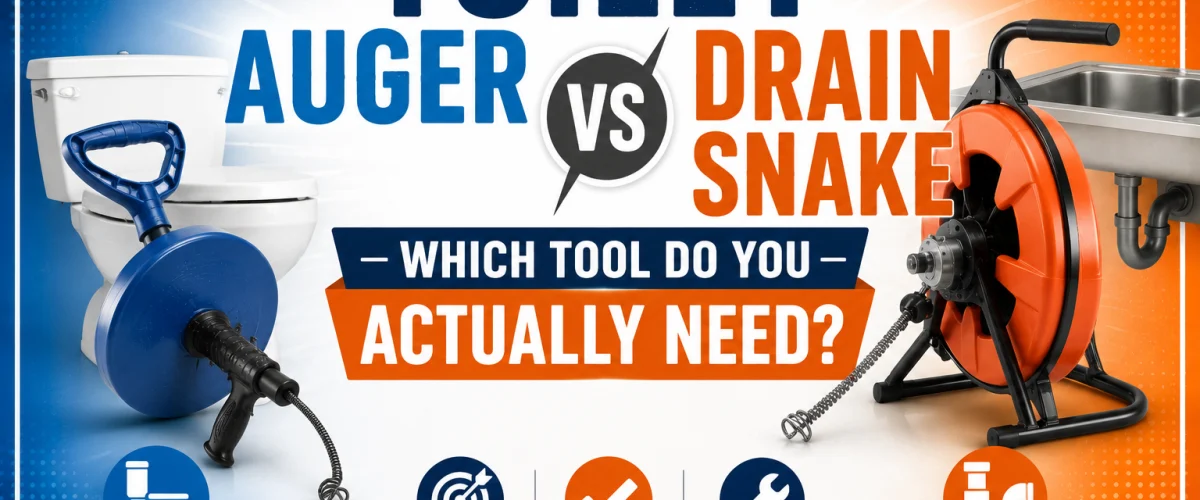
Toilet auger vs drain snake — learn why these look-alike tools serve different jobs, and which one to use before you risk damaging your toilet.
Please note: Information in this guide is based on our research at time of writing and is subject to change. Always consult a licensed plumber for diagnosis of serious plumbing issues before attempting repairs.
A toilet auger and a drain snake look similar enough at a glance — both are long flexible metal cables you crank through a pipe to clear a blockage — that it’s an easy mistake to grab whichever one is on hand. That mistake matters more than it looks like it should. These two tools are built for different jobs, and using the wrong one risks either damaging the toilet bowl or simply failing to clear the blockage at all.
This guide breaks down exactly how each tool works, where the real difference lies, and which one you need depending on where the blockage actually is. For product recommendations once you know which type you need, see our roundup of the best toilet augers and our roundup of the best drain snakes.
✏️ Our Take
These two tools look similar enough that homeowners regularly buy the wrong one — and it matters. A toilet auger has a protective rubber sleeve around the cable where it enters the bowl, which prevents the metal cable from scratching the porcelain as it navigates the tight S-bend of a toilet trap. A standard drain snake has no such protection and will scratch or crack the bowl if used in a toilet. Equally important: a drain snake’s cable is too thin and flexible to push through a toilet trap reliably anyway. If the clog is in the toilet itself, use a toilet auger. If the clog is anywhere in the drain line beyond the toilet — in the pipe in the wall or floor — use a drain snake.
IN THIS GUIDE
A toilet auger, also called a closet auger, is built around a short cable — typically 3 to 6 feet — housed inside a rigid shaft with a curved end. That curve matters: it’s shaped specifically to match the tight S-bend of a toilet’s internal trap, so the tool can navigate a turn that a straight cable simply can’t follow without bending against the porcelain itself.
The defining feature is the protective rubber sleeve fitted at the bowl end of the shaft. That sleeve sits directly against the porcelain while the cable extends and retracts inside it, so the metal cable itself never makes contact with the bowl surface. A toilet auger is purpose-built for the toilet trap specifically — its short cable length means it isn’t designed or intended to reach beyond the trap into the drain line further down. See our roundup of the best toilet augers for current model recommendations.
A drain snake is a fundamentally different tool despite the surface resemblance. Its cable is much longer — typically 25 to 50 feet — and it’s wound on a drum or reel rather than housed in a short rigid shaft. That length is the whole point: a drain snake is designed to travel well past any trap, through the drain pipes running inside walls and under floors, to reach blockages that are physically located far beyond where a toilet auger could ever go.
Drain snakes come in both manual, hand-cranked versions and electric or drill-powered versions for tougher, more compacted blockages. Neither version includes a protective sleeve at the cable end, because a drain snake isn’t designed to be inserted directly into a toilet bowl — it’s meant to go in through a cleanout, a drain opening, or a fixture drain after the trap. See our roundup of the best drain snakes for current model recommendations.
Everything about which tool to reach for comes down to this one design difference. A toilet auger’s rubber sleeve is specifically engineered to protect the porcelain glaze of the toilet bowl while the cable works its way around the trap. A drain snake has no equivalent protection anywhere on its cable — it’s bare metal from end to end, because it’s designed to run through metal or plastic drain pipe, not against a porcelain fixture.
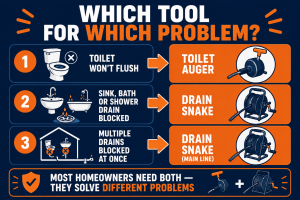
Used in a toilet bowl, that bare cable will scratch or crack the porcelain glaze. Scratched porcelain isn’t just a cosmetic problem — the damaged surface harbors bacteria that a smooth glazed surface normally resists, and the stains that develop in those scratches are permanent. A cracked bowl can mean full toilet replacement. This single design difference is the reason the two tools aren’t interchangeable, regardless of how similar they look in the hardware store aisle.
Reach for a toilet auger when the toilet flushes sluggishly or won’t flush at all and a plunger hasn’t cleared it. A plunger relies on suction and pressure at the drain opening, but it can’t physically reach into the trap the way an auger’s cable can — so when plunging has genuinely failed rather than just been attempted once, the auger is the correct next step.
It’s also the right tool when something was flushed that shouldn’t have been — a child’s toy, a hygiene product, excess toilet paper — and is lodged in the trap rather than fully clogging the drain line beyond it. In general, if the blockage is clearly located in the toilet itself and everything else in the house is draining normally, that points to the toilet trap as the problem, which means a toilet auger. If you’d rather try non-mechanical methods first, see our guide to unclogging a toilet without a plunger.
A drain snake is the right tool when a drain line in the wall or floor is blocked — a bathtub, shower, sink, or floor drain that’s draining slowly or backing up, none of which a toilet auger is built to reach. It’s also the correct next step when a toilet auger has already cleared the toilet trap itself but the toilet is still draining slowly, since that outcome means the blockage was never in the trap in the first place, or a second blockage exists further down the line.
If multiple fixtures in the home are backing up simultaneously — a toilet, a tub and a floor drain all struggling at once, for example — that’s a strong sign the blockage is in a shared drain line rather than any single fixture’s trap, which again calls for a drain snake rather than a toilet auger. See our roundup of the best drain snakes for options across manual and powered versions.
US regional note: In older housing stock across the Northeast and Midwest — particularly homes built before 1970 with cast iron drain lines — a drain snake’s metal cable can catch on corroded pipe joints and dislodge debris that then re-blocks downstream. In these homes it’s worth working slowly and withdrawing the snake carefully rather than forcing it, since the pipe condition is often the real variable, not the blockage itself.
Technically, yes — nothing physically stops you from feeding a drain snake cable into a toilet bowl. In practice, it’s a bad idea for two separate reasons. First, the bare cable risks scratching or cracking the porcelain, as covered above. Second, a standard drain snake’s cable is often too thin and flexible to reliably navigate the tight S-trap curve at all — it can coil up against the bend instead of following it through, which means you may not even succeed in clearing the clog despite the risk to the bowl.
The correct answer is no: use a toilet auger for the toilet trap, and if the blockage turns out to be further down the line, follow up with a drain snake for the pipe beyond it. The two tools are designed to work in sequence for a stubborn combined blockage, not as substitutes for each other.
The table below matches common situations to the tool that wins on that specific factor:
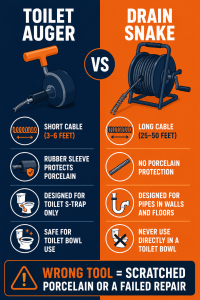
| Situation | Best Choice |
|---|---|
| Toilet won’t flush, plunger failed | Toilet Auger |
| Sink, bath or shower drain blocked | Drain Snake |
| Safe to use directly in toilet bowl | Toilet Auger Only |
| Multiple drains blocked simultaneously | Drain Snake |
| Reaches drain lines in walls and floors | Drain Snake |
| Best for a first-time homeowner to own | Both |
Choose a Toilet Auger if:
Choose a Drain Snake if:
Most homeowners who own both tools find they genuinely solve different problems rather than one making the other redundant — a toilet auger is a low-cost tool worth keeping on hand specifically because a drain snake can’t safely substitute for it.
If neither tool clears the blockage, or if you’re dealing with repeated backups across multiple fixtures, that points to a problem further down the main line that’s outside the scope of either DIY tool. A licensed plumber has access to motorized equipment and camera inspection that can locate and clear blockages neither a toilet auger nor a drain snake can reach.
Find a licensed plumber in your area at PlumberArchive.com — the US plumber directory with 12,000+ verified local plumbers across all 50 states.
Get weekly plumbing tips, honest tool reviews and DIY maintenance guides delivered straight to your Facebook feed. We cover drain maintenance, toilet repairs, tool comparisons and everything in between — written for US homeowners who want to handle more themselves.
You can physically feed a drain snake cable into a toilet bowl, but it’s not recommended. The bare metal cable has no protective sleeve, so it risks scratching or cracking the porcelain glaze — damage that’s permanent and can even void a warranty on a newer toilet. On top of that, most drain snake cables are too thin and flexible to reliably follow the tight S-bend of a toilet trap, so you may not clear the clog anyway. Use a toilet auger, which has a protective rubber sleeve built specifically for this job, instead.
A toilet auger, also called a closet auger, is a short cable — typically 3 to 6 feet — housed in a rigid shaft with a protective rubber sleeve at the bowl end. That sleeve is the key difference from a drain snake: it protects the porcelain while the cable navigates the toilet’s S-trap. A drain snake is much longer (25 to 50 feet), has no protective sleeve, and is designed to travel through drain pipes in walls and floors rather than a toilet bowl specifically.
If only the toilet is affected and every other drain in the house works normally, the blockage is almost certainly in the toilet trap itself — use a toilet auger. If multiple fixtures are slow or backing up at the same time, or if a toilet auger clears the trap but the toilet still drains slowly afterward, the blockage is further down the shared drain line — that calls for a drain snake instead.
For most homeowners, yes — they solve genuinely different problems rather than one replacing the other. A toilet auger is inexpensive and the only tool safe to use directly in a toilet bowl, while a drain snake is what you need for any blockage in the pipes beyond the toilet. Owning both means you’re covered whether the next clog turns out to be in the trap or further down the line.
The rule is simple even though the tools look alike: use a toilet auger for the toilet trap, and a drain snake for everything beyond it. The protective rubber sleeve on a toilet auger exists for a reason — using a drain snake in a toilet bowl instead risks permanent porcelain damage that a few dollars saved on a second tool doesn’t come close to justifying.
Most homeowners genuinely benefit from owning both. They’re inexpensive, they solve different problems, and having the right one on hand means you’re never tempted to reach for the wrong tool under pressure. See our roundup of the best toilet augers and best drain snakes for current recommendations, and our guide to unclogging a toilet without a plunger for non-mechanical methods worth trying first. Once you’ve run either tool, our guide to using a drain inspection camera covers how to confirm the line is actually clear rather than just draining again for the moment.
✍️ About This Comparison
PTR Editorial Team — Product Comparisons. We compare manufacturer specifications, installation requirements, compatibility and available product documentation to help homeowners choose suitable tools and parts. How we review →
Pop-up drains seal to hold water; grid drains never close but resist clogs better and cost less. Here's how to choose between them for your bathroom sink.
Test strips, digital meters or send-to-lab testing? Match the method to your situation — screening, ongoing monitoring, or a real health concern.
25-foot vs 50-foot drain snake: compare handling, the cable diameter trade-off and the jobs that justify extra length, plus where 50 feet stops.

