Comparisons
2 Oct 2026

Pop-Up Drain vs Grid Drain: Which Should You Choose?
Pop-up drains seal to hold water; grid drains never close but resist clogs better and cost less. Here's how to choose between them for your bathroom sink.
Water softener vs water conditioner — a plain-English comparison of how each works, which one your home needs, and the real cost differences. 2026 guide.
Please note: Cost estimates and installation details are based on our research at time of writing and are subject to regional variation. Always test your water hardness and consult a licensed plumber or water treatment professional before purchasing either system.
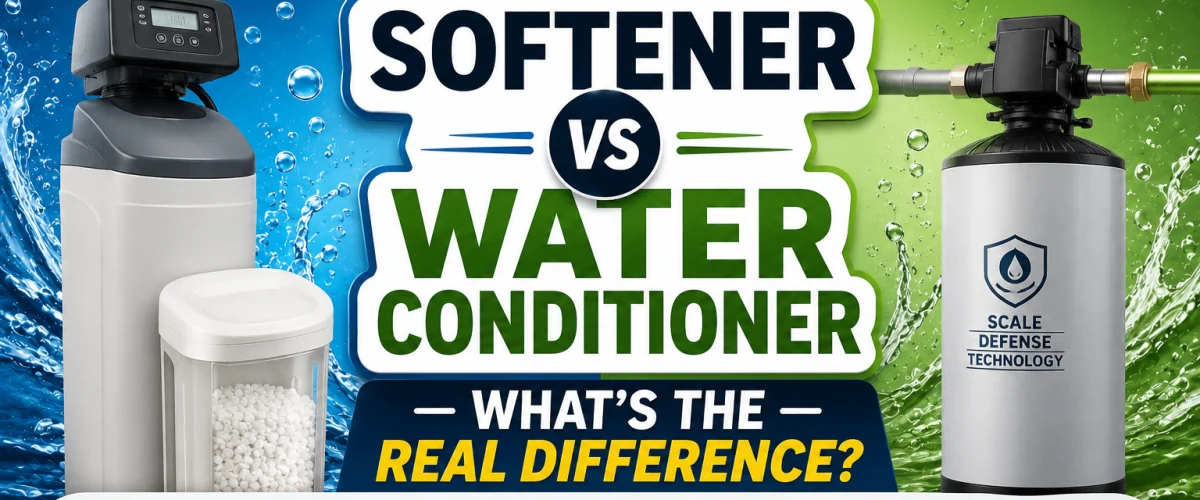
Walk into any home improvement store or browse water treatment equipment online and you’ll encounter the terms water softener and water conditioner used almost interchangeably — sometimes on competing products, sometimes in the marketing copy for the same product. They are not the same thing. A water softener uses an ion-exchange process to physically remove hardness minerals from your water supply. A water conditioner alters how those minerals behave without removing them. Choosing the wrong system means either spending more than you need to or failing to solve the actual problem that’s affecting your home.
This guide compares both systems across every practical factor — how each works, what your water hardness level tells you about which one you need, how they differ in installation and maintenance, and what each costs over time. If you’re already leaning toward a softener, our picks for the best water softeners cover our full lineup for every household size. And if you’re concerned about water damage alongside water quality, our guide to the best water leak detectors covers the tools that catch plumbing leaks before they become a larger problem.
✏️ Our Take
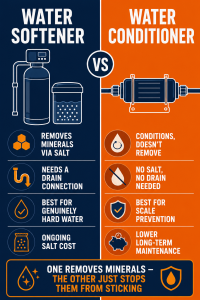
These two terms get used interchangeably in marketing, but they describe genuinely different technologies. A water softener uses an ion-exchange process with salt to physically remove hardness minerals — calcium and magnesium — from your water. A water conditioner doesn’t remove anything; it alters how those minerals behave, typically through a salt-free template-assisted crystallization process, so they’re less likely to stick to pipes and fixtures. If you want hardness minerals gone entirely, you need a true softener. If you want to reduce scale buildup without salt, plumbing changes, or wastewater, a conditioner is the better fit.
IN THIS GUIDE
A traditional water softener uses an ion-exchange process. Inside the system is a tank filled with small resin beads coated in sodium ions. As hard water flows through the tank, calcium and magnesium ions — the minerals responsible for hardness — bind to the resin beads and are held there, while an equivalent number of sodium ions are released into the water in their place. The result is water that has the hardness minerals physically removed and replaced with a small amount of sodium.
Over time, the resin beads become saturated with calcium and magnesium and lose their capacity to exchange ions. The system then enters a regeneration cycle — a process that flushes the resin tank with a concentrated salt brine solution, displacing the accumulated hardness minerals and recharging the beads with sodium. The brine and displaced minerals are discharged as wastewater through a drain connection. After regeneration, the system is ready to treat water again. How often regeneration is needed depends on the hardness level of your incoming water, the capacity of the resin tank, and your household’s daily water usage. Our guide to the best water softeners covers how to match system capacity to your household’s specific needs.
How a Water Conditioner Works
The most common type of salt-free water conditioner uses a process called template-assisted crystallization (TAC). The system contains a media tank — similar in appearance to a softener tank — filled with a specialized polymer bead media. As hard water passes through this media, the calcium and magnesium minerals undergo a physical transformation: instead of remaining dissolved in the water as free ions, they are converted into microscopic crystalline particles.
These crystals remain in the water rather than being removed, but their changed structure means they are far less likely to adhere to pipe walls, water heater elements, fixture surfaces, or appliance components. The hardness minerals are still technically present — a water hardness test will still show hard water — but their behavior is altered so that scale deposits form at a significantly reduced rate. Because the TAC process doesn’t remove anything or create a brine waste stream, the system needs no drain connection, no salt, and no regeneration cycle. Media in a quality TAC conditioner typically lasts several years before replacement is needed.
The clearest signs that a conditioner won’t be sufficient — and that you need a salt-based ion-exchange softener — relate to how water is affecting your daily life, not just your pipes. Visible scale that returns immediately after cleaning on faucets, showerheads, and fixture surfaces is one strong indicator. Soap that won’t lather properly — requiring far more shampoo or dish soap than product instructions suggest — is another characteristic symptom of genuinely hard water. Dry skin and dull, flat hair after showering are also commonly reported by homeowners in very hard water regions, because the dissolved minerals interfere with soap rinse-off and have a direct effect on skin and hair texture.
These symptoms correlate with hardness levels that a conditioner’s scale-prevention approach is simply not designed to address. When water hardness is high enough to affect how soap behaves and how your skin feels, the minerals need to be removed — not just prevented from sticking to surfaces. Our picks for the best water softeners cover systems rated for the high-hardness conditions common in the Midwest, Southwest, and parts of Texas.
A salt-free conditioner is a strong fit when the problem is moderate hardness without the extreme skin-and-soap symptoms that characterize very hard water. If your main concern is protecting appliances and pipes from scale buildup — a tankless water heater, a dishwasher, or a whole-house plumbing system — rather than how the water feels on your body, a conditioner often addresses that specific problem effectively. The TAC process significantly reduces the rate at which scale adheres to heating elements, pipe walls, and fixture internals, extending the working life of those components without requiring any changes to how you use water.
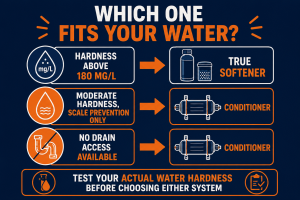
A conditioner is also the right fit when practical constraints rule out a salt-based softener. If your installation location doesn’t have a nearby drain connection for the regeneration waste cycle, a conditioner installs inline without one. If a household member is on a sodium-restricted diet and wants to minimize sodium in drinking water, a conditioner adds none. If you want to avoid the ongoing cost and logistics of salt bag purchases and refills, a conditioner requires no salt at all.
A salt-based water softener requires a drain connection for the regeneration cycle — this is the single largest installation constraint. During regeneration, the system discharges a brine solution with displaced hardness minerals, which must flow to a floor drain, laundry drain, or utility sink. It also requires an electrical outlet for the control head timer, and the main water supply line must be cut to install the unit inline. Bypassing the softener for outdoor irrigation lines is standard practice, since you typically don’t need to soften water used for lawns. After installation, the system needs periodic salt bag refills — how often depends on system capacity and household water usage, but budget for this as a recurring maintenance commitment. The drain access requirement is the same kind of practical constraint covered in our sump pump vs French drain comparison, where installation site access shapes which system is viable.
A salt-free water conditioner installs inline at the main water supply line — no drain connection, no electrical connection, no brine line. The installation is typically simpler and can be completed without access to a nearby drain. The TAC media inside the conditioner tank is self-sustaining during normal operation; no salt is needed and no regeneration cycle runs. After several years of use the media will eventually need replacement, but this is a periodic task measured in years rather than weeks or months.
Salt-based water softeners fall in a $$ to $$$ price tier for the unit itself, with higher-capacity systems for larger households sitting at the top of that range. Professional installation — which involves cutting the main water line, connecting the drain, and configuring the control head — adds to the total upfront cost. The recurring operational cost is salt: bags of softener salt are a regular household purchase, and over several years this adds meaningfully to the total cost of ownership beyond the initial system price.
Salt-free conditioners are often comparable in unit cost to softeners — some fall in the $ to $$ range, others sit in the same $$–$$$ tier. The meaningful cost difference is in long-term operation: a conditioner has no ongoing salt purchase cost and no regeneration-related water consumption. The TAC media will eventually need replacement, but this is a one-time cost measured in years, not a recurring monthly expense. For households where the upfront system price is similar, the conditioner’s significantly lower lifetime maintenance cost is a real advantage over time.
Salt-based water softeners add a small amount of sodium to every gallon of treated water — the precise amount depends on incoming water hardness, but for most households it is well below levels considered significant for healthy adults. However, for people on physician-prescribed sodium-restricted diets, this can be a meaningful concern. The softening process also consumes water during each regeneration cycle — a quantity that varies by system efficiency but represents ongoing water usage that conditioner systems don’t have.
The wastewater discharge from softener regeneration — a salt brine carrying elevated calcium and magnesium — is a genuine regulatory concern in some regions. Municipalities in drought-prone states, particularly in California and parts of the Southwest, have restricted or banned salt-based softener discharge into septic systems and in some cases municipal sewer systems, because of the impact on water reclamation infrastructure. Before purchasing a salt-based softener, checking local regulations is a necessary step. A quality water leak detector installed near your water treatment equipment can provide an early alert if a brine or water line connection develops a slow leak. Salt-free conditioners produce no wastewater discharge at all and are not subject to these restrictions.
The right system depends on your water hardness level, household circumstances, and installation constraints. The table below maps the most common decision factors to the system each one favors.
| Factor | Best Choice |
|---|---|
| Genuinely hard water (180+ mg/L) | SOFTENER |
| Moderate hardness, scale prevention only | CONDITIONER |
| No drain access at install location | CONDITIONER |
| Lowest long-term maintenance | CONDITIONER |
| Sodium-restricted household | CONDITIONER |
| Want hardness minerals fully removed | SOFTENER |
| Municipal discharge restrictions apply | CONDITIONER |
US regional note: Water hardness varies enormously by region — homes in the Midwest, Southwest and parts of Texas often deal with genuinely hard water exceeding 180 mg/L, where a true salt-based softener delivers a noticeably different feel to skin, hair and dishes. In moderately hard water regions like much of the Pacific Northwest and New England, a salt-free conditioner is often sufficient to prevent scale without the maintenance demands of a softener.
Our guide to the best water softeners covers our complete picks for every household size, from compact single-tank units to high-capacity systems for large homes in very hard water regions.
Both water softener and water conditioner installation involve cutting into your main water supply line — a job that’s best assessed by a licensed plumber before purchasing equipment. A professional can test your water hardness on-site, identify any discharge restrictions in your municipality, and recommend the right system size and configuration for your home’s specific water quality and plumbing layout.
Find a licensed plumber in your area at PlumberArchive.com — the US plumber directory with 12,000+ verified local plumbers across all 50 states.
Get weekly plumbing tips, honest tool reviews and DIY guides delivered straight to your Facebook feed. We cover water treatment, water softeners, water quality testing and everything in between — written for US homeowners who want to make smart decisions without overspending.
Not in the traditional sense. A water conditioner does not remove calcium or magnesium from the water supply — a hardness test strip will still register hard water after a conditioner is installed, because the minerals are still present. What a conditioner changes is how those minerals behave: through the template-assisted crystallization process, they are converted into a form that is significantly less likely to adhere to pipe walls, fixture surfaces, and appliance components. So a conditioner prevents scale without softening the water the way a salt-based ion-exchange system does. If you want the traditional soft water experience — improved lather, noticeably different feel on skin and hair — you need a true salt-based softener, not a conditioner.
A salt-free conditioner is often the recommended choice specifically for protecting a tankless water heater from scale damage. Tankless heater manufacturers frequently require some form of scale protection in hard water areas to maintain warranty coverage, and a TAC conditioner satisfies that requirement without adding sodium to the water or requiring a drain connection near the heater. That said, if your water is extremely hard (above 180 mg/L) and you’re also dealing with scale on fixtures and skin and hair symptoms, a softener addresses all of those problems while also protecting the heater. The tankless heater protection goal alone doesn’t require full mineral removal — it requires preventing mineral adhesion, which a quality conditioner handles effectively.
Yes — switching from a salt-based softener to a salt-free conditioner is a common upgrade path for homeowners who want to eliminate the salt maintenance routine or who are moving to a jurisdiction with softener discharge restrictions. The main transition consideration is that scale deposits accumulated inside pipes and appliances during years of untreated hard water don’t disappear automatically when a conditioner is installed — the conditioner prevents new scale formation, but existing buildup stays in place. It’s worth descaling key appliances like the water heater and dishwasher at the time of the switch. Also expect that after switching from a softener to a conditioner, the water will feel slightly different — because the hardness minerals are present again, even if they’re less likely to cause scale.
Yes. A salt-free water conditioner doesn’t add any chemicals to the water and doesn’t remove anything that affects drinking water safety. The calcium and magnesium that remain in conditioned water are naturally occurring minerals that are part of any hard water supply and are not harmful at typical household hardness levels — in fact, calcium and magnesium in drinking water are considered nutritionally neutral to mildly beneficial by most health authorities. Softened water, by contrast, has those minerals replaced with sodium, which is also safe for most people but is a consideration for anyone on a sodium-restricted diet. Neither system is a substitute for a water filtration system if your concern is contaminants like chlorine, lead, or bacteria — those are separate treatment categories entirely.
Water softeners and water conditioners solve related but distinct problems — mineral removal versus mineral behavior modification. The right choice comes down to how hard your water actually is and what problem you’re trying to solve. Test your water hardness with a test strip or a lab kit before purchasing either system: if your hardness exceeds 180 mg/L, a true salt-based softener is almost certainly the better investment — our salt vs salt-free water softener comparison covers that narrower decision once you’ve settled on true softening; if it’s moderate and your primary concern is appliance and pipe protection, a salt-free conditioner addresses that effectively with fewer maintenance demands.
Two practical questions narrow the decision quickly. First, does your installation location have access to a drain? If not, a conditioner is the only viable option without additional plumbing work. Second, does your household have any reason to avoid sodium in the water supply? If so, a conditioner sidesteps the issue entirely. Our guide to the best water softeners covers rated options for high-hardness households once you’ve confirmed a softener is the right fit. And if you’re monitoring for water damage from any source around your treatment equipment or water heater, the best water leak detectors provide an alert layer that catches slow leaks before they cause damage. For related comparisons on drainage and waterproofing systems that similarly come down to installation constraints and site conditions, our sump pump vs French drain guide applies the same framework.
✍️ About This Comparison
PTR Editorial Team — Product Comparisons. We compare manufacturer specifications, installation requirements, compatibility and available product documentation to help homeowners choose suitable tools and parts. How we review →
Pop-up drains seal to hold water; grid drains never close but resist clogs better and cost less. Here's how to choose between them for your bathroom sink.
Test strips, digital meters or send-to-lab testing? Match the method to your situation — screening, ongoing monitoring, or a real health concern.
25-foot vs 50-foot drain snake: compare handling, the cable diameter trade-off and the jobs that justify extra length, plus where 50 feet stops.

