Comparisons
2 Oct 2026

Pop-Up Drain vs Grid Drain: Which Should You Choose?
Pop-up drains seal to hold water; grid drains never close but resist clogs better and cost less. Here's how to choose between them for your bathroom sink.
Continuous feed vs batch feed garbage disposal compared — activation, safety, cost, installation, and which type suits your household in 2026.
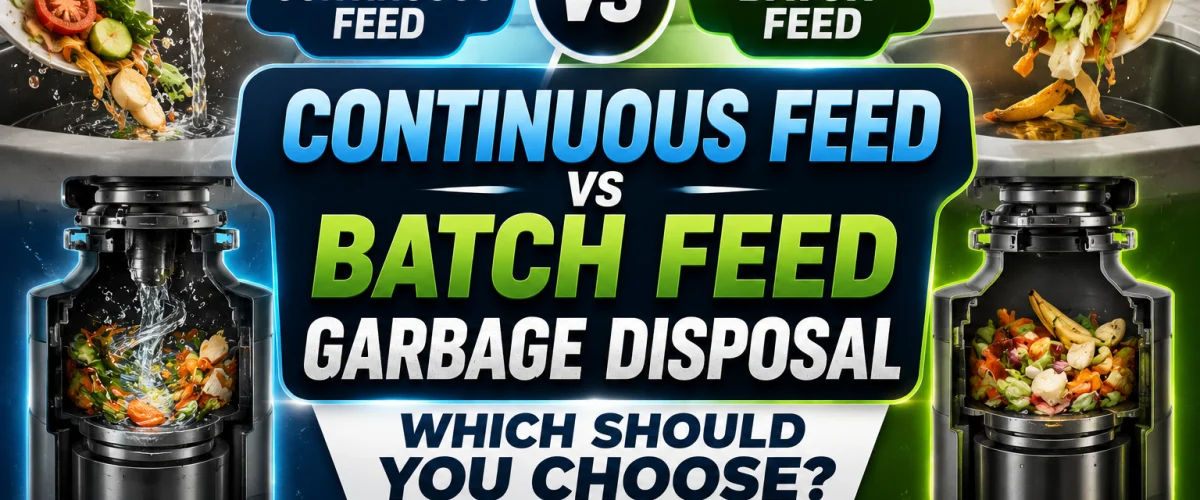
Please note: Cost estimates and installation details are based on our research at time of writing and are subject to regional variation. Always consult a licensed electrician before undertaking new wiring for a disposal installation.
Garbage disposals come in two distinct activation types — and most homeowners never think about the difference until they’re replacing a unit or installing one for the first time. Continuous feed and batch feed disposals grind the same kinds of food waste with comparable motors, but the way each one starts determines who it’s appropriate for, what the installation requires, and how safe it is in daily use.
This guide compares both types across every practical factor: how each activates, what installation involves, how the safety profiles differ, what each costs, and how capacity and noise stack up. If you’re ready to choose a specific model, our roundup of the best garbage disposals covers the top options in both categories. And once you’ve selected the right unit, our guide to installing a garbage disposal covers the full process step by step.
✏️ Our Take
The real difference between continuous feed and batch feed isn’t grinding power — it’s how each one starts. A continuous feed disposal runs the moment you flip a wall switch, waste or no waste, hands or no hands near the drain. A batch feed disposal can only run once its stopper is locked into place over the opening, which makes it physically impossible to operate with the drain exposed. For most households, continuous feed is fine and it’s what you already have working with your existing wall switch. For households with young children, or anyone who’s ever flipped a switch without checking the sink first, batch feed’s built-in safety lockout is worth the extra cost.
IN THIS GUIDE
Continuous feed disposals are what most US homeowners have encountered — they activate when you flip a wall switch and run continuously until you switch them off. Food waste is fed into the drain while the unit is running, which means the drain opening is accessible and the motor is active at the same time. Running water alongside the grinding process carries the processed waste through the drain line and into the sewer.
Batch feed disposals work differently at the activation level. Instead of a wall switch, these units use a specially designed stopper that doubles as the on/off switch itself. You load food waste into the chamber, insert the stopper into the drain opening, and twist it to lock it into position — that twisting action activates the motor. Twist the stopper back to unlock it and the motor stops. The disposal cannot run until the stopper is in place, covering the drain entirely during operation.
A key practical consequence of this design is that batch feed units need no dedicated wall switch wired to the disposal circuit — the stopper handles everything. This matters in kitchens where no disposal switch currently exists and adding one is inconvenient or costly.
Installation Differences
Continuous feed disposals require a wall switch wired specifically to the disposal’s electrical circuit. In many US homes — particularly older homes in the Northeast and Midwest — this switch is already in place from a previous disposal installation. In those kitchens, swapping a continuous feed unit for another continuous feed model involves no new electrical work. If no dedicated switch exists, one needs to be wired in as part of the installation, which adds cost and scope beyond the disposal unit itself.
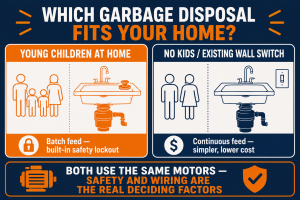
Batch feed disposals need only a standard power connection at the disposal and the usual drain plumbing — no dedicated wall switch required. This makes batch feed the simpler installation in kitchens where no disposal switch exists, or where adding a switch to the wall isn’t practical. The mounting hardware and drain connection for both types are nearly identical across major brands, so either type can occupy the same under-sink footprint as the unit it replaces.
For the complete step-by-step installation process covering both feed types, see our guide to installing a garbage disposal.
The safety difference between these two types is the most substantive practical distinction, and it comes entirely from the activation mechanism. Batch feed disposals are physically incapable of operating with the drain opening uncovered. The stopper must be inserted and twisted into the locked position before the motor activates — hands, utensils, and anything else near the drain opening cannot contact a running disposal, because the disposal cannot run until the stopper is covering the opening.
Continuous feed disposals carry no such constraint. The motor runs whenever the wall switch is on, regardless of whether anything is near or in the drain. For most adults using the disposal attentively, this is a non-issue in daily use. For households with young children who might reach toward a running sink drain, or for anyone who has developed the habit of flipping the disposal switch without checking the sink first, that distinction is genuinely meaningful.
Neither type changes the basic rule for clearing a jam or retrieving something dropped into the disposal — power must be disconnected at the breaker before any hand goes into the chamber, regardless of feed type.
Continuous feed disposals are generally less expensive at equivalent horsepower and grind stage count. They are the dominant type in the US market, which means more manufacturers compete across more price points, and the simpler activation design — a standard wall switch rather than a precision stopper-switch housing — keeps per-unit costs lower. Most entry-level and mid-range disposals on the market are continuous feed models.
Batch feed units typically carry a price premium at equivalent specifications. The stopper-switch mechanism adds both engineering complexity and manufacturing cost that the continuous feed design avoids. At the lower end of the market, batch feed options are notably scarcer — most budget-tier disposals are continuous feed. Premium batch feed models do exist at the higher end, where the safety feature is a deliberate selling point rather than an afterthought.
Installation cost is roughly similar when a working wall switch already exists in the kitchen. When it doesn’t, wiring a new dedicated switch for a continuous feed installation adds cost that a batch feed unit in the same kitchen would not incur — a licensed electrician’s time and materials for a straightforward switch installation adds a meaningful amount to the project total.
Continuous feed’s ability to accept ongoing waste while running is its clearest practical advantage over batch feed. When processing large volumes of food waste — after a large meal, or when cleaning out the refrigerator — you can keep feeding waste into the drain as the motor grinds what’s already in the chamber. The throughput is limited primarily by the motor’s horsepower and the drain line’s capacity to carry processed waste away.
Batch feed disposals are constrained by what fits in the grinding chamber per cycle. Load the chamber, lock in the stopper, let the motor run until grinding is complete, then repeat for the next load. For a household that processes a typical amount of food waste during daily meal cleanup, this is rarely a meaningful limitation in practice. For high-volume use — or for households where the disposal handles cleanup after larger gatherings — the need for multiple separate cycles adds time that continuous feed avoids.
It’s worth being clear that grinding power is independent of feed type. Batch feed and continuous feed units are both available across the same range of motor horsepower ratings, and a higher-horsepower batch feed model will outgrind a lower-horsepower continuous feed model in every scenario. Feed type determines how and when the motor starts — not how effectively it grinds once running.
Noise level in a garbage disposal is determined by motor quality, grinding chamber construction, the thickness and design of the sound insulation jacket around the unit, and how well it’s mounted to reduce vibration transmission to the sink and cabinet — none of which have anything to do with whether it’s continuous or batch feed. An entry-level continuous feed model and a premium batch feed model can have dramatically different noise levels, and the feed type explains none of that difference.
Both types are available across the same range of sound ratings. Premium models in both categories use multi-layer insulation and anti-vibration mounting components that make a meaningful difference compared to basic models. A budget-tier unit in either feed type will typically be louder than a premium unit in either type. If quiet operation is a priority for your kitchen, comparing the specific sound-insulation specifications of individual models matters far more than choosing between feed types.
For a comparison of the quietest models across both feed types, see our roundup of the best garbage disposals.
Going from continuous feed to batch feed in an existing kitchen is mostly a direct mechanical swap at the under-sink level — remove the existing unit, mount the new batch feed disposal on the same drain flange, and connect the drain. The existing wall switch becomes unused. Most homeowners simply leave it in place rather than paying for the electrical work to remove or cap it; a switch that does nothing is not a hazard, just a cosmetic consideration.
Going from batch feed to continuous feed means a dedicated wall switch needs to be wired in if one isn’t already present. This is a routine electrical job — a licensed electrician can typically complete it in under an hour — but it does add cost and scope that a like-for-like replacement would not require. In kitchens where adding a wall switch is impractical due to tile, finishes, or layout, this can be a genuine constraint that keeps batch feed the more sensible option even when continuous feed is preferred.
Many older homes across the Northeast and Midwest already have a dedicated wall switch wired in from a previous continuous feed installation — replacing one continuous feed unit with another requires no new electrical work at all. Newer construction and remodels nationwide are increasingly specifying batch feed models instead, largely driven by the same child-safety reasoning that has pushed appliance manufacturers toward lockout-style designs across other kitchen products. If a disposal jams during this process, our guide on how to unclog a kitchen sink covers drain troubleshooting steps that apply to disposal drain lines as well.
The decision comes down to two factors for most households: whether a wall switch is already in place, and whether the built-in safety lockout of batch feed is meaningful for your household’s specific situation.
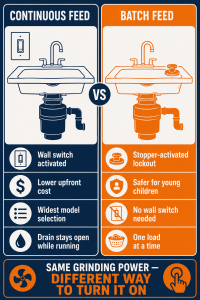
| Situation | Better Choice |
|---|---|
| Households with young children | Batch feed |
| Lowest upfront cost | Continuous feed |
| No existing wall switch (no wiring wanted) | Batch feed |
| Processing large volumes of waste at once | Continuous feed |
| Built-in safety lockout required | Batch feed |
| Widest model selection and price range | Continuous feed |
| Simplest daily use (no stopper to manage) | Continuous feed |
Choose continuous feed if you already have a working wall switch installed and your household is comfortable with the standard activation method. Continuous feed gives you the widest selection of models across every price tier, and it’s the simpler option for high-volume use. Our best garbage disposals roundup covers the top continuous feed models at every horsepower level.
Choose batch feed if you have young children in the home, your kitchen has no dedicated disposal switch and you don’t want to add one, or the built-in safety lockout is genuinely important for how your household uses the kitchen. The price premium over equivalent continuous feed models is real, but for the right household it reflects a meaningful functional difference rather than a cosmetic one.
Installing a disposal that requires new electrical wiring, or dealing with a drain line that needs reconfiguring for a new unit, is often worth handing off to a licensed professional — especially when electrical work is involved. Getting both the plumbing and the wiring done correctly at the same time avoids a return visit later.
Find a licensed plumber in your area at PlumberArchive.com — the US plumber directory with 12,000+ verified local plumbers across all 50 states.
Get weekly plumbing tips, honest tool reviews, and DIY maintenance guides delivered straight to your Facebook feed. We cover kitchen plumbing, bathroom fixtures, appliance comparisons, and everything in between — written for US homeowners who want to make smarter decisions without overspending.
Yes, in a specific and meaningful way. A batch feed disposal cannot physically operate with the drain opening uncovered — the stopper must be inserted and twisted into the locked position before the motor activates. This makes it impossible to accidentally run the disposal with hands near the drain, or for a child to activate it by reaching toward the sink. A continuous feed disposal runs whenever the wall switch is on, with no such restriction on drain access. For households where that distinction matters — particularly those with young children — batch feed’s built-in lockout is a genuine safety advantage, not a marketing claim.
Yes — the mounting hardware and drain connection are standardized across major brands, and a batch feed unit will fit the same drain flange as a continuous feed model in most cases. The main practical change is that your existing wall switch becomes unused once a batch feed unit is installed. Most homeowners leave the switch in place rather than removing it, since capping an unused switch is a purely cosmetic concern rather than a safety issue. The reverse swap — going from batch feed to continuous feed — is also straightforward mechanically, but requires wiring in a dedicated wall switch if one isn’t already present.
No — this is one of batch feed’s practical advantages. The stopper that activates the motor doubles as the on/off switch, so no dedicated wall switch needs to be wired to the disposal circuit. The unit does need a power connection at the disposal itself (standard for all disposals), but that connection is typically made at an outlet under the sink rather than at a dedicated wall switch. This makes batch feed the simpler choice for kitchens that don’t already have a disposal switch installed and where adding one would require new electrical work.
For large volumes of waste, continuous feed is faster because you can load waste continuously while the motor grinds rather than running separate cycles. For a typical household meal cleanup, the difference is not noticeable in practice — the amount of waste fits in a single batch feed chamber load, and the grinding time per cycle is short. Grinding speed and efficiency are determined by motor horsepower and grind stage design, not by feed type. A high-horsepower batch feed model will grind faster than a low-horsepower continuous feed model in every scenario — the feed type is about activation, not grinding power.
Continuous feed is the simpler, more affordable, and more widely available choice — it’s what most US kitchens already have wired in, and for most households it works well without any additional consideration. If a working wall switch is in place and child safety isn’t a specific concern, continuous feed gives you the broadest selection of models and the most competitive pricing at every horsepower tier.
Batch feed’s built-in safety lockout makes it the better choice for households with young children, and it also solves the installation problem neatly in kitchens that don’t have a dedicated disposal switch. The price premium is real, but it reflects a genuine functional difference rather than just a brand distinction. Neither type affects noise level or long-term reliability — those characteristics are model-specific, not feed-type-specific.
Once you’ve decided on the right type, our roundup of the best garbage disposals covers our full picks in both categories across every budget. If you’re ready to install, our guide to installing a garbage disposal walks through the full process from mounting to testing, and our guide to cleaning a garbage disposal covers the ongoing maintenance either type needs. And if the drain line under your sink needs attention before or after the swap, our guide to how to unclog a kitchen sink covers the drain troubleshooting steps most relevant to disposal drain lines.
✍️ About This Comparison
PTR Editorial Team — Product Comparisons. We compare manufacturer specifications, installation requirements, compatibility and available product documentation to help homeowners choose suitable tools and parts. How we review →
Pop-up drains seal to hold water; grid drains never close but resist clogs better and cost less. Here's how to choose between them for your bathroom sink.
Test strips, digital meters or send-to-lab testing? Match the method to your situation — screening, ongoing monitoring, or a real health concern.
25-foot vs 50-foot drain snake: compare handling, the cable diameter trade-off and the jobs that justify extra length, plus where 50 feet stops.

