Please note: Information in this guide is based on our research at time of writing and is subject to change. Always consult a licensed plumber for diagnosis of serious plumbing issues before attempting repairs.
Introduction
A bathroom exhaust fan is one of those fixtures most homeowners choose based on price or how it looks — and that’s exactly why so many bathrooms have fans that run during and after every shower without ever really clearing the humidity. The number that actually matters when sizing a bathroom exhaust fan is CFM — cubic feet per minute — not the brand name on the box or the finish on the cover plate.
This guide walks through the CFM calculation step by step, covers the factors that affect real-world performance (including ducting length and regional climate), and explains how to interpret sone ratings so you know what to expect for noise. If you’ve already worked through the sizing and you’re ready to choose a specific model, our roundup of the best bathroom exhaust fans covers the top options across CFM ranges and budgets. And once you’ve selected the right fan, our guide to replacing a bathroom exhaust fan covers the full installation and wiring process from start to finish.
At a Glance
| Difficulty |
Easy — math only, no tools needed |
| Time |
10–15 Minutes to calculate |
| Cost |
Free to calculate — fan cost varies |
| Tools Needed |
Tape measure, calculator |
| Skill Level |
Beginner |
✏️ Our Take
Most bathroom exhaust fans installed by builders are sized to meet the bare minimum building code, not to actually clear humidity from the specific room they’re in. A fan that’s too small runs constantly without ever really clearing the steam, which is exactly the condition that grows mold behind walls and ceilings over time. The calculation itself takes five minutes — measure the room, do the math, and you’ll know in advance whether your existing fan (or the one you’re about to buy) is actually doing its job.
Why Fan Size Actually Matters
Most homeowners assume that if the bathroom fan is running, it’s doing its job. But an exhaust fan that’s undersized for the room it’s in can run continuously throughout a shower — and for 20 minutes afterward — without ever fully clearing the humidity that’s built up. The mirror still fogs completely, the ceiling stays damp, and moisture that should have been vented out is instead sitting in the room and pushing gradually into wall and ceiling cavities.
Trapped moisture behind walls and ceilings is one of the leading causes of hidden mold growth in US bathrooms. It doesn’t develop from a single steamy shower — it develops from months or years of a fan that’s working but isn’t actually keeping up with the moisture load of the room. Because it happens gradually and invisibly, most homeowners only discover it during a renovation or when a surface has deteriorated enough to show visible staining.
On the other end, an oversized fan isn’t a problem structurally, but it uses more energy than necessary and can be louder than the room warrants. The goal is to match the fan’s output to the actual room — not to the smallest legal minimum, and not so large that you’re paying for capacity the bathroom doesn’t require.
💡 Tip: A fan that runs the whole shower but the mirror still fogs up completely is a strong sign it’s undersized for the room — the test isn’t whether the fan runs, it’s whether the mirror clears within a few minutes of the shower ending.
How to Calculate the CFM You Need
For bathrooms up to 100 square feet, the standard calculation is straightforward: 1 CFM per square foot of floor space. Measure the length and width of the bathroom in feet and multiply the two numbers together to get the square footage. That number is your minimum CFM target. A 60 square foot bathroom needs a minimum 60 CFM fan. A 90 square foot bathroom needs a minimum 90 CFM fan.
The floor area measurement is all you need for most residential bathrooms. Standard 8-foot ceilings don’t require any additional adjustment. If your bathroom has significantly higher ceilings — 10 feet or more — multiply your square footage result by 1.1 to account for the additional air volume in the room.
Regardless of how the math works out, the practical minimum CFM for any bathroom exhaust fan is 50 CFM. A very small bathroom — 30 or 40 square feet — still needs a fan rated for at least 50 CFM. This is both a performance floor and, in most US jurisdictions, a code requirement for intermittent fans.
💡 Tip: Round up, not down — if your calculation lands between two common fan sizes, always choose the larger one rather than the smaller. A fan with a little extra capacity doesn’t hurt anything; one with slightly too little will underperform the room every single day.
CFM Sizing Chart by Room Size
The square footage method works well for most bathrooms. For large primary bathrooms with multiple plumbing fixtures, the fixture-count method gives a more accurate result.
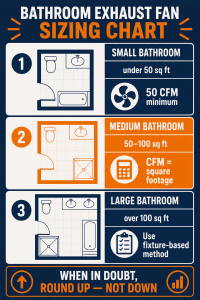
| Bathroom Size |
Square Footage |
Recommended CFM |
| Small |
Under 50 sq ft |
50 CFM minimum |
| Medium |
50–100 sq ft |
CFM = square footage |
| Large |
Over 100 sq ft |
Use fixture method (see below) |
Fixture-based method for large bathrooms. For primary bathrooms over 100 square feet, add up the CFM requirements for each fixture in the space:
- Toilet: 50 CFM per toilet
- Standard shower stall: 50 CFM
- Standard bathtub: 50 CFM
- Jetted or soaking tub: 100 CFM
Add those numbers together for the total CFM the space requires. A large primary bathroom with a toilet, a walk-in shower, and a soaking tub would need: 50 + 50 + 100 = 200 CFM minimum. If the toilet is in a separate compartment from the shower area, consider whether two separate fans would be more effective than one central unit.
💡 Tip: A large primary bathroom with a separate toilet area, walk-in shower, and soaking tub often needs 200+ CFM total — far more than a single basic fan provides. This is why some large bathrooms use two fans rather than one, positioned to cover different areas of the room effectively.
Sone Ratings — How Loud Is Too Loud
CFM tells you how much air the fan moves. Sones tell you how loud it will be doing it. The sone scale measures perceived loudness — how the sound registers to the human ear — rather than raw decibels, which makes it a more useful specification for comparing exhaust fans in a residential setting.
As a practical reference: 1.0 sone is roughly equivalent to the background hum of a quiet refrigerator in the same room. Under 1.0 sone is considered whisper-quiet and is barely noticeable during a shower. 1.5 to 2.0 sones is a noticeable but non-intrusive background sound. At 4.0 sones and above, the fan is loud enough to be the dominant sound in the room — the level most people associate with older builder-grade units.
A higher CFM fan isn’t automatically louder. Premium exhaust fans are engineered to move more air through a better-designed housing with a quieter motor, and many high-CFM models achieve under 1.0 sone ratings. The correlation between high CFM and high noise typically appears at the budget end of the market, where the motor and housing are lower quality. For recommendations across CFM ranges and sone levels, see our best bathroom exhaust fans roundup.
💡 Tip: Don’t assume you need to sacrifice quiet for power — premium fans deliver high CFM at under 1.5 sones. It’s the budget models that tend to be both underpowered and loud. If a fan is rated above 3.0 sones, that’s typically a sign of a lower-quality motor rather than an indicator of high performance.
How Ducting Length Reduces Real-World CFM
The CFM rating printed on the box of a bathroom exhaust fan is measured under ideal test conditions — a short, straight, unobstructed duct run. That number represents the fan’s maximum possible airflow, not its typical real-world performance. Once the fan is installed with actual ductwork navigating through joists and walls to reach an exterior or roof vent, the delivered CFM will be lower than the rated figure.
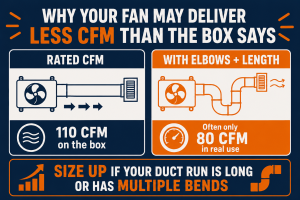
Every foot of duct run adds resistance that reduces airflow. Every 90-degree elbow bend — the turns ductwork makes to navigate around framing — adds the equivalent of several additional feet of straight duct resistance. A fan rated at 110 CFM with a long, winding duct run that includes several elbows may only deliver 75 to 85 CFM into the bathroom. The fan is running at full speed; the duct system is restricting how much of that capacity actually reaches the room.
As a practical rule: if your bathroom is more than 10 feet from an exterior wall or roof vent, or if the duct path requires two or more elbow bends, size up your CFM target by 20 to 25 percent above the calculated minimum to compensate for the losses in the duct run.
⚠️ Warning: If your bathroom is far from an exterior wall or roof vent, size up your CFM rating to compensate for ducting losses — buying exactly to the calculated minimum leaves no margin for a long or winding duct run. A fan running against a lengthy duct path will underperform the room just as reliably as one that’s undersized on paper.
Continuous Run vs Intermittent Fans
Standard bathroom exhaust fans are intermittent — they run only when the light switch or a dedicated fan switch is on, then stop. The entire job of moisture removal happens in bursts: during the shower and for 15 to 20 minutes after. If the fan is switched off too soon, humidity still in the air has no route out, and residual moisture continues to condense on cool surfaces even after the shower has ended.
Continuous-run fans operate at a low, quiet speed throughout the day, providing constant background ventilation that removes moisture, odors, and airborne particulates from the room gradually and consistently. They typically boost to a higher speed when triggered by a humidity sensor or manual switch, then return to the low-speed baseline. Because they’re always working rather than catching up after a shower, continuous-run fans can achieve effective moisture control with a lower peak CFM rating than an equivalent intermittent fan would need.
US regional context. Most US building codes set a minimum of 50 CFM for intermittent (switch-operated) fans or 20 CFM for continuous-run fans in bathrooms without an operable window, but local codes vary by state and county. In humid climate regions like Florida, the Gulf Coast, and the Pacific Northwest, exceeding the code minimum and choosing a continuous-run model is genuinely worth the extra cost. These climates give moisture far less chance to dry out between uses than drier inland states — a bathroom in coastal Florida that gets daily use faces a heavier cumulative moisture load than the same bathroom in Arizona.
💡 Tip: A continuous-run fan is genuinely worth considering in humid climates or for bathrooms that don’t get much natural airflow between uses — the constant low-level ventilation prevents the moisture buildup that intermittent fans are always playing catch-up against.
Building Code Minimum Requirements
In the US, mechanical bathroom ventilation is required by most building codes in bathrooms that don’t have an operable window providing natural ventilation. The International Residential Code (IRC), which most states adopt as the basis for local building codes, sets a minimum of 50 CFM for intermittent fans and 20 CFM for continuously operating fans. Some states and municipalities have adopted stricter local amendments — local code can and does go beyond the IRC baseline in certain jurisdictions, particularly in states with active energy or indoor air quality programs.
If your home has a bathroom window but no exhaust fan, it may technically meet the older code requirements from when the home was built. But an operable window provides effective ventilation only when it’s actually open and when outdoor conditions make opening it practical. In any climate where windows stay closed for most of the year, a bathroom without a mechanical exhaust fan will have persistent humidity problems regardless of window size.
If you’re adding or replacing a fan as part of a renovation, check with your local building department for the current requirements that apply to your jurisdiction before purchasing. For the installation process once you’ve chosen the right fan, our guide to replacing a bathroom exhaust fan covers the step-by-step wiring and installation process in full.
⚠️ Warning: Code minimums are a legal floor, not a performance recommendation — a fan that barely meets code can still be genuinely undersized for comfortable, effective humidity control in that specific room. Meeting the minimum is the starting point for compliance, not the target for actual bathroom performance.
When to Size Up Beyond the Basic Calculation
The square footage calculation gives you a solid baseline, but several specific conditions can push the practical requirement above that number. Sizing up in any of these situations is the right call — the extra CFM costs very little in fan price and nothing in day-to-day operating cost for the protection it provides.
Jetted tubs or steam showers. A jetted tub or steam shower generates substantially more moisture per minute than a standard shower or soaking tub. The square footage calculation doesn’t account for fixture type — a bathroom with a steam shower needs to be treated as a higher-moisture environment than the room size alone suggests. Use the fixture-count method and add margin on top of the calculated minimum.
No window or consistently poor natural airflow. A bathroom with no operable window gets no passive ventilation between uses. The exhaust fan is the only route for humidity removal, which means it needs to do the entire job without any supplemental airflow. In these bathrooms, sizing above the bare minimum is especially important — there’s no fallback if the fan underperforms.
Household usage patterns. A single-bathroom household of five people taking daily showers faces a cumulative daily moisture load that a two-person household doesn’t. If the bathroom is used frequently by multiple people or if household members take consistently long showers, build extra CFM margin into the calculation rather than sizing to the minimum.
Long or winding duct runs. As covered in the ducting section above, every foot of duct run and every elbow bend reduces delivered CFM below the rated figure. If your installation involves a long or complex duct path, size up the fan rating specifically to compensate for those losses rather than buying to the calculated minimum and hoping the delivery matches the rating.
💡 Tip: If you’re already inspecting your bathroom fan as part of a broader home maintenance check, this is the perfect moment to also confirm it’s actually sized correctly for the room — a quick measurement and the calculation above takes five minutes and may tell you something useful. For a complete annual maintenance walkthrough, see our
annual plumbing inspection guide.
Need a Professional Plumber?
If your bathroom has persistent humidity problems despite a running fan — or if your exhaust fan duct needs to be extended, re-routed, or connected to an exterior vent for the first time — a licensed plumber or HVAC contractor can assess the installation and recommend the right solution. Getting the duct configuration right is just as important as choosing the correct fan size.
Find a licensed plumber in your area at PlumberArchive.com — the US plumber directory with 12,000+ verified local plumbers across all 50 states.
Find a trusted plumber near you → PlumberArchive.com
Follow Us on Facebook
Get weekly plumbing tips, honest tool reviews, and DIY maintenance guides delivered straight to your Facebook feed. We cover bathroom ventilation, moisture control, seasonal plumbing maintenance, and everything in between — written for US homeowners who want to handle more themselves.
Follow PlumbingToolsReview on Facebook →
Frequently Asked Questions
Q: What size exhaust fan do I need for a small bathroom?
The minimum for any bathroom exhaust fan is 50 CFM, regardless of how small the room is. For a bathroom under 50 square feet — a small half-bath or powder room — 50 CFM meets both the code minimum and the practical performance requirement. For bathrooms between 50 and 100 square feet, use the 1 CFM per square foot rule: a 60 square foot bathroom needs at minimum a 60 CFM fan, a 75 square foot bathroom needs at minimum a 75 CFM fan, and so on. In every case, round up to the next common fan size rather than down — a small amount of extra capacity costs nothing in operation and ensures the fan keeps up with the room even on the steamiest days.
Q: Can a bathroom exhaust fan be too powerful?
In practical terms, no — a fan with more CFM than the minimum calculation requires is not harmful to the bathroom and won’t create any moisture or structural problems by running. The main trade-off is cost: a higher-CFM fan typically costs more upfront, and a fan running at full speed uses slightly more electricity than a smaller one would in the same space. In terms of performance, more CFM than the minimum means the bathroom clears faster and the fan doesn’t need to run as long after a shower to remove residual humidity. The case for not dramatically oversizing is economic rather than functional — there’s no technical reason to avoid it, just limited additional benefit beyond what the room actually requires.
Q: How do I know if my current fan is too small?
The most direct test is the tissue test: hold a single sheet of tissue paper near the fan grille while it’s running. If the tissue is pulled firmly toward the fan and held against the grille, the fan is moving air effectively. If the tissue flutters weakly or drifts away, the fan isn’t generating adequate airflow — either because it’s undersized, because the duct is obstructed, or because the motor has worn down. The second test is observational: if the bathroom mirror is still completely fogged 10 to 15 minutes after a shower ends with the fan running the entire time, the fan is not keeping up with the room’s moisture load. Measure the bathroom, run the CFM calculation, and compare the result to your fan’s rated CFM — that comparison will tell you definitively whether the unit is sized correctly on paper.
Q: Does duct length really affect fan performance?
Yes — significantly. The CFM rating on a fan’s packaging is measured under ideal conditions with minimal back-pressure from the duct system. Every foot of duct run and every 90-degree elbow adds resistance that reduces the actual airflow the fan delivers into the bathroom. A fan rated at 110 CFM can realistically deliver 80 CFM or less when connected to a long duct run with multiple bends. The effect is proportional to the length and complexity of the duct path: a fan connected directly through an exterior wall with a short straight run loses relatively little. A fan in a central interior bathroom venting through 25 feet of duct with several elbows to reach the roof can lose 30 percent or more of its rated capacity. If your installation involves a long or complex duct path, size up the fan rating by 20 to 25 percent to compensate.
Conclusion
Getting the sizing right before you buy is a five-minute calculation that saves months or years of a fan that’s running constantly without doing its job effectively. For most bathrooms, the math is simple: measure the square footage, use 1 CFM per square foot, apply the 50 CFM minimum regardless of room size, and round up to the next common fan size. For large primary bathrooms with multiple fixtures, the fixture-count method gives a more accurate result — add 50 CFM per toilet, standard shower, and standard tub, and 100 CFM for a jetted or soaking tub.
Always round up rather than down. If your duct run is long or winding, add 20 to 25 percent to the calculated minimum to account for real-world CFM losses in the duct system. If you’re in a humid climate region — Florida, the Gulf Coast, the Pacific Northwest — consider sizing above the bare minimum and evaluating a continuous-run model rather than a standard switch-operated fan.
Once you have your CFM target, our roundup of the best bathroom exhaust fans covers the top options across CFM ranges, sone ratings, and budgets. When you’re ready to install, our guide to replacing a bathroom exhaust fan covers the wiring and installation process step by step. And if an existing fan is undersized or has simply stopped doing its job, our guide to troubleshooting a bathroom fan that’s not working covers diagnosing the cause before you replace it. And if you’re doing this sizing check as part of a broader annual home maintenance pass, our annual plumbing inspection guide covers the full room-by-room process.
✍️ About This Guide
PTR Editorial Team — Plumbing Guides. We compare manufacturer specifications, installation requirements, compatibility and available product documentation to help homeowners choose suitable tools and parts. How we review →