Comparisons
2 Oct 2026

Pop-Up Drain vs Grid Drain: Which Should You Choose?
Pop-up drains seal to hold water; grid drains never close but resist clogs better and cost less. Here's how to choose between them for your bathroom sink.
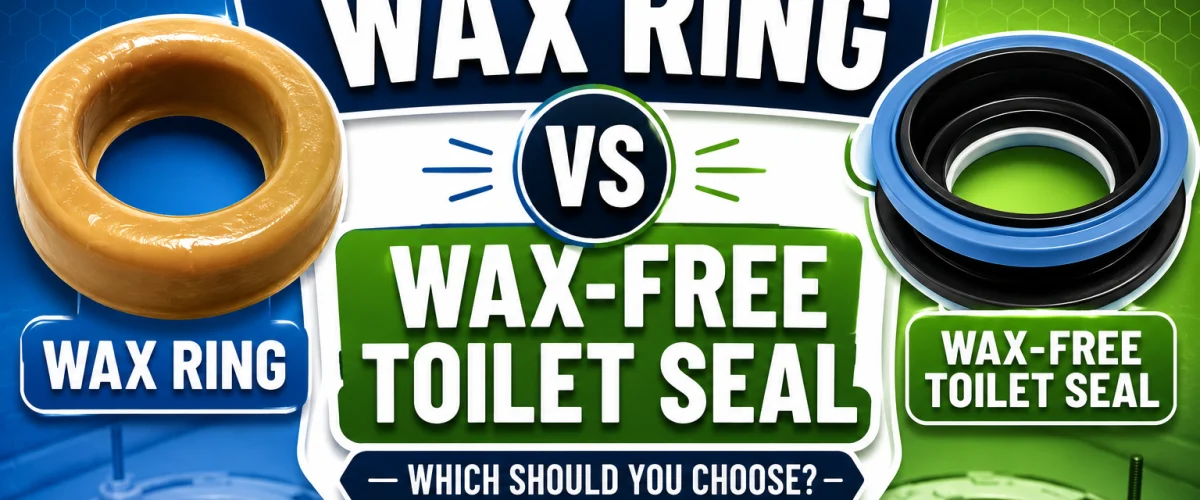
Wax ring vs wax-free toilet seal — compare installation ease, reliability, cost and which works best for low or uneven flanges in US homes.
Please note: Information in this comparison is based on our research at time of writing and is subject to change. Always consult a licensed plumber for installation or diagnosis questions specific to your home.
Every toilet installation requires a seal between the toilet base and the floor flange — and for decades, that seal has meant a wax ring. Wax rings are the traditional choice: inexpensive, proven, and familiar to every plumber who has worked in US homes. Wax-free toilet seals are the modern alternative, offering specific advantages that wax doesn’t — particularly around installation flexibility and how well they handle the flange conditions found in older US housing stock. This guide compares both types across every practical factor, so you can choose the right seal for your specific situation rather than defaulting to whichever one comes to hand first.
Whether you’re replacing an existing toilet or reinstalling one after a bathroom floor replacement, the seal you choose affects how straightforward the installation is and how reliably the joint holds over time. For a full walkthrough of the toilet installation process, our guide to installing a toilet covers the hardware and fitting details alongside the seal. And if you’re addressing broader toilet maintenance at the same time, our roundup of the best toilet repair kits covers the other components worth having on hand while the toilet is already off the floor.
✏️ Our Take
A wax ring has been the standard toilet seal for decades because it works reliably and costs very little — but it has real downsides that wax-free alternatives solve. If you’re reinstalling the same toilet on the same flange, a wax ring is fine and cheap. If you’re dealing with an uneven floor, a flange that sits below floor level, or you simply want a mess-free installation, a wax-free seal is worth the small price premium.
IN THIS GUIDE
A wax ring is exactly what the name suggests — a ring of soft wax, typically made from petroleum-based wax blended with a small amount of polyethylene, formed into a donut shape. When the toilet is lowered onto the floor flange and bolted down, the weight and pressure compress the wax against both the toilet horn (the drain outlet at the base of the toilet) and the flange, forming a watertight seal. The compression is permanent: once the wax is pressed into position, the toilet cannot be repositioned without breaking the seal. A new ring is required for any reinstallation.
A wax-free seal is typically a rubber or foam gasket — sometimes incorporating a rigid plastic sleeve that extends into the drainpipe to direct flow away from the seal surface itself. The rubber or foam material creates a compression seal when the toilet is bolted down, but the key difference is that the gasket can, in many designs, be repositioned during installation without compromising the seal. Wax-free seals are available in several designs from different manufacturers; the unifying characteristic is that they seal without the mess, temperature sensitivity, or single-attempt installation constraint of wax.
Both types connect the toilet horn to the floor flange and serve the same purpose: preventing sewer gases and wastewater from escaping at that joint. They differ in material, installation behavior, and how well each handles non-standard flange conditions.
Wax ring installation requires a single confident placement. Once the toilet is lowered onto the wax and the toilet base contacts the ring, the wax begins to compress and conform to the joint. If the toilet is lifted back off — even slightly — to reposition it, the wax is disrupted and the seal cannot be trusted. A new wax ring must be used for any further attempt. This is the most significant practical drawback of wax for DIY installers: getting a heavy toilet aligned perfectly over two closet bolts on the first lowering attempt, without moving the toilet once it contacts the wax, is harder than it sounds — particularly when working alone.
Wax-free seals allow repositioning during installation in most designs. The rubber or foam gasket does not permanently deform on contact the way wax does, so the toilet can be shifted or lifted and reset during the installation process without losing the seal — provided it hasn’t been fully bolted down and placed into service. This repositioning tolerance makes wax-free seals significantly more forgiving for a homeowner installing a toilet without a helper to guide the bolt alignment. The one-shot constraint of wax is the most common reason DIY installers choose wax-free.
Wax-free seals also make for a cleaner job. Wax rings are greasy and sticky — they transfer easily to hands, clothing, and the floor surface, and can be difficult to clean up if the ring is mishandled or crushed during installation. Wax-free seals are dry to the touch and leave no residue on the floor or your hands.
Wax rings have one of the strongest reliability track records of any plumbing component in US homes. A correctly installed wax ring on a properly positioned flange, under a toilet that doesn’t rock, will typically last for the life of the toilet without requiring any attention. Decades of widespread use across all US climate zones have established wax as a proven material for this application. The failure modes are well understood: wax rings fail when the toilet is not properly secured and rocks over time (gradually disrupting the compressed seal), when the flange sits too far below floor level for the ring to bridge the gap fully, or — less commonly — when the wax is exposed to sustained heat that softens and shifts the material.
Wax-free seals carry a shorter track record simply because they are newer. The rubber and foam materials used in quality wax-free seals perform well in testing and in the real-world use they’ve accumulated, but they haven’t been field-tested across the same decades of US home use that wax has. That said, the failure modes are equivalent — a gasket that degrades, loses compression, or was not correctly seated is no more likely to fail than a wax ring when both are installed correctly on a sound flange.
The most common cause of toilet seal failure applies equally to both types: a toilet that rocks at the base. Any toilet that moves when you sit on it — regardless of what type of seal is installed — will eventually work that seal loose. Properly securing the toilet so it cannot shift is more important for long-term seal reliability than which material you choose.
Wax rings sit firmly in the lowest price tier of toilet installation components. A standard wax ring with horn is one of the least expensive items in any hardware store’s plumbing aisle, and extra-thick variations for low flanges cost only marginally more. The low cost reflects both the simplicity of the material and the volume at which they’re manufactured — wax rings are among the most commonly replaced plumbing components in US residential plumbing, which keeps the price consistently low.
Wax-free seals carry a modest premium. Quality wax-free seals from established manufacturers fall into the $ to $$ range depending on design — models with adjustable sleeves or extended depth for low-flange applications sit at the higher end. The premium remains minor in the context of a full toilet installation, where the seal represents a small fraction of total project cost whether you’re hiring a plumber or doing the work yourself.
The seal is not where you should cut costs in a toilet installation. Both wax and wax-free options are inexpensive enough that choosing the right seal for your flange condition is more important than saving a small amount on a cheaper option that isn’t suited to your situation.
Wax rings cannot be reused once compressed. The deformation that creates the seal is permanent — a wax ring that has been pressed against the flange and toilet horn, even if lifted off before full bolting, has lost the material consistency needed to form a reliable seal on a second attempt. Any time a toilet is removed, a new wax ring is required before reinstalling it. This applies regardless of how long the toilet was seated or whether any leak developed.
Some wax-free designs allow the toilet to be briefly repositioned during installation without ruining the gasket — but this is a different situation from reusing a seal that has been fully seated and placed into service. A wax-free seal that has been compressed under a bolted-down toilet and used for any period of time should be replaced when the toilet is removed, just as a wax ring would be. The repositioning advantage applies only during the installation process itself, not across separate installations.
A toilet flange is designed to sit at or just above the finished floor level — that is the condition a standard wax ring is built for. When the flange is at the correct height, a standard ring fills the gap between the flange and the toilet horn reliably and completely. Where the system breaks down is when the flange sits significantly below the finished floor, requiring the wax to bridge a larger gap than it was designed for. A standard ring in this condition compresses incompletely, leaving the joint under-sealed from the start.
In older US homes — particularly common in the Northeast and Midwest where housing stock tends to be older — flooring has often been replaced or built up over decades, leaving the toilet flange sitting below the finished floor level. This is exactly the scenario where wax-free seals with adjustable designs solve a problem a standard wax ring struggles with. A wax-free seal with an adjustable sleeve can compensate for a recessed flange without requiring the workaround of stacking multiple wax rings — a practice that creates a taller and potentially unstable seal stack that is more vulnerable to being disturbed if the toilet shifts at all.
Extra-thick wax rings exist specifically for low-flange situations and provide more wax volume to bridge a larger gap. These work reasonably well when the flange is only slightly below floor level, but they add complexity to an already more demanding installation. For flanges sitting an inch or more below the finished surface, a wax-free seal designed for low-flange applications is the cleaner and more reliable solution. If the flange itself is damaged or corroded, our roundup of the best toilet repair kits covers flange repair rings and hardware worth addressing while the toilet is already removed.
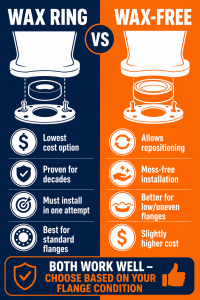
Here’s how wax rings and wax-free seals compare across the factors that matter most for a typical US toilet installation:
| Situation | Wax Ring | Wax-Free Seal | Winner |
|---|---|---|---|
| Standard flange, same toilet | Inexpensive, proven — ideal conditions | Works fine, small cost premium | WAX RING |
| Low or uneven flange | May not bridge gap reliably | Adjustable designs handle this well | WAX-FREE |
| DIY installer working alone | One-shot placement — no repositioning | Repositioning allowed during install | WAX-FREE |
| Lowest cost | Lowest price tier available | Small premium over wax | WAX RING |
| Mess-free installation | Greasy material, transfers to hands and floor | Clean, dry, no residue | WAX-FREE |
| Longest track record | Decades of proven field use in US homes | Newer — good but shorter history | WAX RING |
| Heat exposure near toilet base | Wax can soften — uncommon but real risk | Not heat-sensitive | WAX-FREE |
For any other toilet hardware you need while the toilet is already off the floor, our guide to the best toilet repair kits covers flange repair rings, bolt sets, and other components worth addressing in the same visit.
If your toilet flange is damaged, corroded, or positioned significantly below floor level, a licensed plumber can assess whether the flange needs repair or replacement before a new seal is installed. Getting the flange condition right before setting the new seal is worth the call — a compromised flange will undermine any seal type, and the repair is far easier to address while the toilet is already removed.
Find a licensed plumber in your area at PlumberArchive.com — the US plumber directory with 12,000+ verified local plumbers across all 50 states.
Get weekly plumbing tips, honest tool reviews and DIY maintenance guides delivered straight to your Facebook feed. We cover toilet repairs, bathroom maintenance, pipe care and everything in between — written for US homeowners who want to handle more themselves.
Yes — quality wax-free seals from established manufacturers perform reliably when installed correctly on a sound flange. The main caveat is the track record gap: wax rings have decades of widespread field use across US homes in every climate zone, while wax-free seals have accumulated years rather than decades of real-world data. In practice, both types fail for the same root reason: a toilet that rocks and moves at the base. A properly secured toilet that doesn’t shift will keep either seal type intact for many years. Wax-free seals are a legitimate modern alternative — not a compromise option.
No — once the toilet base contacts the wax ring, repositioning it breaks the seal. Even a partial contact before the toilet’s full weight is applied will displace enough wax to compromise the joint. If you lower a toilet onto a wax ring and realize it’s misaligned, you need to lift the toilet completely clear, remove the old ring, and start again with a new one. This is the most common reason DIY installers choose wax-free seals — most designs allow brief repositioning without damaging the gasket, provided the toilet hasn’t been fully bolted down and placed into service.
Yes — a standard wax ring is designed for a flange at or just above the finished floor level. If your flange is recessed, you need either an extra-thick wax ring (for minor height differences of a quarter-inch or less) or a wax-free seal with an adjustable sleeve designed specifically for low-flange situations. A standard ring on a recessed flange will not form a complete seal under the toilet horn, which leads to a slow leak that may not be immediately visible but will cause subfloor damage over time. Measure the gap between the top of the flange and the finished floor before buying — anything more than a half-inch below the surface warrants a low-flange solution.
The most common signs of a failed toilet seal are water appearing around the toilet base after flushing, soft or discolored flooring at the toilet base (indicating moisture has been seeping for some time), sewer gas odor in the bathroom with no other obvious source, or staining on the ceiling in a room directly below the toilet. Not all seal failures produce visible standing water immediately — slow weeping that evaporates between flushes can cause subfloor damage without pooling on the surface. If you notice any of these signs, particularly soft flooring or sewage odor, inspect and replace the seal as soon as possible. Addressing the repair while the subfloor is still sound is far less expensive than dealing with structural damage that develops if the problem is left to progress.
Wax rings remain the practical default for a straightforward installation — a flange at the correct height, an intact toilet, and an installer who is comfortable with the single-attempt placement. They’re inexpensive, proven across decades of US home use, and available at every hardware store. For those conditions, there’s no compelling reason to choose otherwise. Our roundup of the best toilet wax rings covers both traditional and wax-free options if you’re ready to buy.
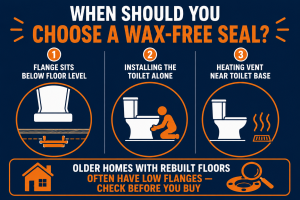
Wax-free seals earn their small price premium in three specific scenarios: a flange that sits below the finished floor level, a solo DIY installation where repositioning flexibility matters, and a bathroom where heat exposure near the toilet base is a genuine concern. In any of these situations, a wax-free seal designed for the job is the more reliable choice — and the cost difference is minor relative to the risk of a failed seal that damages the subfloor before it’s discovered.
Whichever seal type you choose, the long-term performance depends more on flange condition and toilet stability than on the seal material itself. For the full installation process, our guide to installing a toilet covers the hardware and fitting details step by step. If you’re comparing toilet types at the same time, our guide to dual flush vs single flush toilets covers the other major decision in a new toilet installation. And for flange repair components and other toilet hardware, our roundup of the best toilet repair kits covers what to have on hand.
✍️ About This Comparison
PTR Editorial Team — Product Comparisons. We compare manufacturer specifications, installation requirements, compatibility and available product documentation to help homeowners choose suitable tools and parts. How we review →
Pop-up drains seal to hold water; grid drains never close but resist clogs better and cost less. Here's how to choose between them for your bathroom sink.
Test strips, digital meters or send-to-lab testing? Match the method to your situation — screening, ongoing monitoring, or a real health concern.
25-foot vs 50-foot drain snake: compare handling, the cable diameter trade-off and the jobs that justify extra length, plus where 50 feet stops.

