Comparisons
2 Oct 2026

Pop-Up Drain vs Grid Drain: Which Should You Choose?
Pop-up drains seal to hold water; grid drains never close but resist clogs better and cost less. Here's how to choose between them for your bathroom sink.
Dual flush vs single flush toilet — compare water savings, costs, reliability and maintenance to decide which is right for your US home in 2026.
Please note: Information in this comparison is based on our research at time of writing and is subject to change. Always consult a licensed plumber for installation or repair questions specific to your home.
Dual flush toilets have become increasingly common in US homes over the past decade — and the choice between dual flush and single flush touches several practical factors that go well beyond water conservation marketing. It affects your monthly water bill, your long-term maintenance workload, and how easy or difficult it will be to source replacement parts years down the line. This guide compares both systems across every factor that actually matters for US homeowners.
Whether you’re buying a new toilet or wondering whether to replace your current one, the comparison comes down to more than just which button uses less water. If you already have either type and it’s running constantly, our guide to fixing a running toilet covers the most common causes for both systems. And if you’re dealing with a fill valve issue regardless of flush type, our roundup of the best toilet fill valves covers the replacement options.
✏️ Our Take
Dual flush toilets save real water over time, but the savings are smaller than most people expect and the mechanism adds a part that can eventually fail. For most US households on a standard municipal water bill, the payback period on switching from a working single flush toilet is longer than many homeowners assume. If you’re buying new anyway — choose dual flush. If your single flush toilet works fine, the case for replacing it purely to save water is weaker than the marketing suggests.
IN THIS GUIDE
A single flush toilet uses one fixed water volume every time the handle is pressed — typically 1.6 gallons per flush (GPF) in modern US toilets. That 1.6 GPF figure is set by federal law for toilets manufactured after 1994. The mechanism is straightforward: pressing the handle lifts a flapper valve at the base of the tank, releasing the full tank volume into the bowl in one flush cycle. The tank then refills via the fill valve to the same level each time.
A dual flush toilet offers two options — a partial flush for liquid waste using approximately 0.8 to 1.1 gallons, and a full flush for solid waste using the standard 1.6 gallons. The two-option mechanism is typically presented as two buttons on top of the cistern or as two lever positions on a side-mounted handle. Instead of a traditional flapper, dual flush toilets use a tower-style flush valve with a seal designed to allow partial release, which is what creates the two distinct flush volumes. The internal components are fundamentally different from a standard flapper-based single flush mechanism.
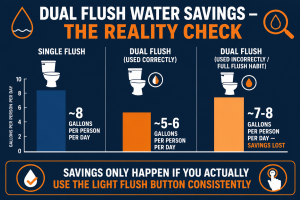
The EPA estimates that the average person flushes a toilet approximately five times per day. For a single flush toilet at 1.6 GPF, that works out to roughly 8 gallons per person per day, or around 2,920 gallons per person per year. For a household of four, that’s approaching 12,000 gallons annually from toilet use alone.
A dual flush toilet used correctly — light flush for liquid waste, full flush for solid waste — can reduce that figure to approximately 5 to 6 gallons per person per day, depending on the specific GPF ratings of the model and the ratio of flush types actually used. Over a full year that represents a meaningful reduction, but the key phrase is used correctly. Real-world water savings depend almost entirely on household behavior rather than the hardware itself.
Dual flush toilets typically carry a $ to $$ premium over comparable single flush models at the same quality tier. That premium exists at every price point — from entry-level builder-grade models through to higher-end brands — because the internal flush valve mechanism is more complex to manufacture than a standard flapper system.
On the savings side, the reduction in water usage translates to a modest decrease in monthly water bills. How modest depends heavily on your local water rate. In areas where water costs are low — much of the rural Midwest and Southeast — the monthly saving from switching to dual flush may amount to only a few dollars, pushing the payback period on the premium to a decade or more. In high-cost water markets — parts of California, Arizona, and major urban centers — the same savings close the gap considerably faster.
The single flush toilet’s greatest practical advantage is its simplicity. The flapper-and-fill-valve mechanism has been in widespread use for decades, is universally understood, and is one of the easiest DIY plumbing repairs a homeowner can do. Universal flapper replacements fit the vast majority of single flush toilets and are available at any hardware store for minimal cost. The repair is typically a ten-minute job that requires no tools beyond a dry rag.
Dual flush toilets use a tower-style flush valve seal in place of a traditional flapper. This component can wear out over time and, when it does, the failure mode is typically a slow, continuous leak from the tank into the bowl — a phantom flush or constant run that can be harder to diagnose than a straightforward flapper issue. The repair parts are specific to the manufacturer and sometimes to the model, which means sourcing a replacement can require more effort than walking to the nearest hardware store aisle.
The fill valve mechanism on both types functions similarly and the repair process is comparable — if either type develops a fill valve problem, our guide to fixing a running toilet covers the diagnosis and replacement process for both.
For a complete toilet replacement, both types install using the same standard rough-in dimensions — the 12-inch rough-in (from the wall to the center of the drain) covers the large majority of US homes, with 10-inch and 14-inch variations available in both flush types. The toilet-to-drain connection, wax ring seating, and supply line connection are identical processes regardless of flush mechanism. A homeowner comfortable with one installation process will find the other equally straightforward.
The difference emerges in long-term parts availability. Single flush toilets use universally compatible components — Fluidmaster and Korky replacement fill valves and flappers fit the overwhelming majority of models regardless of brand, and the parts are stocked at every hardware store nationally. Dual flush models sometimes require brand-specific replacement parts for the flush valve tower, which can mean ordering online or sourcing from a specialty supplier rather than picking up a part locally on a Sunday afternoon.
Whichever type you install, a quality toilet fill valve is worth having on hand as a spare — it’s the component most likely to require attention over the life of the toilet.
For homes on a private septic system, total water volume entering the tank is a genuine operational concern — not just an environmental one. Every gallon flushed down a toilet has to pass through the septic tank, get processed by the bacterial digestion layer, and eventually drain to the leach field. A system that receives less daily water volume has more processing capacity margin and is less prone to the hydraulic overloading that causes wet leach fields and backup problems.
Dual flush toilets, used consistently, reduce the daily water volume entering the septic tank and can meaningfully ease the load on a system operating near capacity. For a household with an aging system, a system sized smaller than current household occupancy warrants, or a leach field showing signs of saturation, the water reduction from dual flush use is a practical benefit beyond mere water conservation.
That said, either type works perfectly well with a properly sized and maintained septic system in good working order. The benefit of dual flush is most relevant when the septic system is the constraint rather than the toilet.
WaterSense is the EPA’s water efficiency certification program, and many dual flush toilets qualify for WaterSense certification where the full flush is rated at 1.28 GPF or lower. Numerous US municipalities offer rebates to homeowners who replace older toilets with WaterSense-certified models — dual flush toilets are among the most commonly eligible products under these programs.
Rebate availability and amounts vary enormously by location. Some utilities offer a straightforward fixed rebate per toilet replaced; others run first-come, first-served programs with annual caps that may be exhausted by mid-year. Single flush WaterSense-certified toilets can also qualify for rebates in some programs, so dual flush is not the only eligible option — but dual flush models appear more frequently on approved product lists due to their lower average GPF ratings.
US regional note: In drought-prone states like California, Arizona, Nevada and parts of Texas, water costs and local rebate programs can change this calculation significantly — some municipalities offer rebates of $50–$100 for installing WaterSense-certified dual flush toilets, which shortens the payback period considerably. Check your local water utility’s rebate program before deciding, as availability varies widely by city and county.
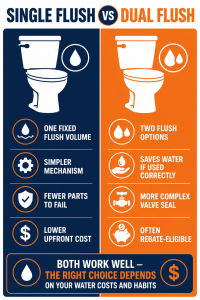
Here’s how the two systems compare across every factor that matters for a US homeowner:
| Factor | Dual Flush | Single Flush | Winner |
|---|---|---|---|
| Water savings | 0.8–1.1 GPF light / 1.6 GPF full | 1.6 GPF every flush | DUAL FLUSH |
| Upfront cost | $ to $$ premium over single flush | Lower at every tier | SINGLE FLUSH |
| Long-term reliability | More complex valve seal — can develop slow leaks | Simple flapper — easy DIY repair | SINGLE FLUSH |
| Replacement parts | Brand-specific — may need to order | Universal parts at any hardware store | SINGLE FLUSH |
| Septic system load | Lower water volume — eases load | Higher volume per use | DUAL FLUSH |
| Rebate eligibility | Frequently eligible — check locally | Some models qualify — fewer options | DUAL FLUSH |
| Simplicity of use | Two-button choice — requires consistent user habit | One action — no choice required | SINGLE FLUSH |
If you’re choosing dual flush, pairing it with a quality toilet seat at the same time is an efficient way to complete the bathroom update in one job.
If you’re replacing a toilet and aren’t comfortable with the wax ring seal, supply line connection, or shutoff valve operation, a licensed plumber can complete the swap in under an hour. It’s also worth having a pro assess your shutoff valve condition before starting — a stuck or corroded shutoff valve is the most common complication in a toilet replacement that would otherwise be straightforward.
Find a licensed plumber in your area at PlumberArchive.com — the US plumber directory with 12,000+ verified local plumbers across all 50 states.
Get weekly plumbing tips, honest tool reviews and DIY maintenance guides delivered straight to your Facebook feed. We cover toilet repairs, water management, pipe maintenance and everything in between — written for US homeowners who want to handle more themselves.
Yes — but the real-world savings are typically smaller than the theoretical maximum suggests. The light flush option (0.8–1.1 GPF) uses significantly less water than the full flush (1.6 GPF), and over tens of thousands of flush cycles that adds up. The critical variable is behavior: households that consistently use the light flush for liquid waste achieve meaningful savings; households that default to the full flush button out of habit or uncertainty see little to no reduction. Research on actual dual flush usage in US homes consistently finds lower savings than manufacturer projections assume. The hardware works — the question is whether your household will use it as intended, consistently, over years.
Not necessarily more likely, but the failure mode is different and can be harder to catch. A worn standard flapper typically produces an obvious sound — water audibly running into the bowl — that most homeowners notice quickly. A dual flush tower seal that begins to fail often produces a very slow, silent seep from tank to bowl that inflates the water bill without an obvious running sound. This “phantom flush” or slow leak can go undiagnosed for months — our ghost flushing fix guide covers how to diagnose and stop it. The repair is also slightly more involved because the tower valve assembly is more complex than a flat flapper, and the replacement part needs to match the specific model. Neither type is immune to leaks over time — the single flush leak is just easier to hear and fix when it happens.
Conversion kits are available that replace the internal flapper and handle mechanism with a dual flush tower assembly. These kits can work reasonably well on many standard toilets, but the results vary significantly depending on the toilet’s tank dimensions and the kit’s compatibility. The conversion also doesn’t change the bowl or trap geometry, which affects flush effectiveness — a bowl designed around a single 1.6 GPF flush may not clear as consistently on the reduced 0.8 GPF light flush. For most homeowners, a conversion kit is worth considering if the toilet is otherwise in good condition and you’re primarily interested in the water savings. If the toilet is old and due for replacement anyway, a dedicated dual flush model is a better long-term solution than a converted single flush.
No — dual flush toilets are not federally mandated in the US. Federal law requires that new toilets meet a maximum flush volume of 1.6 GPF, which both single flush and dual flush designs can satisfy. Some states and municipalities have adopted stricter standards — California’s plumbing code, for example, requires 1.28 GPF or less for new residential toilet installations, which many dual flush models and an increasing number of high-efficiency single flush models meet. No US jurisdiction currently requires the dual-button mechanism itself. Before a major bathroom remodel, check your local building code for any applicable water efficiency standards, as these vary by state and county.
Dual flush toilets save real water, but only when used correctly and consistently — and the payback period on replacing a working single flush toilet varies significantly by location. If you’re buying new and live in a high water-cost or drought-prone area, dual flush is the right choice, especially if a local rebate brings the premium down. If your current single flush toilet works properly, the financial case for replacing it purely on water-saving grounds is often weaker than the marketing implies.
Single flush wins on simplicity, repair ease, and parts availability — if anything goes wrong, you can fix it with a universal flapper from any hardware store. Dual flush wins on water volume and septic load, provided the household actually uses the light flush as intended. The mechanism difference is real, and so is the maintenance difference when something eventually wears out.
Whichever type you choose or currently have, keeping the internals in good working order matters more than the flush type. If your toilet runs constantly, our guide to fixing a running toilet covers the diagnosis and repair steps for both systems. For fill valve replacements, our roundup of the best toilet fill valves covers the options at every price point. And if you’re doing a full bathroom refresh alongside a toilet upgrade, our guide to the best toilet seats covers what to look for.
✍️ About This Comparison
PTR Editorial Team — Product Comparisons. We compare manufacturer specifications, installation requirements, compatibility and available product documentation to help homeowners choose suitable tools and parts. How we review →
Pop-up drains seal to hold water; grid drains never close but resist clogs better and cost less. Here's how to choose between them for your bathroom sink.
Test strips, digital meters or send-to-lab testing? Match the method to your situation — screening, ongoing monitoring, or a real health concern.
25-foot vs 50-foot drain snake: compare handling, the cable diameter trade-off and the jobs that justify extra length, plus where 50 feet stops.

