Introduction
The shower drain is the most frequently blocked drain in US homes — and the cause is almost always the same: hair combined with soap scum that builds up gradually until water stops draining properly. The good news is that the majority of shower drain blockages can be cleared in under 30 minutes without calling a plumber, and without reaching for harsh chemical products. This guide walks you through the correct order of methods to try — starting with the simplest and safest before escalating to anything stronger.
For product recommendations on the tools you will need, see our guide to the best drain snakes and our comparison of chemical vs mechanical drain cleaning methods.
Please note: Product availability and information are based on our research at time of writing and are subject to change. Always check retailer listings for the latest details before purchasing.
⚡ AT A GLANCE
| Difficulty |
Easy to Moderate |
| Time |
15–45 Minutes |
| Cost |
$ — Under $20 for tools |
| Tools Needed |
Drain snake or hair catcher removal tool, gloves, flashlight |
| Skill Level |
Beginner |
✏️ Our Take
A slow or fully blocked shower drain is almost always caused by hair combined with soap scum — and in 90% of cases you can clear it yourself in under 30 minutes without calling a plumber or using harsh chemicals. The trick is working through methods in the right order — starting with the simplest and safest before reaching for anything stronger. Most people reach for chemicals first when a basic drain snake would have solved it faster and safer.
Signs Your Shower Drain Is Blocked
Shower drain blockages rarely appear overnight — they develop gradually over weeks as hair and soap scum accumulate inside the drain pipe. Knowing the warning signs early makes every method in this guide faster and easier to apply before the situation becomes a full blockage.
- Water pools around your feet during showers. Standing water that builds up during a normal shower and drains slowly afterward is the most common early sign of a developing blockage.
- Water drains noticeably slower than normal. If the shower floor takes longer to clear than it used to, hair and soap scum are building up inside the drain pipe — even if the drain is not yet fully blocked.
- Gurgling sounds from the drain. A gurgling or bubbling sound when water drains indicates that air is being forced through a partial blockage — a reliable sign that flow inside the pipe is restricted.
- Unpleasant smell coming from the drain. Decomposing hair and soap scum produce a musty or sulfur-like odor. A drain smell when the shower is not running means the buildup is significant enough to address immediately — though if the drain isn’t actually slow, our smelly drain fix guide covers the other common causes of odor alone.
💡 Tip: Catching a slow drain early — before it fully blocks — makes every method in this guide faster and easier. A slow drain takes 10 minutes to clear. A fully blocked drain can take 45 minutes and multiple rounds of the steps below.
What You’ll Need
Most shower drain blockages require only basic tools — many of which you may already have at home. For product recommendations on drain snakes, see our guide to the best drain snakes, and for hair catchers to prevent future blockages, see our picks for the best drain hair catchers.
- Rubber gloves — essential for keeping your hands clean when removing hair blockages
- Flashlight or phone light — to inspect the drain opening once the cover is removed and assess the blockage depth
- Plunger — a flat cup plunger works well on shower drains to shift soft blockages
- Drain snake — a 5 to 25-foot hand snake or dedicated hair removal tool for reaching and pulling out hair clumps
- Enzymatic drain cleaner (optional) — for clearing residual soap scum after the main blockage is physically removed
- Old towel or rag — to cover overflow holes during plunging and to protect the floor
💡 Tip: Buy a
drain hair catcher now to prevent this problem recurring after you clear today’s blockage. They cost well under $20 and eliminate the single biggest cause of shower drain blockages — hair entering the pipe in the first place.
Step 1 — Remove the Drain Cover
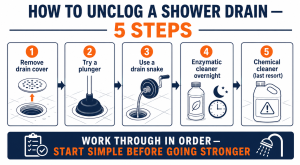
Before you can reach the blockage, you need to remove the shower drain cover to access the pipe opening. This is straightforward on most shower drain types and takes under two minutes.
- Check whether the cover is screwed or clipped in place. Most shower drain covers either unscrew with a flathead screwdriver or simply pop off by lifting from the edge — look for a visible screw in the center, or try gently prying from one side with a flathead tip.
- Remove any screws using a flathead screwdriver. Set the screws aside somewhere safe — a small cup, a piece of tape on the floor nearby, or the sink basin — where they will not roll away and be lost.
- Lift the drain cover free and set it aside. Some covers incorporate a built-in strainer basket — check whether hair has already collected in it and remove any buildup now before moving on.
- Shine a flashlight into the drain opening to get a visual assessment of the blockage. You may be able to see a hair clump within the first few inches of the pipe — if so, you can often remove it by hand with gloves on before needing any other tools.
💡 Tip: If your drain cover has a strainer basket built in — clean it now before continuing to the next steps. A blocked strainer basket is often the entire cause of a slow-draining shower and takes 30 seconds to clear with gloved hands.
Step 2 — Try a Plunger First
A plunger is quick to try and can dislodge soft blockages sitting just below the drain opening before you need to use a snake. The technique matters — follow these steps for maximum effectiveness on a shower drain.
- Add one to two inches of water to the shower floor. This creates a hydraulic seal and increases the pressure you generate with each stroke. If the shower already has standing water from the blockage, you have enough.
- Cover overflow holes with a wet rag if present. Some shower trays have overflow channels along the side — covering them with a folded wet rag prevents suction escaping and makes plunging significantly more effective.
- Place the plunger cup directly over the drain opening, pressing down firmly to create a seal before you begin. A flat cup plunger works best on a flat shower drain floor.
- Push down firmly and pull up quickly 10 to 15 times. Use short, fast strokes rather than slow heavy ones — the suction on the return pull often dislodges hair clumps as effectively as the downward push.
- Check whether water drains faster after plunging. If drainage has improved, run the shower briefly to flush any loosened material through. If there is no improvement, move on to the drain snake in Step 3.
⚠️ Warning: Never use a plunger immediately after pouring chemical drain cleaner into the drain — splashback can cause serious chemical burns to skin and eyes. If you have already used a chemical cleaner, flush the drain thoroughly with water for several minutes before attempting to plunge.
Step 3 — Use a Drain Snake
A drain snake is the most effective tool for shower drain hair blockages. Where a plunger pushes against the clog, a drain snake physically reaches into the pipe and pulls the hair mass out. For shower drains blocked with hair, mechanical removal with a snake is almost always faster, cheaper, and more effective than any chemical product — and it is safe for all pipe types. For product options, see our full guide to the best drain snakes.
- Put on rubber gloves before starting — you will be pulling out compacted hair and soap scum, and gloves keep the process clean and hygienic.
- Insert the drain snake slowly into the drain opening, feeding the cable in gently without forcing it. Guide it down through the pipe — the goal is a smooth entry, not pushing hard against resistance.
- Turn the handle clockwise while pushing the cable gently forward. The rotation helps the tip navigate the bends inside the pipe and work its way toward the blockage.
- You will feel resistance when the tip contacts the hair clump. Do not force the cable through the blockage. Continue rotating while applying gentle forward pressure to hook the snake tip into the hair mass.
- Pull back slowly while still rotating. This action hooks into and pulls the hair clump back out of the drain. Have a plastic bag or several paper towels ready to receive the debris as the cable emerges.
- Repeat two to three times until the snake comes back clean and water runs freely down the drain.
💡 Tip: A drain snake with a hooked or barbed end works far better for hair clogs than a plain straight cable design — the barbs catch and hold the hair mass so you can pull it out cleanly rather than just pushing it further down the pipe. Look for this feature when choosing a snake for shower drain use.
Step 4 — Try an Enzymatic Cleaner
After physically removing the main hair blockage with a drain snake, an enzymatic cleaner is the best follow-up for clearing residual soap scum and organic buildup that clings to the pipe walls. Enzymatic cleaners use naturally occurring bacteria to digest organic matter — they are slower acting than chemical cleaners but completely safe for all pipe types, all plumbing ages, and septic systems.
- Choose an enzymatic drain cleaner specifically formulated for drain maintenance — these are widely available at hardware stores and home centers across the US.
- Pour the recommended amount directly into the drain following the product instructions precisely. Do not exceed the stated dose — more product does not speed up the process.
- Leave overnight for best results. Enzymatic cleaners work slowly — a few hours minimum, overnight is ideal. Do not run water down the shower drain during this period.
- Flush with warm water in the morning to clear the treated material through the pipe and confirm the drain is running freely.
Enzymatic cleaners are safe for older homes with galvanized or copper pipes, safe for PVC, and safe for septic systems — making them the right maintenance choice for most US households after clearing the physical blockage.
💡 Tip: Enzymatic cleaners work slowly using bacteria to digest organic matter — they are not a quick fix for a fully blocked drain but are excellent for maintaining a clear drain after you have removed the main hair blockage with a snake. Use them monthly as a preventive treatment to stop soap scum from rebuilding.
Step 5 — Chemical Drain Cleaner (Last Resort)
Chemical drain cleaners should only be used if the plunger and drain snake have both failed to clear the blockage. They can be effective on organic matter and soap scum, but come with significant safety considerations — particularly for older plumbing and households with septic systems. Read all safety information carefully before use. For a full comparison of approaches, see our guide to chemical vs mechanical drain cleaning.
- Check your pipe type before using. Never use caustic chemical drain cleaners on older metal pipes without first checking the manufacturer’s compatibility guidance — certain chemicals accelerate corrosion in galvanized steel pipes found in older US homes.
- Do not use if you have a septic system. Chemical drain cleaners kill the beneficial bacteria in a septic tank. Use enzymatic cleaners (Step 4) instead — they achieve the same result without harming your septic system.
- Always wear rubber gloves and eye protection. Chemical drain cleaners are caustic and cause serious skin and eye burns on contact. Never handle them without full protection.
- Follow the product instructions exactly. Use the stated quantity, wait the stated time, and flush as directed. Using more product than recommended increases the risk of pipe damage without improving results.
- Never mix chemical products. Combining different chemical drain cleaners can produce dangerous reactions, generate heat, and release toxic fumes. If one product has not worked, flush the drain completely with cold water for several minutes before considering any other chemical approach.
⚠️ Warning: Chemical drain cleaners should be your last resort, not your first step — mechanical methods are safer, cheaper, and usually more effective for hair-based shower drain clogs. If you reach for a chemical cleaner before trying a drain snake, you are adding cost and risk without improving your chances of clearing the blockage.
How to Prevent Future Blockages
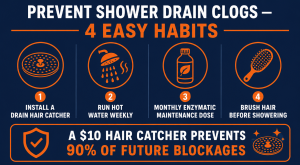
The best shower drain blockage is one that never forms. A few consistent habits take less time per month than clearing a blocked drain takes in an afternoon — and they keep you away from chemical drain cleaners entirely.
- Install a drain hair catcher. This is the single most effective prevention measure available. A drain hair catcher sits over or inside the drain opening and intercepts hair before it enters the pipe. Empty it after each shower. This one step prevents the vast majority of shower drain blockages from forming in the first place.
- Run hot water through the drain weekly. A two-minute blast of the hottest water from your tap once a week helps flush soap scum buildup before it combines with hair and hardens into a blockage.
- Use a monthly enzymatic cleaner maintenance dose. A monthly enzymatic treatment digests the soap scum and organic residue that accumulates in the pipe walls even when a hair catcher is in place.
- Brush hair before showering. Brushing hair before stepping into the shower removes loose hairs that would otherwise fall during washing — significantly reducing the amount that enters the drain.
Hard water states — extra steps required: In Arizona, Texas, Nevada, and Southern California, hard water causes soap and minerals to combine into a far tougher deposit than in soft water areas. Homeowners in these states often need to repeat the drain snake step twice when clearing a blockage, and should treat the monthly enzymatic cleaner routine as essential rather than optional. A drain hair catcher is even more important in hard water states — the thicker soap scum layer binds more aggressively with hair and forms blockages faster than in soft water homes.
💡 Tip: A
drain hair catcher prevents 90% of future shower drain blockages — it is the single best investment you can make after clearing today’s clog. They are inexpensive, take 30 seconds to install, and require no tools.
When to Call a Plumber
Most shower drain blockages are DIY-solvable. But certain symptoms indicate a problem beyond a simple hair clog — one that a plunger and drain snake cannot fix and that requires a licensed plumber to assess and clear properly.
- Multiple drains blocked simultaneously. If your shower drain, bathroom sink, and toilet are all draining slowly at the same time, the problem is not in the shower drain — it is in the main sewer line or main stack. This requires a plumber, not a drain snake.
- Gurgling from other drains when the shower runs. If flushing the toilet causes the shower drain to gurgle, or running the shower causes gurgling at the bathroom sink, you have a venting or main sewer line issue rather than a local shower drain blockage.
- Blockage returns within days of clearing. If you clear the drain fully and it blocks again within a few days, there is an underlying cause — a damaged pipe, root intrusion, or persistent buildup that needs professional assessment to diagnose and resolve.
- Standing water that will not drain at all. If you have worked through all five steps in this guide and the drain will not clear, the blockage is deeper in the drain line than a hand snake can reach — a professional drain machine or camera inspection is the next step.
- Sewage smell present. A persistent sewage smell from the drain — particularly one that also appears in other rooms — indicates a sewer gas issue that requires immediate professional attention and should not be left unaddressed.
⚠️ Warning: If multiple drains in your home are blocked at the same time — this indicates a main sewer line problem, not a simple shower drain clog. Call a licensed plumber immediately. Do not attempt to clear a main sewer line blockage with the methods in this guide.
Need a Professional Plumber?
If the steps in this guide have not cleared your shower drain, or if you are seeing symptoms that point to a main sewer line problem, you need a licensed plumber. Search PlumberArchive.com — the US plumber directory with 12,151+ verified plumbers across all 50 states.
Find a trusted plumber near you →
Frequently Asked Questions
Q: How do I unclog a shower drain without chemicals?
The most effective way to unclog a shower drain without chemicals is to use a drain snake to physically remove the hair blockage. Start by removing the drain cover and shining a flashlight into the pipe to assess the clog. Insert the snake, rotate the handle clockwise while pushing gently until you feel resistance, then pull back slowly to extract the hair mass. Repeat two to three times until the snake comes back clean and water drains freely. For most shower drain blockages, a drain snake clears the problem completely without any chemical products. See our guide to the best drain snakes for product recommendations at every budget.
Q: Why does my shower drain keep getting blocked?
Recurring shower drain blockages almost always come down to one of two causes: hair is regularly entering the drain without a catcher intercepting it, or you live in a hard water state where mineral deposits combine with soap to form a tough deposit that traps hair more aggressively than in soft water areas. The most effective long-term fix is to install a drain hair catcher and add a monthly enzymatic cleaner treatment to your routine. If the drain blocks repeatedly despite a hair catcher being in place, a deeper buildup issue or a partially damaged pipe may need a professional drain cleanout to resolve properly.
Q: Is it safe to use a drain snake in a shower drain?
Yes — using a drain snake in a shower drain is completely safe when done correctly. Shower drains do not have a ceramic surface to protect the way toilet bowls do, so there is no risk of scratching from a standard drain snake cable. Insert the cable gently rather than forcing it, and rotate clockwise as you push forward to navigate the pipe bends without kinking the cable. A hand snake of five to 25 feet is appropriate for a standard shower drain. For stubborn blockages where a hand snake is not generating enough torque, a powered drum snake provides additional force. See our picks in the guide to the best drain snakes for both manual and powered options.
Q: How often should I clean my shower drain?
As a general rule, empty your drain hair catcher after every shower, and give the drain a quick inspection weekly. Run a monthly enzymatic cleaner treatment to break down soap scum and organic residue before it accumulates into a blockage. If you live in a hard water state — Arizona, Texas, Nevada, or Southern California — increase this to a hot water flush twice weekly and an enzymatic treatment every two weeks. A physical cleanout with a drain snake once every three to six months is a sensible preventive step for households that notice hair buildup returning quickly after clearing.
Conclusion — How to Unclog a Shower Drain
Work through the five steps in order and you will clear the vast majority of shower drain blockages without a plumber. Start with the plunger — it is quick, costs nothing extra, and handles soft blockages in under five minutes. If plunging does not shift it, a drain snake is your most effective next step — it physically removes the hair clump that causes most shower drain blockages and works faster and more safely than any chemical product.
Once the drain is clear, prevent the next blockage before it starts. A drain hair catcher eliminates 90% of future shower drain blockages for a very low upfront cost — it is the single best investment you can make immediately after clearing the drain today. A monthly enzymatic cleaner treatment handles the residual soap scum that builds up even with a catcher in place, keeping the pipe walls clean between physical cleanouts.
If multiple drains in your home are affected at the same time, or if the blockage returns within days of clearing, the problem goes beyond a simple shower drain clog. In that case, call a licensed plumber. For more context on when to use mechanical versus chemical approaches, see our full guide to chemical vs mechanical drain cleaning.
✍️ About This Guide
Written by Mike Reynolds, DIY Home Improvement Writer at PlumbingToolsReview — former residential contractor helping US homeowners tackle plumbing repairs with confidence. Learn how we test →