Please note: Product availability and information are based on our research at time of writing and are subject to change. Always check the manufacturer for the latest details before purchasing.
Introduction
The finish you choose for a faucet does more than change its color — it determines how much time you will spend cleaning it, how well it holds up against the mineral content in your water, and whether it still looks good five years after installation. Choose the wrong finish and you end up either polishing it daily to keep it looking clean or replacing it early because it has corroded or discolored beyond recovery.
This guide covers the six finishes you will find on the vast majority of US bathroom and kitchen faucets in 2026 — chrome, brushed nickel, matte black, oil-rubbed bronze, brushed gold, and polished brass. For each one we cover maintenance requirements, hard water performance, best room pairings, and what to avoid. If you are ready to buy once you have chosen a finish, our guides to the best bathroom faucets and best kitchen faucets cover reviewed models in every finish across the major US brands.
⚡ AT A GLANCE
| Difficulty |
Easy — no tools needed |
| Time |
10–15 Minutes to decide |
| Cost |
Free to plan |
| Tools Needed |
None — planning guide only |
| Skill Level |
Beginner |
💡 OUR TAKE
Most homeowners pick a faucet finish based on what looks good in the store and regret it six months later when it shows every fingerprint or clashes with their cabinet hardware. The finish decision is actually simple once you know two things — your water type and your existing hardware finish. Chrome and brushed nickel are the safest all-round choices for most US homes. Matte black looks stunning but shows water spots in hard water areas.
The 6 Most Popular Faucet Finishes
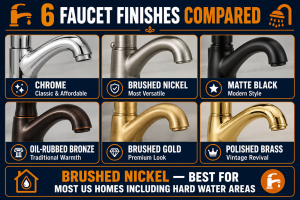
These are the six finishes you will encounter across the major US faucet brands — Moen, Kohler, Delta, Pfister, and American Standard. Every finish below is available from at least two of those brands, which matters for matching fixtures across a bathroom renovation.
| Finish |
Best For |
Maintenance |
Hard Water |
Price Tier |
| Chrome |
Classic look, guest bathrooms |
Low |
Poor |
$ |
| Brushed Nickel |
Any room, high-use areas |
Low |
Excellent |
$$ |
| Matte Black |
Modern style, powder rooms |
High |
Poor |
$$ |
| Oil-Rubbed Bronze |
Traditional, craftsman homes |
Medium |
Good |
$$ |
| Brushed Gold |
Premium look, statement pieces |
Medium |
Good |
$$$ |
| Polished Brass |
Vintage style, period homes |
High |
Poor |
$$ |
💡 Tip: When in doubt, choose brushed nickel — it matches almost any cabinet hardware, hides water spots well, and is available from every major US faucet brand including Moen, Kohler, and Delta.
Chrome — Classic and Affordable
Chrome is still the most common faucet finish found in US homes — particularly in older builds and rentals — and for good reason. It is the most affordable finish across every brand, it cleans up easily with standard household products, and it gives a bright, crisp look that suits most traditional bathroom styles. Chrome faucets are also the easiest to find replacement parts for, which matters when you need to repair rather than replace.
The significant downside is visibility of water spots and fingerprints. Chrome’s highly polished surface reflects light clearly in all directions, which means every water droplet and smudge shows up against the bright background. In a frequently used bathroom with young children or hard water, chrome requires daily wiping to maintain its appearance. This is not a finish you can ignore and it will still look clean — it needs active maintenance.
- Most affordable finish — available at every price tier from budget to premium
- Polished surface is easy to clean with a damp cloth and standard cleaner
- Shows water spots and fingerprints clearly — requires frequent wiping
- Pairs well with: silver cabinet hardware, white or grey bathrooms, stainless steel appliances
- Avoid in: hard water areas, homes with young children, high-use master bathrooms
- Best rooms: guest bathrooms, utility rooms, laundry rooms
Chrome is a particularly strong choice in kitchen faucets where it coordinates naturally with stainless steel sinks, appliances, and cabinet hardware. In kitchens with a predominantly stainless or grey palette, chrome blends seamlessly.
💡 Tip: Chrome is the easiest finish to find replacement parts for — every major plumbing brand stocks chrome across their full product range. If long-term repairability matters, chrome has the best availability of any finish.
Brushed Nickel — Most Versatile
Brushed nickel is the most popular faucet finish in US homes in 2026 — and it has held that position for several years running. The textured, matte surface is achieved by brushing the nickel plating in one direction, which creates microscopic grooves that scatter light rather than reflect it cleanly. That is exactly why it hides water spots and fingerprints so effectively — smudges and mineral deposits do not create the sharp reflective contrast they create on polished chrome.
For most US homeowners, brushed nickel is the right default answer. It works in modern and traditional bathrooms equally well, it coordinates with silver, chrome, and some warm gold hardware, and it is available from every major brand at mid-range price points. It is also the finish most real estate agents recommend for resale — it has the broadest appeal across buyer demographics of any finish available today.
- Most popular finish in US homes — broadest buyer appeal for resale
- Brushed texture hides water spots and fingerprints naturally
- Works in modern, transitional, and traditional bathroom styles
- Coordinates with silver, chrome, and warm-toned gold hardware
- Excellent hard water performance — mineral deposits far less visible than on chrome
- Best rooms: master bathroom, kitchen, any high-use area
In hard water states like Arizona, Texas, Nevada, and Southern California where mineral deposits are heavy, brushed nickel consistently outperforms every other finish. Homeowners in these states report brushed nickel as the most low-maintenance finish choice — the brushed texture disrupts the white mineral deposit lines that appear clearly on smooth polished surfaces. If you live in a hard water area and are choosing between brushed nickel and any polished finish, choose brushed nickel without hesitation.
💡 Tip: Brushed nickel is the safest finish choice for resale value — it appeals to the widest range of buyers. If you plan to sell your home within the next few years, brushed nickel is the lowest-risk finish choice in any bathroom or kitchen.
Matte Black — Modern but High Maintenance
Matte black has been the fastest-growing faucet finish trend across the US from 2024 through 2026. Its appeal is easy to understand — in a modern or farmhouse-style bathroom with white fixtures and dark grout, a matte black faucet creates a strong visual anchor that looks deliberately designed rather than defaulted to. Against white marble, subway tile, or shiplap walls, matte black looks exceptional.
The trade-off is significant maintenance. The flat, non-reflective surface that makes matte black look so clean in store displays is the same surface that shows every water spot, soap residue mark, and fingerprint in daily use. In soft water areas with low mineral content, daily wiping keeps matte black looking clean. In hard water areas, mineral deposits leave white calcium marks against the dark surface — a stark visual contrast that is difficult to ignore and requires immediate cleaning after every use.
- Fastest growing finish trend in US bathrooms 2024–2026
- Creates a striking visual contrast in modern and farmhouse-style bathrooms
- Shows water spots, limescale, and fingerprints heavily — especially against white deposits
- Requires daily wiping in standard use, after-every-use cleaning in hard water areas
- Pairs with: white fixtures, dark grout, brass or warm metal accents
- Best rooms: powder rooms with low daily use, master bathrooms in soft water areas
⚠️ Warning: Matte black in a hard water area is a high-maintenance commitment — mineral deposits show white against the dark surface. Test your water hardness before choosing matte black for a frequently-used bathroom. If your water is hard, choose brushed nickel instead and save matte black for a low-use powder room.
Oil-Rubbed Bronze — Warm and Traditional
Oil-rubbed bronze is the defining finish choice for traditional, craftsman, and Tuscan-style US homes. The finish starts as a dark bronze color with lighter highlights on the raised surfaces, and unlike plated finishes, it is designed to evolve — the surface develops a deeper, richer patina over months and years of use. This living finish characteristic means the appearance of oil-rubbed bronze improves rather than degrades with age, which is the opposite of polished finishes that show wear and scratching over time.
The warm brown tones of oil-rubbed bronze coordinate naturally with wood cabinetry, warm tile tones, and the earthy hardware found in traditional kitchens and bathrooms. It performs reasonably well in moderate hard water areas — the dark, textured surface masks water spots better than chrome or polished brass, though not as effectively as brushed nickel. Maintenance is moderate: the living finish does not require polishing, but occasional cleaning with a soft cloth and mild soap keeps the surface looking its best.
- Living finish — develops a natural patina over time, appearance improves with age
- Warm brown tones complement wood cabinetry and traditional hardware
- Moderate hard water performance — better than chrome, not as good as brushed nickel
- Avoid mixing with chrome or brushed nickel in the same room — tones clash visibly
- Pairs with: wood cabinets, warm tiles, oil-rubbed or antique bronze cabinet hardware
- Best rooms: master bathroom in a traditional home, kitchen with warm wood tones
💡 Tip: Oil-rubbed bronze is a living finish — the appearance changes subtly over time as it develops a patina. This is intentional and considered desirable by most homeowners who choose it. If you want a finish that looks the same on day one as it does five years later, choose a plated finish like brushed nickel instead.
Brushed Gold / Champagne Bronze — Premium Look
Brushed gold and champagne bronze sit at the premium end of the faucet finish market and have grown rapidly in popularity as US homeowners invest more in bathroom and kitchen renovations. The brushed texture — the same technique used for brushed nickel — gives these gold-toned finishes a softer, more understated appearance than the older polished gold finishes that dominated in the 1980s. The result is a warm metallic look that reads as contemporary rather than dated.
Champagne bronze and brushed gold are not identical. Champagne bronze, most closely associated with Delta’s finish line, has a slightly warmer, more yellow-gold tone. Brushed gold from Moen or Kohler tends to sit at a slightly cooler, more rose-gold-adjacent tone. The difference is subtle but noticeable when placed side by side. If you are comparing finishes from different brands for the same bathroom — for example a Kohler vs Moen decision — request finish samples and compare them in your actual bathroom lighting before committing, since the tone can look meaningfully different under warm versus cool lighting.
- Premium finish — available mainly from mid-range to high-end brands
- Brushed texture hides water spots better than polished gold
- Good hard water performance — similar to brushed nickel
- Warmer tone than chrome or brushed nickel — pairs with warm-toned palettes
- Pairs with: white marble, navy cabinets, modern farmhouse style, warm wood tones
- Best rooms: master bathroom, powder room statement piece
💡 Tip: Champagne bronze and brushed gold are slightly different tones — champagne bronze is typically warmer and more yellow-gold, while brushed gold can lean slightly cooler. Always compare physical finish samples in your actual bathroom lighting before deciding, as the tone shifts noticeably between warm and cool light sources.
Polished Brass — Vintage Revival
Polished brass fell out of fashion in the early 2000s but has been making a measured comeback in the US interior design scene through 2025 and 2026 — partly driven by the broader vintage and maximalist aesthetic trend and partly because unlacquered brass, which develops a natural patina over time, appeals to homeowners who want a finish that looks genuinely aged rather than factory-new. In period-style homes with antique white fixtures, dark wood accents, and vintage hardware, polished brass can be the right and most authentic choice.
High maintenance is the unavoidable reality of polished brass. The bright, mirror-like surface shows fingerprints as clearly as polished chrome, and in hard water areas, calcium deposits are visible immediately after water contact. Lacquered brass stays bright but can peel over time; unlacquered brass patinas naturally and requires periodic polishing to maintain a bright appearance. Polished brass is not suitable for high-use bathrooms where consistent appearance is a priority.
- Making a comeback in 2025–2026, driven by vintage and maximalist interior trends
- High maintenance — shows fingerprints and water spots clearly
- Poor hard water performance — mineral deposits immediately visible
- Unlacquered versions develop a natural patina — requires periodic polishing
- Pairs with: antique white fixtures, dark wood, vintage-style hardware
- Best rooms: powder room accent piece, period-style homes with consistent styling
💡 Tip: Unlacquered brass develops a natural patina over time — some homeowners love this evolving look, but it requires periodic polishing to maintain a bright appearance. Lacquered brass stays bright but can chip or peel if scratched. Decide which behavior you prefer before purchasing.
How to Match Finishes Across Your Home
The most common finish mistake in US bathroom renovations is mixing finishes within the same room — a chrome faucet with brushed nickel towel bars, or an oil-rubbed bronze cabinet pull with a matte black toilet paper holder. Each finish looks fine on its own; together they look like unfinished work. The rules for matching finishes are straightforward once you know them.
Rule 1 — Match All Hardware Within Each Room
Every metal surface in a single bathroom or kitchen should share the same finish family: faucet, towel bar, toilet paper holder, towel ring, robe hook, and light fixture hardware. The eye groups these elements together automatically and inconsistency reads as oversight rather than design choice.
Rule 2 — You Can Mix Finishes Between Rooms
Different rooms in the same home can have different finishes without conflict — your master bathroom can be brushed nickel while your powder room is matte black and your kitchen is champagne bronze. What matters is that each room is internally consistent. Mixing finishes between rooms is a design choice; mixing within a room is a mistake.
Rule 3 — Brushed Finishes Mix More Easily Than Polished Ones
If you want to use two finishes in the same room intentionally — for example mixing a brushed nickel faucet with matte black cabinet hardware — brushed and matte finishes coexist more naturally than mixing two polished finishes. The lack of high-gloss reflection reduces the visual competition between them. Two polished finishes (polished chrome and polished brass, for example) clash more obviously because both compete for the same reflective light.
Rule 4 — The Two-Finish Approach
A popular designer approach in modern US bathrooms is using one dominant finish for all functional hardware (brushed nickel faucets, towel bars, toilet paper holder) and one accent finish for decorative elements (matte black cabinet hardware, light fixture). This two-finish approach works because there is a clear visual hierarchy — one finish dominates, one accents.
💡 Tip: A reliable designer approach is brushed nickel fixtures with matte black cabinet hardware — the contrast works well in modern bathrooms and both finishes are widely available, making it easy to find matching products across towel bars, faucets, and cabinet pulls from the same brand family.
Which Finish Is Right for Your Water Type?
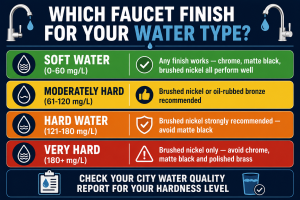
Water hardness is the single most important practical factor in choosing a faucet finish — more important than style preference in high-use rooms. Hard water leaves mineral deposits (calcium and magnesium carbonate) on every surface water touches, and the visibility of those deposits varies dramatically by finish. The table below maps US water hardness levels to finish recommendations.
| Water Type |
Hardness Level |
Recommended Finishes |
| Soft Water |
0–60 mg/L |
Any finish — chrome, matte black, and brass all perform well |
| Moderately Hard |
61–120 mg/L |
Brushed nickel or oil-rubbed bronze recommended |
| Hard Water |
121–180 mg/L |
Brushed nickel strongly recommended — avoid chrome and matte black |
| Very Hard Water |
180+ mg/L |
Brushed nickel only — avoid chrome, matte black, and polished brass |
In hard water states like Arizona, Texas, Nevada, and Southern California where mineral deposits are heavy, polished chrome and matte black finishes show water spots and limescale buildup far more visibly than brushed nickel or oil-rubbed bronze. Homeowners in these states consistently report brushed nickel as the most low-maintenance finish choice — the brushed texture disrupts and disguises white calcium deposits that appear as sharp, clear lines on smooth polished surfaces.
⚠️ Check your water hardness first: If you are unsure of your water hardness, your local water utility publishes an annual water quality report online. Search your city name plus “water quality report” to find your hardness level in mg/L or grains per gallon. This takes two minutes and can save you years of cleaning frustration.
Need a Professional Plumber?
If you need a licensed plumber to install your new faucets or advise on finish matching for a full bathroom renovation, search PlumberArchive.com — the US plumber directory with 12,151+ verified plumbers across all 50 states.
Find a trusted plumber near you →
Frequently Asked Questions
Q: What is the most popular faucet finish in the US right now?
Brushed nickel is the most popular faucet finish in US homes in 2026 and has held that position for several consecutive years. Its combination of low maintenance, excellent hard water performance, and compatibility with virtually any bathroom or kitchen style makes it the default choice for new builds and renovations alike. Matte black is the fastest-growing finish in terms of year-over-year growth, particularly in modern and farmhouse-style bathrooms, but brushed nickel still leads significantly in overall installed volume.
Q: Which faucet finish is easiest to keep clean?
Brushed nickel is the easiest finish to maintain in most US homes. The brushed texture hides water spots, fingerprints, and minor mineral deposits between cleaning sessions, meaning it looks acceptably clean with a weekly wipe rather than daily attention. Chrome requires the least cleaning product to restore shine once you do clean it, but it shows spots so clearly that it needs cleaning more frequently. Oil-rubbed bronze and brushed gold are both moderate — they hide spots reasonably well and do not require frequent polishing.
Q: Can I mix faucet finishes in my bathroom?
Within a single room, keep all hardware finishes consistent — faucet, towel bars, toilet paper holder, robe hook, and light fixture hardware should all share the same finish. Mixing finishes within a room reads as unfinished work rather than intentional design. Between rooms, you can use different finishes freely — your master bathroom and guest bathroom can have different finishes without any problem. If you want to deliberately use two finishes in one room, use one dominant finish for all functional hardware and one accent finish for decorative elements, and choose matte or brushed finishes rather than two polished ones, which tend to clash visually.
Q: Which faucet finish is best for hard water?
Brushed nickel is the best finish for hard water areas — its textured surface disguises calcium and mineral deposits far better than any smooth, polished finish. If your water hardness is above 120 mg/L, brushed nickel is the clear recommendation. Oil-rubbed bronze also performs well in moderate hard water (61–120 mg/L). Avoid chrome, matte black, and polished brass in hard water areas — all three show white mineral deposits sharply against their surfaces and require daily wiping to stay clean. If you live in Arizona, Texas, Nevada, or Southern California, check your city’s annual water quality report for your exact hardness level before choosing a finish.
Conclusion — Which Faucet Finish Should You Choose?
For most US homeowners, brushed nickel is the right answer. It is low maintenance, performs excellently in hard water areas, suits any room style from modern to traditional, and has the broadest appeal for resale. If you live in a soft water area and want a bold modern look, matte black is a strong choice for a powder room or low-use bathroom. If your home has a traditional or craftsman style with warm wood tones, oil-rubbed bronze is the most authentic and natural choice.
- Hard water areas (AZ, TX, NV, Southern CA): Brushed nickel — avoid chrome, matte black, and polished brass
- Modern or farmhouse style: Matte black for low-use rooms, brushed nickel for high-use rooms
- Traditional or craftsman homes: Oil-rubbed bronze with matching warm hardware throughout
- Premium renovation: Brushed gold or champagne bronze — compare brand samples in your lighting before buying
- Period or vintage style: Polished brass in a powder room — avoid in daily-use bathrooms
- Budget-conscious: Chrome — easy to find, easy to clean, excellent parts availability
Whatever finish you choose, apply it consistently across all hardware in each room. Once you have decided on a finish, our guides to the best bathroom faucets and best kitchen faucets cover reviewed models in every finish from Moen, Kohler, Delta, and Pfister. For a full brand comparison before you buy, see our Kohler vs Moen guide.
✍️ About This Guide
Written by Mike Reynolds, DIY Home Improvement Writer at PlumbingToolsReview — former residential contractor helping US homeowners tackle plumbing repairs with confidence. Learn how we test →