Comparisons
2 Oct 2026

Pop-Up Drain vs Grid Drain: Which Should You Choose?
Pop-up drains seal to hold water; grid drains never close but resist clogs better and cost less. Here's how to choose between them for your bathroom sink.
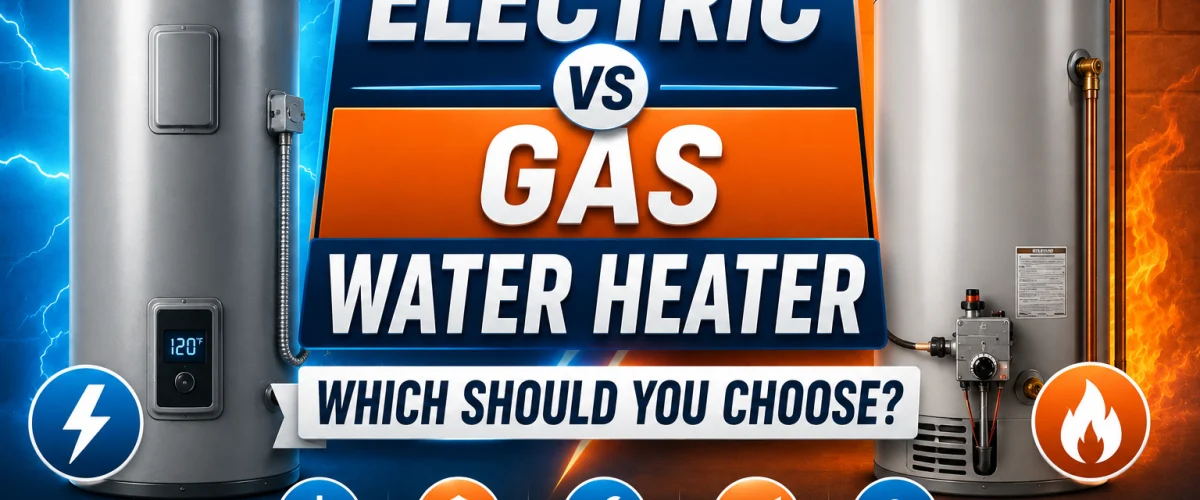
Electric vs gas water heater — which costs less to run in 2026? We compare installation cost, running cost, efficiency, recovery rate and safety for US homeowners.
Please note: Costs and product details are based on our research at time of writing and are subject to change. Always check with local suppliers and your utility provider for current rates before making a decision.
Choosing between an electric and gas water heater is one of the most common home improvement decisions US homeowners face — and also one of the most consequential, since a water heater typically runs for 10–15 years. Get it right and you save significantly on energy bills over that period. Get it wrong and you pay a premium every month for the lifetime of the appliance.
The good news is that the landscape has changed meaningfully in 2026. Heat pump electric water heaters have matured into a genuinely competitive technology — they now rival gas on running costs in many US states, and they qualify for federal tax credits that bring purchase prices down. The old rule that “electric always costs more to run” is no longer accurate across the board. This guide covers installation cost, running cost, efficiency, recovery rate, and safety — giving you everything you need to make the right choice for your home. See also our full comparison of tankless vs tank water heaters and our roundup of the best water leak detectors to protect any water heater installation.
🔧 OUR TAKE
This decision is more straightforward than most homeowners think — if your home already has a gas line the decision is almost always gas for running cost savings. If you are on all-electric or installing in a location without gas access, a modern heat pump water heater is now genuinely competitive with gas on running costs. The old assumption that electric always costs more to run is no longer accurate in 2026.
IN THIS GUIDE
Electric water heaters come in two distinct types that behave very differently in terms of efficiency and running cost, and it is important to distinguish between them when comparing to gas.
Standard resistance electric heaters are the most common type found in US homes. They work by passing electricity through a heating element submerged in the tank — the same principle as an electric kettle. They are simple, reliable, and inexpensive to purchase. They work anywhere with a 240V outlet and require no gas line or venting. The downside is running cost: resistance heating is inherently less efficient than gas combustion in most US energy markets.
Heat pump electric heaters are the modern alternative that has changed the calculus on this comparison. Rather than generating heat directly, they extract heat from the surrounding air and transfer it into the water — the same technology used by a refrigerator in reverse. This makes them approximately three times more efficient than standard resistance electric heaters and genuinely competitive with gas on monthly running costs in many states. They cost more to purchase but often qualify for federal and state tax credits.
Gas water heaters also come in two main fuel variants. Natural gas is the most common in US homes — roughly half of US households have natural gas service, and in those homes a gas water heater is typically the default choice for running cost reasons. Natural gas heaters require a gas supply line and a flue or venting system to exhaust combustion gases.
Propane gas heaters serve homes without access to natural gas lines — rural properties and newer developments that were not built with gas infrastructure. Propane typically costs more per unit of energy than natural gas, which reduces the running cost advantage over electric. Gas heaters heat water faster than standard resistance electric, with a hot water recovery rate roughly twice as fast for a standard 50-gallon tank. This matters in larger households with high simultaneous hot water demand.
Installation cost varies significantly between fuel types and heater technology. Here is how the four main configurations compare on total installed cost (unit plus labor):
Electric heaters win on pure purchase price. However, if your home already has a gas line at the water heater location, the installation cost difference between gas and electric narrows considerably — the gas line infrastructure is already paid for.
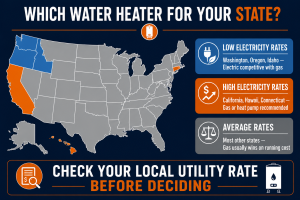
Running cost is where this decision is really made — and where the answer varies most by location. Annual operating costs for a typical 50-gallon tank heater in a 2–3 person household break down broadly as follows:
US Regional Context: In states with low electricity rates like Washington, Oregon, and Idaho — where hydroelectric power keeps costs low — electric water heaters are genuinely competitive with gas on running costs, and a heat pump electric model may actually cost less to run annually than gas. In states with high electricity rates like California and Hawaii, gas or heat pump water heaters offer significantly lower operating costs compared to standard resistance electric. Your local utility rate is the single most important factor in this decision — check your current electricity and gas rates before committing.
Energy efficiency tells you how much of the energy you pay for actually ends up heating your water. Higher efficiency means less energy wasted and lower bills for the same amount of hot water produced.
Heat pump electric wins clearly on efficiency. Both standard electric and gas heaters are eligible for Energy Star certification when they meet performance thresholds — look for the Energy Star label when shopping, as certified models often qualify for utility rebates in addition to federal tax credits.
Recovery rate measures how quickly a water heater can reheat a full tank of cold water after it has been depleted — a critical factor for larger households with multiple simultaneous hot water users.
Recovery rate matters most for large households where hot water demand is high and simultaneous — multiple showers in the morning, a dishwasher running at the same time as laundry. For a one- or two-person household with moderate demand, even a standard electric heater’s two-hour recovery is unlikely to be a real-world problem. If you are thinking about a tankless vs tank water heater comparison, tankless heaters eliminate recovery time entirely by heating water on demand.
Both electric and gas water heaters are safe when properly installed and maintained. However, they carry different types of risk that homeowners should understand.
Gas water heater risks: Gas combustion produces carbon monoxide — a colorless, odorless gas that is deadly at elevated concentrations. A properly installed and vented gas water heater expels CO through the flue, but a cracked heat exchanger, blocked flue, or incomplete combustion can allow CO to accumulate inside the home. Gas supply leaks — though rare with professionally installed systems — present an explosion and fire risk. Both risks require specific safety measures: CO detection and regular maintenance.
Electric water heater risks: Electric heaters produce no combustion gases — there is no CO risk and no venting requirement. They are inherently safer in enclosed spaces, basements, and utility closets where ventilation may be limited. Electric heaters are also the safer choice in flood-prone locations — a flooded basement with a gas water heater presents a far more serious hazard than one with an electric model, since water intrusion near gas connections and ignition sources is dangerous. Investing in quality water leak detectors near any water heater installation is strongly recommended regardless of fuel type.
Both types carry a pressure and temperature relief valve (T&P valve) as a mandatory safety device — this vents the tank if pressure or temperature reaches unsafe levels. Annual inspection of the T&P valve is recommended for both types.
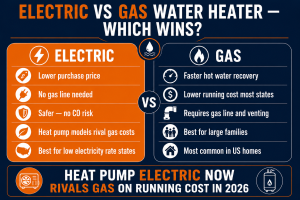
Here is how the two options compare head-to-head across the key decision factors:
| Factor | Electric | Gas | Winner |
|---|---|---|---|
| Purchase cost | Lower | Higher | ELECTRIC |
| Installation cost | Lower | Higher (gas line + venting) | ELECTRIC |
| Running cost (standard electric) | Higher in most states | Lower in most states | GAS |
| Running cost (heat pump electric) | Competitive | Competitive | TIE |
| Energy efficiency | Heat pump: ~300% | ~80–85% | ELECTRIC (HP) |
| Hot water recovery rate | Slower (standard) | Faster | GAS |
| Safety | No CO risk, safer in floods | CO risk, requires venting | ELECTRIC |
| Environmental impact | Lower (heat pump + clean grid) | Higher emissions | ELECTRIC (HP) |
| No gas line required | ✓ Works anywhere | ✗ Gas line required | ELECTRIC |
If you are going electric and considering a tankless model for the best efficiency and unlimited hot water, see our full guide to tankless vs tank water heaters before you buy. And if a heat pump model has caught your eye, our dedicated heat pump vs gas water heater comparison goes deeper on that specific matchup.
Whatever type you choose, install quality water leak detectors near the unit — a slow water heater leak can cause serious structural damage before it becomes visible. Also check your home’s water pressure using a gauge; if pressure is consistently above 80 PSI, a pressure reducing valve protects the water heater and all other appliances. See our guide on how to increase water pressure for more on managing home water pressure.
Water heater installation — particularly gas — should always be performed by a licensed professional. If you need a trusted plumber or gas fitter in your area, search PlumberArchive.com — the US plumber directory with 12,151+ verified plumbers across all 50 states.
Get weekly plumbing tips, honest tool reviews, and DIY guides delivered to your Facebook feed.
In most US states, natural gas is cheaper to run than standard resistance electric — gas is typically less expensive per unit of energy than electricity in the majority of American energy markets. However, this is not universal. In states with low electricity rates (Washington, Oregon, Idaho), the running cost difference narrows significantly. And if you choose a heat pump electric water heater rather than a standard resistance model, the efficiency advantage (approximately 3× that of standard electric) makes heat pump electric genuinely competitive with gas in many markets. The honest answer: check your local electricity and gas rates, then calculate which works out cheaper for your specific location.
Yes — switching from gas to electric is technically straightforward, though it requires some electrical work. A standard electric water heater needs a dedicated 240V circuit, which most homes already have or can add at modest cost through a licensed electrician. You will no longer need the gas line at the water heater location, which can be capped off by a licensed plumber. The main consideration is whether you want standard resistance electric or the more efficient (and larger) heat pump model — heat pump heaters require adequate space around them for air circulation, typically a minimum of 700–1,000 cubic feet of surrounding air space.
A heat pump water heater uses the same technology as a refrigerator or air conditioner — but in reverse. Instead of generating heat by running electricity through a resistance element, it extracts heat energy from the surrounding air and transfers it into the water tank. Because it moves heat rather than creating it, it delivers approximately three units of heat energy for every one unit of electricity consumed, making it around three times more efficient than a standard electric water heater. Heat pump water heaters are larger than standard models, require adequate surrounding air space, and cost more to purchase — but they qualify for significant federal tax credits under the Inflation Reduction Act and have lower annual running costs that typically recover the price premium within a few years.
A well-maintained tank water heater — either electric or gas — typically lasts 10–15 years. Electric models often reach the upper end of that range since they have fewer components subject to combustion-related wear. Gas models can approach 15 years with regular maintenance including annual anode rod inspection and flushing of sediment from the tank base. Signs that a water heater is nearing end of life include rust-colored water, a rumbling or popping sound during heating (indicating sediment buildup), visible corrosion on the tank exterior, and inconsistent water temperature. If your heater is over 10 years old and showing any of these signs, replacement is more cost-effective than repair.
For most US homeowners who already have a gas line, gas wins on running cost versus standard resistance electric — and that advantage compounds meaningfully over a 10–15-year appliance lifetime. If your home has the gas infrastructure in place and you have a large family with high hot water demand, gas remains the practical choice.
But the comparison is no longer as clear-cut as it once was. A heat pump electric water heater now matches gas on running cost in many US states, beats it on efficiency, qualifies for federal tax credits that reduce the purchase price gap, and carries none of the CO or combustion safety risks that gas requires managing. In states with low electricity rates, heat pump electric can actually be the cheaper option to run.
Before finalizing your choice, also consider whether a tankless model makes sense for your household — see our full comparison of tankless vs tank water heaters for the full picture. And once installed, protect your investment with quality water leak detectors — a slow tank leak caught early costs far less to address than one that goes unnoticed for months.
✍️ About This Comparison
PTR Editorial Team — Product Comparisons. We compare manufacturer specifications, installation requirements, compatibility and available product documentation to help homeowners choose suitable tools and parts. How we review →
Pop-up drains seal to hold water; grid drains never close but resist clogs better and cost less. Here's how to choose between them for your bathroom sink.
Test strips, digital meters or send-to-lab testing? Match the method to your situation — screening, ongoing monitoring, or a real health concern.
25-foot vs 50-foot drain snake: compare handling, the cable diameter trade-off and the jobs that justify extra length, plus where 50 feet stops.

