Comparisons
20 Sep 2026

Utility Pump vs. Sump Pump (2026) — Which Do You Need?
Utility pump vs sump pump: one is portable for occasional jobs, the other a permanent install for ongoing water. See which your basement needs.
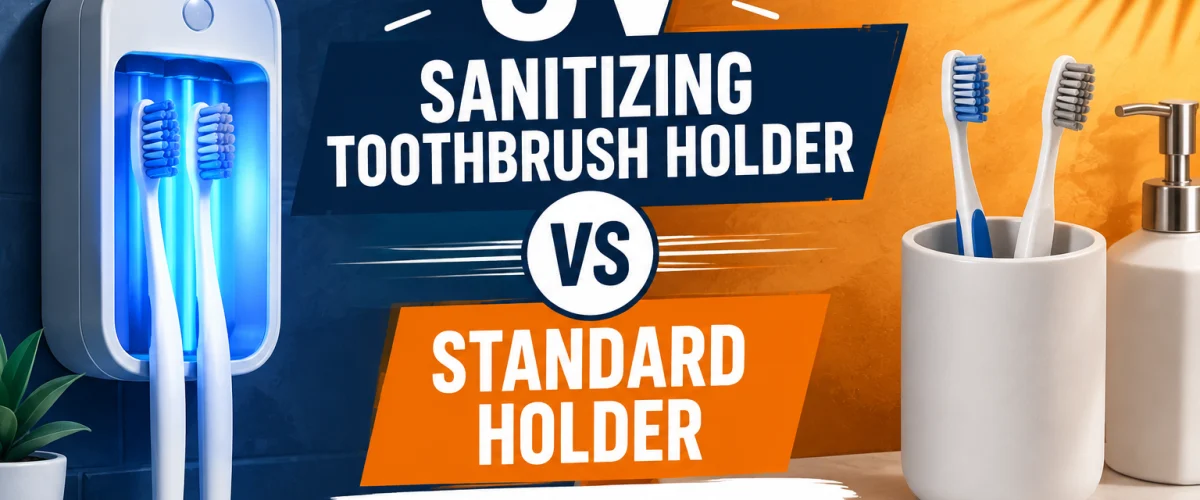
One actively sanitizes and dries with built-in technology, the other simply holds your toothbrush — here's whether a UV sanitizing holder is actually worth the upgrade.
Please note: Information in this comparison is based on our research at time of writing and is general in nature. Always check specific product packaging and manufacturer claims before purchasing.
A toothbrush holder seems like one of the simpler purchases in the bathroom, until the UV sanitizing category enters the picture. These holders add genuine technology — a UV-C light source, sometimes paired with active air circulation — that actively targets bacteria on the bristles after each use, rather than relying purely on ambient air to dry the toothbrush the way a standard holder does. That technology comes at a real cost, both in upfront price and in added complexity, and whether it’s worth paying for depends entirely on how much value you place on active bacteria reduction versus the passive drying a simple holder already provides reasonably well on its own.
This isn’t a case where the more advanced option is automatically the better one. A standard holder handles the basic job — keeping the toothbrush upright and letting it air dry between uses — without needing power, batteries, or any maintenance beyond an occasional wipe-down. A UV sanitizing holder does more, but “more” isn’t the same as “necessary” for every household. This comparison walks through what each type actually does, whether the added sanitizing genuinely makes a measurable difference, and which one makes sense for your specific situation.
At a Glance
Standard Holder
UV Sanitizing Holder
✏️ Our Take
For most households, a standard passive holder is genuinely sufficient — regular toothbrush replacement (every 3-4 months) and basic air drying between uses already keep bacterial growth to a reasonable level without any added technology. A UV sanitizing holder is worth considering specifically for households with someone immunocompromised, recovering from illness, or simply willing to pay a premium for the added peace of mind of active sanitizing. This isn’t a case where one option is objectively better — it’s a genuine value judgment about whether the added cost and complexity buys enough real benefit for your specific household.
IN THIS GUIDE
Here’s how a standard holder and a UV sanitizing holder stack up across the factors that matter most when deciding whether the added technology is worth it.
| Factor | Standard Holder | UV Sanitizing Holder |
|---|---|---|
| Bacteria reduction | Passive air drying only | Active UV-C and/or forced air, measurably higher reduction |
| Power required | None | Battery or plug-in power required |
| Typical cost | Generally $ | Generally $$–$$$ |
| Setup and daily use | Just set the toothbrush in place | Set toothbrush, run a sanitizing cycle each use |
| Ongoing maintenance | Occasional wipe-down only | Battery changes or charging, eventual bulb/LED wear |
| Long-term reliability | No electronics to fail | More components, more potential points of failure |
| Best suited for | Most healthy households | Immunocompromised members, recovering illness, added peace of mind |
A standard holder is mechanically simple. It keeps the toothbrush upright, usually with some open airflow around the bristles, and relies entirely on ambient room air to dry it between uses. There’s no cycle to run and nothing to activate — you set the toothbrush in place after brushing, and the holder’s only job is to keep it standing where air can reach it rather than lying flat somewhere it can’t dry properly.
A UV sanitizing holder adds an active step on top of that basic function. Most models use a UV-C light source positioned to shine directly on the bristle head, running a set cycle — typically several minutes — after each use to actively kill bacteria rather than simply letting them die off passively as the brush dries. Some models pair the UV light with active air circulation, using a small fan to speed up drying alongside the sanitizing cycle, and a few include a sealed or partially enclosed compartment specifically to reduce airborne contamination reaching the bristles between cycles.
The practical difference in daily use is small but real: a standard holder asks nothing of you beyond setting the toothbrush down, while a UV model typically requires starting a cycle (automatically or with a button press) and occasionally checking that the light or fan is actually functioning as expected. Neither is complicated, but one is active and one is entirely passive, and that distinction carries through to every other comparison in this guide.
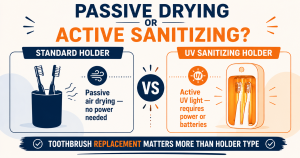
Toothbrushes naturally accumulate some bacteria between uses regardless of which holder they sit in — this is a normal, expected part of oral hygiene rather than a sign of a problem, and it happens with any holder type. Passive air drying already does a reasonably good job of limiting that bacterial growth on its own, since bacteria generally struggle to multiply as quickly on a bristle head that’s allowed to dry out fully between uses compared to one left damp.
UV sanitizing does provide additional, measurable bacteria reduction beyond what passive drying achieves alone — this isn’t marketing exaggeration, active UV-C exposure genuinely kills bacteria more effectively than air drying by itself. Where the claim gets overstated is in how much that additional reduction actually matters for a typical, healthy household member’s day-to-day oral health. The practical health impact tends to be modest rather than dramatic for most people, since a well-dried standard holder already keeps bacterial levels within a reasonable range that hasn’t been shown to meaningfully affect oral health outcomes for otherwise healthy users.
Put another way: UV sanitizing is a genuine, real improvement over passive drying alone, but it’s an incremental one layered on top of a baseline that’s already reasonably effective. Regular toothbrush replacement remains a more impactful factor for overall oral hygiene than which holder type you use, which is worth keeping in mind before assuming the added technology is doing more heavy lifting than it actually is.
Standard holders are inexpensive, generally landing at the lower end of the price range for bathroom accessories, and they carry no ongoing cost or maintenance beyond an occasional wipe-down to keep them clean. Once purchased, there’s nothing further to buy, charge, or replace for the life of the product — the cost you see upfront is the entire cost of ownership.
UV sanitizing holders cost noticeably more upfront, and that higher price is only part of the ongoing picture. Most models require power, either through disposable or rechargeable batteries or by staying plugged in near an outlet, which adds a small recurring cost and one more household task to remember over the holder’s lifespan. Battery-powered models need periodic replacement batteries, while plugged-in models depend on having a suitable outlet within reach of wherever the holder is mounted or placed, which isn’t always a given in every bathroom layout.
None of this makes a UV holder a bad value on its own — it simply means the true cost of ownership extends beyond the sticker price in a way a standard holder’s never does. Factoring in that ongoing maintenance is worth doing honestly before deciding the upfront price difference is the only cost that matters. A plugged-in model also needs a nearby outlet, which is worth planning for if you’re organizing a tight vanity around it — our guide to organizing a small bathroom vanity covers fitting accessories like this into limited counter space.
A standard holder has no electronic components at all, which makes it essentially maintenance-free for years. There’s no bulb to burn out, no fan motor to wear down, and no circuit board to fail — the only way a standard holder stops working is physical damage, like a crack or a broken base, which is uncommon for a product with this little to go wrong in the first place.
A UV sanitizing holder has meaningfully more that can go wrong over time simply because it has more parts in the first place: the UV bulb or LED itself, any fan or air circulation component, the power source and its connections, and whatever electronics control the sanitizing cycle. Each of these is an additional potential point of failure that a purely passive design never has to account for. This doesn’t mean UV holders are unreliable — quality models can perform well for years — but the ceiling on how little can go wrong is structurally lower than it is for a standard holder, purely because there’s more mechanism involved.
Over a multi-year ownership period, this difference tends to show up as UV holders eventually needing some form of repair, part replacement, or full replacement once a key component wears out, while a standard holder from the same era is often still functioning exactly as it did on day one. That’s not a reason to avoid UV holders outright, but it is a genuine tradeoff worth weighing against the sanitizing benefit before deciding it’s worth the added complexity.
Which Should You Choose?
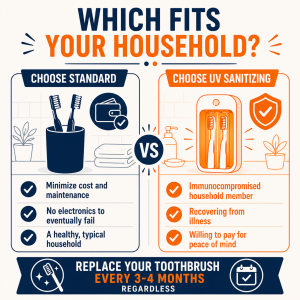
For most households, a standard holder is the sensible default, especially if minimizing cost, maintenance, and things that could eventually break matters most to you. It handles the fundamental job well, costs little, and asks nothing of you beyond the occasional wipe-down — for a healthy household with no particular reason to prioritize active sanitizing, it genuinely covers the need without any real downside.
A UV sanitizing holder makes more sense for specific situations rather than as a default upgrade for everyone. Households with an immunocompromised member, someone currently recovering from illness, or anyone who places genuine value on the added peace of mind of active sanitizing regardless of the incremental nature of the health benefit are the clearest fits. In these cases, the extra cost and added maintenance are a reasonable tradeoff for a household that has a specific reason to prioritize it, even though the practical health benefit for an otherwise healthy household remains modest rather than dramatic.
If you’re genuinely unsure which category you fall into, default to the standard holder. It’s easy to upgrade later if your household’s needs change, but there’s little reason to pay for and maintain technology you don’t have a specific use for today. Note that sanitizing technology and holder material are separate decisions — if you’re also weighing bamboo against stainless steel for this or other bathroom accessories, our bamboo vs. stainless steel bathroom accessories comparison covers that tradeoff independently of the sanitizing question addressed here.
Choosing a toothbrush holder isn’t a plumbing decision on its own, but if you’re tackling a broader bathroom update or dealing with fixture issues while you’re at it, search PlumberArchive.com — the US plumber directory with 12,000+ verified local plumbers across all 50 states.
Get weekly plumbing tips, honest tool reviews and DIY guides delivered straight to your Facebook feed.
Yes — UV-C light is a genuinely effective sanitizing method, and a properly functioning UV sanitizing holder does measurably reduce bacteria on a toothbrush’s bristles beyond what passive air drying achieves alone. The effect is real, not just a marketing claim. What’s worth keeping in perspective is the practical significance of that reduction for a typical healthy user: passive drying already keeps bacterial levels within a reasonable range, so UV sanitizing is a genuine additional improvement rather than the difference between a hygienic toothbrush and an unhygienic one.
For a typical healthy household with no specific health concerns, it’s a genuine but optional upgrade rather than a necessity. Standard holders combined with regular toothbrush replacement and basic air drying already provide reasonably effective hygiene for most people. A UV holder adds real, measurable benefit on top of that baseline, so it isn’t wasted money if you value the added peace of mind — but it also isn’t correcting a meaningful gap that a standard holder leaves open for most healthy users.
This varies significantly by model and by how the holder is powered. Battery-powered models typically need replacement batteries every few months to roughly a year depending on usage frequency and battery capacity, while models with rechargeable batteries usually need charging on a schedule similar to other small rechargeable electronics, ranging from weekly to monthly. Plugged-in models avoid this concern entirely but require a suitable outlet within reach of the holder’s placement. Check the specific product’s stated battery life before purchasing if this is a deciding factor for you.
No special cleaning is required beyond periodic wiping with mild soap and water, ideally every week or two, to remove toothpaste residue, water spots, and general buildup around the base and bristle openings. Making sure the holder itself is drying properly between cleanings — rather than sitting in a puddle of water at its base — matters just as much as cleaning frequency, since standing water at the holder’s base can undermine the passive drying benefit the holder is otherwise providing for the toothbrush itself.
UV sanitizing and standard toothbrush holders aren’t really competing to do the same job at different price points — they’re offering genuinely different levels of function, and the right choice depends on how much you value the added active sanitizing over the cost, power requirements, and extra points of failure that come with it. A standard holder is the sensible default for most healthy households, handling the basic job well without any real downside.
A UV sanitizing holder is worth the upgrade specifically for households with a genuine reason to prioritize active bacteria reduction, or for anyone willing to pay for the added peace of mind even without a specific medical need. Neither choice is wrong — it’s a value judgment, not a right-or-wrong upgrade. Our toothbrush holder reviews round up specific models across both categories — four passive holders plus one sensor-based model — but only touch briefly on whether the sanitizing technology itself is worth the upgrade; this comparison is the dedicated deep dive on that specific question.
Prices and ratings may change. Always check Amazon for current prices.
✍️ About This Comparison
Written by Sarah Mitchell, Home Improvement Editor at PlumbingToolsReview — specializing in helping homeowners make smart buying decisions without overspending. Learn how we test →
Utility pump vs sump pump: one is portable for occasional jobs, the other a permanent install for ongoing water. See which your basement needs.
Pipe repair clamp, tape, or epoxy — which should you use for a leaking pipe? Compare how each works, durability, and when to reach for which.
Not sure if your home has a septic tank or a sewer connection? Learn how to tell which one you have, plus the maintenance and cost differences.

