Comparisons
20 Sep 2026

Utility Pump vs. Sump Pump (2026) — Which Do You Need?
Utility pump vs sump pump: one is portable for occasional jobs, the other a permanent install for ongoing water. See which your basement needs.
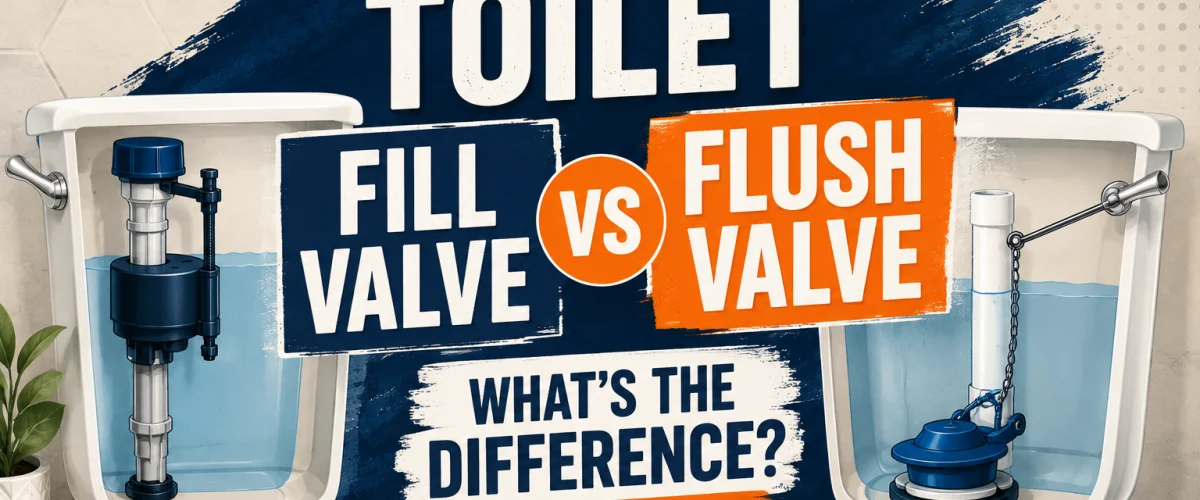
One controls water coming into the tank, the other controls water leaving it — here's the real difference between a fill valve and a flush valve.
Please note: Information in this comparison is based on our research at time of writing and is general in nature. Always check specific product packaging and manufacturer instructions before purchasing or attempting a repair.
Fill valve and flush valve are two of the most commonly confused terms in toilet repair, and it’s easy to see why — both sit inside the same tank, both include the word “valve,” and both play a role in how a toilet operates every time it’s used. But they control water moving in opposite directions, and they fail in completely different ways.
The fill valve manages water coming into the tank. It connects to the home’s water supply line and refills the tank to the correct level after every flush, shutting off automatically once that level is reached. The flush valve, by contrast, is the fixed assembly at the bottom of the tank — the valve seat and overflow tube that the flapper seals against — and it’s what actually releases water out of the tank into the bowl when you flush. One brings water in, the other lets water out, and understanding that distinction is the key to correctly diagnosing a toilet problem instead of guessing at the wrong part.
At a Glance
Fill Valve
Flush Valve
✏️ Our Take
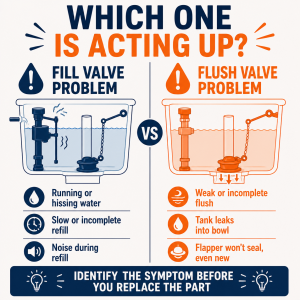
The easiest way to keep these straight is to think about water direction: the fill valve is about water coming in, the flush valve is about water going out. They’re both essential to how a toilet tank works, but they fail in different ways and are diagnosed differently — a fill valve problem usually shows up as running water or a slow refill, while a flush valve problem usually shows up as a weak or incomplete flush. If you’re not sure which one is causing an issue, it’s worth identifying the specific symptom first rather than guessing and replacing the wrong part.
IN THIS GUIDE
Here’s how the fill valve and flush valve stack up across the factors that matter most when diagnosing a problem or planning a repair.
| Factor | Fill Valve | Flush Valve |
|---|---|---|
| What it controls | Water entering the tank | Water leaving the tank |
| Connects to | The home’s water supply line | The flapper, which seals against it |
| Typical failure symptom | Running water, hissing, slow refill | Weak flush, leaking seal, incomplete flush |
| Replacement scope | Standalone unit | Usually a full kit, including flapper and gasket |
| Tank removal required | No | Often, depending on the toilet’s design |
| Typical cost tier | Generally $ | Generally $–$$ |
| Best suited for | A worn or noisy fill valve on its own | Persistent flush or seal problems the flapper alone doesn’t fix |
The fill valve sits on one side of the tank, typically toward the left, and connects directly to the water supply line entering through the bottom or side of the tank. Its job is straightforward: after each flush empties the tank, the fill valve opens and refills it back up to the correct level. Most fill valves use a float — either a ball on an arm or a cup that rides up and down the valve’s shaft — to sense when the water has reached the right height, at which point the valve shuts off automatically. Some newer fill valves use a diaphragm or electronic sensor instead of a mechanical float, but the underlying job is identical regardless of the exact mechanism.
The flush valve is a different assembly entirely, and it isn’t a single moving part the way a fill valve is. It’s the fixed opening at the bottom of the tank — surrounded by a valve seat — combined with the attached overflow tube that runs up alongside it. The flapper, a separate rubber or silicone seal, sits over this opening and seals it shut, holding water in the tank between flushes. When you press the flush handle, a chain or lever lifts the flapper away from the flush valve seat, and water rushes out through that opening into the bowl below. Once the tank empties enough, the flapper drops back down and reseals against the flush valve, and the fill valve takes over to refill the tank for the next use.
The overflow tube built into the flush valve assembly also serves a safety function: if the fill valve were to malfunction and overfill the tank, excess water drains down through the overflow tube into the bowl instead of spilling over the top of the tank onto the floor. This is one more reason the two components, while functionally opposite, are actually designed to work together as a system rather than in isolation.
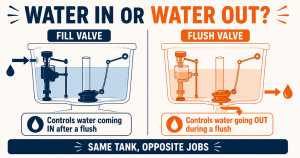
Both terms include the word “valve,” both parts live inside the same tank, and both are involved in the general category of “toilet tank repair,” which is more than enough overlap to cause genuine confusion, especially for anyone who isn’t dealing with a toilet tank on a regular basis. Add to that the fact that most people only think about either component when something has already gone wrong, and it’s easy to see why the names get mixed up under pressure while troubleshooting a running or malfunctioning toilet.
The bigger source of confusion, though, is that “flush valve” is sometimes used loosely and interchangeably with “flapper,” since the flapper is the visible moving part attached to the flush valve assembly and the one most people actually handle during a repair. Technically, the flush valve is the fixed seat and overflow tube, while the flapper is the separate seal that opens and closes against it — but in casual conversation and even in some product listings, the terms blur together. This naming overlap is the single most common source of confusion when researching a toilet repair or shopping for replacement parts online.
Because the fill valve controls water entering the tank, its failure symptoms are almost always tied to the refill cycle rather than to the flush itself. Continuous or intermittent running water — a toilet that keeps making noise well after a flush should have finished, or one that cycles on and off on its own throughout the day — is one of the clearest signs the fill valve isn’t shutting off cleanly once the tank reaches the correct level.
A loud hissing, whining, or whistling sound during the refill cycle is another strong indicator, particularly if the noise is new or has gotten more noticeable over time as internal components wear down. A tank that refills noticeably slower than it used to, or one that never quite reaches a full, consistent water level even after several minutes, often points to internal wear or mineral buildup restricting flow through the fill valve rather than a problem with the flush side of the system.
All of these symptoms share a common thread: they’re related to water coming into the tank, not water leaving it. If you notice any of them, the fill valve — rather than the flush valve or flapper — is almost always the component to investigate first. Our guide to how to replace a toilet fill valve walks through the full replacement process step by step if a new fill valve turns out to be the fix you need.
Signs of a Failing Flush Valve
Flush valve problems show up on the opposite end of the cycle — during the flush itself, rather than the refill afterward. A weak or incomplete flush, where waste isn’t fully cleared on the first attempt, is one of the most common symptoms, and it often gets misattributed to a clog when the actual cause is insufficient water reaching the bowl through a compromised flush valve opening or a flapper that isn’t lifting fully out of the way.
Water slowly leaking from the tank into the bowl between flushes — sometimes audible as a faint trickling sound, sometimes only visible as water usage that seems higher than it should be — is another sign, though this one deserves a closer look before assuming the cause. This symptom is frequently blamed entirely on a worn flapper, and a bad flapper certainly can cause it. But it can also involve wear or mineral buildup at the flush valve seat itself, the surface the flapper actually seals against, in which case simply replacing the flapper alone won’t fully resolve the leak.
A telling sign that points specifically to the flush valve seat rather than just the flapper is when a brand-new flapper still doesn’t create a proper seal. If you’ve already replaced the flapper and the toilet still leaks or runs, the flush valve seat itself — corroded, warped, or coated in mineral deposits — is the more likely remaining culprit, and at that point a full flush valve kit replacement is usually the more reliable fix than continuing to swap flappers.
A fill valve is typically replaced as a standalone unit, and it’s generally a simpler, faster repair. The whole job usually involves shutting off the water supply, draining the tank, disconnecting the old valve at its base and the supply line connection, then installing the new valve and reconnecting everything — a job most confident DIYers can complete in well under an hour without removing the tank from the bowl at any point.
A flush valve is a more involved repair by comparison. It’s usually replaced as part of a complete kit that includes a new flapper and gasket rather than as an isolated part, and depending on the specific toilet’s design, replacing it often requires removing the tank from the bowl entirely to access the flush valve’s mounting nut from underneath. That adds meaningfully more time and a few additional steps — disconnecting the water supply, removing the tank bolts, carefully lifting the tank off the bowl, and reversing the process once the new flush valve kit is installed — compared to a fill valve swap.
In terms of cost, fill valves are generally the less expensive of the two parts, landing at the lower end of the price range for toilet repair components. Flush valve kits tend to cost somewhat more, reflecting the additional parts included and the more involved engineering of the valve seat and overflow tube assembly, though neither part represents a major expense on its own. If you’re shopping for a fill valve specifically, our toilet fill valve reviews compare current options across price tiers.
Fill valve swaps are usually manageable DIY jobs, but a flush valve replacement that requires removing the tank can get more involved, especially on an older toilet. If you’d rather leave it to a professional, search PlumberArchive.com — the US plumber directory with 12,000+ verified local plumbers across all 50 states.
Get weekly plumbing tips, honest tool reviews and DIY guides delivered straight to your Facebook feed.
No, though the two are closely related and often confused. The flush valve is the fixed valve seat and overflow tube assembly built into the bottom of the tank. The flapper is a separate rubber or silicone part that sits on top of the flush valve seat and lifts away from it to release water during a flush. Think of the flush valve as the opening and the flapper as the lid that covers it — they work together, but they’re two distinct parts, and a flush valve replacement kit typically includes a new flapper precisely because they’re sold and installed as a matched set. Our toilet flapper vs fill valve comparison covers the flapper-specific side of this in more detail, if that’s the distinction you’re trying to sort out instead.
Yes, indirectly. If the flush valve seat is worn, corroded, or coated in mineral deposits, the flapper may not be able to form a complete seal against it even if the flapper itself is in good condition. That imperfect seal lets water slowly leak from the tank into the bowl, which triggers the fill valve to periodically top off the tank — producing the same kind of intermittent running or refilling sound most people associate with a fill valve problem. This is exactly why a running toilet doesn’t automatically mean the fill valve is at fault; ruling out a worn flush valve seat is worth doing, especially if a fresh flapper alone hasn’t solved the issue.
A standalone fill valve is generally the less expensive of the two parts. A flush valve is typically sold as a complete kit that includes a new flapper and gasket, which reflects both the additional included parts and the somewhat more involved engineering of the valve seat and overflow tube assembly, so it tends to cost a bit more. Neither part represents a major expense on its own — the bigger cost difference between the two repairs usually comes from labor time if you’re hiring a plumber, since a flush valve job that requires removing the tank takes meaningfully longer than a straightforward fill valve swap.
In most cases, yes. The flush valve’s mounting nut is located underneath the tank, and on the majority of standard two-piece toilets, the only practical way to access and tighten that nut is to disconnect the water supply, remove the tank bolts, and lift the tank off the bowl. Some specific toilet designs may allow limited access without a full tank removal, but this isn’t the case for most standard residential toilets in the US, which is the main reason a flush valve replacement is considered a more involved repair than a fill valve swap.
The fill valve and flush valve aren’t competing parts or interchangeable terms — they’re two components that handle opposite jobs in the same system, one managing water coming into the tank and the other managing water leaving it. Getting the terminology right matters in practice, not just for accuracy’s sake, since correctly identifying which one is actually failing is what determines whether you’re looking at a quick standalone swap or a more involved kit replacement that requires pulling the tank.
If your symptoms point to running water, hissing, or a slow refill, start with the fill valve. If they point to a weak flush or a seal that won’t hold even after a new flapper, the flush valve assembly is the more likely cause. When in doubt, our toilet flapper vs fill valve comparison can help narrow things down further if the flapper specifically is in question.
Prices and ratings may change. Always check Amazon for current prices.
✍️ About This Comparison
Written by Sarah Mitchell, Home Improvement Editor at PlumbingToolsReview — specializing in helping homeowners make smart buying decisions without overspending. Learn how we test →
Utility pump vs sump pump: one is portable for occasional jobs, the other a permanent install for ongoing water. See which your basement needs.
Pipe repair clamp, tape, or epoxy — which should you use for a leaking pipe? Compare how each works, durability, and when to reach for which.
Not sure if your home has a septic tank or a sewer connection? Learn how to tell which one you have, plus the maintenance and cost differences.

