Comparisons
2 Oct 2026

Pop-Up Drain vs Grid Drain: Which Should You Choose?
Pop-up drains seal to hold water; grid drains never close but resist clogs better and cost less. Here's how to choose between them for your bathroom sink.
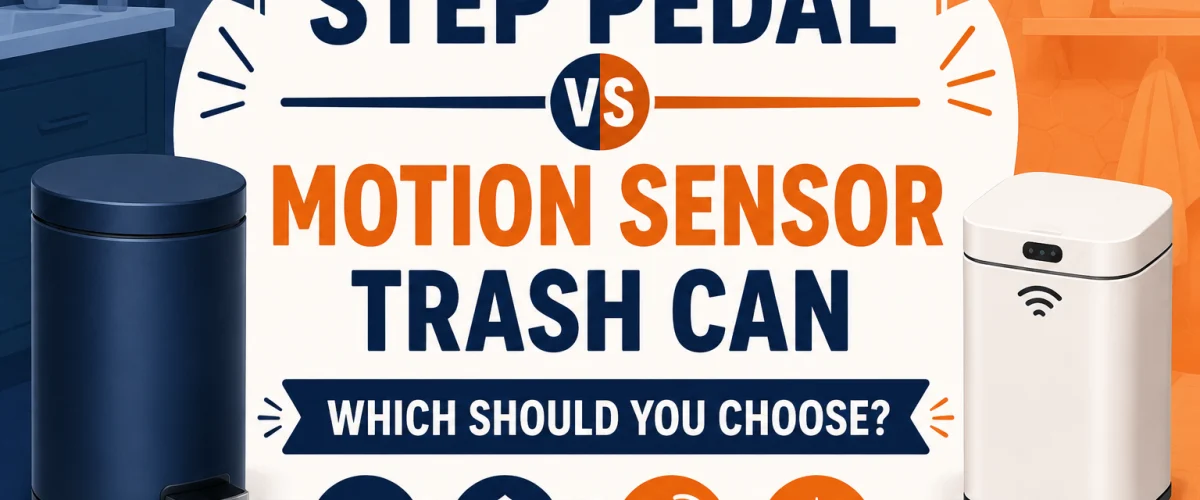
One opens with a press of your foot, the other opens the moment your hand gets close — here's how step pedal and motion sensor trash cans actually compare.
Please note: Information in this comparison is based on our research at time of writing and is general in nature. Always confirm a specific product’s power source and sensor specifications before purchasing.
Choosing between a step pedal and a motion sensor trash can comes down to a fairly simple tradeoff once you look past the surface-level convenience question: how much do you value fully hands-free operation, and how much are you willing to accept in exchange for it? A step pedal is a purely mechanical mechanism — press it with your foot, the lid lifts, decades of proven design behind it. A motion sensor can removes even that small foot-press step entirely, opening automatically the moment your hand gets close, but it does so by introducing batteries or charging and electronics into a product that’s traditionally had none of either.
Neither approach is objectively better — one prioritizes simplicity and long-term reliability, the other prioritizes convenience and reduced touchpoints. This guide compares the two mechanisms directly: how each one actually works, which holds up better over years of daily use, and which genuinely matters more for hygiene versus which is simply a nice-to-have.
At a Glance
Step Pedal
Motion Sensor
✏️ Our Take
A step pedal trash can is the more dependable long-term choice for most bathrooms — it’s a simple mechanical part with nothing to charge, replace batteries in, or eventually malfunction electronically. A motion sensor can is genuinely worth considering if hands-free operation matters to your household, particularly in a shared or high-traffic bathroom where touching a pedal or lid repeatedly is a real hygiene concern. Neither option is more effective at containing odor or holding capacity — the difference is entirely in how the lid opens and what that convenience costs you in price and upkeep.
IN THIS GUIDE
Here’s how step pedal and motion sensor trash cans stack up on the factors that actually matter when choosing between them.
| Factor | Step Pedal | Motion Sensor |
|---|---|---|
| How it opens | Foot press on a mechanical pedal | Automatically, when a hand approaches |
| Power source | None required | Batteries or rechargeable battery |
| Hand contact required | No (foot operated) | No (fully hands-free) |
| Typical price tier | $–$$ | $$–$$$ |
| Ongoing maintenance | Effectively none | Battery replacement or periodic charging |
| Points of potential failure | Low — hinge or pedal wear only | Higher — sensor, motor, and power source |
| Best suited for | Most bathrooms; simplicity and lower cost | Shared or high-traffic bathrooms; hygiene priority |
A step pedal trash can uses a simple mechanical linkage. Pressing the foot pedal lifts the lid via an internal lever or hinge system — a direct, physical connection between your foot and the lid with no electronics involved at all. There’s no sensor, no motor, and nothing to power. The entire mechanism is a handful of moving parts working together the same way they have for decades, which is exactly why step pedal cans have such a long track record of reliable operation.
A motion sensor trash can works on a completely different principle. An infrared or ultrasonic sensor built into or near the lid continuously monitors the space in front of the can, and when it detects a hand or object approaching within a set distance, it triggers a small motor that lifts the lid automatically. No physical contact is required at any point — you simply approach the can and the lid opens on its own, then typically closes again a few seconds after your hand moves away.
Most motion sensor models also include a manual override button, usually on top of the lid, for situations where sensor operation isn’t needed or convenient — during cleaning, for example, or if the batteries have died and you need the can to still function in some capacity. This override is worth checking for specifically when comparing models, since not every motion sensor can includes one, and its absence turns a dead battery into a genuinely inconvenient problem rather than a minor one.
Sensor placement and range also vary between models, and this affects how the can actually behaves in day-to-day use. Some sensors are tuned for a wide detection zone that opens the lid as soon as you’re generally nearby, while others require your hand to pass much closer before triggering. Neither approach is inherently better, but it’s worth knowing which behavior a specific model uses before installing it, since a sensor tuned for a wide zone in a small, busy bathroom can end up opening more often than you’d actually want.
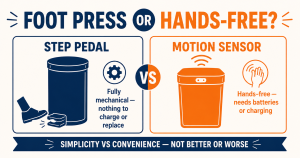
A step pedal’s mechanical simplicity means there’s very little to actually fail over years of daily use. Worn hinges or a loose pedal are the most common issues that eventually crop up, and they’re usually simple to fix — a drop of lubricant, a tightened screw, or in the worst case a full replacement of an inexpensive part — or in many cases just easy enough to live with as a minor inconvenience. There’s no software, no sensor calibration, and no motor to eventually burn out.
A motion sensor can carries meaningfully more that could eventually go wrong. It depends on either replaceable batteries, which need periodic replacement, or a rechargeable built-in battery, which needs periodic charging and will itself degrade in capacity over years of use the way all rechargeable batteries do. Beyond the power source, the sensor and the small motor that actually lifts the lid are both additional components with their own potential failure points that a step pedal simply doesn’t have. None of this means motion sensor cans are unreliable — well-made models hold up fine for years — but the honest comparison is that a purely mechanical design has fewer things that can break in the first place. Build quality also varies more across motion sensor models than it does across step pedal cans, simply because there’s more to get right — sensor calibration, motor durability, and battery compartment design all factor into how well a given model actually holds up, whereas a step pedal’s short list of moving parts leaves much less room for a manufacturer to cut corners that end up mattering.
A motion sensor can’s genuine advantage here is eliminating hand contact with the can entirely. There’s nothing to press, touch, or grip at any point in the process, which matters more in shared bathrooms, households managing illness, or for anyone specifically prioritizing reduced touchpoints throughout the home. This is a real, tangible benefit rather than a marketing point — for someone actively trying to minimize what they touch, a motion sensor can genuinely delivers on that goal.
That said, it’s worth being precise about what a step pedal actually requires, since the hygiene gap between the two is smaller than it might first appear. A step pedal already keeps hands off the lid itself — you operate it with your foot, not your hand, so the surface people actually touch with their hands is no different between a step pedal can and a motion sensor can in ordinary use. The sensor can’s real advantage isn’t “hands stay cleaner than a step pedal” so much as “nothing gets touched at all, including with a foot,” which is a genuine but narrower benefit than it initially sounds.
A step pedal can is typically less expensive upfront than a comparable motion sensor model, and it has effectively no ongoing maintenance cost beyond the can itself and the liners you’d need regardless of which type you choose. Once it’s installed in your bathroom, there’s essentially nothing further to spend on it.
A motion sensor can costs more upfront, and it adds a small but real ongoing cost on top of that: replacement batteries at whatever interval your specific model requires, or the inconvenience — though not the direct expense — of periodic charging if it uses a rechargeable battery instead. Neither of these costs is large in isolation, but they’re worth factoring in as a genuine long-term cost difference between the two options rather than just comparing the sticker price at checkout. Over several years of ownership, the total cost gap between a step pedal and a motion sensor can is meaningfully wider than the upfront price difference alone suggests.
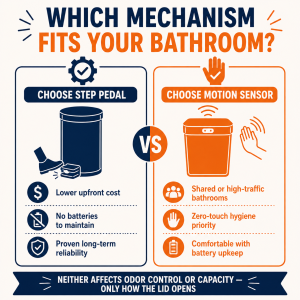
Choose a step pedal for most bathrooms, where simplicity, proven reliability, and lower cost matter more than the incremental convenience of fully hands-free operation. For a typical single-person or family bathroom without a specific hygiene concern driving the decision, a step pedal delivers everything most households actually need without introducing batteries, charging, or additional points of failure into the equation.
Choose a motion sensor specifically for shared or high-traffic bathrooms where hands-free operation is a genuine hygiene priority — a busy household bathroom, a workplace restroom, or any space where reduced touchpoints are a real, considered goal rather than a nice-to-have. It’s also a reasonable choice for anyone who simply prefers the convenience and doesn’t mind the added battery maintenance that comes with it. If you’re weighing a similar manual-versus-automatic decision elsewhere in your bathroom, our timer switch vs humidity sensor switch comparison covers a comparable tradeoff for exhaust fan controls.
Whichever mechanism you choose, it’s worth remembering that neither one determines how well the can actually manages odor day to day — that comes down to habits and maintenance more than the lid mechanism itself. Our bathroom trash can odor guide covers the emptying schedule, cleaning routine, and liner choices that matter regardless of which lid-opening mechanism you end up with. And if you’re still narrowing down a specific model, our bathroom trash can reviews compare the top manual step-pedal and open-top options — note that roundup covers manual designs specifically, not motion sensor models, so use this comparison first to decide which mechanism fits your bathroom before shopping.
A trash can isn’t a plumbing fixture, but if you’re refreshing bathroom hardware alongside a bigger project, search PlumberArchive.com — the US plumber directory with 12,000+ verified local plumbers across all 50 states.
Get weekly plumbing tips, honest tool reviews and DIY guides delivered straight to your Facebook feed.
Most do, yes. Motion sensor cans are powered either by replaceable batteries or a built-in rechargeable battery, since the sensor and motor that open the lid both require electricity to function. Some models are impressively efficient and can run for many months on a set of batteries, while others need more frequent replacement or charging depending on usage and design. Check a specific model’s power requirements and estimated battery life before buying if this is a deciding factor for you, since it varies meaningfully across products.
Generally, yes, simply because a step pedal has fewer components that can fail. It’s a purely mechanical design with no sensor, motor, or power source to eventually stop working, while a motion sensor can depends on all three of those additional systems functioning correctly. This doesn’t mean motion sensor cans are unreliable — well-made models hold up fine for years of normal use — but a step pedal’s mechanical simplicity gives it an inherent reliability advantage on paper, and in most households’ real-world experience as well.
Many models include a manual override button on top of the lid specifically for this situation, letting you open it by hand if the sensor stops responding or the batteries die. This isn’t universal across every motion sensor can, though, so it’s worth checking for specifically when comparing products. A model without any manual override becomes genuinely inconvenient the moment its power source is depleted, so this feature is worth prioritizing if you’re choosing between similar motion sensor options.
For most single-person bathrooms, probably not — the hygiene advantage of hands-free operation matters most in shared or high-traffic settings, and a single user doesn’t face the same touchpoint concerns that make a motion sensor genuinely valuable in a busier bathroom. A step pedal delivers the same practical function at a lower upfront cost and with no ongoing battery maintenance. A motion sensor can still be a reasonable personal preference if you simply like the convenience, but it’s not a strong practical necessity in that specific situation the way it can be in a shared space.
Step pedal and motion sensor trash cans both solve the same basic problem, but they get there through very different tradeoffs. A step pedal offers proven mechanical reliability, lower cost, and effectively zero ongoing maintenance, at the cost of requiring a foot press to operate. A motion sensor offers genuinely hands-free convenience and a real hygiene benefit in the right setting, at the cost of batteries or charging and additional points of potential failure. For most households, a step pedal remains the simpler, more dependable default. For shared or high-traffic bathrooms where reduced touchpoints are a real priority, a motion sensor’s added convenience and cost are easier to justify. Match the mechanism to how the bathroom is actually used, and the right choice becomes straightforward.
Prices and ratings may change. Always check Amazon for current prices.
✍️ About This Comparison
PTR Editorial Team — Product Comparisons. We compare manufacturer specifications, installation requirements, compatibility and available product documentation to help homeowners choose suitable tools and parts. How we review →
Pop-up drains seal to hold water; grid drains never close but resist clogs better and cost less. Here's how to choose between them for your bathroom sink.
Test strips, digital meters or send-to-lab testing? Match the method to your situation — screening, ongoing monitoring, or a real health concern.
25-foot vs 50-foot drain snake: compare handling, the cable diameter trade-off and the jobs that justify extra length, plus where 50 feet stops.

