
Comparisons
2 Nov 2026

Shower Filter vs Water Softener: What Each Can—and Cannot—Do
Softening reduces hardness; shower filters target specific substances. Compare what each is documented to do, check claims and test your water first.
Plumber's putty vs silicone: different jobs, not a contest. Putty for drain flanges and fixture bases; silicone for tub, tile and stone. When to use each.
Please note: Information in this comparison is based on our research at time of writing and is general in nature. Always check the specific product packaging and the fixture manufacturer’s instructions before choosing a sealant or attempting a repair.
Plumber’s putty and silicone sealant end up in the same drawer, get reached for on the same kinds of jobs — sink drains, faucet bases, fixtures around water — and are constantly treated as interchangeable options where you just pick your favorite. They are not. They are fundamentally different materials doing different things: plumber’s putty is a soft, non-hardening compound that seals a clamped joint by filling the gap, while silicone is an adhesive that cures into a flexible, waterproof rubber bond. This is not a contest to crown a winner. Each one is the correct answer for a specific set of situations, each is the wrong answer for others, and there is a real middle ground where either will work and the manufacturer’s instructions decide it. This comparison lays out what each material actually is, how they behave differently, and how to match the material to the job in front of you.
IN THIS GUIDE
At a Glance
Plumber’s Putty
Silicone Sealant
Plumber’s putty is essentially a workable dough: mineral oils and a fine powdered mineral filler such as limestone or clay, blended to a consistency you can roll into a rope in your hands. Nothing in it dries or reacts. It seals purely by being squeezed into and across a gap, and it holds that seal for as long as it stays compressed between two surfaces. That simple, unchanging nature is the source of both its strengths — instant, removable, forgiving — and its limits.
Silicone sealant is a reactive adhesive. Uncured, it is a paste of silicone polymer that starts to cure the moment it meets moisture in the air, cross-linking into a solid, flexible rubber over the following day. As it cures it also bonds chemically to the surfaces it touches. The result is a continuous waterproof membrane that stretches and recovers with movement and stays stuck. For plumbing and wet-area work the product you want is labeled 100% silicone (often sold as “kitchen and bath” with a mildew inhibitor) — not siliconized latex or acrylic “tub and tile” caulk, which is easier to tool but far less durable in standing water. These are two different chemistries built for two different kinds of joint, which is why the comparison is about fit, not superiority.
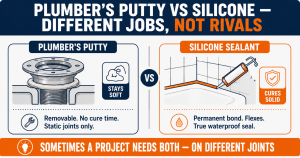
This is the core practical difference, and almost everything else follows from it. Plumber’s putty never cures. It goes into the joint soft and stays soft for years, sealing the instant the fixture is tightened down. There is no wait: you can pack a sink strainer in putty, tighten it, and run water the same minute. Over a long time the exposed outer edge of a putty bead slowly stiffens and can be picked away, but the material inside the joint stays pliable.
Silicone does the opposite by design. After you apply and tool it, it skins over in roughly half an hour to an hour and reaches full cure in about 24 hours (longer in a cold or dry room, and thick beads cure from the outside in and take longer still). Until it is cured it is not waterproof and it has not developed its bond, so a tub or shower joint sealed with silicone needs to stay dry overnight before it is used. In exchange, once cured it is a permanent, flexible, bonded seal that does not depend on anything clamping it in place. Neither behavior is “better” — a joint you want to seal and use immediately wants putty; a joint that has to bond and flex wants silicone.
Both keep water where it belongs, but they do it in different ways and for different conditions. Plumber’s putty blocks slow seepage at a static joint that is held together mechanically — the flange of a sink strainer clamped down by its locknut, a pop-up drain body drawn against the basin, a faucet base pulled down by its mounting nut. In that setting the water is not under pressure; it is just sitting or draining past, and the compressed putty fills the path it would otherwise take. Putty is not an adhesive and it is not rated for a joint that is pressurized, fully submerged for long periods, or not clamped tight. Take the clamping force away and the seal is gone.
Silicone creates a genuine bonded waterproof membrane. Because it sticks to both surfaces and cures into rubber, it seals a joint that nothing is squeezing shut and it keeps sealing while the joint flexes, expands, and gets soaked repeatedly. That is what a tub-to-tile joint, a shower corner, or the perimeter of a drop-in sink actually needs: a seal that survives standing water, temperature swings, and the slight movement of a filled tub. It still is not a pressure-pipe sealant — no one seals a supply line with it — but for holding back standing and splashing water in a wet area, it is doing something putty structurally cannot.
If there is any chance you will need to take the fixture apart again, this section is the one that matters. Because plumber’s putty never hardens, a fixture bedded in it comes apart cleanly: loosen the nut, lift the part, and the putty scrapes off both surfaces with a plastic edge or a fingernail. Resealing is a two-minute job — fresh rope, reseat, tighten. Swapping a basket strainer, servicing a pop-up, or pulling a faucet you might upgrade later is all straightforward when the seal underneath is putty.
Cured silicone is committed. To remove it you cut the bead with a utility or oscillating blade, peel what you can, then scrape and often use a silicone-softening solvent to clear the residue before a new bead will bond — slow work, and easy to scratch a finish or chip a tile edge doing it. Neither behavior is a flaw; it is what each material is for. That permanence is exactly the point on a tub surround you never intend to disturb, and the easy release is exactly the point on a fixture you will open again. It is a real reason to prefer putty on a drain flange or strainer even in a spot where silicone would also seal — and no reason at all to use putty on a tiled joint.
Most jobs point clearly to one material. Reach for plumber’s putty when the joint is a clamped fixture connection on a non-porous surface:
Reach for silicone when the seal has to bond, flex, and stand up to standing water:
A useful rule of thumb: putty seals a joint that a nut is holding shut; silicone seals a joint that nothing is holding shut. When a fixture ships with its own rubber gasket, use the gasket and skip both.
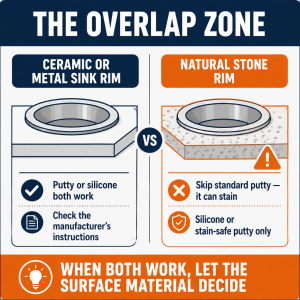
There is a genuine middle ground, and pretending a hard rule always applies does no one any favors. A few joints work with either material:
• The rim of a drop-in sink. Putty under the strainer is not in question, but the sink-rim-to-counter seal itself can be made with putty or with silicone. Putty is faster and keeps the sink liftable for service; silicone bonds the rim down and seals better against water pooling on the counter. Many drop-in sinks are installed with silicone for that reason, and many are installed with putty and clips.
• A faucet base on ceramic or metal. Putty is the traditional choice and is fully adequate. Some faucet makers now specify silicone instead, or a supplied gasket, and a few plumbers prefer silicone here for the extra grip on a base that gets bumped.
• A tub or shower drain flange. Some drain assemblies call for putty, some for silicone, and some for a gasket — this genuinely varies by product.
When both would work, let two things decide, in order: first, the fixture manufacturer’s printed instructions, which override any general guidance including this article; second, whether you value quick future serviceability (lean putty) or a bonded, no-clamp seal (lean silicone). On a natural-stone surface, the overlap narrows — use stain-free putty or silicone, never standard putty.
On cost, both are inexpensive. A tub of plumber’s putty is a low, one-time outlay that lasts across many small jobs; a tube or cartridge of quality 100% silicone costs somewhat more and tends to get used up or skin over in the nozzle before a homeowner finishes it. Neither is a budget concern next to the fixtures they seal.
Ease of use is where the day-to-day difference shows. Putty needs no tools, no masking, no skill, and no waiting — warm it, roll it, set it, tighten, wipe the squeeze-out, done. It is almost impossible to make a mess that matters. Silicone asks more: a cartridge needs a caulk gun (squeeze tubes avoid that), a clean bead usually means masking tape on both sides and tooling the joint with a wet finger or a tool within a few minutes, and then a cure wait before the area can get wet. Rushed or over-applied silicone is genuinely messy to fix once it skins. For a first-timer, putty is close to foolproof; a good silicone bead takes a little practice. Our guide to using plumber’s putty covers the putty technique, and our how to caulk a bathtub walkthrough covers running a clean silicone bead.
Yes, on some jobs — but it is a deliberate choice for a specific reason, not a default. The clearest example is a drop-in sink: the strainer and drain body are bedded in putty as normal, and a bead of silicone is run around the sink rim where it meets the countertop. Those are two separate joints getting the material each one needs, not two products doubled up on the same seam. Similarly, a faucet might be set on putty at its base while a thin silicone bead seals a separate escutcheon against the wall behind it.
What is not a good idea is layering one over the other on the same joint to “make sure,” or using putty where the manufacturer specifies silicone and adding a putty layer as a shortcut. If a joint needs a bonded, flexible, waterproof seal, putty underneath it does not change that. And where the instructions call for one material specifically, use that one. Treat “together” as assigning the right material to each joint, not as insurance.
Match the material to the joint. If a nut or clamp holds the joint shut and you might open it again, that is putty. If the joint has to bond, flex, and hold back standing water on its own, that is silicone. When either would work, the fixture manufacturer’s instructions and your own preference for serviceability break the tie. The table below covers the situations that come up most often.
| Your Situation | Better Choice |
|---|---|
| Sink basket strainer or drain flange on a stainless or enameled sink | Plumber’s putty — clamped joint, stays serviceable |
| Faucet base or pop-up flange on ceramic or metal, no gasket supplied | Plumber’s putty (silicone also works; follow the faucet instructions) |
| Faucet base or sink rim on granite, marble, or quartz | Silicone, or a stain-free putty — never standard putty |
| Tub-to-tile joint, shower corner, or drop-in sink rim to counter | Silicone — needs a bonded, flexible, waterproof seal |
| A fixture you expect to remove or service again before long | Plumber’s putty — comes apart clean, no cutting |
| Any seal that must hold back standing water with nothing clamping it | Silicone — putty cannot seal an unclamped joint |
None of these are absolute. A drop-in sink can be set in putty with clips or bonded with silicone; a faucet maker may specify either; a natural-stone job can use stain-free putty instead of silicone. Where the overlap is real, the printed instructions and your serviceability preference decide — and if you are choosing a putty for any of the putty rows above, our 5 Best Plumber’s Putty review covers standard and stain-free formulas.
✏️ Our Take
Plumber’s putty and silicone are not competitors — they are complementary tools for different joints, and a well-stocked kit has both. Putty is the fast, forgiving, reversible seal for a fixture connection that a nut holds shut: drain flanges, strainers, pop-up bodies, faucet bases on non-porous surfaces. Silicone is the bonded, flexible, genuinely waterproof seal for a joint that has to hold on its own and take standing water: tub and tile joints, shower corners, sink rims, and anything on natural stone. Plenty of installations use both, each on the joint it suits. When a job sits in the overlap zone, follow the fixture manufacturer’s instructions first, and after that choose by whether you value easy future service or a permanent bond.
Prices and ratings may change. Always check Amazon for current prices.
If a fixture will not seal no matter which material you try, or a leak keeps coming back after a correct reseal, search PlumberArchive.com — the US plumber directory with 12,151+ verified local plumbers across all 50 states.
Get weekly plumbing tips, honest tool reviews and DIY guides delivered straight to your Facebook feed.
✍️ About This Comparison
PTR Editorial Team — Product Comparisons. We compare manufacturer specifications, installation requirements, compatibility and available product documentation to help homeowners choose suitable tools and parts. How we review →
Softening reduces hardness; shower filters target specific substances. Compare what each is documented to do, check claims and test your water first.
A recirculation pump needs a path back to the water heater. Compare a dedicated return line with an under-sink bypass, and check your heater model first.
Compare PEX expansion, crimp and press connections system by system: the tubing, fittings, rings or sleeves, tools, inspection and temperature limits each maker documents.

