Comparisons
20 Sep 2026

Utility Pump vs. Sump Pump (2026) — Which Do You Need?
Utility pump vs sump pump: one is portable for occasional jobs, the other a permanent install for ongoing water. See which your basement needs.
PEVA and fabric shower curtain liners solve the same problem in very different ways — here's how they actually compare on cost, care, and day-to-day feel.
Please note: Product and material information referenced here is based on our research at time of writing and is general in nature. Always check a specific product’s label for care instructions before use.
Once you’ve settled on using a shower curtain liner at all, the next question is which material to buy: PEVA, the standard plastic-like liner sold everywhere, or fabric, a softer woven option that costs more and asks more of you in return. Both fully do the job a liner exists to do — keeping water inside the tub or shower — so this isn’t a case of one option being objectively better than the other.
It’s a genuine tradeoff between low-maintenance affordability and a softer, more upscale look and feel. PEVA is inexpensive, wipeable, and easy to ignore between cleanings. Fabric costs more, needs regular machine washing to stay ahead of mildew, but can look and feel nice enough to stand on its own as the bathroom’s only curtain. This comparison walks through both materials side by side so you can weigh that tradeoff against your own priorities, whether you’re shopping fresh or comparing specific options in our shower curtain liner reviews.
At a Glance
PEVA / Plastic
Fabric
✏️ Our Take
PEVA and fabric liners aren’t really competing to be the “better” waterproof barrier — both do that job effectively. The real difference is maintenance philosophy. PEVA is the low-effort choice: wipe it down occasionally, replace it when it wears out, and don’t think about it much in between. Fabric asks more of you — regular machine washing is really necessary to prevent mildew buildup — but rewards that effort with a softer look that can double as a standalone decorative curtain rather than needing a separate one layered on top. Neither is the wrong choice; it’s a question of how much upkeep you’re willing to do for a nicer look and feel.
IN THIS GUIDE
Before going section by section, here’s how PEVA and fabric liners stack up on the factors that matter most when choosing between them.
| Factor | PEVA / Plastic | Fabric |
|---|---|---|
| Typical cost | $ | $$ – $$$ |
| Feel and texture | Smooth, plastic-like | Soft, woven |
| Routine cleaning | Wipe down as needed | Regular machine washing |
| Mildew prevention effort | Lower | Higher |
| Standalone decorative use | Not really — needs a curtain layer | Often yes, on its own |
| Appearance | Purely functional | Softer, more upscale |
| Best for | Low-maintenance, budget-first buyers | Buyers prioritizing look and feel |
PEVA — short for polyethylene vinyl acetate — is a plastic-like material that has become the standard affordable shower curtain liner option in most US households. It’s the liner most people picture when they think “shower curtain liner”: a smooth, semi-translucent or lightly frosted sheet that hangs on the inside of the tub or shower to keep water contained where it belongs.
Where PEVA earns its popularity is consistency. As a waterproof barrier, it performs reliably shower after shower without much thought required — it doesn’t absorb water the way a woven material can, so it keeps splashing water inside the tub with little variability from one liner to the next. That non-porous surface also makes routine care easy: a quick wipe-down handles most day-to-day grime without needing a full wash cycle.
PEVA liners are also widely available in a range of thicknesses, often described by gauge, with heavier gauges generally feeling more substantial and holding up longer than the thinnest, most budget-oriented options. That range lets shoppers dial in how much they want to spend without ever leaving the PEVA category — from the most basic liner sold nearly everywhere to a heavier-gauge version that’s still inexpensive but noticeably more durable. For anyone who wants a liner that works reliably with almost no ongoing attention, PEVA is a fully capable, low-effort default.
Fabric shower curtain liners are typically made of polyester or a similar woven material that’s been treated for water resistance, rather than relying on a solid plastic sheet to block water the way PEVA does. That woven construction is what gives fabric its defining characteristic: a noticeably softer look and feel than plastic, closer to a regular curtain or drape than to a utilitarian liner.
Because the water-resistant treatment is applied to a fabric base rather than a plastic film, performance depends more on the quality of that treatment and how well it holds up over repeated washing than it does with PEVA. A well-treated fabric liner sheds water effectively and dries at a reasonable rate, though it generally won’t feel quite as instantly water-repellent to the touch as a plastic surface — the tradeoff for the softer texture that makes fabric appealing in the first place.
One of fabric’s most practical advantages is that some liners are designed to be used entirely on their own, serving as both the decorative curtain and the waterproof barrier in one piece rather than needing a separate outer curtain layered on top for looks. That single-layer setup can simplify a bathroom’s overall look considerably, particularly in smaller bathrooms where two layers of curtain can feel visually busy or take up more rod space than necessary.
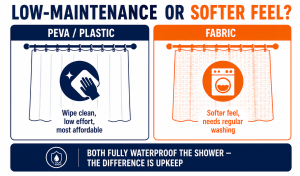
Maintenance is where the two materials diverge the most, and it’s usually the deciding factor for buyers once they understand what each option actually asks of them day to day. PEVA liners can generally be wiped down with a cloth or sponge for routine grime, and depending on the specific product, some can also be hand-washed or run through a gentle machine cycle occasionally when buildup gets more noticeable. But that deeper cleaning is more of an occasional refresh than a required habit — a PEVA liner left un-washed for a long stretch will still mostly do its job, just with visible soap scum or mineral spotting.
Fabric liners are a different story. Because the woven material holds moisture differently than a smooth plastic surface — soaking into the fibers rather than beading and running off — regular machine washing is genuinely necessary to prevent mildew from taking hold, not just a nice-to-have for appearance’s sake. Our how to clean and prevent mold on a shower curtain liner guide walks through that specific washing process in detail, including cycle settings and how often to run it, and it’s worth reading in full before committing to a fabric liner if you’re not already in the habit of washing bathroom textiles regularly.
In practice, this maintenance gap is less about which material is more “durable” and more about how much routine you’re willing to build around it. PEVA tolerates neglect reasonably well. Fabric performs best — and stays mildew-free — only with consistent upkeep.
Durability and Mold/Mildew Resistance
PEVA’s smooth, non-porous surface has a real practical advantage when it comes to resisting mold: there’s no woven texture for moisture or soap residue to work into, so mildew has a harder time getting a foothold compared to a fabric surface with fibers that hold onto dampness. That’s part of why PEVA can tolerate a more relaxed cleaning schedule without the same mildew risk fabric carries.
That said, PEVA is not immune. Left bunched up and damp after a shower, even a plastic liner can develop mold in the folds and along the bottom edge, particularly without good airflow. The advantage isn’t that PEVA can’t grow mildew — it’s that it takes longer to become a problem and requires less proactive effort to stay ahead of it.
Fabric requires more consistent maintenance to stay ahead of mildew specifically because its woven structure holds moisture longer, but that doesn’t mean it’s less durable overall. A well-cared-for fabric liner, washed on a regular schedule as covered in our mold-prevention guide, can last a long time and often outlasts a thin, budget-tier PEVA liner that’s replaced rather than cleaned once it starts looking worn. Durability and mildew resistance aren’t quite the same question — PEVA has the edge on passive mildew resistance, while a well-maintained fabric liner can hold up just as long or longer with the right care routine.
PEVA liners are generally the more affordable option at nearly every price point in this category, typically falling in the $ tier regardless of gauge or brand. Even at the heavier-gauge, more durable end of the PEVA lineup, prices stay well below what most fabric liners cost, making PEVA the default choice for anyone shopping primarily on budget.
Fabric liners typically cost more, usually landing in the $$ to $$$ range depending on the fabric weight and finish. Options marketed as hotel-quality, or specifically designed to be used without a separate decorative curtain on top, tend to sit at the higher end of that range, since they’re doing double duty as both function and decor rather than being a purely utilitarian layer. That higher price reflects both the material itself and the fact that a single fabric liner is often replacing two products — a liner and a curtain — rather than just one.
Whether the added cost is worth it comes down to how much you value the appearance upgrade and whether you’d otherwise be buying a separate decorative curtain anyway. For a bathroom that already has a curtain doing the visual work, PEVA’s lower cost is hard to argue with. For a bathroom where the liner is the only curtain, fabric’s higher price starts to look more like a one-time cost than an ongoing one.
PEVA’s purely functional plastic appearance is exactly what its name implies — a liner, not a design element. That’s not a knock against it; when paired with a decorative outer curtain, PEVA disappears from view almost entirely, doing its job invisibly behind the fabric or patterned layer that actually sets the bathroom’s look. On its own, though, without an outer curtain, PEVA tends to look utilitarian and a bit sparse, which is why it’s rarely chosen as a bathroom’s sole curtain in more style-conscious spaces.
Fabric’s softer texture and wider range of colors, patterns, and finishes make it a genuinely viable standalone option in a way PEVA typically isn’t. A quality fabric liner used alone can give a bathroom a more polished, hotel-like look — thicker, more substantial-looking material hanging in a single clean layer rather than a thin plastic sheet peeking out from behind a curtain. For bathrooms where the shower curtain is a visible part of the overall design, particularly primary bathrooms or spaces meant to feel more finished, fabric’s appearance advantage is often the deciding factor over cost.
The style question really comes down to whether the liner is meant to be seen. In a secondary bathroom or a setup where a patterned curtain already provides the visual interest, PEVA’s appearance is a non-issue. In a bathroom where the liner is the whole show, fabric’s look-and-feel advantage matters a lot more.
Choose PEVA if you want the lowest-maintenance, most affordable option and don’t mind — or actively prefer — a purely functional liner that stays out of sight behind a decorative curtain. It’s the practical default for guest bathrooms, rental properties, or any household that would rather spend a few minutes wiping down a liner occasionally than build a regular wash cycle into their routine.
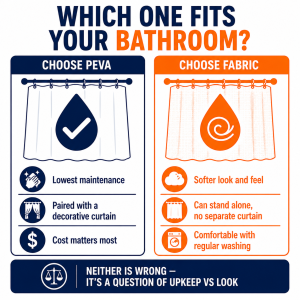
Choose fabric if you want a softer look and feel, you’re comfortable committing to more regular washing to keep mildew in check, or you want a single liner that can stand on its own without an additional curtain layered on top. It’s the better fit for a primary bathroom where appearance matters more, or for anyone who’d rather do a bit more upkeep in exchange for a nicer everyday look.
Some households end up using both in different bathrooms rather than picking one material for the whole house — PEVA in a secondary or kids’ bathroom where low maintenance wins out, and fabric in a primary bathroom where the extra care feels worth it for the payoff in appearance. If you’re also reconsidering how the curtain hangs, our shower curtain rod reviews cover the hardware side of that same bathroom refresh.
If a persistent bathroom moisture or ventilation issue is making mildew a recurring problem no matter which liner you choose, search PlumberArchive.com — the US plumber directory with 12,000+ verified local plumbers across all 50 states.
Get weekly plumbing tips, honest tool reviews and DIY guides delivered straight to your Facebook feed. We cover cleaning, maintenance, and everything in between — written for US homeowners who want to make smart decisions without overspending.
Yes, many fabric liners are specifically designed for exactly this — serving as both the waterproof barrier and the visible decorative curtain in a single layer. Not every fabric liner is marketed this way, so it’s worth checking the specific product’s description if using it alone is your goal, but standalone-capable fabric liners are common enough that this is one of fabric’s main practical advantages over PEVA, which is rarely used without an outer curtain layered on top.
PEVA itself is generally marketed and used as a PVC-free alternative to older vinyl shower curtain liners, which is part of why it became the standard plastic-like option in the first place. If avoiding PVC specifically is a priority, look for a liner labeled PEVA (or another named PVC-free material) rather than an unlabeled vinyl liner, and check the product listing directly, since labeling and materials can vary by brand.
It depends more on care than on the material alone. A heavier-gauge PEVA liner can last a long while with minimal upkeep, but thinner, budget PEVA liners are often replaced rather than nursed along once worn. A fabric liner washed regularly on the schedule covered in our mold-prevention guide can last just as long, or longer — but only if the washing routine is kept up, since neglect tends to shorten a fabric liner’s life faster than it would a PEVA liner’s.
If your existing fabric curtain isn’t specifically treated and sold as a standalone waterproof liner, yes — most decorative fabric curtains are not water-resistant on their own and will let water through or wick moisture along the bottom hem, which can lead to water damage on the floor or surrounding walls over time. Check the product description for your existing curtain; if it isn’t explicitly labeled as a liner or water-resistant, pairing it with a separate PEVA or fabric liner underneath is the safer approach.
PEVA and fabric shower curtain liners both handle the core job of keeping water where it belongs — the real difference is what each one asks of you afterward. PEVA is the low-maintenance, budget-friendly default: wipeable, inexpensive, and easy to pair with a decorative curtain doing the visual work. Fabric costs more and needs regular machine washing to stay ahead of mildew, but rewards that effort with a softer look and feel that can stand on its own as the bathroom’s only curtain. Neither is the wrong choice — it comes down to how much upkeep you’re willing to trade for a nicer everyday look. If you’re ready to compare specific products, our shower curtain liner reviews cover options in both materials.
Prices and ratings may change. Always check Amazon for current prices.
✍️ About This Comparison
Written by Sarah Mitchell, Home Improvement Editor at PlumbingToolsReview — specializing in helping homeowners make smart buying decisions without overspending. Learn how we test →
Utility pump vs sump pump: one is portable for occasional jobs, the other a permanent install for ongoing water. See which your basement needs.
Pipe repair clamp, tape, or epoxy — which should you use for a leaking pipe? Compare how each works, durability, and when to reach for which.
Not sure if your home has a septic tank or a sewer connection? Learn how to tell which one you have, plus the maintenance and cost differences.

