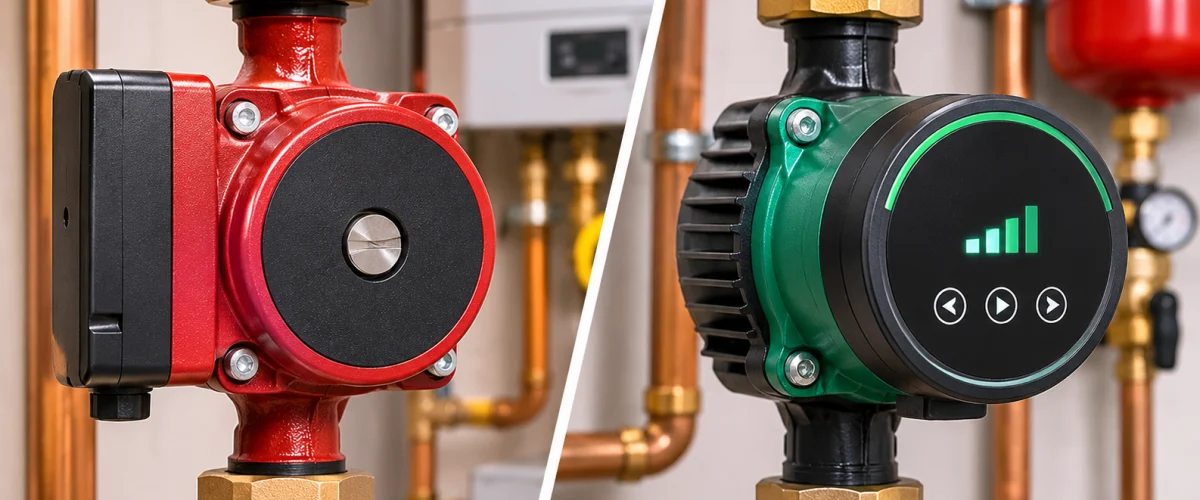
Please note: This is general information for closed-loop, hot-water heating systems, not a sizing or wiring guide for your system. Makers’ documents come first, and a qualified professional should handle hot, pressurised and electrical work.
A circulator is the pump that moves hot water around a closed heating loop. When one fails, you can usually fit a similar pump, or choose a variable-speed ECM circulator that adjusts to the system. This comparison is about hot-water heating with baseboard, radiant or fan-coil zones. It isn’t about hot-water recirculation for faucets.
The short answer: a single-speed pump is the simpler, familiar replacement. A variable-speed ECM pump gives you more control and, on the makers’ figures, a much lower electrical draw, but it has more settings to get right. Which one suits you depends on your system and on the specific pump, not on the motor type alone.
Two Separate Features: Motor and Speed Control
ECM describes the motor (an electronically commutated, permanent-magnet motor). It doesn’t automatically mean the pump adjusts itself to the system. Speed control is a separate feature, and ECM pumps differ in what they offer.
Same motor, different control
- Taco’s 0015e3 instruction sheet describes the 0015e3, an ECM pump with three settings and curves “equivalent” to Taco’s 0015 3-Speed. Low (5 ft) and Medium (10 ft) vary the speed to hold a constant pressure, while High runs at full fixed speed.
- Taco’s 0018e instruction sheet lists an ECM pump whose modes include infinitely variable fixed speed, constant pressure, proportional pressure and a self-adjusting TacoAdapt mode.
- Grundfos’s ALPHA/UPSe data booklet lists constant curve, constant pressure and proportional pressure modes for its UPSe pump.
So “ECM” tells you about the motor. The control mode tells you whether the pump reacts as zones open and close. Don’t apply one model’s modes to every ECM pump.
✏️ Our Take
Match the pump to the heating system before choosing by motor type, brand or advertised savings. Work out the flow and head the loop needs, check the connection and controls, and then see whether a variable-speed ECM pump offers a mode that suits how your zones work.
Quick Comparison
Adjustable settings are not the same as automatic operation. A multi-speed switch or a fixed ECM setting stays where you put it, while a pressure mode makes the pump adjust within its limits.
| What to compare |
Single-speed |
Multi-speed (switch) |
Variable-speed ECM |
| Motor and speed control |
One speed whenever it runs, as with Taco’s 007-F5 and Bell & Gossett’s NRF-22. |
Three speeds chosen by a switch, as on the Taco 0015 3-Speed and Grundfos UPS. It stays at the speed you pick. |
ECM motor with a selectable mode. In pressure modes the pump adjusts itself; fixed-speed or constant-curve modes do not. |
| Response as zones open and close |
No change in speed; flow and pressure shift along the pump’s curve as valves open and close (general behaviour). |
Same, at the chosen speed. You can pick a lower speed if the loop allows. |
In Taco’s constant-pressure settings the pump varies its speed to maintain a constant pressure difference as heating load changes. Fixed-speed or constant-curve modes act like a fixed-speed pump. |
| Electricity use |
The NRF-22 submittal lists 92 W; Taco’s 007 catalog sheet lists 0.74 A at 115 V for the 007-F5. |
Taco’s 3-speed sheet lists 0.54, 0.74 and 0.85 A at speeds 1, 2 and 3 for the 0015, so draw depends on the speed picked. |
Taco lists up to 44 W for its 0018e and 0015e3, and Grundfos lists about 3 to 38 W for the UPSe. These are limits, not your average draw. |
| Setup and controls |
Nothing to set. |
Set the speed switch once. |
Choose a mode and setting, with a dial on the Taco pumps. The right mode depends on your system. |
| Replacement compatibility |
Check flow and head, flange, voltage and fluid. |
Same checks. |
Same checks, plus the model’s modes. Makers publish replacement charts, and Grundfos mentions a compatibility check in its GO app. |
| Where each may suit |
A simple loop, a like-for-like swap, nothing else to adjust. |
Replacing an existing multi-speed pump, or where one lower speed is enough. |
Zoned systems, particularly with zone valves, and where lower draw or a pressure mode matches how you use the system. |
What Single-Speed Actually Means
A single-speed circulator runs at one speed whenever it has power. There’s nothing to set and nothing to adjust. If a zone valve closes, the pump doesn’t change speed. It simply works against more resistance.
That is different from a pump with a speed switch. Taco’s 0015 3-Speed and Grundfos’s UPS (Grundfos’s 3-speed literature) let you adjust the pump speed to suit the loop, with three speeds on a switch, but once picked it stays there; the pump doesn’t adjust itself. Both are adjustable, not automatic. A single-speed pump is easy to understand, easy to swap like for like and has nothing to misconfigure.
What Variable-Speed ECM Adds
On a variable-speed ECM pump, you choose a control mode. Taco’s 0018e instruction sheet lists fixed speed, for zoning with circulators; constant pressure, which it labels for zone valves; proportional pressure, which it labels for panel radiators with thermostatic radiator valves; and TacoAdapt, which Taco describes for constant-circulation systems and says adjusts automatically. Constant-pressure mode adjusts speed to maintain a selected pressure difference. Proportional-pressure mode changes the pressure target as demand changes. That is the automatic part. Taco’s own dial offers fewer settings than its app does.
Grundfos’s ALPHA/UPSe data booklet makes the same split for the UPSe: constant pressure for zone valve systems, proportional pressure for systems with thermostatic radiator valves, and constant curve, where the pump “runs at constant speed or power,” for zone pump systems. Not every ECM pump offers every mode, and some makers add others that we haven’t checked. Read the sheet for your model, and note that choosing the right mode is part of the job.
The other difference is electrical draw. Taco lists up to 44 W for these ECM pumps, and Grundfos about 3 to 38 W for the UPSe, against 92 W for B&G’s single-speed NRF-22 (Bell & Gossett’s submittal). Both Taco and Grundfos say their ECM pumps use less power than comparable AC pumps. Those are maker claims, so how much you save depends on your own system, as the next section explains.
Which Suits Your System?
These are things to weigh, not rules.
1. One heating zone, fairly steady demand
With nothing opening and closing, there is little for a pressure mode to follow. A single-speed or fixed-setting pump may be enough. An ECM pump may still draw less if it runs many hours, so check the sheet.
2. Several zones with zone valves
Taco labels its constant-pressure mode for zone valves, and Grundfos’s booklet recommends constant pressure for zone valve systems. Check that your model offers that mode. Our zone valve guide covers the valves themselves.
3. Existing controls or a fixed requirement
If your zone controls switch the pump, or the old pump has a specific flange or wiring, those can decide the choice. Check how the new pump is switched and what your controller expects. If every zone has its own circulator, Taco labels its fixed-speed mode for that, and Grundfos recommends constant curve for zone pump systems.
Will the Electricity Savings Justify an Upgrade?
Four things decide it: the pump’s actual electrical draw, how many hours it runs, the control mode, and what you pay for electricity. The sheets give maximum or range figures, not your average, so a savings number from a brochure doesn’t transfer to your home. This calculation covers circulator electricity only. It does not estimate any change in boiler fuel use.
Optional calculation, with stated assumptions
Annual kWh saved = difference in average watts × annual operating hours ÷ 1,000
Illustration only: suppose an old single-speed pump draws 92 W (the figure on Bell & Gossett’s NRF-22 submittal) and a new ECM pump averages 30 W in your system (an assumption below the 44 W maximum on Taco’s sheets and within Grundfos’s 3 to 38 W), and the pump runs 4,000 hours a year (also an assumption). That is 62 W × 4,000 ÷ 1,000 = 248 kWh a year. Multiply by your electricity rate. Replace each number with your own; none of them is a promise, and this is not a payback estimate.
Before Replacing an Existing Circulator
Most of this is on the old pump’s label and in the piping around it. Taco’s replacement guide says flow rate and head-loss calculations should be done to select the right circulator, so don’t choose by house size or by matching horsepower. Check:
- Flow and head the loop needs, not just what the old pump delivered.
- Connection and flange dimensions, including whether your old flanges and gaskets can be reused.
- Supply voltage and control compatibility: how the pump is switched, and what your zone controls expect.
- Fluid, temperature and pressure: Taco’s ECM pumps accept water or up to 50% glycol and a top water temperature of 230 °F, and cast-iron models are for closed loops, so check the sheet for yours.
- Orientation and space: the sheet’s mounting positions and dimensions.
- Model-specific requirements, including the modes and settings you will need to set.
Our guide to the best hydronic circulator pumps lists the maker figures for several models we researched. Draining, wiring and swapping a circulator involves hot, pressurised and electrical work, which a qualified professional should handle.
Common Questions
Q: Is every ECM circulator variable-speed?
No. ECM describes the motor technology; it does not guarantee automatic speed adjustment. Check the specific pump’s operating modes. For example, Taco’s 0015e3 instruction sheet calls it a variable-speed pump, but its choice is three settings, and on High it runs at full fixed speed. Taco’s 0018e adds fixed speed, proportional pressure and TacoAdapt. Read which modes the specific model lists.
Q: Can an ECM pump replace my existing circulator?
Often, if connection, flow and head, voltage and fluid match. Makers publish replacement charts, and Grundfos’s data booklet mentions a replacement compatibility check through its GO app. Taco describes its chart as a guide to comparable head and flow, and says calculations should still be done. Treat a chart as a starting point, not a guarantee.
Q: Will variable speed fix noisy or uneven heating?
Not by itself. Noise and uneven heat often come from air, balancing or controls, and a different pump doesn’t diagnose any of them. If you hear gurgling or have cold spots, start with our guide to cold baseboards when the boiler is running, and see air separator vs air scoop if air is the suspect.
Which Would We Choose?
If your system is a single zone, the old pump is working well and you want the simplest swap, a matching single-speed pump is a sensible choice. If you have several zones, especially on zone valves, and your installer confirms the pump offers a mode that suits them, a variable-speed ECM pump is worth considering for its control and lower stated draw. Either way, choose by your loop’s flow, head and controls, and diagnose air, balancing or control faults before you blame the pump.
✍️ About This Comparison
PTR Editorial Team — Product Comparisons. We compare manufacturer specifications, installation requirements, compatibility and available product documentation to help homeowners choose suitable tools and parts. How we review →