Please note: Information in this comparison is based on manufacturer documents and pages we read on 18 November 2026 and is subject to change. It is general information, not a diagnosis of your heating system. Have a qualified heating professional assess and work on a hot, pressurised system.
Introduction
If your baseboards keep gurgling, it’s tempting to buy a better air-removal fitting and call the problem solved. But choosing between an air scoop and a microbubble air separator starts with two questions: what’s already installed, and why is air still causing trouble?
For an upgrade, we’d generally favour a properly selected microbubble separator. A working air scoop doesn’t automatically need replacing, though—especially if the heating is quiet and the existing system is performing well.
This comparison covers hot-water hydronic heating, including baseboard and radiant systems. Steam heating needs a different approach.
✏️ Our Take
- For an upgrade: put a microbubble separator on the shortlist, particularly when recurring air problems have been properly diagnosed.
- For a quiet, working system: don’t replace an air scoop simply because a newer design exists.
- Before ordering: check the expansion-tank arrangement, installation space, connection type and operating conditions. A more capable separator still needs the right installation.
What’s the Difference?
An air scoop is a type of air separator. The names aren’t two completely separate categories.
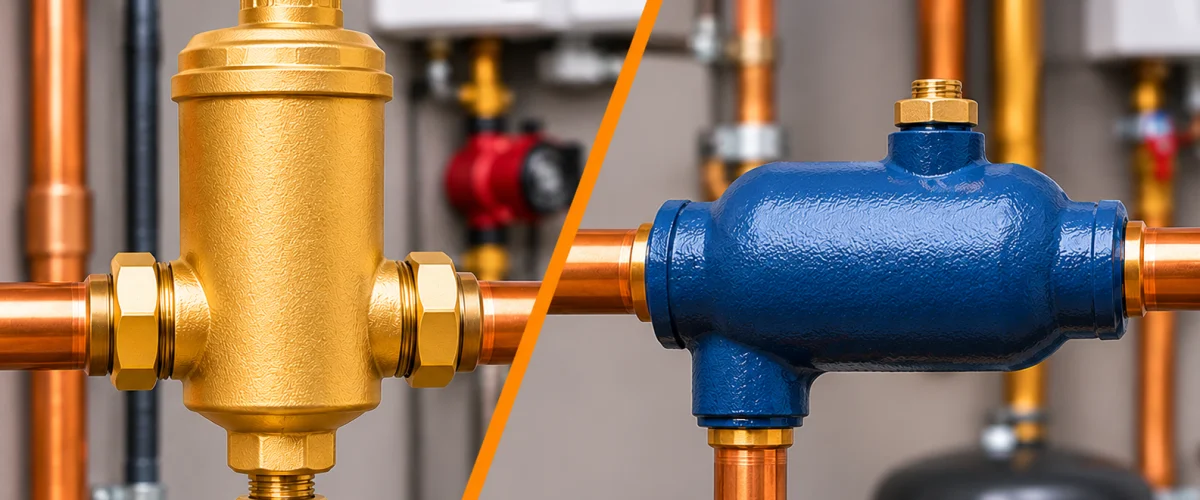
In everyday shopping, however, “air scoop” usually means a traditional enlarged fitting with an internal baffle. “Air separator” often means a microbubble model with an internal element that helps tiny bubbles collect together. That’s the distinction we’re using here.
| What you’re comparing |
Traditional air scoop |
Microbubble air separator |
| How it works |
Slows the flow so bubbles can rise and collect |
Helps small bubbles collect and combine before venting |
| Main distinction |
Relies on buoyancy and its chamber/baffle design |
Adds an internal bubble-collecting element |
| Air discharge |
Commonly uses a separate automatic vent |
Commonly incorporates an automatic vent assembly |
| Installation space |
Check straight-pipe requirements |
Check orientation, clearance and model-specific instructions |
| Buying decision |
May remain suitable in a working installation |
Worth considering for a planned upgrade or recurring air trouble |
Taco describes its scoops as enlarged chambers that reduce water velocity, with baffles helping direct air upward. Caleffi’s DISCAL instructions describe microbubbles joining into larger bubbles before rising to the vent. Sources: Taco air-control guide, Caleffi DISCAL instructions.
How an Air Scoop Works
An air scoop gives passing water more room. As the flow slows inside the chamber, bubbles have an opportunity to rise. An internal baffle helps guide them toward the top.
What happens next depends on the system. The collected air may leave through an automatic vent, or be directed toward a conventional plain-steel expansion tank in an air-control arrangement. Taco documents both approaches. Source: Taco Air Scoop submittal.
That distinction matters when you’re replacing an older fitting. Don’t assume every tank hanging near a boiler belongs to the same type of air-management system.
From a buyer’s perspective, keeping a serviceable scoop can be sensible when the system heats evenly, stays quiet and needs no other piping work. Our advice is to assess the actual problem before buying a replacement.
What a Microbubble Separator Adds
A microbubble separator gives small bubbles a surface on which to collect. They join together, become large enough to rise, and leave through the vent.
Different manufacturers use different internal designs. Caleffi, for example, describes mesh elements in its combined air-and-dirt separators that encourage bubbles to adhere and grow before release. Source: Caleffi operating-principle explanation.
This makes microbubble separation worth discussing when an existing system keeps having air-related trouble. Caleffi’s troubleshooting guidance specifically suggests considering a microbubble separator in place of an older scoop on systems with recurring air issues. That is manufacturer guidance, rather than a PTR side-by-side test. Source: Caleffi hydronic troubleshooting.
We’d also consider one when the boiler piping is already being altered. Ask the installer to quote the complete job with each option, rather than comparing the fittings alone.
Installation Can Decide the Choice
Before you compare brands, look at the available pipework.
Check the straight run
Taco’s Air Scoop submittal shows an 18-inch minimum straight run upstream in its installation diagram. That requirement can affect whether the fitting suits a cramped boiler space. It is a Taco example, not a measurement to apply to every scoop. Source: Taco Air Scoop submittal.
Some microbubble designs have different requirements. Spirotherm’s instructions for its VSR/VHR models say a specified number of straight pipe diameters before and after the unit is unnecessary, but those models must be upright in horizontal piping. Don’t extend that mounting rule to every Spirovent or every other separator. Source: Spirotherm VSR/VHR instructions.
Check the location
Air separation works best where conditions encourage dissolved gas to leave the water. Caleffi identifies high water temperature and low pressure as favourable conditions, generally pointing to the heat-source outlet in heating systems. Source: Caleffi placement guidance.
That doesn’t mean choosing the nearest convenient gap beside the boiler. The circulator and expansion-tank connection also need consideration. Spirotherm recommends locating the expansion-tank connection on the circulator’s suction side. Source: Spirotherm VSR/VHR instructions.
If you’re also replacing the pump, our hydronic circulator comparison can help you understand the product choices before discussing the layout with your installer.
Check These Details Before You Buy
A listing that says “for boilers” isn’t enough to establish fit. Put these details on your shortlist:
- Connection: pipe size, threaded or sweat, and the exact thread standard.
- Orientation: whether that model accepts horizontal piping, vertical piping or both.
- Operating limits: temperature, pressure and compatibility with the system fluid.
- Flow: the manufacturer’s selection guidance and pressure-drop information.
- Clearance: room for the vent and any service access.
- Tank arrangement: compatibility with the existing expansion-tank and air-management design.
- What’s included: the vent, service fittings and any required adapters.
Our boiler expansion-tank comparison explains the closed-loop heating tanks covered in that guide.
Before you buy: if your system has an older plain-steel compression tank, have the installer identify how air is managed before changing the scoop or adding automatic venting. Taco distinguishes air-control systems from systems that discharge separated air through a vent. Source: Taco air-control guide.
Should You Replace the Scoop You Already Have?
Keep it under consideration if the system works well. There’s little value in shopping for a cure when you haven’t identified a problem.
Discuss a microbubble upgrade if air trouble keeps returning. Ask the installer to investigate the cause as well as the separator. Caleffi’s troubleshooting approach emphasises finding the underlying fault instead of replacing components by guesswork. Source: Caleffi hydronic troubleshooting.
Compare the installed job. Our recommendation is to ask what pipework, fittings and service access each option needs. A part that looks like an easy swap online may be less convenient beside your boiler.
Replacing either fitting involves the heating-water circuit. Have a qualified heating professional handle the work rather than opening a hot, pressurised system.
Common Questions
Q: Is an automatic air vent the same as an air separator?
No. A vent releases air that reaches it. A separator helps collect air from moving system water so it can be released. They can work together, and many separators include a vent.
Caleffi explains that point vents and inline separators serve different purposes. Our automatic air vents and air eliminators guide separates those product types. Source: Caleffi placement guidance.
Q: Does an air separator also remove dirt?
Only if the particular model is designed for it. Manufacturers offer air-only and combined air-and-dirt products. Don’t assume a magnetic dirt separator or an air separator performs both jobs. Source: Caleffi product categories.
Conclusion — Which Would We Choose?
For a planned upgrade, a correctly selected microbubble separator would usually be our first option to discuss with the installer.
For an existing system that heats properly and stays quiet, we wouldn’t rush to remove a working scoop. The useful purchase is the one that suits your piping and addresses an identified problem.
✍️ About This Comparison
PTR Editorial Team — Product Comparisons. We compare manufacturer specifications, installation requirements, compatibility and available product documentation to help homeowners choose suitable tools and parts. How we review →