
Reviews
18 Nov 2026

5 Radiant Floor Heating Manifolds for PEX Loops
Compare five radiant floor heating manifolds for PEX loops, from a 3-loop to an 8-loop option, and what to check before you order.
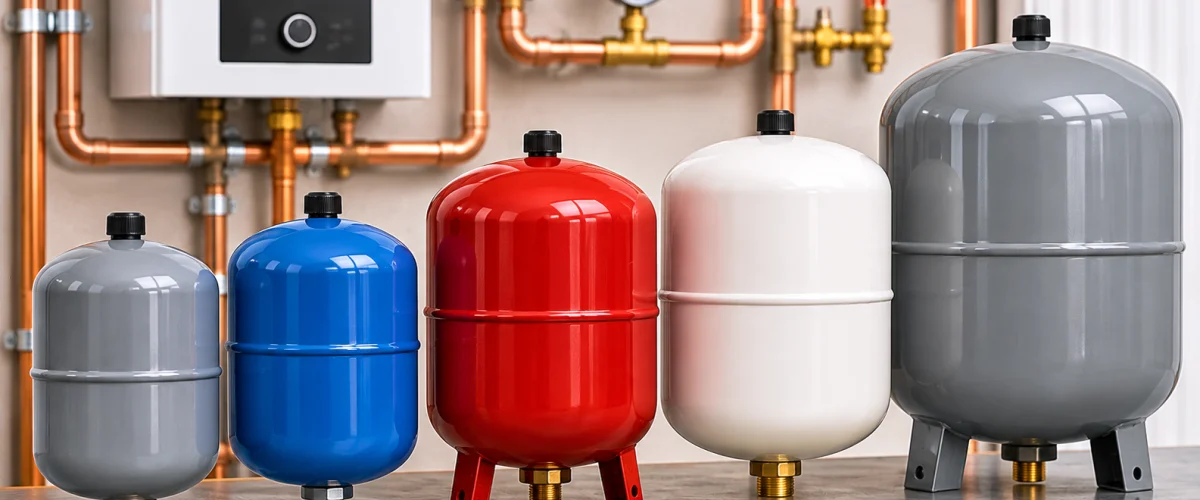
Four closed-loop boiler expansion tanks from Amtrol and Bell & Gossett: what to match before ordering, tank volume versus acceptance, and fit questions for your installer.
Please note: Product availability and information are based on our research at time of writing and are subject to change. Always check Amazon for the latest details before purchasing. Reviews remain editorially independent.
If the expansion tank on your boiler has gone bad, there are four things to match before you buy a new one: that it is the right kind of tank, how much water it can take, how it connects, and whether it fits the space. This guide compares four closed-loop heating tanks: Amtrol’s Extrol EX-15, EX-30 and EX-90, and Bell & Gossett’s HFT-30, which we line up next to the EX-30. We read the makers’ documents and the Amazon listings. We have not tested the tanks, and your installer should confirm the final choice.
These tanks are for boilers and other closed hot-water heating loops. They are not for drinking water, and mixing the two up causes trouble: Amtrol’s manual says to use its Extrol tanks only in residential closed hydronic systems, not on domestic water, where corrosion and tank failure may result. A quick way to tell is where the old tank sits and what its label says. A heating tank belongs on the boiler’s supply piping near the circulator (Amtrol’s manual puts it on the suction side of the circulator), and Bell & Gossett suggests screwing it into the bottom of an air separator. Its label should name heating or boiler use. If you cannot read the label, ask your installer. A tank on the cold-water line to a water heater is the other kind, and our review of potable water heater expansion tanks covers those.
Tank volume is how big the tank is. Maximum acceptance is how much expanded water it can actually take on, and it is always smaller. The EX-30 is a 4.4 gallon tank with 2.5 gallons of maximum acceptance. The EX-90 is 14 gallons with 11.3. So the number on the front of the box does not tell you what the tank can handle; the acceptance figure does. Amtrol and Bell & Gossett each print one acceptance figure per tank without spelling out the conditions beside the table, so we show them as printed.
Here is how Amtrol’s chart reads. It is a worked example, not your answer. Amtrol assumes water only, a 12 psig fill pressure, a 30 psig relief valve and a 180 F average temperature. On that basis, a boiler with 100,000 BTU/h of net output points to the EX-30 with finned baseboard, but to the EX-60 with cast iron radiators. At 150,000 BTU/h with cast iron radiators the chart points to the EX-90. At 50,000 BTU/h with finned baseboard it points to the EX-15. Some rows call for the EX-60, which is not in this guide. Change the fill pressure, relief setting, temperature or add antifreeze and the answer can change. Amtrol says to ask its technical support for fluids other than water. Bell & Gossett’s HFT sheet and manual give no sizing chart, so a tank from either maker needs your installer’s sizing.
✏️ Our Take
Size first, brand second. The EX-15 is for small boilers, the EX-30 is the middle size, and the EX-90 is for big systems. The HFT-30 matches the EX-30 on every number the two makers print, so you can pick between them on fit, height and mounting orientation, as long as your installer confirms it for your install. The listings are the weak spot: read the notes under each tank first.
IN THIS GUIDE
Smaller to larger. This is not a ranking. Acceptance is shown as each maker prints it. All four have a 1/2 in male NPT connection, a 100 psi maximum working pressure, a 240 F maximum operating temperature and a 12 psi factory air charge.
Wide table: this table is wider than the page on small screens — swipe or scroll it sideways to see every column →
| Tank | Tank volume | Max acceptance | Diameter x height | Buying link |
|---|---|---|---|---|
| Amtrol Extrol EX-15 | 2.0 gal | 1.0 gal | 8 x 13 in | View on Amazon |
| Amtrol Extrol EX-30 | 4.4 gal | 2.5 gal | 11 x 15 in | View on Amazon |
| Bell & Gossett HFT-30 | 4.4 gal | 2.5 gal | 11 x 14 in | View on Amazon |
| Amtrol Extrol EX-90 | 14.0 gal | 11.3 gal | 15 x 21 in | View on Amazon |
The HFT-30 sits right after the EX-30 because they are the same size on paper. The order is not a ranking.
Size and connection: 2.0 gallons tank volume, 1.0 gallon maximum acceptance; 8 in across and 13 in high (Amtrol lists 5 lb shipping weight); 1/2 in male NPT steel system connection; 12 psi factory air charge.
The EX-15 is the smallest tank in this guide. It is a steel tank with a butyl/EPDM diaphragm that keeps the heating water apart from the air cushion. Amtrol’s brochure lists the Extrol tanks for expansion control in most residential closed-loop boiler systems, and its manual says to use them only in closed hydronic systems, never on domestic water.
You might consider it if your installer’s sizing points to the smallest class. In Amtrol’s chart that means a small boiler: up to 50,000 BTU/h net output with finned baseboard or convectors, or up to 25,000 BTU/h with cast iron radiators or baseboard.
Advantages
Limitations
Before you click: the listing is titled “Amtrol 15 Extrol Boiler System Expansion Tank, 2 gal Volume, 8″ Diameter, 13″ Height”. Its bullets repeat the 1/2 in NPTM connection, 1.0 gallon acceptance and 100 psig rating. A second Amazon listing for the #15 exists; we used the one whose title gives the model and size.
Amtrol
Best for: A small closed-loop boiler system, once your installer confirms the sizing
Amtrol's smallest in-line Extrol tank for closed hydronic heating systems: 2.0 gallons tank volume with 1.0 gallon maximum acceptance, a 1/2 in male NPT connection and a 12 psi factory air charge.
Size and connection: 4.4 gallons tank volume, 2.5 gallons maximum acceptance; 11 in across and 15 in high (Amtrol lists 9 lb shipping weight); 1/2 in male NPT steel system connection; 12 psi factory air charge.
The EX-30 is the middle of Amtrol’s in-line range, and the size its chart picks for a wide middle band of boilers. Amtrol’s installation manual says to fit it on the supply side of the boiler, on the suction side of the heating circulator, and to mount it vertically with the tank hanging downward only. The piping has to carry the full weight of the tank when it is full of water, and it should not go on a dead-end pipe or anywhere air can collect. If you are replacing a circulator at the same time, our guide to hydronic circulator pumps covers that side.
You might consider it if your installer’s sizing points to the mid-size class: in Amtrol’s chart, 75,000 to 150,000 BTU/h net output with finned baseboard, or 75,000 to 100,000 with convectors.
Advantages
Limitations
Before you click: the listing is titled “Amtrol 30 Extrol Boiler System Expansion Tank, 4.4 gal Volume, 11″ Diameter, 15″ Height” and its bullets give 1/2 in NPTM, 2.5 gallons acceptance and 100 psig. Amazon’s other Extrol listings have mismatched details (one shows a 30-gallon capacity, another a fuel type of gasoline), so check the title and the part number before ordering.
Amtrol
Best for: A mid-size closed-loop boiler system, once your installer confirms the sizing
Amtrol's mid-size in-line Extrol tank for closed hydronic heating systems: 4.4 gallons tank volume with 2.5 gallons maximum acceptance, a 1/2 in male NPT connection and a 12 psi factory air charge.
Size and connection: 4.4 gallons tank volume, 2.5 gallons maximum acceptance; 11 in across and 14 in high (Bell & Gossett lists 9 lb shipping weight); 1/2 in male NPT connection; 12 psi factory air charge.
The HFT-30 (part 1BN327) is Bell & Gossett’s 4.4-gallon tank. Its published numbers match the EX-30’s: the same tank volume, the same maximum acceptance, the same 1/2 in connection, 100 psi, 240 F and 12 psi factory charge. We are treating it as an equal-capacity alternative, not a guaranteed swap, because the two makers’ figures are printed on their own bases and neither lists the conditions beside the table. Your installer should confirm fit for the actual install.
There are a few differences worth knowing. The HFT-30 is one inch shorter. Bell & Gossett’s manual says a residential tank may be installed vertically or horizontally, where Amtrol says downward-hanging only for the EX-30. It also suggests screwing the tank into the bottom of an air separator on the supply line, and says not to put it on a dead-end pipe or in an overhead joist space. If a tank is too small for the system, the manual warns that system pressure will run higher than you want when the water is hot.
You might consider it if you want the same size as the EX-30 from a different maker, or the shorter tank fits your space or orientation better, and your installer confirms the replacement matches what your system needs.
Advantages
Limitations
Before you click: the listing is titled “BELL & GOSSETT HFT-30, 1/2″ NPT M Connection HFT Expansion Tank” and shows part number 1BN327. The title also says it “replaces” an Amtrol tank, which is the seller’s wording; Bell & Gossett does not make that claim in the documents we read, so confirm fit yourself. A second HFT-30 listing exists with less detail.
Bell & Gossett
Best for: The same size as the EX-30 from a different maker, once your installer confirms fit
Bell & Gossett's 4.4-gallon Series HFT diaphragm tank for closed hydronic heating systems (part 1BN327).
Size and connection: 14.0 gallons tank volume, 11.3 gallons maximum acceptance; 15 in across and 21 in high (Amtrol lists 23 lb shipping weight); 1/2 in male NPT steel system connection; 12 psi factory air charge.
The EX-90 is the biggest in-line tank in this guide, and it is a big step up: its 11.3 gallons of maximum acceptance is more than four times the EX-30’s. That is why Amtrol’s chart sends its larger cast iron radiator and cast iron baseboard rows to this model. It hangs from the piping like the others, so the piping has to carry a full 14 gallons plus the tank. Bigger boilers move on to Amtrol’s floor-standing SX models, which are outside this guide.
You might consider it if your installer’s sizing points to the large class: in Amtrol’s chart, 150,000 BTU/h net output with cast iron radiators, 125,000 to 150,000 with cast iron baseboard, or 250,000 to 300,000 with finned baseboard.
Advantages
Limitations
Before you click: Confirm the seller is shipping the EX-90 (112-1) with the connection your system needs.
Amtrol
Best for: A large closed-loop boiler system, once your installer confirms the sizing
Amtrol's largest in-line Extrol tank for closed hydronic heating systems: 14.0 gallons tank volume with 11.3 gallons maximum acceptance, a 1/2 in male NPT connection and a 12 psi factory air charge.
The instructions packed with your exact tank come first. Everything here is general and never overrides a model-specific rule. Both makers say the tank should be installed by a qualified professional, and both warn that any pressurised tank can eventually corrode, weaken and leak, so it should be checked from time to time and not hidden where a leak would do damage. Amtrol also says to have the system’s relief valve inspected at least every three years. A tank that is too small will not stop the relief valve from dripping, so if yours does after a swap, tell your installer.
Sometimes a job is too big for DIY. To find local plumbers, you can search PlumberArchive.com, a plumber directory.
Documents and listings read on 15 November 2026. Amazon listing details are used only where attributed to the listing.
✍️ About This Review
PTR Editorial Team — Product Reviews. We compare manufacturer specifications, installation requirements, compatibility and available product documentation to help homeowners choose suitable tools and parts. How we review →
Compare five radiant floor heating manifolds for PEX loops, from a 3-loop to an 8-loop option, and what to check before you order.
Compare four boiler point vents and one inline air separator: what to match before you buy, from thread and mounting to pressure ratings.
Compare five hydronic zone valves for hot-water baseboard heating, with quick tips on matching the model, pipe connection and controls.

