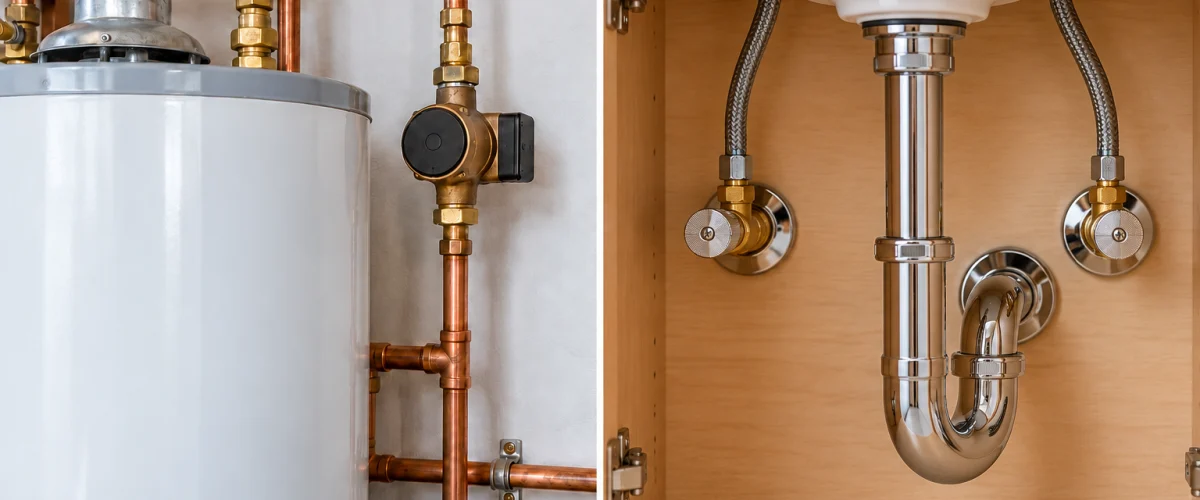
Please note: Check your water heater’s instructions and the installation requirements that apply where you live before buying or installing recirculation equipment.
If the hot tap at a distant sink takes a long time to run warm, the water standing in the hot line has cooled and has to leave first. A recirculation pump moves that cooled water back toward the water heater instead of down the drain. Which system fits your house depends less on the pump than on the path the water takes back.
There are two common paths. A dedicated return line is a separate pipe from the far end of the hot line to the heater. An under-sink bypass (some makers say crossover or comfort valve) lets cooled water pass from the hot line into the cold line, which then carries it back. This guide helps you match a layout to your plumbing before you choose equipment. If you have no return line and want specific systems, see our roundup of hot-water recirculation systems for homes without a return line.
✏️ The Short Answer
Find out whether your house has a separate return pipe. If it does, or the walls are open and a plumber can add one, a dedicated return uses a pipe made for the job. If there is none and the walls are closed, a bypass is one way to retrofit, with trade-offs: some warm water may reach the cold tap where it is installed, and one bypass may not serve every branch of the piping.
Do not choose by where the pump sits, because the same position appears in both layouts. Check your exact water heater model before choosing a pump, especially a tankless or heat pump model. The control (timer, sensor, button or heater logic) is a separate decision.
The Two Layouts at a Glance
This compares plumbing layouts, not products.
| Question |
Dedicated return |
Under-sink bypass |
| How does the water get back? |
Through a separate pipe from the far end of the hot line to the heater |
Through the cold-water line, via a valve or pump at the farthest fixture |
| What must the house have? |
A return pipe, existing or added |
No dedicated return pipe required; connecting pipework or hoses depend on the kit. Access to the hot and cold connections at the far fixture. |
| Where can the pump go? |
At or near the heater; some heaters have a pump built in |
At the heater, with a valve under the sink, or under the sink itself |
| Cold-tap effect |
The cold-water supply is not used as the intended return path. |
The cold line is the return path, so makers say some warm water can appear in it at that fixture until the cold tap runs briefly |
| Main question to settle |
Does a return line exist, and where does it connect at the heater? |
Is a bypass documented for your exact heater, and how does the hot line branch? |
| Often considered when |
Building, remodeling with open walls, or a return pipe is already there |
The walls are finished and there is no return pipe |
Pump Location Does Not Identify the Layout
The same equipment can appear in both layouts. Taco’s TacoGenie page lists “Standard Piping” and “Recirculation Piping” models, with different maximum pipe lengths for each. APCOM’s page describes an under-sink kit and a separate bypass kit whose pump goes on top of the water heater.
So ask which pipe carries the water back. Look at the plumbing around the heater, or ask whoever installed it. A. O. Smith’s technical bulletin says, for its storage heaters, that the drain valve may not be used as the return inlet and that some heaters lack dedicated return connections. If you cannot tell, have a plumber confirm before you buy.
What Each Layout Asks of Your House
Dedicated return. Confirm that a return pipe exists and where it connects at the heater. If one has to be added, the work depends on how the plumbing is routed and how much of it you can reach, which a plumber has to assess on site. A. O. Smith says an expansion tank is required for a recirculating (closed) loop with its storage heaters; your heater’s manual and your installer decide what your system needs.
Under-sink bypass. ENERGY STAR describes the method: the pump sends cooled water from the hot line back to the heater through the cold water line, and a control turns it off at the desired temperature. It needs no dedicated return pipe. The trade-offs:
- Warm water at the cold tap. ENERGY STAR says that where hot water returns through the cold pipes, the cold water warms slightly and returns to its usual temperature in a short time. Xylem’s 2020 manual for its Autocirc E1 gives 4 to 5 seconds after the cold tap opens, one maker’s figure for one model and not a promise for your house.
- Not scald protection. Navien and A. O. Smith both recommend thermostatic mixing valves at points of use. Our guide to checking and adjusting a tank water heater’s temperature covers the heater side.
- Branches. A bypass sits at one fixture, so if the hot line branches it may not help every branch. That is our reasoning, not a maker’s finding; ask which fixtures a setup is meant to serve.
Layout Is Not the Same as Controls
The layout decides the water’s path; the control decides when the pump runs. Either layout can use any of these, depending on the equipment.
- Timer only. The pump runs during programmed hours. A timer-only control does not itself check whether the pipe is warm or whether anyone needs hot water, so it can run when nobody does and miss a need outside the schedule. ENERGY STAR says systems that run continuously can use more energy than they save.
- Schedule plus temperature sensing. A sensor starts the pump when the line cools and stops it when hot water arrives, within the hours allowed. APCOM’s page describes its kits this way; Xylem’s catalog lists its E10 as a fixed thermostat with a timer.
- Demand start. A button, remote or motion sensor starts the pump; Taco’s page lists a push button with optional wireless or motion-sensor accessories, and says a heat sensor shuts the pump off. With a demand-start system, hot water still has to travel to the tap, so expect to wait after the request. The documents describe the pump running until a sensor detects hot water, and none gives a time for your house.
- Heater logic. Navien’s ComfortCirc manual describes built-in temperature and flow sensors, on-demand, schedule and always-on modes, and, with its heat pump water heater, control of the pump from the heater.
ENERGY STAR says demand systems can save water and energy in some situations, and the Department of Energy’s Building America page says the best way to operate the pump is with demand-initiated controls. Neither gives a savings figure for the choice of control. Ask which control a setup uses and where any button or sensor goes.
Check the Exact Heater Model
A layout is only half of compatibility: the pump or valve also has to be documented for your heater, and makers’ current pages vary. Xylem’s 2025 catalog calls its Autocirc circulators designed for standard water heaters and says its E10 suits retrofits and systems with tankless water heaters. APCOM’s page lists a bypass kit for single-pipe homes with a tank or indirect heater and a separate tankless bypass kit, and tells readers with a dedicated return line to ask a plumber about other models. The point is that a statement applies to one kit, on one layout, with one heater type.
Before you buy, gather your heater’s exact model number, whether it has a built-in pump or a return connection, your layout, and the pump maker’s current document for that combination. Take extra care with heat pump water heaters: Navien’s manual says adding a recirculation system to one may make it operate more frequently, and the pump documents we reviewed mostly do not address them. Check what your heater’s manual and warranty say about added recirculation equipment, and where the documents do not settle it, ask the heater maker or installer and keep the answer in writing. If you are still choosing a heater, see tankless vs. tank water heaters.
Installation and Comparing Complete Quotes
We give no install times or costs, because the documents do not support a figure that fits every house. The work changes with access to the pipes, where power is available, insulation, an expansion tank, mixing valves or backflow devices where the heater maker calls for them, and permits or inspections. Rules vary by location, so ask your installer or local building department what applies.
Two quotes that both say “recirculation pump” can describe different jobs. Make each one state:
- the layout, and which fixtures it is meant to serve;
- the exact equipment, and the heater model it was checked against;
- the control, and where any button or sensor goes;
- electrical work, and any wall or ceiling opening and its repair;
- insulation, expansion tank, mixing valves, backflow devices and permits, and whether they are included;
- warranty terms for the equipment and the labor, and what happens if the result is not what you were told to expect.
If a quote includes a savings estimate, ask for the assumptions behind it: hot-water use, how long the pump runs, heater type and pipe length.
Which Setup Fits Your Home
- A dedicated return may fit if the house already has a return pipe, you are building or opening walls anyway, or the hot line branches to several distant bathrooms.
- An under-sink bypass may fit if the walls are finished, there is no return pipe, and one far fixture or one run of pipe is the main problem, and the equipment is documented for your exact heater.
- Look further first if hot water never arrives, or runs out quickly. Investigate the cause before assuming recirculation is the answer; our guide to a water heater with no hot water is a starting point. If one far bathroom is the whole story, a heater closer to it is another route; see point-of-use vs. whole-house water heaters.
Sources
Read at the time of writing. Statements are the makers’ or agencies’ own; we did not test any system.
✍️ About This Comparison
PTR Editorial Team — Product Comparisons. We compare manufacturer specifications, installation requirements, compatibility and available product documentation to help homeowners choose suitable tools and parts. How we review →