Please note: Product availability and information are based on our research at time of writing and are subject to change. Always check Amazon for the latest details before purchasing.
Introduction
A hose bib timer is a battery-powered valve that threads onto an outdoor faucet and opens and closes the water on a schedule you set — so a garden bed, a row of planters, a drip line, or a soaker hose gets watered at the same time every day whether or not anyone is home. That makes it one of the most useful upgrades you can add to a hose bib: it keeps a vegetable garden alive through a week-long vacation, waters early when evaporation is lowest, and takes a daily chore off your list. It helps to be clear about what a timer is not — it hangs off the faucet, it does not replace it. If your outdoor faucet is aging, dripping, or hard to turn, fix that first with our guide to the 5 best outdoor faucets, then add scheduling on top. This review covers the best hose bib timer for a single-zone yard, across five distinct types. Once you’ve picked one, our how to install and program a hose bib timer guide walks through setup.
✏️ Our Take
There is no single best hose bib timer for every yard. The right pick depends on how much programming flexibility you want, whether you value a readable screen or a dial you can set in seconds, and how much weather the connection has to survive. A digital LCD timer gives precise start times and multiple cycles a day, which matters for drip irrigation and seed beds; a single-dial or analog timer trades that precision for a setup you can finish without the manual. Brass inlets shrug off cross-threading and high pressure; all-plastic timers cost less but need a gentler hand. Any of the five below will reliably run one zone on a daily schedule.
Quick Comparison Table
Full Reviews — 5 Best Hose Bib Timers
1. RAINPOINT Programmable Timer, 1 Outlet — Best Overall
🏆 Best Overall
★★★★★
Digital LCD · 1 Outlet · Rain Delay / Manual / Auto · 2 × AAA
The RAINPOINT programmable timer covers the widest range of watering jobs with the least fuss. A large segmented LCD shows the active program, the next run, and the battery level, and setup is a short menu: a start time, a run length from one minute to just under four hours, and a frequency from hourly to weekly. It threads onto a standard 3/4-inch hose bib, drives one outlet, and runs a full season on two AAA batteries. Automatic mode runs the schedule, manual gives a one-off soak without disturbing it, and a rain delay pauses watering up to three days.
The molded-plastic housing carries an IP54 rating — fine for a faucet on a wall, not one sitting in water — and the plastic inlet needs a careful start. The valve closes gradually to avoid water-hammer knock. It is not the toughest timer here, but for a garden, greenhouse bench, or one-zone drip system it is the most capable all-round pick at a mid-range price.
✓ Pros
Readable LCD and short menu handle a daily lawn cycle or a multi-start drip schedule equally well
Automatic, manual, and rain-delay modes cover every common watering situation
Season-long AAA battery life with a fail-safe that closes the valve on low battery
✗ Cons
Plastic housing and inlet are weather-resistant but not built for years of hard freeze and sun
Single outlet — running separate zones on different schedules means buying more than one
🛒 Check Price on Amazon — $$ →
2. Orbit One Outlet Single-Dial (62056) — Best for Simplicity
🎛️ Best for Simplicity
★★★★☆
Single-Dial · 1 Outlet · Brass Swivel Inlet · 2 × AA
Orbit’s single-dial timer strips scheduling down to one knob. You turn the dial to pick how often the water runs — from every six hours up to once every seven days — and a second setting picks how long, from one minute to four hours. A small LCD confirms the choice and counts down to the next cycle, with no menus to page through and no start times to enter. For a sprinkler or soaker hose that should come on once a day and otherwise be left alone, it is the fastest timer here to set up.
The build punches above the price. The inlet is a brass swivel, so it takes repeated hose changes and higher line pressure without wearing, and the housing is weatherproofed for a full season outside. It runs on two AA batteries and includes the same 24-, 48-, and 72-hour rain delay as pricier units. The trade for the simplicity is flexibility: no multiple watering windows in a day, and coarse frequency steps mean choosing the closest option rather than an exact interval — weak for finicky drip schedules, fine for garden and lawn watering.
✓ Pros
One dial sets the whole schedule — the quickest timer here to get running
Brass swivel inlet stands up to frequent hose swaps and high water pressure
Standard 24/48/72-hour rain delay and a clear countdown display
✗ Cons
No multiple daily start times and only coarse frequency steps — a poor match for precise drip irrigation
Single zone, and the dial has to be re-set if the batteries drain completely
🛒 Check Price on Amazon — $$ →
3. Raindrip R675CT Analog 3-Dial — Best Analog Simplicity
🎚️ Best Analog Simplicity
★★★★☆
Analog 3-Dial · 1 Zone · Rain Delay · 2 × AA
The Raindrip R675CT keeps the interface off the screen entirely. Three physical dials do the work: one sets how often the water runs, one sets how long, and a third handles manual watering and rain delay in one sweep — turn it one way for an immediate soak of 3 to 90 minutes, the other way to postpone the schedule 24 to 72 hours. There is no LCD and no clock to set, which is the appeal: nothing to reprogram after a bump or a battery swap. It controls one zone and is aimed squarely at drip and micro-irrigation.
It does still take two AA batteries — the dials are analog, but a battery turns the valve — and it fails safe, closing the valve and holding your settings on low battery. It needs at least 15 PSI to seat and release the valve, so it is not the pick for a rain barrel or a gravity feed. The housing is functional plastic rather than brass. For a set-and-forget drip system on a pressurized spigot, it is the least fussy timer in the group.
✓ Pros
Three-dial analog interface has no clock to set and nothing to reprogram after a battery change
One dial combines manual watering and a 24–72 hour rain delay
Fail-safe valve closes and keeps your settings when the battery gets low
✗ Cons
Still needs two AA batteries despite the analog dials — it is not a water-powered timer
Needs at least 15 PSI and a plastic housing, so it is unsuited to low-pressure or gravity setups
🛒 Check Price on Amazon — $$ →
4. RAINPOINT Brass Swivel Timer — Best Durable Construction
🛡️ Best Durable Construction
★★★★☆
Digital LCD · 1 Outlet · Brass Inlet · IP65 · 2 × AAA
This is the RAINPOINT for a timer that lives outdoors year-round on a faucet that sees real weather. The inlet is reinforced brass rated to well over 100 PSI, which resists the cross-threading and thread wear that eventually splits a plastic coupling, and the casing carries an IP65 rating — sealed against dust and direct water jets, a step up from the IP54 standard model. RAINPOINT quotes 20,000-cycle valve testing, and the valve and metal inlet filter tend to outlast everything else on a timer.
The controls are full digital: a large LCD with a dial and four buttons, runs from one minute to just under four hours, and frequency from every eight hours out to weekly, with the standard three-day rain delay. It drives a single outlet on two AAA batteries. The downsides come with the heavier metal build — it costs more than the plastic RAINPOINT, adds weight on the hose bib, and the programming has more steps than a dial timer. For a permanent install you would rather not revisit, that is a reasonable trade.
✓ Pros
Reinforced brass inlet and IP65-sealed casing built for year-round outdoor exposure
High-cycle valve rating and metal inlet filter — the parts most likely to fail last longest here
Full digital scheduling with a readable LCD and standard rain-delay options
✗ Cons
Heavier on the faucet and priced above the all-plastic RAINPOINT
More programming steps than a dial timer, and still only one zone
🛒 Check Price on Amazon — $$ →
5. RAINPOINT Outdoor Plastic Timer — Best Budget
💰 Best Budget
★★★★☆
Digital LCD · 1 Outlet · All-Plastic · 2 × AAA
The all-plastic RAINPOINT is the entry point: the same core digital timer as the pricier models, in a lighter housing with a plastic inlet instead of brass. You still get an LCD, automatic scheduling with adjustable run length and frequency, a manual mode, and a rain delay, and it runs one zone on two AAA batteries. For a seasonal user who brings the timer indoors over winter, or anyone testing whether a timer fits their routine, it covers the essentials for the lowest outlay here.
The compromises are what the price implies. The plastic inlet needs a careful hand, the housing is weather-resistant rather than sealed, and it is best treated as a warm-season tool rather than left on an exposed faucet through a hard freeze. It is no simpler to program than the pricier units — you save on materials, not complexity. Within those limits it runs one zone on a reliable daily schedule at a genuinely low price.
✓ Pros
Lowest price here for a full digital timer with automatic, manual, and rain-delay modes
Light on the faucet and easy to bring indoors for winter storage
Same scheduling features as the costlier RAINPOINT models on a single zone
✗ Cons
Plastic inlet and unsealed housing make it a warm-season tool, not a year-round outdoor fixture
No simpler to program than the pricier units — the savings are purely in materials
🛒 Check Price on Amazon — $ →
Buying Guide
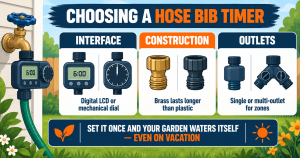
Interface is the first fork. A digital LCD timer lets you set exact start times and, on most models, more than one watering window a day — worth it for drip irrigation, seed beds, and anything where timing precision matters. A single-dial or analog timer gives that up for a setup you can finish in under a minute with no manual, which is plenty for a once-a-day lawn or garden cycle. Neither type is inherently more reliable; choose based on how much control you actually need.
Build quality concentrates at the inlet. A brass swivel connector resists cross-threading and handles higher line pressure without wearing, and it is what you want on a faucet that stays outside all year. An all-plastic inlet is lighter and cheaper and works fine if you hand-tighten it carefully and bring the timer in before a hard freeze. A timer also cannot compensate for a faucet that never fully closes; if yours weeps at the spout or handle, fix that first with our guide on how to fix a leaking outdoor faucet / hose bib.
Every timer in this review runs a single outlet. To run a lawn zone and a vegetable bed on different schedules, buy a dedicated two-outlet timer or run two single-outlet units off a Y-splitter — often the cheaper route, and one failure then does not stop all watering.
Two popular categories are absent here on purpose. WiFi and smart timers — Orbit B-hyve, Rachio, meross, GoveeLife and others — draw heavy search interest for app control and weather-based skipping, and fully mechanical clockwork-dial timers stay perennially popular for their no-battery appeal. We checked both segments closely, and as of this update no individual product in either one clears the customer-rating bar we require before naming a model — the smart timers stumble on connectivity and app reliability, the clockwork dials on valve leaks and inconsistent shutoff. Both are worth watching, and we will add a model if one rises above that bar. For now, a straightforward battery-powered digital or analog timer is the more dependable buy.
Need a Professional Plumber?
Installing a hose bib timer is a no-tools, hand-tight job, but a faucet that will not shut off, leaks behind the wall, or has a cracked stem is worth a professional’s eyes before you rely on a timer to control it. Search PlumberArchive.com — the US plumber directory with 12,151+ verified local plumbers across all 50 states.
Find a trusted plumber near you → PlumberArchive.com
Frequently Asked Questions
Q: Do hose bib timers work with drip irrigation systems?
Yes — drip and micro-irrigation are the job these timers do best. The timer threads onto the faucet and the drip tubing or manifold connects to its outlet, so the whole zone runs on the schedule you set. Two things to check: most drip setups want a pressure regulator downstream of the timer, and low-pressure gravity systems will not open a battery-driven valve reliably. Drip zones are also usually watered in longer, less frequent cycles than a sprinkler, which every timer here can be set for.
Q: How long do the batteries last?
Most hose bib timers get through a full watering season on one set of alkaline batteries — roughly six to eight months of daily cycles — whether they use two AAA or two AA cells. Cold weather, very frequent cycling, and high line pressure all shorten that. Every timer here fails safe, closing the valve when the battery gets low. Replace the batteries at the start of each season rather than waiting for the warning, and bring the timer indoors over winter.
Q: Can I use a hose bib timer with a frost-free faucet?
Yes, with one seasonal caveat. A timer threads onto a frost-free sillcock exactly as it does onto a standard hose bib and works normally through the watering season. The catch is winter: a frost-free faucet only drains properly if the hose — and anything else on the outlet, including a timer — is removed, so the pipe can empty back toward the heated side of the wall. Leaving a timer attached over winter traps water in the faucet and defeats the design. If you are weighing which faucet type you have or need, our comparison of frost-free vs standard outdoor faucet lays out the difference.
Q: What’s the difference between a hose bib timer and a smart sprinkler controller?
A hose bib timer is a self-contained battery valve that screws onto one faucet and runs one zone on a fixed schedule you set by hand. A smart sprinkler controller is a wall-mounted, wired unit that drives multiple in-ground valve zones, connects to WiFi, and adjusts watering automatically from local weather data. The controller is the tool for a permanent multi-zone in-ground system; the timer is for hose-connected watering — drip lines, soaker hoses, raised beds — where running one wire-free zone off the spigot is all you need.
Conclusion — Which Hose Bib Timer Should You Buy?
For most yards, the RAINPOINT Programmable Timer is the hose bib timer to buy. It handles the full range of watering jobs — a daily lawn cycle, a multi-start drip schedule, a one-off manual soak — through a readable screen and a short setup menu, runs a season on a set of AAA batteries, and sits at a mid-range price. It is the only timer here carrying our Best Overall badge, and it is the safe default if you are not sure which features you will end up using.
Choose around it based on what you value. The Orbit single-dial 62056 is the fastest to set up and has a brass inlet, if you only need one cycle a day. The Raindrip R675CT is the least fussy for a permanent drip system, with three analog dials and no clock to reset. The RAINPOINT brass swivel is the one to leave outside year-round, and the all-plastic RAINPOINT covers the essentials for the lowest price if you store it indoors each winter. Whichever you pick, the timer is only as good as the faucet it hangs on — a solid outdoor faucet comes first, scheduling second.
Prices and ratings may change. Always check Amazon for current prices.
✍️ About This Review
PTR Editorial Team — Product Reviews. We compare manufacturer specifications, installation requirements, compatibility and available product documentation to help homeowners choose suitable tools and parts. How we review →