Please note: Product availability and information are based on our research at time of writing and are subject to change. Always check Amazon for the latest details before purchasing.
Introduction
An outdoor faucet — or sillcock — takes more punishment than almost any other fitting in your home. It spends every year exposed to summer heat, winter freeze cycles, UV, and garden hose strain. Choose the wrong one and you are looking at burst pipes, costly water damage, or a leaking fitting that wastes water for years. Choose the right one and you might never think about it again.
We reviewed the five best outdoor faucets available in 2026, covering frost-free sillcocks for cold climates, heavy-duty quarter-turn hydrants for long-term reliability, and budget spigots for mild-weather regions. Whether you are replacing a worn sillcock, upgrading to a frost-free model, or tackling a new installation, there is a pick in this list for you. If you run into any supply pipe issues during your project, our guides to the best pipe repair kits and PEX vs copper pipes have you covered.
Quick Comparison Table
The 5 Best Outdoor Faucets — Full Reviews
1. Eastman 10″ Frost Free Sillcock 80222 — Best Overall
🏆 BEST OVERALL MOST POPULAR
The Eastman 80222 Frost Free Sillcock is our Best Overall choice for outdoor faucets in 2026. This 10-inch sillcock uses Eastman’s proven frost-free design to protect your outdoor water supply through harsh winters — the stem extends 10 inches back from the spigot face into your home’s heated interior, so the internal shutoff mechanism sits in a warm space where it cannot freeze. Available with either a 1/2-inch MIP or 1/2-inch sweat connection, it suits most standard copper plumbing configurations without requiring adapter fittings.
The chrome-plated brass construction gives the 80222 both a clean appearance and genuine corrosion resistance — important for a fitting that will spend decades exposed to sun, rain, and freeze-thaw cycles. Eastman is one of the most trusted names in US residential plumbing supply, stocked at every major hardware store and backed by decades of contractor use. At the $ price tier, the 80222 delivers reliable frost protection at a price that makes it the natural first choice for most homeowners.
- 10-inch frost-free stem — keeps shutoff inside heated wall space
- 1/2-inch MIP x 1/2-inch sweat connections — fits most copper plumbing
- Chrome-plated brass body — corrosion-resistant and weather-durable
- Anti-siphon protection meets US plumbing code requirements
- Standard 3/4-inch garden hose thread outlet — no adapter needed
- Trusted Eastman brand — widely available for easy replacement parts
✓ Pros
- Excellent frost-free protection for cold climates
- Trusted Eastman brand
- Easy MIP or sweat connection
- Great value at the $ price tier
- Chrome-plated brass resists corrosion
✗ Cons
- 10-inch length may not suit all wall thicknesses
- Chrome finish may show wear over time
🛒 Check Price on Amazon — $ →
2. Prier P-164D12 12″ Quarter-Turn Frost Free Hydrant — Pro Choice
👷 PRO CHOICE HEAVY DUTY
The Prier P-164D12 is the professional-grade choice in this lineup. Prier has manufactured outdoor hydrants and sillcocks in the US for over 70 years, and the P-164 series reflects that heritage. The quarter-turn ball valve mechanism allows you to fully open or shut the water supply with a single 90-degree handle turn — far faster and more positive than multi-turn valve designs, and significantly less prone to stem wear over decades of repeated use.
The 12-inch barrel keeps the internal shutoff well inside the wall, and the heavy-duty brass construction is built to outlast the home it is installed in. Anti-siphon protection is integrated into the design and certified to ASSE 1019 and IAPMO standards, making it compliant with all US plumbing codes. If you are installing an outdoor faucet you genuinely never want to replace, the Prier P-164D12 is the long-term investment worth making.
- Quarter-turn ball valve — full open/close in a single 90-degree handle turn
- 12-inch frost-free barrel — internal shutoff stays in heated wall space
- Heavy-duty brass construction — built to professional contractor standards
- Anti-siphon certified: ASSE 1019 and IAPMO code compliant
- Fully serviceable — replaceable parts available without wall removal
- Compatible with 1/2-inch copper or iron pipe supply lines
💡 Tip: Quarter-turn ball valves are the preferred choice of licensed plumbers over multi-turn stem valves — they seal completely with one movement and are far less likely to develop drips at the packing nut over years of use.
✓ Pros
- Quarter-turn operation for fast shutoff
- Heavy-duty brass built to last decades
- Anti-siphon certified for code compliance
- Fully serviceable without wall removal
- 70+ years of Prier manufacturing heritage
✗ Cons
- Higher price point than standard sillcocks
- Professional installation recommended for best results
🛒 Check Price on Amazon — $$ →
3. Midline Valve 12″ Frost-Free Sillcock — Our Top Pick
⭐ OUR TOP PICK POPULAR CHOICE
The Midline Valve 12-inch Frost-Free Sillcock is our Top Pick for homeowners who want a well-specified, lead-free outdoor faucet at an accessible price. The 12-inch length suits most standard exterior wall constructions, including both 2×4 and 2×6 framing with insulation. The chrome-plated brass body provides solid corrosion resistance, and the 1/2-inch MIP or sweat inlet connects straightforwardly to existing copper plumbing without adapter fittings.
Lead-free certification is the standout specification here — it confirms this sillcock meets Safe Drinking Water Act requirements, which matters even for outdoor faucets since garden hose water is frequently used for drinking, pets, and children’s play. The 3/4-inch hose bib outlet accepts all standard garden hoses without an adapter. For a frost-free sillcock that checks every practical box at a competitive price, the Midline Valve is the easy recommendation.
- Lead-free certified — meets Safe Drinking Water Act requirements
- 12-inch frost-free length — suits 2×4 and 2×6 exterior wall framing
- Chrome-plated brass body — corrosion-resistant finish
- 1/2-inch MIP/sweat inlet x 3/4-inch hose bib outlet
- Anti-siphon protection built in — meets plumbing code
- Compatible with standard copper plumbing and all garden hose fittings
✓ Pros
- Lead-free certified for safe outdoor water use
- Chrome-plated brass resists corrosion
- 12-inch length suits most wall thicknesses
- Competitive price for the specification
- Anti-siphon protection included
✗ Cons
- Less well-known brand than Eastman or Prier
- Limited availability in some regions
🛒 Check Price on Amazon — $ →
4. Boltigen 12″ Anti-Siphon Frost Free Sillcock — Staff Pick
🎯 STAFF PICK GREAT VALUE
The Boltigen 12-inch Anti-Siphon Frost Free Sillcock stands out in this lineup for its push-to-fit connector — the most DIY-friendly installation option of any faucet in this review. The 1/2-inch push-fit connection works directly with standard copper, CPVC, or PEX pipe without soldering, compression fittings, or specialized tools. Push the pipe in firmly until it seats and the connection is complete. For homeowners replacing an existing sillcock without a propane torch, this is the most accessible option in the lineup.
No-lead brass construction keeps this sillcock fully code compliant in all US jurisdictions, and the included backflow preventer provides a second layer of protection against contaminated outdoor water being drawn back into the supply line. The 12-inch barrel suits most residential exterior wall configurations. If your project involves new supply pipe runs, our comparison of PEX vs copper pipes will help you choose the right material for your installation.
- Push-to-fit 1/2-inch inlet — no solder, no compression tools required
- No-lead brass construction — code compliant in all 50 US states
- Backflow preventer included — additional protection for supply line
- 12-inch frost-free barrel — internal shutoff in heated wall space
- Anti-siphon certified — meets plumbing code requirements
- 3/4-inch hose bib outlet for all standard garden hose connections
💡 Tip: The push-to-fit inlet is compatible with PEX pipe as well as copper and CPVC — making this the easiest option if you are running a new PEX supply line to a new exterior faucet location. No torch, no fittings, no experience required.
✓ Pros
- Push-to-fit connector makes installation tool-free
- Backflow preventer included for code compliance
- No-lead brass construction
- Works with copper, CPVC, and PEX pipe
- 12-inch frost-free protection
✗ Cons
- Push-fit connection less permanent than soldered options
- Relatively newer brand on Amazon
🛒 Check Price on Amazon — $ →
5. EFIELD 1/4-Turn Outdoor Spigot SILLCOCK045 — Best Value
💰 BEST VALUE POPULAR CHOICE
The EFIELD 1/4-Turn Outdoor Spigot is the Best Value pick in this lineup — a budget-friendly outdoor spigot with a quarter-turn ball valve that delivers fast, positive water control at an everyday price. The 1/2-inch male NPT inlet connects to standard iron pipe or male-threaded fittings, and the 3/4-inch GHT outlet accepts all standard garden hose connections without an adapter. The quarter-turn mechanism has the added advantage of clear open/closed positioning — you can see at a glance whether the water is on or off.
The critical limitation to understand before buying: this is not a frost-free design. The ball valve and shutoff mechanism sit at the exterior face of the spigot, not inside your wall, which means standing water in the faucet body can freeze in cold climates. For mild-climate states, unheated garages fitted with internal isolation valves, or summer-only use, the EFIELD is a practical and affordable solution. For any region that sees freezing temperatures, choose one of the frost-free models above instead.
- Quarter-turn ball valve — instant full open/close with one handle movement
- 1/2-inch male NPT inlet — fits standard iron pipe and threaded connections
- 3/4-inch GHT outlet — accepts all standard garden hose fittings
- Solid brass construction — durable at the price point
- Compact and lightweight — easy to handle and install
- Widely available — popular choice for mild-climate outdoor water supply
⚠️ Warning: This spigot is NOT frost-free. Do not install it in any region that experiences freezing temperatures without an internal isolation valve you can shut off and drain each fall — or choose one of the frost-free sillcocks above to avoid burst pipe risk entirely.
✓ Pros
- Most affordable option in this lineup
- Quarter-turn operation for fast water control
- Fits standard garden hose connection
- Well-reviewed by hundreds of monthly buyers
- Clear visual open/closed indicator
✗ Cons
- Not frost-free — not suitable for freezing climates
- No anti-siphon protection
🛒 Check Price on Amazon — $ →
Outdoor Faucet Buying Guide
Frost-Free vs Standard Outdoor Faucets — Which Do You Need?
This is the single most important question when buying an outdoor faucet. A standard outdoor spigot has its shutoff at the face of the faucet — which means when you turn it off, water still sits in the faucet body and exposed supply pipe. In any climate that drops below 32°F, that standing water can freeze, expand, and burst the pipe or fitting. The damage typically happens inside the wall, which makes it expensive and disruptive to repair.
A frost-free sillcock solves this problem by extending the shutoff mechanism 8 to 12 inches back through the wall into your home’s heated interior. When you turn off the water, it drains out of the faucet body by gravity, leaving nothing to freeze. Frost-free models are required by plumbing code in most US states with freezing winters, and they are strongly recommended for any home in USDA Hardiness Zones 1 through 7. If you live in the Sun Belt or a year-round warm climate, a standard spigot like the EFIELD can work — but a frost-free model costs little more and eliminates all freeze risk entirely.
How to Choose the Right Length Sillcock for Your Wall
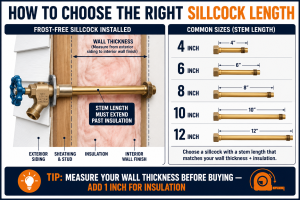
The length of a frost-free sillcock — typically 8, 10, or 12 inches — must match the depth of your exterior wall so the internal shutoff sits inside the heated portion of your home. Here is how to measure:
- Measure wall thickness from the exterior siding face to the interior wall surface.
- Add 1 inch to ensure the shutoff clears the insulation and sits in conditioned air space.
- Standard 2×4 framing with siding: typically requires a 6 to 8-inch sillcock.
- Standard 2×6 framing with insulation and siding: typically requires a 10 to 12-inch sillcock.
- Insulated concrete or masonry walls: measure carefully — you may need a 12-inch or longer model.
When in doubt, choose the longer length. A sillcock that extends too far into the wall is less of a problem than one that is too short and leaves the shutoff mechanism in an unheated space. Use our guide to water pressure gauges to check your home’s supply pressure before installation — high pressure can accelerate wear on sillcock valve seats.
Connection Types Explained: MIP, Sweat, Push-Fit, and PEX
Outdoor faucets connect to your home’s supply pipe in several ways, and matching the connection type to your existing plumbing is essential:
- MIP (Male Iron Pipe) — threaded connection. Screws directly onto female-threaded pipe or fittings. Simple to install with a wrench and thread tape. Compatible with both copper and iron supply lines with the right adapter.
- Sweat (soldered) — the sillcock inlet slides over copper pipe and is soldered in place with a propane torch. Creates a permanent, leak-free joint that is the professional standard for copper supply lines.
- Push-to-fit — the pipe pushes into the fitting and is locked in place by internal collets. No tools, no solder. Works with copper, CPVC, and PEX. Ideal for DIY installs and retrofit situations.
- PEX crimp/clamp — specialist fittings for PEX pipe systems. Requires a crimp or clamp tool but creates very strong, durable connections well suited to outdoor applications.
If you are replacing an existing faucet, the easiest path is matching the same connection type. If you are running new supply pipe, see our comparison of PEX vs copper pipes to choose the right material for your project.
Anti-Siphon and Backflow Prevention — Why It Matters
An anti-siphon valve is a one-way check device built into most quality sillcocks that prevents outdoor water — which may be contaminated by fertilizers, pesticides, or garden debris — from being drawn back into your home’s drinking water supply under negative pressure conditions. Most US plumbing codes require anti-siphon protection on all outdoor faucets, and it is a legitimate health protection, not just a code formality.
All four frost-free sillcocks in this review include anti-siphon protection. The EFIELD standard spigot does not — if you choose it, consider installing a separate hose bib vacuum breaker (an inexpensive inline fitting) to bring it up to code. Check your local municipality’s requirements if you are unsure — inspectors do check outdoor faucets during permit work. If your supply system shows signs of pressure issues that could trigger backflow, our guide to water pressure gauges can help you diagnose the root cause.
DIY Installation Tips for Outdoor Faucets
Replacing an outdoor faucet is a manageable DIY project for most homeowners, but a few preparation steps make the difference between a straightforward job and a frustrating one:
- Locate and shut off the supply valve — find the isolation valve that serves your outdoor faucet (usually in the basement or crawlspace directly behind the faucet) and shut it off before opening any connections.
- Drain the line — open the old faucet to release any remaining pressure, then dry the supply pipe with a rag before making any new connections.
- Measure the wall thickness before ordering your sillcock — getting the wrong length is the most common installation mistake.
- Use thread tape on MIP connections — wrap 2–3 turns of PTFE thread tape clockwise on the male threads before assembly. Do not use tape on sweat fittings.
- Caulk around the escutcheon — seal the gap between the faucet flange and exterior siding with a suitable exterior caulk to prevent water ingress into the wall cavity.
- Test before patching — turn the supply back on and check for leaks at the connection point before sealing up any wall access panels.
If your project uncovers damaged supply pipe behind the wall, our guide to the best pipe repair kits covers the fastest options for patching copper, CPVC, and PEX pipe without a full replacement.
Frequently Asked Questions
Q: What is a frost-free outdoor faucet?
A frost-free outdoor faucet — also called a frost-free sillcock or anti-siphon sillcock — has an elongated stem that positions the internal shutoff valve 8 to 12 inches inside your home’s heated wall space, rather than at the exterior face of the faucet. When you turn the faucet off, the stem retracts and water drains out of the faucet body by gravity, leaving nothing to freeze in the exposed exterior section. Standard outdoor faucets leave standing water in the faucet body after shutoff, which can freeze, expand, and crack the fitting or the supply pipe behind it. In any US climate with freezing winters, a frost-free model is the correct choice and is typically required by local plumbing code.
Q: How do I know what length sillcock I need?
Measure the full thickness of your exterior wall from the outside face of the siding to the interior wall surface, then add 1 inch to ensure the internal shutoff clears into conditioned air space. A standard 2×4 framed wall with siding typically needs a 6 to 8-inch sillcock; a 2×6 framed wall with insulation usually needs 10 to 12 inches. Masonry and insulated concrete walls may require 12 inches or more. When measuring is difficult, err on the side of the longer option — a sillcock that extends a couple of extra inches into the wall causes no problems, while one that is too short will leave the shutoff in an unheated space and defeat the frost-free purpose entirely.
Q: Can I install an outdoor faucet myself?
Yes — replacing a like-for-like outdoor faucet is one of the more accessible DIY plumbing tasks for a confident homeowner. The key requirements are: locating and shutting off the supply isolation valve, draining the line, making the correct connection (threaded, soldered, or push-fit depending on your model), and sealing around the escutcheon with exterior caulk. Sweat (soldered) connections require a propane torch and basic soldering technique — if you are not comfortable with that, choose a push-to-fit model like the Boltigen or a threaded MIP model that only needs a wrench and thread tape. Installing a faucet in a new location (cutting through siding and framing, running new supply pipe) is a more involved project and may require a permit in your jurisdiction.
Q: Why is my outdoor faucet still freezing with a frost-free sillcock?
There are two common causes. First, check that no hose is attached when the faucet is off — a connected garden hose traps water in the faucet body and prevents the gravity drain from working, which can cause a frost-free sillcock to freeze just like a standard one. Always disconnect hoses at the end of each season. Second, check that the sillcock is correctly pitched — the barrel must slope slightly downward toward the outside so water can drain by gravity when the valve closes. If the faucet was installed level or with a slight upward slope toward the exterior, water pools in the barrel. Finally, if the sillcock is significantly shorter than your wall is thick, the shutoff may still be sitting in unheated insulation — in which case a longer replacement is the only fix.
Conclusion — Which Outdoor Faucet Should You Buy?
For most US homeowners, the Eastman 80222 Frost Free Sillcock is the right answer — it delivers proven frost-free protection from a trusted brand at the $ price tier, and the MIP/sweat dual connection suits most existing copper plumbing without any adapter work. For the most durable long-term installation, the Prier P-164D12 is the professional’s choice — its quarter-turn ball valve and heavy-duty brass construction are built to last the lifetime of the home. And for homeowners who want to avoid soldering entirely, the Boltigen push-to-fit model is the easiest DIY installation in this lineup.
- Best Overall: Eastman 80222 — proven frost-free protection, trusted brand, easy installation
- Pro Choice: Prier P-164D12 — quarter-turn ball valve, 70+ years of US manufacturing heritage
- Our Top Pick: Midline Valve 12″ — lead-free certified, 12-inch length, competitive price
- Staff Pick: Boltigen 12″ — push-to-fit inlet, no tools required, works with PEX and copper
- Best Value: EFIELD SILLCOCK045 — affordable quarter-turn spigot for mild climates only
Before you start your installation, check your home’s supply pressure with one of our recommended water pressure gauges — high pressure accelerates wear on outdoor faucet valve seats. And if your project uncovers damaged pipe behind the wall, our guide to the best pipe repair kits covers the fastest repair options for every pipe type. Not sure which style you need? Our frost-free vs standard comparison covers the core choice, and how to replace an outdoor faucet walks through the swap.
✍️ About This Review
PTR Editorial Team — Product Reviews. We compare manufacturer specifications, installation requirements, compatibility and available product documentation to help homeowners choose suitable tools and parts. How we review →