Please note: Information in this comparison is based on our research at time of writing and is general in nature. Always check the specific product packaging and the fixture manufacturer’s instructions before choosing parts or attempting a repair.
Introduction
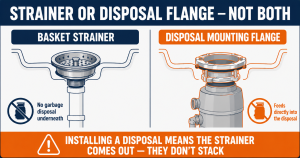
If you have looked under a kitchen sink and wondered whether the basket strainer sits on top of the garbage disposal, feeds into it, or works alongside it, the answer is none of those. A basket strainer and a garbage disposal mounting flange are two different fittings that do the same structural job — sealing and connecting the drain opening in the bottom of the sink bowl — and only one of them can occupy that opening at a time. They are not a pair. Installing a disposal does not add a part beneath the strainer; it means taking the strainer out completely and putting the disposal’s own flange assembly in its place. Removing a disposal for good works the other way: the flange comes out and a standard strainer goes back in. This comparison explains what each assembly is, how to tell which one you have, how converting between them changes the plumbing, and how to decide which one belongs in your sink.
At a Glance
Basket Strainer
- What it is: a two-piece drain fitting — a flanged body clamped into the sink hole by a locknut, with a lift-out perforated basket
- Works with a garbage disposal? No — a strainer has nothing for a disposal to mount to; the disposal brings its own flange
- Removable / serviceable? Yes — the whole assembly unthreads with a strainer wrench; washers and parts are cheap and standardized
- Typical materials: stainless steel or chrome-plated brass body; rubber and fiber washers; plastic on budget units
- Installation complexity: low — hand tools, one person, roughly 30–60 minutes
- Typical price range: $ for a complete strainer; $$ for a heavy solid-brass unit
Disposal Mounting Flange
- What it is: the sink-side half of a garbage disposal’s mounting system — a flange plus a ring-and-gasket assembly the disposal body locks onto from below
- Works with a garbage disposal? It is the disposal’s mount — nothing else attaches to it, and the unit cannot hang without it
- Removable / serviceable? Yes, but you work around the weight and wiring of the disposal; more parts, more steps
- Typical materials: stainless or coated-steel flange; steel mounting ring and fasteners; fiber or rubber gasket; some plastic components by brand
- Installation complexity: moderate — part of a disposal install: electrical, extra weight, a lower tailpiece, often a dishwasher connection
- Typical price range: included with the disposal; the disposal itself is $$–$$$ by motor size and features
What a Basket Strainer Is (and Does)
A kitchen basket strainer is the standard drain fitting for a sink bowl that has no garbage disposal. It has two working parts. The strainer body is a short metal tube with a wide flange at the top; the flange sits in the sink’s drain opening, bedded on a ring of plumber’s putty or a rubber gasket, and a large, thin locknut threaded onto the body from underneath pulls the flange down tight and holds the whole assembly in the sink. A stack of washers — a rubber washer against the underside of the sink, then a fiber friction washer — sits between that locknut and the sink to make the seal and let the nut turn without dragging. The removable basket, the perforated cup with a stopper post, drops into the body from above and lifts straight back out.
Below the sink, a tailpiece threads or slip-connects onto the bottom of the strainer body and drops down to the P-trap. The strainer’s job is simple: give the sink a sealed, standardized outlet, catch food scraps and dropped teaspoons in the basket before they reach the trap, and let you plug the bowl by seating the basket’s stopper. Nearly every US kitchen sink uses the same 3-1/2 inch opening, so basket strainers are interchangeable across brands and a replacement is rarely a question of fit. If you are choosing one, our review of the 5 Best Kitchen Sink Strainers & Baskets covers the locknut, post-style, and twist-lock designs worth buying.
What a Disposal Mounting Flange Is (and Does)
A garbage disposal does not keep the strainer and tap into it — it comes with its own drain fitting, usually called the mounting assembly or sink flange, and that fitting takes the strainer’s place in the opening. From above, the disposal’s sink flange looks a lot like a strainer flange: a metal rim seated in the same 3-1/2 inch hole, bedded on plumber’s putty or a foam gasket in exactly the same way. The difference is everything below the sink. Instead of a locknut and a tailpiece, the flange carries a stack of mounting hardware. On the common three-bolt design, that is a backup flange, a fiber gasket, and a mounting ring drawn up against the underside of the sink by three long screws, with a snap ring clipped into a groove on the flange sleeve to hold the stack in place. The disposal body then lifts to that ring and twists a fraction of a turn to lock — the whole heavy unit hanging from those three screws and that snap ring.
So the flange is not a strainer with an adapter bolted on. It is a purpose-built mount whose whole job is to hang the weight of the disposal from the sink and route the bowl’s drainage down through the disposal chamber rather than straight into a trap. There is no removable basket; the disposal’s own rubber splash guard sits in the throat instead, and below it is the impeller plate, not an open pipe. Water leaves the disposal through a discharge elbow on the side of the unit, several inches lower than a strainer tailpiece would sit — which is the reason the trap plumbing on that side of the sink has to be rebuilt when a disposal goes in. Mounting systems vary by brand: InSinkErator-pattern units use the three-bolt snap-ring system described here, while some Moen and Waste King models use a single bayonet-style ring that turns and locks in one motion. If you are shopping for a unit, our review of the 5 Best Garbage Disposals covers motor sizes, grind stages, and mount types.
How to Tell Which One You Currently Have
You almost never have to guess. A garbage disposal is a large, heavy canister — usually black or brushed stainless, about the size of a gallon jug — bolted under one side of the sink, with a cord running to an outlet or wall switch. If something that size is hanging under the basin, that bowl has a disposal flange. If the underside of that drain is just a slim metal tube with a wide locknut where it meets the sink and a tailpiece running down to the trap, that bowl has a basket strainer. The difference is unmistakable once you are looking.
From above, the tells are just as clear. A basket strainer has a removable perforated basket you can lift straight out, leaving an open metal ring you can see the tailpiece through. A disposal opening has no removable basket — instead there is a black rubber splash guard, and beneath it the disposal’s impeller plate rather than a clear drop to a pipe. With the disposal switch off, run the tap: water that disappears straight down with an open gurgle is going through a strainer; water that pools briefly on a rubber baffle before draining is going through a disposal.
Two things occasionally cause confusion. A bowl can have an ordinary basket strainer even in a kitchen that is “wired for” a disposal, with the switch and outlet in place but no unit ever mounted. And a disconnected, seized, or dead disposal left in place still has its disposal flange in the sink — a non-working disposal is still a disposal as far as the drain fitting goes. What matters here is what is physically mounted in the opening, not whether it runs.
Can You Have Both?
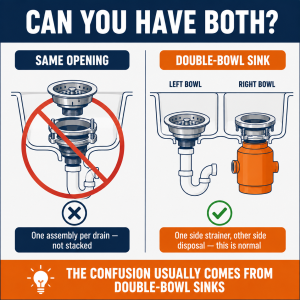
No — not on the same drain opening, and this is the single most common misunderstanding about how a disposal is plumbed. A disposal does not install beneath, inside, or downstream of a basket strainer. The two are alternatives for the exact same spot: the hole in the bottom of the sink bowl. Fitting a disposal means the strainer body, its locknut, its washers, and its tailpiece all come out, and the disposal’s flange and mounting assembly go into the now-empty opening. You cannot leave the strainer in and add a disposal “under” it — there is nowhere for it to sit and nothing for it to lock onto, because the mounting ring clamps directly to the sink through its own flange.
Where the “both” idea comes from is the double-bowl sink, and in that case it is half true. A two-bowl sink has a separate drain opening in each bowl, so one bowl can carry a garbage disposal and the other a plain basket strainer — a very common arrangement. The two drains then meet at a shared trap (or a tee into one trap) below the cabinet. So a kitchen can absolutely have a strainer and a disposal at the same time; they just cannot share a single opening. On a one-bowl sink it is strictly one fitting or the other.
One accessory muddies the picture: fitted basket-style stoppers that drop into a disposal’s throat to plug the bowl for filling. That is a loose plug sitting in the splash guard, not a strainer assembly — the disposal flange is still what is mounted in the sink.
Converting a Strainer to a Disposal
Going from a plain strainer to a disposal is the more common conversion, and it changes three things on that side of the sink. First, the strainer assembly comes out entirely — basket, body, locknut, washers, and the tailpiece down to the trap. Second, the disposal’s own flange goes into the empty opening, sealed with plumber’s putty or its supplied gasket the same way the strainer was, and its mounting ring is assembled and drawn up tight from below. Third, the drain plumbing is rebuilt to suit the disposal: water now exits through a discharge tube on the side of the unit, well below where the old tailpiece sat, so that tailpiece is replaced by a discharge elbow and the trap on that side is reset at the lower height — often gaining a tee if the other bowl drains through the same trap.
Beyond the plumbing, a disposal needs power — a switched receptacle or a countertop air switch — and if you have a dishwasher, its drain hose moves to the disposal’s dishwasher inlet after the knockout plug inside is removed. None of this is exotic, but it is a genuinely bigger job than swapping a strainer, with more connections that have to be right, and the electrical side may call for a permit or an electrician depending on local code. Our step-by-step guide to how to install a garbage disposal walks through the mounting assembly, the discharge and dishwasher connections, and the wiring.
Converting a Disposal Back to a Strainer
The reverse conversion is less common, but it does happen — a disposal fails and the owner decides not to replace it, a new homeowner does not want one, or a remodel designs it out. Here the disposal is disconnected from power, twisted off its mounting ring, and lifted out, and then the mounting flange assembly is removed from the sink opening. A standard basket strainer goes back into that opening, sealed and clamped the normal way, and a plain tailpiece reconnects it to the trap.
The part people underestimate is the trap. Because the disposal discharged low, the trap on that side was almost certainly lowered when the disposal went in, so putting a strainer back usually means raising the trap or fitting a longer tailpiece to reach it and re-cutting the trap arm to keep its slope. And if a dishwasher drained into the disposal, its hose now needs a high loop or air gap into a dedicated branch tailpiece, since it can no longer connect to the disposal inlet. Our guide to how to replace a kitchen sink strainer covers seating and sealing the new strainer itself; the trap and dishwasher rework is the extra piece specific to coming off a disposal.
Cost and Complexity Comparison
On cost, the two are not close — but a disposal is a motorized appliance and a strainer is a fitting, so it is not a like-for-like comparison. A complete basket strainer sits in the $ tier, with heavier solid-brass models reaching into $$. A garbage disposal is a much larger outlay, climbing from $$ to $$$ with horsepower, sound insulation, and grind stages. The mounting flange is not a separate line item — it comes in the disposal’s box, and a basic strainer is cheap enough that its cost barely figures into a conversion either way.
Complexity tracks the same divide. Fitting or replacing a strainer is a hand-tool job: clear the cabinet, drop the trap into a bucket, unthread the old unit, seal and clamp the new one, reconnect the trap, and leak-test — an afternoon at the outside, often far less. Installing a disposal adds real weight to support overhead, an electrical connection, a trap reset at a new height, and frequently a dishwasher hookup, so it has more steps and more points where a mistake shows up as a leak or a hum. Removing a disposal and returning to a strainer sits in between: the strainer side is easy, but undoing the disposal’s low trap and its dishwasher routing is the fiddly part. None of the three is beyond a careful DIYer, but only the strainer swap is genuinely quick.
Worth saying plainly: neither fitting is higher quality than the other, and neither is a compromise — they are built for different kitchens. The real question is not which is better made but which your sink should have, and that comes down to whether you want a disposal.
Which Do You Need?
The choice is almost entirely about whether a garbage disposal earns its place in your kitchen — local sewer or septic rules, how much food waste you generate, whether you compost, and how much you value scraping plates straight into the sink. Once that is settled, the fitting follows automatically: want a disposal, and its flange is the fitting; skip it, and a basket strainer is the fitting, complete with nothing missing. The table covers the situations that come up most.
| Your Situation |
What You Need |
| No disposal now, and you do not want one |
A basket strainer — the correct, complete drain fitting for a disposal-free bowl |
| Adding a garbage disposal for the first time |
The disposal’s own mounting flange (comes with the unit) — the existing strainer is removed, not kept |
| Replacing a failed disposal with another disposal |
Reuse or replace the mounting flange; a same-brand swap often keeps the existing mount. No strainer involved |
| Removing a garbage disposal for good |
A new basket strainer in the opening, plus trap-height and dishwasher-drain rework on that side |
| Double-bowl sink with a disposal on one side |
A disposal flange on that bowl and a basket strainer on the other — both, one per opening |
| Not sure which you currently have |
Check below: a heavy powered canister is a disposal; a slim tube with a locknut is a strainer. From above, a lift-out basket means a strainer |
Note that “both” appears only once in that table — for a double-bowl sink, where each opening gets its own fitting. On any single opening the answer is one or the other.
✏️ Our Take
This is a “which do you need” question, not a “which is better” one. A basket strainer and a disposal mounting flange are both correct, complete drain fittings — they simply serve different kitchens, and only one can occupy a given sink opening at a time. Decide the disposal question first: if you want one, its flange comes in the box and the strainer comes out; if you do not, a strainer is exactly right and nothing is missing. The only place “both” is true is a double-bowl sink, where each bowl gets its own fitting. When you are ready for the actual work, hand off to the dedicated strainer-replacement and disposal-installation guides — this article’s job was only to tell you which one you are doing.
Prices and ratings may change. Always check Amazon for current prices.
✍️ About This Comparison
PTR Editorial Team — Product Comparisons. We compare manufacturer specifications, installation requirements, compatibility and available product documentation to help homeowners choose suitable tools and parts. How we review →