Comparisons
20 Sep 2026

Utility Pump vs. Sump Pump (2026) — Which Do You Need?
Utility pump vs sump pump: one is portable for occasional jobs, the other a permanent install for ongoing water. See which your basement needs.
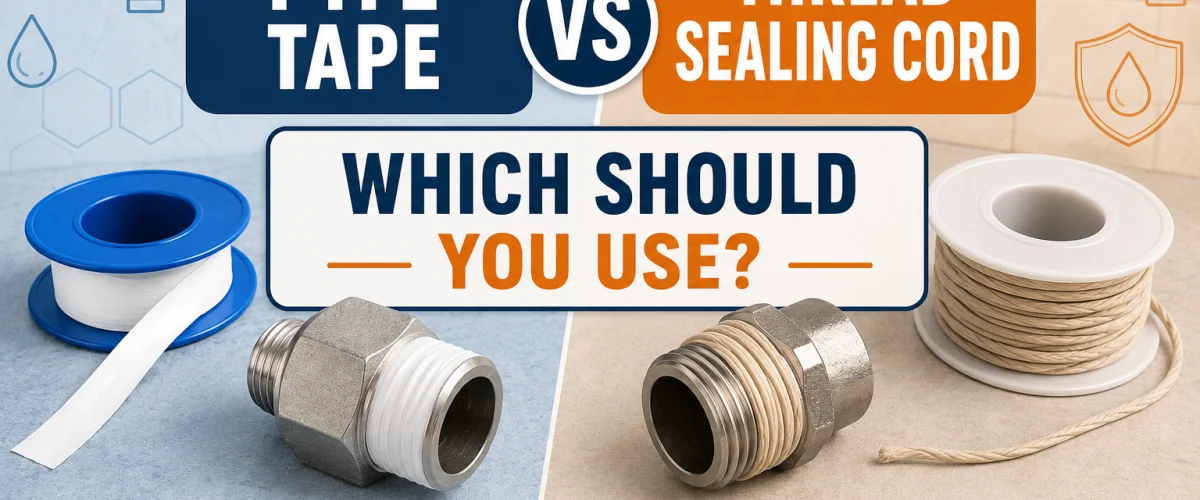
PTFE tape and thread sealing cord both seal threaded pipe connections, but they work differently — here's how to choose between them.
Please note: Product information referenced here is based on our research at time of writing and is general in nature. Always check a specific product’s label before use.
PTFE tape and thread sealing cord both do the same basic job — sealing a threaded pipe connection so it doesn’t leak — but they go about it in genuinely different ways. PTFE tape, better known by the brand-generic name Teflon tape, is the thin white or yellow tape most homeowners already have a roll of somewhere in a drawer. Thread sealing cord is less familiar to most DIYers: a waxed or coated cord that’s wound around the threads instead of wrapped flat, and it’s a mainstay in professional plumbing for situations tape doesn’t always handle cleanly.
Neither one is the “upgrade” or the “outdated” option here — they’re two established sealing methods that each have a place. PTFE tape is the more familiar default for the vast majority of standard household connections, while thread cord solves specific problems tape can struggle with, particularly on threads that aren’t perfectly clean and uniform. This comparison walks through how each one works, when each pulls ahead, and how to decide which belongs in your toolbox — or whether you need both.
At a Glance
PTFE Tape
Thread Sealing Cord
✏️ Our Take
For most standard household plumbing connections with clean, undamaged threads, PTFE tape is the simpler, more familiar choice — it’s what most homeowners already have on hand and know how to use. Thread sealing cord earns its place in situations tape struggles with: irregular, damaged, or oddly-shaped threads where tape can bunch, shred, or fail to seal evenly. It’s less a question of one being better overall and more about matching the method to the condition of the threads you’re actually working with.
IN THIS GUIDE
Before going section by section, here’s how PTFE tape and thread sealing cord stack up on the factors that matter most when choosing between them.
| Factor | PTFE Tape | Thread Sealing Cord |
|---|---|---|
| Typical cost | $ | $ – $$ |
| Best on | Clean, standard threads | Irregular or damaged threads |
| Learning curve | Very short | Slightly steeper |
| Application risk | Can bunch or shred on rough threads | Doesn’t shred; needs correct winding technique |
| Familiarity | Standard default for most homeowners | Common in professional plumbing |
| Gas-line rated versions | Yes (yellow tape) | Yes (check product labeling) |
| Best for | Standard household connections | Worn, irregular, or higher-stakes fittings |
PTFE tape — polytetrafluoroethylene tape, though almost nobody calls it that — is a thin, flat tape that’s wrapped around a fitting’s threads before it’s screwed into place. It’s the sealing method most DIYers picture first, and for good reason: it’s inexpensive, widely stocked at every hardware store, and simple enough that most people have already used it at some point without thinking much about the mechanics behind it.
The way it seals is straightforward once you look closely. Pipe threads aren’t perfectly smooth — there are microscopic gaps and irregularities between the ridges even on a well-manufactured fitting. When PTFE tape is wrapped around the threads in the correct direction and the fitting is tightened, the tape compresses into those gaps, filling them in and creating a barrier that water or gas can’t easily pass through. Our how to apply plumber’s tape correctly guide covers the specific wrap direction and wrap count that make this work reliably.
Because the tape is thin and flat, it does its best work on threads that are reasonably uniform to begin with. On a clean, standard fitting, the compressed tape distributes evenly around the entire circumference of the threads, and the seal holds up well over time. That reliability on ordinary threads is exactly why PTFE tape has become the default — it handles the overwhelming majority of household plumbing connections without needing any special technique beyond the basics.
Thread sealing cord takes a different physical approach to the same problem. Instead of a flat tape, it’s a waxed or specially coated cord — closer in appearance to a length of heavy string or yarn — that’s wound around the threads rather than wrapped flat against them. The coating typically serves two purposes at once: it lubricates the threads slightly to help the fitting tighten smoothly, and it acts as the actual sealing compound that fills the gaps between threads.
Because a cord is round rather than flat, it conforms to irregular surfaces more readily than tape can. On threads that aren’t perfectly uniform — slightly worn from repeated use, chipped at some point, or simply manufactured with a bit more irregularity than a brand-new fitting — the cord can settle into the uneven gaps in a way flat tape sometimes can’t. Rather than bunching up or leaving a gap where the thread shape changes, the cord flexes into place as the fitting is tightened.
This is why thread sealing cord shows up so often in professional plumbing. Working across a wide range of fittings — some new, some decades old, some with threads that have seen better days — professionals need a sealing method that performs consistently even when the thread condition isn’t ideal. Cord’s forgiving nature on imperfect threads is exactly the situation where it earns its reputation over tape, including in the plumbing tape reviews on this site, where a dedicated thread cord pick sits alongside the tape options specifically for that reason.
PTFE tape is the better choice for the vast majority of everyday household plumbing work, and it’s worth being specific about why rather than defaulting to it purely out of habit. The clearest case is clean, undamaged, standard threads on common household fittings — supply lines, faucet connections, showerheads, and similar fixtures where the threads are new or in good condition. On threads like these, tape’s flat profile compresses evenly all the way around, and there’s no irregular surface for it to struggle with.
Speed and familiarity also weigh heavily in tape’s favor. Most people already know how to apply tape, even if only loosely, and the technique takes just a few seconds once the correct wrap direction is understood. For a quick repair or a routine fixture swap, reaching for tape rather than learning a new technique on the spot is often the more practical choice, especially when the threads in question don’t show any obvious wear or damage.
General-purpose water line connections are the other clear case for tape. When thread condition isn’t a specific concern — a new fitting straight out of the package, or a connection you’ve worked with before without issue — there’s no particular reason to reach for cord instead. Tape’s simplicity and familiarity make it the sensible default whenever the threads themselves aren’t presenting a problem to solve.
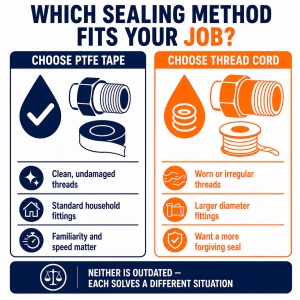
Thread sealing cord earns its place specifically on the fittings tape tends to struggle with. Irregular, worn, or slightly damaged threads are the clearest case — a fitting that’s been removed and reinstalled several times, an older piece of plumbing showing some wear, or threads that were never perfectly uniform to begin with. On surfaces like these, flat tape can bunch up at the irregular spots or fail to seal evenly across the whole circumference, while cord’s flexibility lets it settle into the gaps that tape skips over.
Larger-diameter fittings are another situation where cord tends to have an edge. As fitting size increases, so does the total thread surface that needs even coverage, and a flat tape can be more prone to gaps or uneven compression across a wider circumference. Cord’s round profile and flexibility make it easier to achieve consistent coverage on these larger connections without the extra wraps and careful overlap tape sometimes needs at that scale.
Cord is also worth considering any time you want a professional-grade seal on a higher-stakes connection — a fitting that’s difficult to access for a future repair, or one where a failed seal would cause a more serious problem than a typical drip. Its forgiving performance on less-than-perfect threads gives it a bit more margin for error than tape offers in the same situation, which is part of why it’s a common choice among professional plumbers working across fittings of varying age and condition.
PTFE tape has a genuinely short learning curve. Once you understand the correct wrap direction — matching the direction the fitting tightens, so the tape presses into the threads rather than unwinding — and roughly how many wraps a standard fitting needs, the whole process takes just seconds. Our how to apply plumber’s tape correctly guide walks through that technique in detail, and it’s a skill that transfers to essentially every tape application you’ll ever do.
Thread sealing cord asks a bit more of a first-time user. The winding technique differs meaningfully from tape’s flat wrap — the cord needs to be wound with enough tension and in a pattern that lets it conform to the threads properly, and getting that wrong on your first attempt can produce an uneven seal rather than the reliable one cord is capable of. It’s still an approachable skill for a DIYer willing to practice on a spare fitting before using it on a connection that matters, but it isn’t quite as instantly intuitive as tape.
In practice, this difference in learning curve is one of the main reasons tape remains the default for most households while cord stays more common in professional use — professionals apply it often enough that the technique becomes second nature, while an occasional DIYer may only reach for it when a specific problem calls for it.
PTFE tape is generally the more affordable option, typically sitting at the $ tier regardless of brand, and it’s widely available in bulk multi-roll packs that push the effective cost per application down even further. For a household that only needs tape occasionally, even a single inexpensive roll tends to last through dozens of small repairs and fixture installations before it runs out.
Thread sealing cord tends to sit at a comparable or slightly higher price point, generally landing in the $ to $$ range depending on the brand, coating type, and whether it’s rated for gas as well as water applications. A single roll of cord typically covers a large number of applications as well, so the higher per-roll price doesn’t necessarily translate to a meaningfully higher cost per repair over time — it’s more a matter of the upfront price tag looking a little steeper on the shelf.
For most households, cost alone isn’t likely to be the deciding factor between the two — both are inexpensive relative to the cost of a plumbing repair gone wrong. The bigger question is which one is the right tool for the threads you’re actually sealing, which is where the earlier sections in this comparison matter more than the price tag.
Default to PTFE tape for standard household connections with clean, undamaged threads. This covers the large majority of everyday plumbing work — supply lines, faucets, showerheads, and similar fixtures — and tape’s combination of familiarity, speed, and reliability on uniform threads makes it the sensible starting point for nearly any repair or installation where the threads themselves aren’t presenting a specific problem.
Reach for thread sealing cord specifically when the threads are irregular, worn, or visibly damaged, or when you’re working on a larger-diameter fitting where cord’s flexibility offers better, more even coverage than a flat tape can provide. It’s also worth considering on a fitting that would be inconvenient or costly to revisit if the seal failed.
It’s also worth being clear about what this comparison is not: it isn’t the same question as tape versus liquid pipe thread sealant, which is a separate comparison covered in our pipe thread sealant vs teflon tape article. That comparison weighs tape against a paste-style liquid sealant applied with a brush — a different pairing of methods entirely from tape versus a wound cord. If you’re trying to decide among all three sealing methods, that article and this one cover different halves of the decision.
If you’re dealing with a fitting that’s difficult to access safely, or a connection where a failed seal would be more than a minor inconvenience, search PlumberArchive.com — the US plumber directory with 12,000+ verified local plumbers across all 50 states.
Get weekly plumbing tips, honest tool reviews and DIY guides delivered straight to your Facebook feed. We cover cleaning, maintenance, and everything in between — written for US homeowners who want to make smart decisions without overspending.
Yes — thread sealing cord works on essentially the same range of standard threaded fittings that PTFE tape does. There’s no fitting type that specifically requires tape over cord; the choice comes down to thread condition and personal comfort with the winding technique rather than the fitting itself ruling one option out. If a specific product carries a specialty rating, such as gas-line certification, always check the label to confirm before use, but general applicability between tape and cord overlaps almost completely.
Removal difficulty is fairly similar between the two in most cases. Both tape and cord residue should be cleaned off the threads before reapplying a fresh seal, and neither typically bonds to the fitting in a way that makes disassembly significantly harder than the other. As with tape, it’s worth fully removing old cord residue rather than layering new sealant over it, since leftover material from either method can prevent a new seal from forming properly.
Some thread sealing cord products are specifically formulated and rated for gas line use, similar to how some PTFE tape comes in a yellow, gas-rated version. This isn’t universal across every cord product, though, so always check the specific product’s label or listing for a gas rating before using it on a gas connection, and consult a licensed professional for gas line work if you have any doubt about the correct material or technique.
It’s generally not necessary, and it can actually make things harder rather than better. Both tape and cord are designed to be a complete sealing solution on their own when applied correctly, and combining them can make a fitting difficult to thread on evenly or lead to over-tightening as you compensate for the extra bulk. If one method isn’t sealing reliably, the better fix is usually switching to the other — or checking whether thread damage is the underlying cause — rather than layering both together.
PTFE tape and thread sealing cord both seal a threaded connection effectively — the real question is which one matches the threads you’re actually working with. Tape is the simpler, faster, more familiar choice for standard household fittings with clean threads, and it’s the right default for the vast majority of everyday plumbing work. Cord earns its place on irregular, worn, or damaged threads where tape tends to bunch or seal unevenly, and on larger fittings where its flexibility offers more consistent coverage. Neither is a better product overall — matching the method to the thread condition in front of you is what actually determines which one seals reliably.
Prices and ratings may change. Always check Amazon for current prices.
✍️ About This Comparison
Written by Sarah Mitchell, Home Improvement Editor at PlumbingToolsReview — specializing in helping homeowners make smart buying decisions without overspending. Learn how we test →
Utility pump vs sump pump: one is portable for occasional jobs, the other a permanent install for ongoing water. See which your basement needs.
Pipe repair clamp, tape, or epoxy — which should you use for a leaking pipe? Compare how each works, durability, and when to reach for which.
Not sure if your home has a septic tank or a sewer connection? Learn how to tell which one you have, plus the maintenance and cost differences.

