Comparisons
20 Sep 2026

Utility Pump vs. Sump Pump (2026) — Which Do You Need?
Utility pump vs sump pump: one is portable for occasional jobs, the other a permanent install for ongoing water. See which your basement needs.
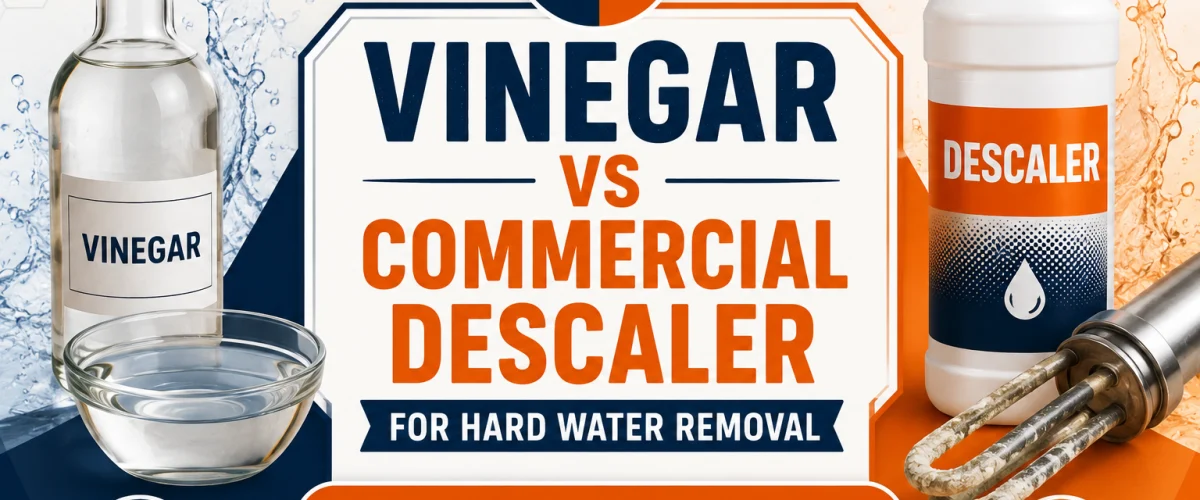
Plain white vinegar and commercial descaling products both dissolve hard water buildup — here's how they actually compare on cost, strength, and convenience.
Please note: Product and cleaning information referenced here is based on our research at time of writing and is general in nature. Always check a specific product’s label for surface compatibility and safety instructions before use.
Once you’ve decided an acidic cleaner is the right approach for hard water buildup on shower glass and fixtures, a second, more specific question follows close behind: plain household vinegar, or a commercial descaling product made for exactly this job? It’s a genuinely close call for most household situations, not a case of one option being clearly superior to the other.
Both are acidic solutions working on the same basic chemistry — dissolving calcium and magnesium mineral deposits so they can be wiped or scrubbed away. Where they actually differ is strength, speed, cost, and convenience, and the right choice mostly comes down to how severe the buildup is, how sensitive the surface is, and how much you value convenience over saving a few dollars. This comparison walks through both options side by side so you can make that call with a clear picture of the tradeoffs, building directly on the cleaning-solution step in our how to remove hard water stains from shower glass guide.
At a Glance
Vinegar
Commercial Descaler
✏️ Our Take
For most routine hard water buildup — the everyday cloudiness and light mineral film that builds up between regular cleanings — plain white vinegar works just as well as a commercial descaler, at a fraction of the cost. Where commercial descalers earn their higher price is on heavier, more stubborn buildup that hasn’t been addressed in a while, where a stronger or faster-acting formulation can mean fewer repeat applications. Neither is the “wrong” choice for routine bathroom maintenance — vinegar is the more economical default, and a commercial descaler is worth reaching for when buildup has gotten ahead of you or when you want a faster result with less scrubbing effort.
IN THIS GUIDE
Before going section by section, here’s how the two options stack up on the factors that matter most when choosing between them.
| Factor | Vinegar | Commercial Descaler |
|---|---|---|
| Acid strength | Mild (acetic acid) | Often stronger or purpose-blended |
| Best for | Light-to-moderate, routine buildup | Heavy or long-neglected buildup |
| Typical cost | $ | $$ |
| Sit time needed | Longer, especially on tougher deposits | Often shorter, faster-acting |
| Scent | Mild vinegar odor during use | Often fragranced |
| Ready-to-use format | Often diluted or transferred to a spray bottle | Usually sold spray-ready |
| Availability | Already in most kitchens | Grocery or hardware store, dedicated purchase |
White vinegar is a mild acid — acetic acid — and that acidity is exactly what makes it effective against hard water buildup. Calcium and magnesium mineral deposits react with the acid and dissolve, breaking down into a form that wipes or rinses away rather than staying bonded to the glass or fixture surface. It’s the same basic chemical reaction that makes any acidic cleaner work on mineral deposits, commercial or otherwise.
What sets vinegar apart is really about concentration and formulation rather than the underlying chemistry. Standard household white vinegar is a comparatively mild acid concentration, which is part of why it’s safe to use around food and on a wide range of household surfaces without much fuss. That mildness is also its main limitation: because the acid concentration is lower than most commercial products, vinegar typically needs more contact time on tougher buildup to fully dissolve it, particularly on deposits that have been accumulating for a while.
Vinegar’s biggest practical advantage is availability. It’s a genuine kitchen staple already sitting in most US households, sold everywhere from grocery stores to convenience stores at low cost, and it doesn’t require a special product formulated for bathroom cleaning to be effective. For anyone who cleans their shower glass regularly and hasn’t let buildup progress past a light film, straight vinegar applied with patience is a fully capable solution on its own.
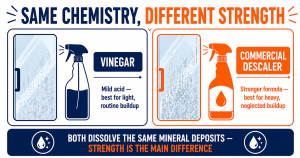
Commercial descaling products work on the same underlying principle as vinegar — an acid that dissolves mineral deposits — but they’re generally formulated with a higher acid concentration, or a different acid type altogether, specifically optimized for mineral removal rather than general household use. That stronger or more targeted formulation is the main reason commercial descalers tend to act faster and cut through heavier buildup with less waiting.
Beyond raw acid strength, formulation is where commercial products often pull ahead in convenience. Many include surfactants that help the solution spread evenly and penetrate mineral deposits more effectively, and some include thickening agents that help the product cling to vertical surfaces like shower glass rather than running off before it has time to work — solving the same problem that a soaked cloth or paper towel addresses when using plain vinegar. Some are also formulated with a specific surface in mind, such as glass-safe or chrome-safe versions, which can offer added peace of mind on surfaces you’re less familiar with.
The tradeoff for that stronger, more convenient formulation is cost and, in some cases, added fragrance or chemical ingredients that a plain household product doesn’t carry. For buildup that’s gotten ahead of a regular cleaning schedule, though, that extra strength and cling can turn a multi-step, patience-heavy process into a single faster treatment.
For light, routine buildup — the kind that accumulates over a week or two of normal showering without a deep clean — vinegar and commercial descalers perform comparably. Both dissolve the thin mineral film without much difficulty, and the difference in sit time between the two is often small enough not to matter in practice. This is the buildup category most regularly-maintained bathrooms fall into, and it’s where vinegar’s lower cost makes it the easy default.
The gap widens on heavier, longer-neglected buildup. A visible white or chalky crust that’s been accumulating for months responds more slowly to vinegar’s milder acid concentration, often requiring a longer sit time, multiple applications, and more scrubbing effort to fully clear. A commercial descaler’s stronger formulation typically cuts through that same buildup faster and with less repeated effort, which is exactly the scenario where the higher price starts to feel justified rather than like an unnecessary upgrade.
Neither option is incapable of handling heavy buildup — vinegar will still get there with enough patience and repeated treatments. The practical difference is how much time and scrubbing it takes to get to the same result, and that’s the tradeoff worth weighing against the price difference.
Both vinegar and most commercial descalers are acidic, and that’s worth remembering regardless of which one you reach for — acidity is what makes them effective on mineral deposits, but it also means surface compatibility needs checking before broad use, not just with commercial products carrying unfamiliar ingredient lists.
Natural stone surfaces are the clearest example of where this matters. Marble, travertine, and similar stone surfaces can be etched or dulled by acidic cleaners of either kind, including plain vinegar, since the acid reacts with the stone itself rather than just the mineral deposits sitting on top of it. Standard glass and chrome tolerate both vinegar and most commercial descalers well, but specialty coatings, certain matte finishes, and some brushed metal surfaces can have different care requirements worth checking against the specific product’s label.
Spot-testing an unfamiliar surface in an inconspicuous area before broad application is a reasonable precaution with either option, particularly the first time you’re using a given product on a given surface. This is a low-effort step that avoids a much bigger problem than the buildup you’re trying to remove in the first place.
Vinegar is meaningfully less expensive per use, and for many households the real cost is close to zero since it’s already sitting in the kitchen for cooking purposes. Even bought specifically for cleaning, a bottle of white vinegar is a low-cost, generic household staple that typically falls in the $ price tier and lasts through many cleaning sessions.
Commercial descalers cost more both per bottle and per use, generally landing in the $$ tier, since you’re paying for a purpose-formulated product rather than a multipurpose household staple. That higher cost per use is offset somewhat by needing fewer total applications on tougher buildup — if a commercial descaler clears heavy buildup in one treatment where vinegar would need two or three rounds, the actual cost gap on that specific job narrows, though vinegar still tends to come out ahead on pure cost for routine, light maintenance cleaning.
Vinegar’s biggest convenience advantage is that it’s usually already in the house, which means no special trip to the store is needed before you can start cleaning. The tradeoff is that it sometimes requires a bit of extra setup — diluting it or transferring it into a spray bottle for easier application, since it isn’t typically sold in a ready-to-use cleaning format.
Commercial descalers are widely available at most grocery and hardware stores, so picking one up isn’t difficult, but it does mean a dedicated purchase rather than reaching for something already on hand. Where commercial products often win on convenience is format: most come in a spray bottle ready to use straight out of the packaging, with no dilution or transferring required, which can matter if you want to start cleaning immediately without any prep step.
Reach for vinegar as the default for routine maintenance cleaning and light, everyday buildup, especially if cost is a consideration or you already have a bottle in the kitchen. For most households cleaning shower glass and fixtures on a regular basis, vinegar handles the job completely and repeatedly without ever needing an upgrade.
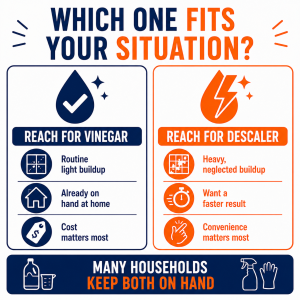
Reach for a commercial descaler when you’re tackling heavier, longer-neglected buildup that’s gotten ahead of your regular cleaning schedule, or when convenience and speed matter more to you than saving a few dollars per bottle. It’s also a reasonable choice if you want a ready-to-use spray format without any setup, or if you’re specifically looking for a formulation designed for a surface you’re less confident treating with a generic acid.
Many households end up keeping both on hand rather than picking one permanently — vinegar for routine upkeep, and a commercial descaler in reserve for the occasional deep clean when buildup has had more time than it should to set in. If you’re not yet sure how hard your water actually is, our how to test your water for hardness guide can help you understand whether you’re dealing with routine mineral buildup or a more aggressive hardness level that calls for more frequent cleaning either way.
This same DIY-versus-purpose-made-product decision comes up elsewhere in bathroom and drain maintenance too — our chemical vs mechanical drain cleaning comparison walks through a similarly structured tradeoff for clearing clogged drains.
If hard water buildup has become a recurring, whole-home problem beyond what regular cleaning can manage, search PlumberArchive.com — the US plumber directory with 12,000+ verified local plumbers across all 50 states.
Get weekly plumbing tips, honest tool reviews and DIY guides delivered straight to your Facebook feed. We cover cleaning, maintenance, and everything in between — written for US homeowners who want to make smart decisions without overspending.
Yes, in most cases, though it takes more patience than it does on light buildup. Heavy, long-neglected mineral deposits typically require a longer sit time and possibly more than one application with vinegar, since its acid concentration is milder than most commercial descalers. It will generally get there eventually with repeated treatment, but if you want to clear heavy buildup faster with less repeated effort, a commercial descaler’s stronger formulation is the more efficient choice for that specific situation.
Combining vinegar with dish soap is common for general cleaning, but it isn’t a way to make a stronger descaling solution — dish soap doesn’t add acid strength, and mixing an acid with certain surfactant-heavy soaps can actually reduce the acid’s effectiveness rather than boosting it. If you want a stronger result on hard water buildup specifically, a longer sit time with plain vinegar or switching to a commercial descaler formulated for mineral removal is more effective than combining vinegar with other household cleaners.
Most are safe for standard glass, chrome, and similar common bathroom finishes, but not universally safe for every surface — natural stone in particular can be etched or dulled by many commercial descalers, the same way it can be by vinegar, since both are acidic. Always check the specific product’s label for surface compatibility before broad use, and spot-test an inconspicuous area first if you’re treating a surface you’re unfamiliar with or unsure about.
Not really. A stronger commercial descaler clears existing buildup faster, but it doesn’t change how quickly new mineral deposits form after each shower — that’s driven by your water’s hardness level and how consistently you dry surfaces afterward, not by which cleaner you use. Regular light maintenance, regardless of which product you choose, is still what prevents buildup from reaching the heavy stage in the first place; a stronger cleaner just makes catching up faster if you do fall behind.
Vinegar and commercial descalers both dissolve hard water buildup through the same basic acidic reaction, and for routine, light-to-moderate cleaning, vinegar handles the job just as effectively at a fraction of the cost. Commercial descalers earn their higher price on heavier, longer-neglected buildup, where a stronger formulation clears deposits faster and with less scrubbing. Neither is a wrong choice for general bathroom maintenance — many households simply keep both on hand, reaching for vinegar day to day and a commercial descaler when buildup has gotten ahead of them. Whichever you choose, checking surface compatibility first and never mixing either with a bleach-based cleaner applies equally to both.
Prices and ratings may change. Always check Amazon for current prices.
✍️ About This Comparison
Written by Sarah Mitchell, Home Improvement Editor at PlumbingToolsReview — specializing in helping homeowners make smart buying decisions without overspending. Learn how we test →
Utility pump vs sump pump: one is portable for occasional jobs, the other a permanent install for ongoing water. See which your basement needs.
Pipe repair clamp, tape, or epoxy — which should you use for a leaking pipe? Compare how each works, durability, and when to reach for which.
Not sure if your home has a septic tank or a sewer connection? Learn how to tell which one you have, plus the maintenance and cost differences.

