Please note: Information in this comparison is based on our research at time of writing and is subject to change. This guide is not a substitute for a professional plumbing assessment or certified water testing — if you have specific concerns about your home’s pipe material or water quality, confirm them with a licensed plumber or a certified lab.
Introduction
Copper pipe vs galvanized steel pipe isn’t really a “which should I buy” decision the way most plumbing comparisons are. Galvanized steel is rarely installed new in US homes today, so if you’re weighing these two materials, odds are you’re not shopping for a new install — you’re trying to figure out what’s already running behind your walls, and whether you should be concerned about it.
That’s the framing this comparison uses. We’ll cover how to tell which material you actually have, why galvanized steel was once the standard and why it eventually fell out of favor, how it corrodes over time from the inside where you can’t see it, and why copper became the common replacement material starting decades ago. We’ll also cover the signs that suggest aging galvanized pipe may need attention, and what to expect, in general terms, if replacement becomes necessary.
At a Glance
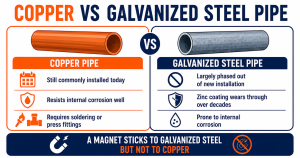
Copper Pipe
- Still commonly installed today
- Resists internal corrosion well
- Higher material cost than galvanized steel
- Requires soldering or press fittings to install
Galvanized Steel Pipe
- Largely phased out of new installation
- Prone to internal corrosion and mineral buildup over decades
- Often found in homes built before the 1960s–80s, depending on region
- Corrosion can restrict water flow and affect water quality
✏️ Our Take
If your home was built before the 1960s to 1980s (the range varies by region), there’s a real chance some of your supply lines are still galvanized steel rather than copper — and the concern isn’t really about copper vs galvanized as a matter of preference, it’s about whether your existing galvanized pipe has reached the point where corrosion is affecting water flow or quality. Galvanized steel isn’t installed new in US homes today for exactly this reason: the zinc coating that protects it eventually wears through, and the steel underneath corrodes from the inside in a way that’s invisible until it becomes a real problem. Copper became the standard replacement because it resists this internal corrosion far better over a comparable lifespan.
Quick Comparison Table
The table below summarizes how copper and galvanized steel compare across the factors that actually matter to a homeowner deciding whether — or when — to be concerned about existing galvanized pipe.
| Factor |
Winner |
| Resistance to internal corrosion |
COPPER |
| Lower material cost |
GALVANIZED STEEL |
| Maintains consistent water flow long-term |
COPPER |
| Still commonly used in new installations |
COPPER |
| Higher tensile strength per dollar |
GALVANIZED STEEL |
| Long-term water quality consistency |
COPPER |
How to Identify Which Pipe Material You Have
Before worrying about corrosion, water quality, or replacement cost, it helps to simply confirm what material is actually running through your home. The two are usually easy to tell apart on sight once you know what to look for. Copper pipe has a distinctive reddish-brown or orange metallic color, and it stays relatively smooth and consistent along its length, though it can darken or develop a dull patina with age. Galvanized steel pipe, by contrast, is dull gray in color, with visible threaded joints connecting each section — a noticeably different look from copper’s smooth, soldered or press-fit connections.
Color alone isn’t always definitive, especially on pipe that’s dusty, painted over, or partially obscured, so a simple physical test is worth doing as well. Galvanized steel is magnetic, while copper is not, which makes a magnet one of the most reliable ways to confirm what you’re looking at. Visible corrosion is another clue worth checking for: galvanized steel often shows rust-colored staining or flaking corrosion at the threaded joints over time, even when the surrounding pipe still looks intact, since threaded connections are frequently where the protective zinc coating wears thin first.
If you want a more complete walkthrough — including how to identify PEX and CPVC alongside copper and galvanized steel — our guide to identifying your pipe material covers all four materials in more detail, including where in a typical home to look first.
💡 Tip: A simple magnet test is one of the fastest ways to distinguish the two — a magnet will stick to galvanized steel pipe but not to copper. This works well for pipe you can physically access, like in a basement or crawlspace.
Why Galvanized Steel Was Once the Standard
Galvanized steel pipe is ordinary steel pipe coated in a layer of zinc, applied specifically to resist rust and extend the pipe’s usable life compared to bare steel. For much of the 20th century, it was the standard material for residential water supply lines across the US, well before copper and, decades later, plastic piping like PEX and CPVC became the more common choices for new construction and replacement work.
At the time, galvanized steel made practical sense. It was strong, could handle the pressure demands of a home’s water supply, and was relatively inexpensive and widely available compared to alternatives on the market. Builders throughout much of the early-to-mid 20th century installed it as a matter of course, and for many years it performed the job it was designed for reasonably well.
What wasn’t fully appreciated at the time — or at least not weighed as heavily as material cost and strength — was how the zinc coating would behave over a multi-decade service life. That long-term behavior is exactly what eventually pushed the industry toward copper as the standard replacement, which we cover in more detail further down.
How Galvanized Steel Corrodes Over Time
The zinc coating on galvanized steel pipe is a sacrificial layer — it’s designed to corrode in place of the steel underneath, protecting the pipe for as long as the coating itself remains intact. The problem is that this process happens gradually, from the inside of the pipe, where water is flowing constantly and where nobody can see it happening. A galvanized pipe can look perfectly fine from the outside for decades while the protective layer inside is steadily wearing thin.
Once the zinc coating is sufficiently worn through in a given section, the underlying steel is directly exposed to water, and true corrosion — rust — begins. Unlike the zinc coating, this rust doesn’t protect anything; it simply continues to build up, along with mineral deposits from the water itself, gradually narrowing the pipe’s internal diameter. Because this buildup accumulates slowly over years and even decades, it’s easy to mistake the resulting symptoms for general aging rather than recognizing them as a specific, ongoing pipe material issue.
A narrower internal diameter means less room for water to move, which shows up as reduced water pressure and flow at fixtures throughout the home — often most noticeable at higher elevations in a house or at fixtures farthest from the main supply line. The corrosion byproducts themselves can also affect water quality, sometimes contributing to a metallic taste or a rust tint in the water, particularly after the pipe has sat unused for a period, such as overnight or after a vacation. This is also where older plumbing systems sometimes raise a separate, related concern: homes with copper pipe installed before 1986 may have joints connected with lead-based solder, and older service lines in some areas may be lead pipe entirely. If you have any reason to suspect lead — whether from galvanized pipe corrosion products, old solder joints, or an aging service line — our guide to testing for lead in your plumbing walks through how to confirm it rather than guessing based on symptoms alone.
Why Copper Became the Common Replacement
Copper became the standard replacement for galvanized steel roughly starting in the 1960s and 1970s in much of the US, and the reason comes down almost entirely to how it ages compared to galvanized steel. Copper naturally resists the kind of internal corrosion that eventually compromises galvanized pipe, largely because it doesn’t rely on a separate sacrificial coating that can wear through over time — the material itself holds up well against water passing through it for decades.
That corrosion resistance translates directly into a practical benefit: copper pipe tends to maintain a consistent internal diameter and steady water flow over a much longer service life than galvanized steel, without the gradual narrowing that comes from rust and mineral buildup. For homeowners, that means fewer surprises decades down the road — a copper supply line installed correctly and left undisturbed is far less likely to develop the reduced-pressure symptoms that aging galvanized pipe eventually shows.
Copper isn’t the only material that eventually took over from galvanized steel, though. Starting later, PEX tubing emerged as a common alternative to copper itself, valued for its flexibility and generally lower installation cost. That’s a different comparison from the one covered here — if you’re weighing copper against PEX specifically for a repipe or new installation, our PEX vs copper pipes comparison covers that decision directly, separate from the galvanized replacement question this guide focuses on.
Signs Your Galvanized Pipes May Need Attention
Because galvanized steel corrodes gradually and from the inside, the signs that it may need attention tend to build slowly rather than appear all at once. The most common indicator is water pressure that has noticeably declined over a period of years rather than dropping suddenly — a slow decline is far more consistent with internal corrosion narrowing the pipe than with something like a single failed fixture or valve.
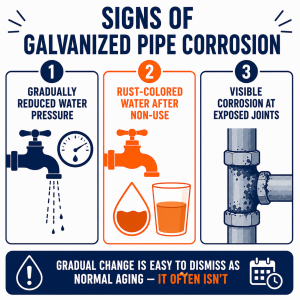
Rust-colored or discolored water is another sign worth taking seriously, especially when it appears specifically after the water hasn’t been run for a while, such as first thing in the morning or after returning from a trip. That pattern is consistent with corrosion byproducts that have settled in the pipe overnight and get flushed out when water starts moving again, clearing up somewhat as the tap runs longer. Visible corrosion or rust staining at any exposed pipe joints — in a basement, crawlspace, or utility area — is a more direct physical sign, since threaded galvanized joints are frequently where deterioration shows up first and most visibly.
The age of the home itself is also a useful general risk indicator, even without other symptoms present yet. A home built during the decades when galvanized steel was the standard residential material carries a higher baseline likelihood of still having some galvanized supply lines somewhere in the system, even if portions have been updated over the years. None of these signs on their own confirm exactly how severe the situation is — that’s a job for a professional inspection — but together they’re a reasonable basis for having your plumbing evaluated rather than waiting for a more serious failure.
⚠️ Warning: Reduced water pressure that develops gradually over years, rather than suddenly, is a classic sign of internal corrosion narrowing galvanized pipe from the inside — this is easy to dismiss as normal aging rather than recognizing it as a pipe material issue.
Cost of Replacement
A full galvanized-to-copper repipe is a significant undertaking, both in terms of cost and disruption, which is why it’s rarely something homeowners jump into without a professional assessment first. Cost generally falls into the higher $$$–$$$$ range for a whole-home repipe, though the exact scope depends heavily on the size of the home, how accessible the existing pipe is behind walls and floors, and how much of the system actually needs replacing versus how much has already been updated over the years.
For older homes, it’s common for this kind of project to be done in phases — replacing the most problematic sections or a single bathroom or floor at a time — rather than tackling the entire home’s plumbing in one project. This phased approach can spread out both the cost and the disruption to daily life, and it allows a homeowner to prioritize the areas showing the clearest signs of trouble first.
Before assuming a full repipe is necessary, it’s worth getting a professional plumbing assessment. A licensed plumber can evaluate the actual condition of your existing galvanized pipe, confirm how much of the system is affected, and recommend a scope of work that matches the real severity of the issue rather than defaulting to the most extensive — and most expensive — option available.
Frequently Asked Questions
Q: Is galvanized steel pipe dangerous?
Galvanized steel pipe itself isn’t inherently dangerous, but aging galvanized pipe that has corroded internally can raise legitimate concerns worth taking seriously — restricted water flow, discolored water, and corrosion byproducts affecting water quality among them. The level of concern depends on the specific condition of the pipe in your home, which isn’t something to assume from age alone. If you have specific water quality concerns, testing is the most reliable way to know what’s actually in your water rather than relying on general assumptions about galvanized pipe as a category.
Q: How do I know how old my home’s plumbing is?
The age of your home’s original construction is a reasonable starting point, though it doesn’t guarantee the plumbing hasn’t been updated since. Home inspection records, if available from when the home was purchased, often note the plumbing material directly. A licensed plumber can also make a direct visual and physical assessment of accessible pipe, which is generally the most reliable way to confirm both the material and its general condition without guessing.
Q: Can galvanized pipe be repaired instead of fully replaced?
In some cases, yes — a plumber may be able to address a localized issue, such as a section with a leak or severe blockage, without replacing the entire system all at once. Whether a repair versus a fuller replacement makes more sense depends on how widespread the corrosion actually is throughout the home’s plumbing, which is best determined through a professional assessment rather than assumed based on symptoms at a single fixture.
Q: Does galvanized steel pipe affect lead testing results?
Galvanized steel pipe itself is not a source of lead, but that doesn’t rule out lead exposure from other sources in an older home’s plumbing, including lead-based solder used at pipe joints prior to 1986 or an older lead service line in some areas. If you’re testing your water for lead, it’s worth doing so regardless of which pipe material you have, since galvanized steel and lead are separate, independent concerns that can both be present in an older home’s plumbing system.
Conclusion
Galvanized steel pipe is more commonly found in older housing stock across the northern and midwestern US, where residential construction from the early-to-mid 20th century often used it as the standard material, though it appears in older homes nationwide. If you’re unsure of your home’s plumbing history, checking with a licensed plumber or reviewing any available home inspection records is a reliable starting point before assuming a full repipe is needed.
Copper remains the more common choice today precisely because it holds up better than galvanized steel over a comparable service life, resisting the internal corrosion that eventually affects aging galvanized pipe. If your home shows signs like gradually declining water pressure, discolored water, or visible corrosion at exposed joints, the right next step is a professional evaluation — not necessarily a full replacement, but an accurate picture of what’s actually happening inside your pipes before deciding what to do about it.
Prices and ratings may change. Always check Amazon for current prices.
✍️ About This Comparison
PTR Editorial Team — Product Comparisons. We compare manufacturer specifications, installation requirements, compatibility and available product documentation to help homeowners choose suitable tools and parts. How we review →