Reviews
23 Sep 2026

5 Best Natural Gas & Propane Leak Detectors (2026) — Expert Reviews
Compare 5 top natural gas & propane leak detectors for 2026 — plug-in alarms vs handheld sniffers, tested for accuracy, price and home safety.
5 best water filter pitchers (2026) — expert reviews of Brita, ZeroWater, Waterdrop, PUR & Clearly Filtered pitchers for cleaner tap water.
Please note: Product availability and information are based on our research at time of writing and are subject to change. Always check Amazon for the latest details before purchasing. his review may also contain Creator Connections links, which may earn an additional commission at no extra cost to you. Reviews remain editorially independent.
Not every water filtration problem calls for cutting into a supply line or clearing out a cabinet under the sink. A water filter pitcher sits on a counter or refrigerator shelf, needs no tools to start using, and can go with you if you move — a tradeoff against the flow rate and capacity of a permanently installed system.
This roundup covers five standalone countertop pitchers built around different filtration priorities — a standard carbon pitcher for everyday taste and odor, a multi-stage pitcher engineered to cut total dissolved solids, a long-life filter built to lower cost per gallon, a compact pitcher for smaller households, and a comprehensive filter targeting PFAS and fluoride most basic pitchers don’t touch. That’s different from our whole-house water filters review, which covers systems installed at the main line, and our under-sink water filters review, which covers point-of-use systems plumbed into a kitchen faucet.
✏️ Our Take
A water filter pitcher trades the installation and cost of a whole-house or under-sink system for something you can set on a counter or refrigerator shelf today. The right pick depends on what you’re actually filtering for: a standard carbon pitcher handles taste and odor well and covers most everyday needs, a multi-stage pitcher targets total dissolved solids more aggressively for noticeably different-tasting water, and a comprehensive filter goes further still to address PFAS and fluoride that basic carbon filtration doesn’t touch at all. Filter life and replacement cost matter just as much as the pitcher itself — a cheaper pitcher with short-lived filters can cost more over a year than a pricier pitcher with a long-life filter.
IN THIS GUIDE
| Product | Rating | Best For | Price |
|---|---|---|---|
| Brita Large 10-Cup Pitcher BEST OVERALL |
★★★★★ | Everyday taste and odor filtration | $ |
| ZeroWater 10-Cup 5-Stage Pitcher | ★★★★★ | Households with high total dissolved solids | $$ |
| Waterdrop PT-07B Pitcher | ★★★★★ | Lowest cost per gallon filtered | $ |
| PUR 7-Cup Pitcher | ★★★★★ | Smaller households and tighter budgets | $ |
| Clearly Filtered 80oz Pitcher | ★★★★★ | Broadest contaminant removal, including PFAS | $$$ |
🏆 Best Overall
WQA/NSF Certified
The Brita Large 10-Cup Pitcher is our top overall pick — a standard carbon-filtration pitcher covering the vast majority of everyday water-taste concerns. Exceptional buyer demand and a very large review base confirm this is the trusted default water filter pitcher for most US households.
WQA/NSF certification backs up its chlorine taste and odor claims, along with reduced zinc, copper, and mercury, and the 10-cup capacity fits a standard refrigerator door shelf. Replacement filters are sold everywhere from grocery to hardware stores, so restocking is never a hassle. The tradeoff is scope: standard carbon targets taste, odor, and a specific contaminant list rather than the broader range some premium filters address, and the filter needs replacing more often than long-life alternatives.
✓ Pros
Exceptional buyer demand and a very large review base confirm this is the trusted default water filter pitcher for most households
WQA/NSF certification backs up its chlorine taste and odor removal claims
Replacement filters are sold everywhere from grocery stores to hardware stores, so restocking is never a hassle
10-cup capacity fits standard refrigerator door shelves
✗ Cons
Standard carbon filtration targets taste, odor, and a specific list of contaminants rather than the broader range some premium filters address
Filter life is shorter than long-life alternatives, meaning more frequent replacement
⭐ Best for TDS Reduction
5-Stage Filtration
Standard carbon filtration handles taste and odor well, but it wasn’t built to move the needle on total dissolved solids — the dissolved minerals that can leave tap water tasting flat or metallic. The ZeroWater 10-Cup Pitcher is built specifically for that problem. Exceptional buyer demand and a very large review base confirm dependable performance for buyers who want a genuinely different result on TDS.
Its 5-stage filtration goes well beyond basic carbon, and IAPMO certification covers reduction of lead, chromium, and PFOA/PFOS. The Ready-Pour spout lets you pour a glass while the lower reservoir is still filtering. Buyers switching from a basic carbon pitcher consistently notice a real difference in taste, especially with harder source water. The tradeoffs: a higher price tier than a standard carbon pitcher, and filters that need replacing more often given the more aggressive filtration.
✓ Pros
Exceptional buyer demand and a very large review base confirm dependable performance for buyers specifically concerned about total dissolved solids
5-stage filtration goes well beyond basic carbon filtration
IAPMO certification specifically covers lead, chromium, and PFOA/PFOS reduction
Ready-Pour spout allows pouring while the lower reservoir is still filtering
✗ Cons
Higher price tier than standard carbon pitchers, reflecting the more intensive filtration stages
5-stage filters typically need replacement more frequently than long-life alternatives given the more aggressive filtration they perform
🛒 Check Price on Amazon — $$ →
🎯 Best Long-Life Filter / Value
200-Gallon Filter Life
The sticker price of a pitcher only tells part of the cost story — how long the filter lasts matters just as much. The Waterdrop PT-07B is built around that math, with a 200-gallon filter life roughly five times longer than the standard carbon filters most pitchers ship with. Exceptional buyer demand and a very large review base confirm dependable performance at a genuinely low cost per gallon filtered.
NSF certification backs up its reduction claims for PFOA/PFOS and chlorine, and the 10-cup capacity matches standard refrigerator storage. Dramatically fewer replacement purchases mean less time reordering filters, and the lower price tier than several premium competitors makes the long-life filter feel like a bonus rather than a markup. The main tradeoff is brand recognition — Waterdrop doesn’t carry the same household-name status as Brita, and individual long-life filters can cost more upfront, even though cost per gallon works out lower over time.
✓ Pros
Exceptional buyer demand and a very large review base confirm dependable performance at a genuinely low cost per gallon filtered
200-gallon filter life means dramatically fewer replacement purchases compared to standard 40-gallon carbon filters
NSF certification backs up PFOA/PFOS and chlorine reduction claims
Lower price tier than several competitors despite the longer filter life
✗ Cons
Longer-life filters can be more expensive individually than standard short-life filters, even though the cost per gallon works out lower over time
Less established brand recognition than Brita for buyers who prioritize a familiar name
💰 Best Compact / Budget
Dishwasher Safe
Not every household needs a full 10-cup pitcher taking up refrigerator space. The PUR 7-Cup Pitcher is sized for smaller households or anyone who’d rather refill often than dedicate a shelf to a large pitcher. Strong buyer demand and a solid review base confirm dependable performance at the most accessible price point in this roundup.
The dishwasher-safe pitcher body is a genuine convenience upgrade over hand-wash-only designs. Faster filtration means less waiting for a refill, and the LockFit cap design helps cut down on spills. The obvious tradeoff is capacity: 7 cups means more frequent refilling for a larger household, and PUR’s filtration targets a narrower contaminant list than the multi-stage options elsewhere in this roundup.
✓ Pros
Strong buyer demand and a solid review base confirm dependable performance at the most accessible price point in this roundup
Compact 7-cup size fits smaller refrigerators and single-person or small households well
Dishwasher-safe pitcher body simplifies cleaning compared to hand-wash-only designs
Faster filtration and a LockFit cap design that reduces spills during pouring
✗ Cons
Smaller 7-cup capacity means more frequent refilling for larger households
PUR’s filtration targets a narrower contaminant list than the premium multi-stage options in this roundup
👷 Best for PFAS & Comprehensive Contaminant Removal
Targets Fluoride & PFAS
Most pitchers in this roundup — and on the market generally — don’t address fluoride or microplastics at all. The Clearly Filtered 80oz Pitcher does, targeting an unusually broad range of contaminants that puts it in a genuinely different tier of filtration. Strong buyer demand and a solid review base confirm dependable performance for buyers seeking the broadest contaminant reduction available in a countertop pitcher.
NSF certification backs up its claims across that wide contaminant list, including PFAS (“forever chemicals”) and fluoride, and BPA/BPS-free construction runs throughout. For households with documented PFAS concerns in local water testing, or anyone trying to filter fluoride out of drinking water, this is the pick built for that job. The cost is real: this is the highest price tier in this roundup, and replacement filters cost correspondingly more than standard carbon filters.
✓ Pros
Strong buyer demand and a solid review base confirm dependable performance for buyers seeking the broadest possible contaminant reduction in this roundup
NSF certification backs up its claims across an unusually wide range of targeted contaminants, including PFAS and fluoride
Most pitchers in this category don’t address fluoride or microplastics at all, making this a genuinely different tier of filtration, with BPA/BPS-free construction throughout
✗ Cons
Highest price tier in this roundup by a meaningful margin, reflecting the more extensive filtration technology
Replacement filters carry a correspondingly higher cost than standard carbon filters
🛒 Check Price on Amazon — $$$ →
A basic carbon filter is built around chlorine taste and odor plus a defined list of metals — the right tool for the most common complaint about tap water. A multi-stage filter adds passes aimed at reducing total dissolved solids, changing the taste more than carbon alone. A comprehensive or PFAS-targeted filter goes further, using media engineered to capture persistent contaminants like PFAS and fluoride. None of these is universally “better” — it depends on what’s actually in your water.
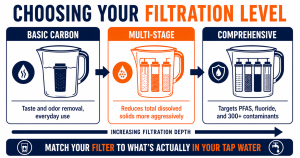
NSF (and the related WQA and IAPMO) certifications mean a product has been independently tested against a published standard for a specific claim, such as chlorine or lead reduction. Certification is claim-specific: a filter certified for chlorine hasn’t necessarily been tested for PFAS unless that’s a separate, listed certification. Check which contaminants a certification actually covers rather than assuming broader coverage.
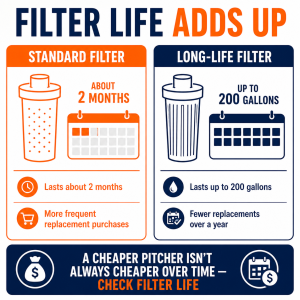
A pitcher’s upfront price is only half the cost equation. Standard carbon filters need replacing every couple of months, while long-life filters can last five times as long or more. A cheaper pitcher with short-lived filters can easily cost more over a year than a pricier pitcher with a long-life filter. Compare annual filter cost, not just the pitcher’s price tag.
A 10-cup pitcher suits most households and fits standard refrigerator door shelves, while a compact 7-cup pitcher fits smaller kitchens or limited door storage better. Larger households may prefer the largest capacity available, since refilling more than once a day gets old fast. Measure your door shelf clearance before buying if space is tight.
Water filter pitchers have become especially popular across the US in areas where municipal water quality reports have raised concerns about PFAS (“forever chemicals”) or where households simply want a taste improvement over their local tap water without the expense of a whole-house system. Homeowners on well water, or those in regions with documented PFAS contamination in local water testing, may want to prioritize a comprehensive-filtration pitcher over a standard carbon model, since basic carbon filtration alone does not address these more persistent contaminants. If you’re not sure what’s actually in your water to begin with, our how to test your water for hardness guide covers the first step most homeowners skip.
Sometimes a job is too big for DIY. If you need a licensed plumber in your area, search PlumberArchive.com — the US plumber directory with 12,151+ verified plumbers across all 50 states.
Get weekly plumbing tips, honest tool reviews and DIY guides delivered to your Facebook feed.
Most standard carbon-filter pitchers do not remove fluoride — carbon filtration isn’t designed to capture it. Look specifically for a pitcher certified for fluoride reduction, like the comprehensive filter in this roundup, rather than assuming any pitcher handles it by default.
A pitcher filters water in small batches as you pour and can move with you between homes, but it only serves water poured through it. A whole-house system filters every drop entering at the main line, and an under-sink system filters water at a single faucet, but both require plumbing installation. Our whole-house water filters and under-sink water filters reviews cover those options in more detail.
It depends on the filter type. Standard carbon filters commonly need replacing every couple of months with regular use, while long-life filters can last five times longer or more. Check the manufacturer guidance for your pitcher, since usage volume and source water quality both affect how quickly a filter’s capacity is used up.
NSF certification means a product has been independently tested against a published standard for a specific contaminant claim — not a blanket guarantee that the product filters everything mentioned in its marketing. Check exactly which contaminants a certification covers rather than assuming broader coverage than what’s been tested.
For most households, the Brita Large 10-Cup Pitcher is the easiest recommendation — a WQA/NSF-certified standard carbon pitcher that covers everyday taste and odor concerns. If your tap water tests high on total dissolved solids, the ZeroWater 10-Cup 5-Stage Pitcher is built for that job, and if lowest cost per gallon matters most, the Waterdrop PT-07B pairs a long filter life with a lower price tier.
For smaller households or tighter budgets, the PUR 7-Cup Pitcher is a sensible pick, and for anyone concerned about PFAS or fluoride, the Clearly Filtered 80oz Pitcher is the only option here built to address them directly. Whichever you choose, match the filtration type to what’s actually in your water rather than defaulting to the most familiar brand name.
✍️ About This Review
Reviewed by James Carter, Senior Tool Reviewer at PlumbingToolsReview — 15 years of hands-on experience in residential plumbing and tool testing. Learn how we test →
Compare 5 top natural gas & propane leak detectors for 2026 — plug-in alarms vs handheld sniffers, tested for accuracy, price and home safety.
5 septic tank riser kits compared for 2026 — Tuf-Tite and Polylok risers by diameter and height, so you can bring tank access to grade level.
The 5 best sewage and effluent ejector pumps for 2026, expert-reviewed: grinder, standard solids-handling and light-duty effluent pumps compared.

