Please note: Product availability and information are based on our research at time of writing and are subject to change. Always check Amazon for the latest details before purchasing.
Introduction
A braided supply line is the short, flexible connector that carries water from a shutoff valve to a fixture or appliance — the toilet, the kitchen sink, the washing machine, the dishwasher. It’s an unglamorous part, usually hidden behind a cabinet door, which is exactly why it gets ignored until it fails without much warning.
This roundup covers five braided stainless steel supply lines, each matched to a different fixture — a toilet connector, a faucet supply pair, a washing machine hose set, a dishwasher kit, and a longer faucet line for setups that don’t fit the standard length. That’s a different focus than our braided vs rigid supply line comparison, which weighs stainless against rigid copper in general — here we’re picking the correct line for the fixture in front of you.
✏️ Our Take
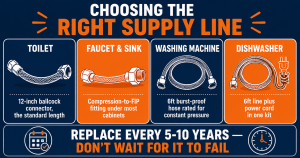
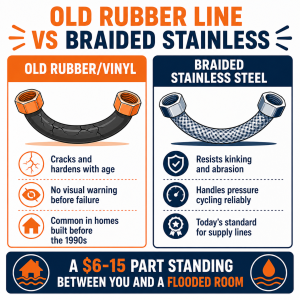
A braided supply line is one of the cheapest insurance policies in your home — a $6–15 part standing between you and a burst connection that floods a bathroom, kitchen, or laundry room while you’re at work or asleep. The right pick depends entirely on the fixture: toilets and faucets use compact compression fittings, while washing machines and dishwashers need longer, heavier-duty lines rated for constant pressure between uses. Stainless steel braiding has made the old rubber and vinyl supply line all but obsolete — if any line under your sinks or behind your appliances still isn’t braided stainless, it’s worth replacing on a schedule rather than waiting for it to fail.
Quick Comparison Table
Full Reviews — 5 Best Braided Supply Lines
1. Eastman 12 Inch Flexible Toilet Connector, 7/8 Inch Ballcock x 3/8 Inch Compression, Stainless Steel Braided Hose, 48088 — Best Overall
🏆 Best Overall
Standard Toilet Fit
The Eastman 12 inch toilet connector is the standard 7/8 inch ballcock by 3/8 inch compression fitting that matches the vast majority of US toilets, and the benchmark product in this category. Exceptional buyer demand and a very large review base confirm it as the trusted default for homeowners nationwide.
Stainless steel braided sheathing resists kinking and abrasion far better than the old rubber or vinyl lines it replaces, and installation is simple — hand-tighten each end, then add a quarter turn, no special tools required. Its low price makes it an easy preventative swap. The one limitation is the fixed 12 inch length, so measure your setup before ordering; toilets set further from the shutoff valve need a longer connector from elsewhere in this roundup.
- 7/8 inch ballcock x 3/8 inch compression fitting matches standard US toilets
- Stainless steel braided sheathing resists kinking and abrasion
- Hand-tighten plus quarter-turn installation — no special tools needed
✓ Pros
Exceptional buyer demand and a very large review base confirm this is the trusted default toilet connector for homeowners nationwide
Stainless steel braided sheathing resists kinking and abrasion far better than older rubber or vinyl lines, and matches the standard 7/8 inch ballcock x 3/8 inch fitting on the vast majority of US toilets
Straightforward hand-tighten-plus-quarter-turn installation with no special tools, and a low price point that makes it an easy preventative swap even before a line fails
✗ Cons
Fixed 12 inch length only — measure your specific setup before ordering, as toilets set further from the shutoff valve will need a longer connector from elsewhere in this roundup
🛒 Check Price on Amazon — $ →
2. Braided Stainless Steel Faucet Supply Lines: 16-Inch Flexible Hose Connector – 3/8″ Compression x 1/2″ FIP Water Supply Lines for Kitchen Bathroom Sink Hose Extension, PROCURU 9SF16-2P — Best for Faucets & Sinks
⭐ Best for Faucets & Sinks
Matched Pair
Replacing the supply lines under a kitchen or bathroom sink is one of the most common under-sink repair jobs, and this PROCURU pair is purpose-built for it. Strong buyer demand and a standout listing among faucet supply lines confirm dependable performance, and it’s sold as a matched 2-pack for hot and cold so both lines get replaced together for a consistent seal.
The 3/8 inch compression by 1/2 inch FIP fitting matches the standard faucet shutoff valve and tailpiece thread found on nearly all US sinks, and the construction is certified safe for potable water. Its compact length works well in a typical sink cabinet, though faucets set unusually far from the shutoff valve may need a longer connector like the Midanya pick further down this list.
- 3/8 inch compression x 1/2 inch FIP fitting for kitchen and bathroom sink faucets
- Sold as a 2-pack — matched hot and cold pair
- Certified-safe construction for potable water
✓ Pros
Strong buyer demand and a standout listing among faucet supply lines confirm dependable performance for one of the most common under-sink repair jobs
Sold as a matched pair so both hot and cold lines get replaced together for a consistent seal
3/8 inch compression x 1/2 inch FIP fitting matches the standard faucet shutoff valve and tailpiece thread on nearly all US sinks, with certified-safe construction for potable water
✗ Cons
16 inch length may be too short for faucets set unusually far from the shutoff valves, or cabinets with deep under-sink storage
🛒 Check Price on Amazon — $ →
3. K&J Premium 6ft Washing Machine Hoses Burst Proof 2 Pack – Hot and Cold Water Supply Hoses for Washing Machines (Stainless Steel) — Best for Washing Machines
🎯 Best for Washing Machines
Burst-Proof Rated
A washing machine hose sits under constant water pressure between loads, not just while running, making it one of the higher-stakes connections in the home. This K&J pair is explicitly marketed and tested as burst-proof, and strong buyer demand confirms reliable performance under sustained pressure cycling.
The burst-proof construction directly addresses the single biggest risk with washing machine hoses — a failure while no one is home. The 6ft length is the standard hookup distance, sold as a matched pair with heavier-duty stainless braiding than typical faucet-grade lines, at a higher price than the faucet and toilet connectors here. The fixed length won’t suit machines installed unusually close to or far from the shutoff valves.
- Explicitly tested and marketed as burst-proof
- 6ft length — standard washing machine hookup distance
- Heavier-duty stainless braiding rated for appliance-level pressure cycling
✓ Pros
Strong buyer demand confirms reliable long-term performance for an appliance connection that runs under constant water pressure between uses
Explicit burst-proof construction addresses the single biggest risk with washing machine hoses — a failure while no one is home
6ft length is the standard hookup distance, sold as a matched hot and cold pair with heavier-duty stainless braiding than typical faucet-grade lines
✗ Cons
Higher price tier than the faucet and toilet connectors here, and the fixed 6ft length won’t suit machines installed unusually close to or far from the shutoff valves
🛒 Check Price on Amazon — $$ →
4. Eastman 6 Ft. Dishwasher Installation Kit, Braided Stainless Steel Supply Line with 3/8 Inch Compression Ends, 3-Prong Straight Power Cord, 41150 — Best for Dishwashers
👷 Best for Dishwashers
Complete Install Kit
Installing a dishwasher normally means sourcing a water supply line and a power cord separately, and this Eastman kit combines both in one purchase. Strong buyer demand and a solid review base confirm it’s a trusted, complete solution rather than a piecemeal fix.
The braided stainless water line uses 3/8 inch compression ends that match standard dishwasher inlet fittings, and the bundled power cord simplifies the electrical side of the install. At 6ft, the line accommodates most under-counter placements — a convenience some buyers won’t need if only replacing the water line, and a length that may not suit unusual layouts with the shutoff valve set far away.
- Combines braided stainless water supply line and 3-prong power cord in one kit
- 3/8 inch compression ends match standard dishwasher water inlet fittings
- 6ft length accommodates most under-counter dishwasher placements
✓ Pros
Strong buyer demand confirms this is a trusted, complete solution rather than a piecemeal fix
Combines the braided stainless water supply line and the 3-prong power cord in a single kit, simplifying a dishwasher install to one purchase
3/8 inch compression ends match standard dishwasher water inlet fittings, and the 6ft length accommodates most under-counter placements
✗ Cons
The bundled cord is a convenience some buyers won’t need, and the fixed 6ft length may not suit layouts with the shutoff valve far from the dishwasher
🛒 Check Price on Amazon — $ →
5. Midanya 32-Inch Long Faucet Water Supply Lines, Braided Stainless Steel Supply Hose, 3/8-Inch Female Compression Thread x M10 Male Connector, 2 Pcs (1 Pair) — Best Long-Length / Budget Pick
💰 Best Long-Length / Budget Pick
Extended 32″ Reach
Every standard faucet supply line runs into the same limitation: it’s too short. The Midanya pair solves that with a notably longer 32 inch length, exactly the fix for faucets set unusually far from the shutoff valve. Solid buyer demand and an established review base confirm dependable performance at that longer length.
It uses a 3/8 inch female compression thread on one end and an M10 male connector on the other — common on certain modern and European-style faucets that standard FIP connectors elsewhere in this roundup won’t match. It’s sold as a pair, at the lowest price tier here despite the added length. Confirm your faucet’s connector type before ordering, since M10 thread is less universal than standard FIP.
- 32 inch length — notably longer than standard faucet supply lines
- 3/8 inch female compression thread x M10 male connector
- Sold as a pair for hot and cold replacement
✓ Pros
Notably longer 32 inch length solves the exact problem that trips up buyers of shorter faucet lines — faucets set unusually far from the shutoff valve
Solid buyer demand and an established review base confirm dependable performance at the longer length
M10 male connector fits certain modern and European-style faucets that standard FIP connectors won’t match, sold as a pair at the lowest price tier in this roundup
✗ Cons
M10 thread is less universal than standard FIP — confirm your connector type before ordering; sheathing here is a lighter-duty grade than the appliance-rated picks elsewhere
🛒 Check Price on Amazon — $ →
Braided Supply Line Buying Guide
Understanding connection types — compression, FIP, ballcock, and M10 threads
Supply lines use several different fitting types, and matching them matters more than brand or price. Compression uses a nut and ferrule to seal against a bare pipe end, usually at the shutoff valve. FIP (Female Iron Pipe) is a standard thread found on faucet tailpieces. Ballcock is specific to toilets — a 7/8 inch threaded connection to the fill valve. M10 is a metric thread on certain modern and European-style faucets that won’t interchange with standard FIP. Check both ends of the line you’re replacing, since the valve side and fixture side often differ.
How to measure for the correct length before ordering
Measure the straight-line distance between the shutoff valve outlet and the fixture inlet, then add a few inches for a gentle bend rather than a taut line. Toilets and faucets typically run 12 to 20 inches; washing machines and dishwashers run 4 to 6 feet. When in doubt, size up.
Braided stainless steel vs braided nylon vs vinyl/PVC — why stainless is now the standard
Older supply lines were plain rubber or vinyl/PVC tubing with no reinforcement, which degrades and cracks with age. Braided nylon improved on that with a woven outer layer, but it can still stretch and weaken under sustained pressure. Braided stainless steel is now the standard: the metal braiding resists kinking, abrasion, and rodent damage, and holds its pressure rating far longer than nylon or unreinforced rubber.
Burst-proof ratings and what they actually mean
A “burst-proof” rating generally refers to a reinforced inner core combined with the stainless steel outer braid, engineered to hold a rated pressure without rupturing as the line ages. It’s not a guarantee against a connection-point leak — a loose or corroded nut and ferrule can still fail — but it substantially reduces the risk of the line itself splitting, which matters most for washing machine hoses under constant pressure between uses.
US regional context: older housing stock and hard water wear
Supply line failures are especially common in older US housing stock still fitted with the original rubber or vinyl connectors from decades past — a common situation in homes built before the 1990s that haven’t had a plumbing update. Homeowners in hard water regions of the US should also inspect supply lines more frequently, since mineral buildup at the connection point can accelerate wear on the ferrule and nut even when the braided sheathing itself still looks intact. Replacing every supply line in the home on a 5–10 year rotation — rather than waiting for a visible failure — is a low-cost habit that pays for itself the first time it prevents a flood.
Troubleshooting a specific leak instead? Our how to detect and fix a leaking toilet supply line guide walks through diagnosing the source before you buy a replacement part.
Frequently Asked Questions
Q: How often should braided supply lines be replaced?
A common rule of thumb is every 5 to 10 years, even with no visible signs of failure. The rubber inner core still ages, and the nut and ferrule are subject to mineral buildup and corrosion regardless of how the outer braiding looks. Replacing on a schedule is the lower-risk approach.
Q: Can I use a faucet supply line on a toilet, or vice versa?
Not directly, in most cases. Toilets use a 7/8 inch ballcock fitting, different from the 1/2 inch FIP tailpiece thread used on most faucets. The shutoff valve end is often a shared compression fitting, but the fixture end has to match your specific toilet or faucet — always confirm both ends before buying.
Q: What’s the difference between braided stainless steel and braided nylon lines?
Both add a woven outer layer over an inner rubber core, but stainless steel resists kinking, abrasion, and rodent damage more effectively than nylon and holds its pressure rating longer as it ages. Nylon lines are typically less expensive but considered a step below stainless for continuous water pressure.
Q: Do braided supply lines still need periodic inspection if they haven’t failed?
Yes. A visual check every few months is worth it — look for dampness, rust staining, or a chalky mineral crust around the nut and ferrule, early signs of a developing leak. The braided sheathing can look intact even as the connection points corrode.
Conclusion
For most toilets, the Eastman 12 Inch Flexible Toilet Connector is the easiest recommendation — the standard fitting, standard length, and trusted default. For sink and faucet replacements, the PROCURU 16-Inch Faucet Hose Connector covers the standard compression-to-FIP setup under most US sinks, while the Midanya 32-Inch Faucet Water Supply Lines is the pick when a faucet sits further from the shutoff valve, or uses an M10 connector instead of FIP threading.
For appliances, the K&J Premium 6ft Washing Machine Hoses gives burst-proof protection for a connection under pressure around the clock, and the Eastman 6 Ft. Dishwasher Installation Kit bundles the water line and power cord into one purchase. Still deciding between braided stainless and rigid copper? Our braided vs rigid supply lines comparison covers that, and if your toilet’s refill behavior — not the supply line — is the real problem, our toilet fill valves review covers that instead.
✍️ About This Review
PTR Editorial Team — Product Reviews. We compare manufacturer specifications, installation requirements, compatibility and available product documentation to help homeowners choose suitable tools and parts. How we review →