Please note: Information in this guide is based on our research at time of writing and is subject to change. Always consult a licensed plumber for diagnosis of serious plumbing issues before attempting repairs.
Introduction
If your toilet periodically makes a flushing sound or refills with no one nearby, you’re dealing with ghost flushing — a specific, well-understood symptom caused by water slowly leaking from the tank into the bowl. As the tank level drops low enough to trigger the fill valve, it refills itself automatically, producing that distinctive running sound. The symptom is distinct from general running toilet issues: ghost flushing happens in brief cycles rather than continuously, sometimes every few minutes and sometimes every few hours depending on how severe the leak is.
This guide walks through exactly how to diagnose the cause and fix it — almost always a worn toilet flapper that’s no longer sealing properly. Most repairs take under 30 minutes and cost well under $15 in parts. If your toilet is running continuously rather than cycling on and off, our broader guide on how to fix a running toilet covers the full range of causes beyond just ghost flushing.
At a Glance
| Difficulty |
Easy |
| Time |
15–30 Minutes |
| Cost |
$ — flapper replacement typically under $15 |
| Tools Needed |
Food coloring or dye tablet for diagnosis, no tools for most repairs |
| Skill Level |
Beginner |
✏️ Our Take
Ghost flushing — when your toilet flushes itself with no one around — sounds mysterious but has one overwhelmingly common cause: a worn or warped flapper letting water slowly leak from the tank into the bowl. As the tank level drops, the fill valve eventually kicks in to refill it, and that refill cycle is what sounds like a phantom flush. The fix is almost always an inexpensive flapper replacement, not a sign anything is seriously wrong with your toilet.
What Is Ghost Flushing?
Ghost flushing is the term for a toilet that periodically refills or makes a flushing sound with nobody touching it. The sound typically happens every few minutes to every few hours, with the interval depending on how fast the tank is leaking. In minor cases the toilet may ghost flush only once every hour or two; in more severe cases it can cycle every few minutes, running almost continuously.
The mechanism is simple: water is slowly leaking out of the tank through the flapper and into the bowl. As the water level in the tank drops low enough, the fill valve activates automatically to bring it back up — and that refill noise is what sounds like a phantom flush. The toilet itself isn’t actually flushing; it’s compensating for water it’s silently losing. This is a more specific problem than a generally running toilet, which can have several root causes and may run continuously rather than cycling on and off.
💡 Tip: Ghost flushing is technically a refill cycle responding to a slow leak, not an actual flush — the toilet is compensating for water it’s losing, not flushing on purpose. Knowing this makes diagnosis straightforward: the tank is leaking, and the most likely culprit is the flapper.
The Dye Test — Confirm the Cause in 5 Minutes
Before replacing any parts, confirm that water is actually leaking from the tank into the bowl with a simple dye test. Remove the toilet tank lid and add several drops of food coloring — or a dye tablet specifically made for this purpose — directly into the tank water. Replace the lid and wait 10 to 15 minutes without flushing or using the toilet.
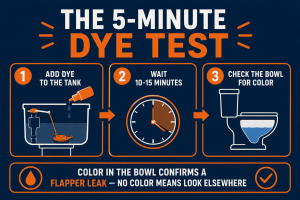
After waiting, look into the bowl. If the bowl water has taken on any color from the dye, water is leaking past the flapper seal. If the bowl water remains completely clear, the leak may be coming from elsewhere — possibly the fill valve overflowing into the overflow tube, which you can confirm by removing the tank lid and watching whether the water level sits at or above the overflow tube opening while the tank is filling.
💡 Tip: This test costs nothing and takes the guesswork out of diagnosis — confirm the leak before buying any replacement parts. Food coloring works just as well as commercial dye tablets and is something most households already have on hand.
Cause 1 — A Worn or Warped Flapper
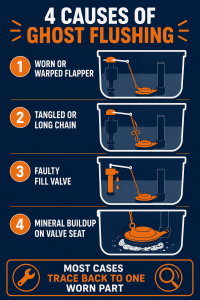
The overwhelmingly most common cause of ghost flushing is a flapper that’s no longer sealing correctly. The flapper is the rubber valve at the bottom of the tank that holds water in place until you flush. Over time, the rubber degrades, warps, or develops a mineral film that prevents it from sitting flat against the valve seat. Even a minor imperfection in the seal is enough to allow a slow trickle into the bowl that triggers repeated refill cycles.
Flappers have a limited service life regardless of use. In average conditions they last four to five years before the rubber begins to break down. For a wide selection of replacements compatible with most US toilet brands, see our guide to the best toilet flappers — matching the right size and mounting style to your toilet is the main consideration.
💡 Tip: Lift the flapper and run your finger along the seal edge — if it feels gritty, warped, or doesn’t sit flat, that’s your answer. A healthy flapper seal should feel smooth and pliable, not brittle, ridged, or coated in a visible film.
Cause 2 — A Flapper Chain That’s Too Long or Tangled
Even a perfectly good flapper can ghost flush if the chain connecting it to the flush handle is too long, kinked, or tangled. A chain with too much slack can fold underneath the flapper when it closes, holding it just slightly open and allowing a slow leak. A tangled or kinked chain can hold the flapper up just enough to prevent a clean seal. The leak caused by this is often intermittent — the chain may shift into and out of position on its own, causing ghost flushing that appears and disappears unpredictably.
Check the chain length by looking into the tank after a flush. The chain should have a small amount of slack — roughly half an inch — enough to let the flapper drop fully closed without restriction, but not so much that it pools on the floor of the tank where it can snag beneath the seal. If the chain is too long, clip it to a higher link on the handle arm. If it’s tangled, straighten it out and reattach it cleanly before running the dye test again.
💡 Tip: The right amount of chain slack is about a half inch — enough to let the flapper close fully, not so much that it can snag underneath. This is a free fix that takes under a minute and is worth checking before buying any replacement parts.
Cause 3 — A Faulty Fill Valve
Less commonly, ghost flushing can be caused by a fill valve that isn’t shutting off completely at the end of a refill cycle. A fill valve in this condition allows a continuous slow trickle into the tank that eventually overflows into the overflow tube and drains into the bowl — triggering another refill cycle in the process. This produces the same periodic refilling sound as a leaking flapper, but the dye test will tell them apart: if the dye stays clear in the bowl while the tank is still being filled, the flapper is likely fine. Our comparison of a toilet flapper vs fill valve covers the distinguishing signs in more depth if you want a second way to confirm which part is actually causing the problem.
If the dye test shows no color in the bowl after 15 minutes, remove the tank lid and watch whether the water level rises to the overflow tube opening. If water is running down the overflow tube, the fill valve isn’t closing properly and should be replaced. For compatible options, our guide to the best toilet fill valves covers the main choices for US toilets.
💡 Tip: If the dye test shows no color in the bowl but you still hear periodic refilling, suspect the fill valve rather than the flapper. Look inside the tank — if water is reaching or overflowing the top of the overflow tube, the fill valve isn’t shutting off properly.
Cause 4 — Mineral Buildup on the Valve Seat
In some cases, the flapper itself is still in good condition but the valve seat it rests against has accumulated enough mineral deposits that a clean seal is no longer possible. Hard water leaves calcium and magnesium buildup on every surface it contacts inside the tank, and the flapper seat is particularly vulnerable because it’s continuously submerged. A rough or crusted seat prevents the flapper from sitting flat regardless of how new the rubber is.
US regional note: In hard water states like Arizona, Texas, Nevada and parts of California, mineral deposits build up on the flapper seal and the valve seat faster than in soft water regions, causing flappers to warp or seal poorly years before they would in a low-mineral area. Homeowners in these states should expect to replace flappers every 1–2 years rather than the 4–5 years common elsewhere. Inspecting and cleaning the valve seat at each replacement is especially important in these regions.
To address a mineral-crusted seat, soak a cloth in white vinegar and hold it against the seat for several minutes to soften the deposits, then gently wipe away the residue with a soft cloth. Repeat if needed. In some cases this restores the seal without requiring any part replacement at all.
⚠️ Warning: Don’t scrub the valve seat with anything abrasive — a scratched seat will never seal properly again, even with a new flapper installed on top of it. Use only a soft cloth or sponge, and let the vinegar do the loosening work rather than mechanical scrubbing.
How to Replace a Flapper
Replacing a toilet flapper is one of the simplest plumbing repairs a homeowner can do — it requires no tools, no experience, and takes under 15 minutes from start to finish. Here’s the full process:
- Turn off the water supply. Locate the shut-off valve on the wall behind or beneath the toilet and turn it clockwise until it stops. Flush the toilet once to empty most of the water from the tank.
- Disconnect the chain. Unhook the chain from the flush handle arm — it usually unclips from a small hook or ring. Set it aside but note where it was connected.
- Remove the old flapper. Most flappers slide off two pegs on either side of the flush valve, or unhook from a collar that fits around the overflow tube. Slide or lift it free and inspect the seat underneath before installing the replacement.
- Install the new flapper. Fit the new flapper onto the same mounting points in reverse order. Press it down firmly to confirm it seats flat and covers the valve opening completely.
- Reattach the chain. Clip the chain back to the handle arm with roughly half an inch of slack. Confirm the flapper seats fully closed in its resting position before proceeding.
- Turn the water back on and test. Open the shut-off valve, let the tank refill, and flush once to verify normal operation. Run the dye test again after 15 minutes to confirm the leak is resolved.
For help choosing the right replacement, our guide to the best toilet flappers includes options for all major toilet brands common in US homes.
💡 Tip: Bring your old flapper to the store or have a photo ready — flapper shapes and mounting styles vary more than people expect, and matching it saves a return trip. The two main differences are mounting style (side pegs vs. collar around the overflow tube) and valve size (2-inch vs. 3-inch openings).
Why Ghost Flushing Costs You Money
Ghost flushing is easy to tune out as a minor nuisance — the toilet refills, the sound stops, and the cycle doesn’t seem urgent. But the water being lost through a leaking flapper adds up to a significant volume before most homeowners notice the impact on their water bill. A small, steady trickle past the flapper seal can drain the tank multiple times per hour without ever producing a visible or dramatic leak.
Even a moderate ghost flushing problem can waste hundreds of gallons of water per month. In areas with usage-based water billing — which includes most of the US — that translates directly into higher monthly costs. In regions like the Southwest where water rates are higher and conservation surcharges apply, the financial impact is more pronounced than in areas with lower base water costs.
Fixing ghost flushing promptly is one of the highest-value repairs available to any homeowner measured by cost against savings: the part costs well under $15 and the repair takes under 30 minutes, while the ongoing water waste from leaving it unfixed can cost multiples of that every single month.
💡 Tip: A toilet leaking just one drop per second can waste over 2,000 gallons a month — what sounds like a minor annoyance is actually a real expense. Fixing ghost flushing as soon as it’s diagnosed is one of the fastest-payback plumbing repairs a homeowner can make.
Need a Professional Plumber?
If you’ve worked through the dye test and all four causes in this guide and your toilet is still ghost flushing, or if you find a shut-off valve that won’t fully close or a fill valve that won’t stop running even after replacement, a licensed plumber is the right call. Getting professional eyes on a persistent problem is always preferable to letting water waste continue unchecked.
Find a licensed plumber in your area at PlumberArchive.com — the US plumber directory with 12,000+ verified local plumbers across all 50 states.
Find a trusted plumber near you → PlumberArchive.com
Follow Us on Facebook
Get weekly plumbing tips, honest tool reviews and DIY maintenance guides delivered straight to your Facebook feed. We cover toilet repairs, drain clearing, water heater maintenance and everything in between — written for US homeowners who want to handle more themselves.
Follow PlumbingToolsReview on Facebook →
Frequently Asked Questions
Q: Why does my toilet randomly flush itself?
What sounds like a random flush is almost always a refill cycle triggered by water leaking out of the tank. The most common culprit is a worn or warped flapper that’s no longer sealing tightly against the valve seat, allowing a slow trickle into the bowl. As the tank water level drops, the fill valve kicks in automatically to refill it — and that refill sound is what you’re hearing. In the large majority of cases, a flapper replacement resolves the issue completely. The dye test described in this guide confirms the diagnosis in under 15 minutes before you buy any parts.
Q: How do I know if my toilet flapper needs replacing?
The most reliable indicator is the dye test: add food coloring to the tank, wait 15 minutes without flushing, and check whether color appears in the bowl. If it does, the flapper is leaking and needs replacement. You can also inspect the flapper directly — lift the tank lid, reach in, and press the flapper firmly against the seat. If the ghost flushing stops while you’re holding it down but resumes when you let go, the flapper isn’t sealing on its own. Physically examining the seal edge for warping, grit, or stiffness is also useful: a healthy seal should feel smooth and pliable. Most flappers should be replaced every four to five years as a matter of routine, and every one to two years in hard water areas.
Q: Can ghost flushing increase my water bill?
Yes, meaningfully. Even a moderate flapper leak can waste hundreds of gallons per month before it’s noticed or fixed. A toilet dripping just one drop per second past the flapper seal can lose over 2,000 gallons in a month. In areas with metered water billing — which covers the majority of US households — that volume translates directly into higher monthly costs. The fix is inexpensive and takes under 30 minutes, making it one of the most cost-effective plumbing repairs available relative to the ongoing savings it generates.
Q: How often should toilet flappers be replaced?
Under normal conditions, most toilet flappers last four to five years before the rubber begins to degrade and the seal becomes unreliable. In hard water areas — particularly Arizona, Texas, Nevada, and parts of California — mineral buildup accelerates wear on both the rubber and the valve seat, and replacement every one to two years is more appropriate. In soft water regions like the Pacific Northwest and New England, a good flapper may last longer, but checking it every few years and running a dye test annually is good practice. Ghost flushing is often the first sign that a replacement is overdue.
Conclusion
Ghost flushing sounds mysterious but has a simple, well-understood cause in almost every case: a worn flapper letting water slowly leak from the tank into the bowl. The dye test confirms the diagnosis in 15 minutes, the repair takes under 30, and the part costs well under $15. It’s the kind of repair that’s easy to put off because the toilet still works — but the ongoing water waste makes fixing it promptly one of the highest-value plumbing tasks in any home.
Work through the causes in order: start with the dye test to confirm a tank-to-bowl leak, check the chain for excess slack before buying anything, then replace the flapper if the seal is worn. In most cases that’s all it takes. If your toilet is running continuously rather than cycling on and off, our guide to how to fix a running toilet covers the broader range of causes. For replacement parts, see our guide to the best toilet flappers and the best toilet fill valves for options compatible with most US toilet brands.
✍️ About This Guide
PTR Editorial Team — Plumbing Guides. We compare manufacturer specifications, installation requirements, compatibility and available product documentation to help homeowners choose suitable tools and parts. How we review →