
Guides
23 Nov 2026

Boiler Keeps Switching On and Off? Understanding Short Cycling
Boiler keeps switching on and off? See how short cycling differs from normal cycling, a thermostat ending its call, or a fault, and what to check safely.
Boiler running but one heating zone cold? See how a call for heat differs from heat arriving, what valves, pumps or air can mean, and what to check safely.
Please note: This is general information about closed-loop hot-water heating, not a diagnosis of your system. Your equipment’s own instructions come first, and a heating professional should handle anything involving electrical controls, pumps, valves, boiler settings or pressurised hot water.
This guide is about closed-loop, hot-water home heating where a boiler circulates water to baseboards or similar emitters and the house is divided into zones, each with its own thermostat. It isn’t about steam, electric baseboards or radiant floor manifolds (for those, see our guide to purging air from a radiant floor loop).
The short answer: a running boiler, or a thermostat asking for heat, doesn’t prove hot water is reaching a room. When one zone stays cold while another heats normally, that points your attention at what is particular to that zone, but it can’t tell you which part is at fault. Below: the chain between a call for heat and a warm room, the possibilities a heating professional works through, and the few checks that are safe from a distance.
✏️ Our Take
IN THIS GUIDE
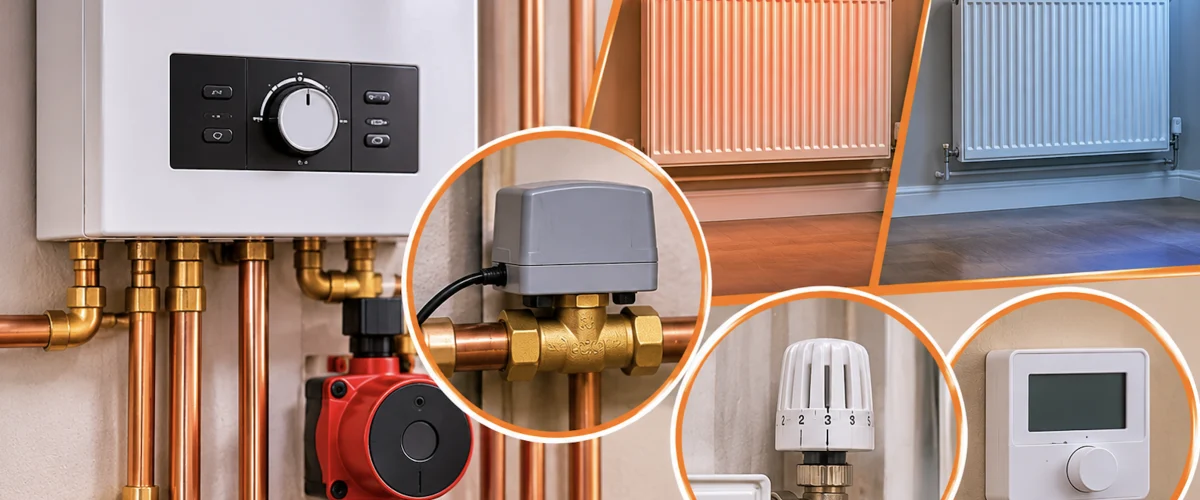
Caleffi describes three jobs in a hydronic system: the boiler makes heat, circulators move the water, and the piping delivers it. Its troubleshooting guide recommends checking them in sequence rather than guessing. For one zone, that runs roughly: the thermostat asks for heat; the zone’s controls respond, by opening a valve or starting a pump; the boiler is enabled; water moves through the zone’s loop; and the baseboards release the heat.
A fault at any step looks the same from the living room: a cold room. A thermostat that is calling shows only the first step, and Resideo’s zone-valve instructions show how separate the steps are: the installer’s checkout raises the thermostat, then confirms the valve opens and its switch signals the circulator. That check is for a trained technician.
One circulator serves the system and each zone has a motorised valve. Caleffi’s zoning article says a thermostat signals its zone’s valve to open and that, in most such systems, the circulator and heat source are enabled whenever one or more zones call. Many valves also have an end switch that closes when the valve is fully open, usually to signal other equipment. Resideo’s normally closed valves open when their motor is energised, and a spring returns them to closed.
Each zone has its own pump. Per Caleffi’s article on circulator zoning, a thermostat signals that zone’s circulator, and the heat source is enabled too. Taco’s relay instruction sheet describes the common arrangement: the thermostat call energises a switching relay, and the relay powers the circulator.
Real systems can mix these approaches or use manifolds with their own actuators. If you’re unsure which you have, your installer can tell you; this guide never asks you to identify equipment, trace pipes or interpret wiring.
Assuming the boiler must be fine because another zone is warm is incomplete reasoning. Another zone heating doesn’t tell you which part of this zone’s path is the problem, and it doesn’t rule out equipment the zones share. One transformer can supply several zone valves, and Caleffi’s list of reasons a zone valve or circulator may not run includes a transformer that isn’t supplying 24 volts and a blown fuse in a zone control panel. So the careful conclusion is narrow: the trouble may be particular to this zone or to something it shares, and only a professional can say which.
Treat these as clues, not diagnoses. Each row fits several causes.
| What you notice | What it could suggest | What to note |
|---|---|---|
| The zone’s thermostat shows a message, or its settings aren’t what you expected | The zone may not be asking for heat: the wrong mode, a setpoint at or below room temperature, a schedule, or weak batteries. | The mode, setpoint and any message, exactly as shown. |
| The thermostat is set to heat and the room still doesn’t warm after a good while | Anywhere along the chain: the zone’s valve or pump, its controls, air or restricted flow, or something shared. | How long you waited, the room-temperature trend, and which other zones heat normally. |
| Gurgling or swishing from that zone, especially after draining or repairs | Air in the loop may be affecting flow. Sound is a clue, not proof. | When it started and what work came before. |
| Heat arrives late, or the zone seems to wait while another zone runs | Some valves take time to open, and one Taco relay sheet describes a priority setting that pauses other connected zoning panels while the priority zone runs. Persistent symptoms need a professional’s assessment. | Which zone seems to come first, and for how long. |
These follow the order heat travels, not how likely each is; none of the manufacturer documents we read ranks them. They are possibilities a professional works through, not a checklist for you.
Caleffi’s guide puts the thermostats near the start of its sequence: set to heat, a setpoint above the room temperature, any schedule or setback accounted for, and no low-battery indicator on a battery-powered model. Taco’s relay sheet likewise says batteries should be fresh and correctly installed.
With zone valves, Caleffi notes that some valves with thermal motors can need up to three minutes to open fully, so a short wait isn’t a fault. If a valve has power and still doesn’t open, its guide points to the actuator; if the end switch doesn’t close, the signal that starts the circulator and enables the boiler may not be sent. Don’t force a valve open: Resideo’s instructions note that the auxiliary switch is not energised when a valve is opened manually, so it doesn’t send its usual signal, and say a trained service technician should install and service the valve.
With a circulator on each zone, Caleffi says to check that the zone’s circulator turns on when its thermostat calls. One with power that doesn’t run has likely failed; one without power means working back through the wiring and devices, including its relay. That is professional work, and Taco’s sheet points to the thermostat and its wiring first when a relay’s call-for-heat indicator doesn’t come on.
Taco’s instruction sheet for one expandable relay describes a priority setting: with it on and the priority zone running, the other connected zoning panels stop until that zone is satisfied. That is the sheet’s documented behaviour for that arrangement, and the pause is temporary by design. Whether your system has anything like it is a question for your installer. If a zone stays cold, don’t assume a priority pause is the reason: persistent symptoms need a heating professional’s assessment, which can include the controls.
Caleffi says closed-loop systems are meant to run with very little air; with too much, circulators don’t provide proper flow, gurgling or swishing is a clue, and a large pocket can block flow completely. Its flow checklist also asks whether a valve that should have opened has failed to. Proper air removal can mean forced-water purging, a job for a professional.
Pressure and fill settings can affect how water moves; judging them depends on your boiler’s own instructions. If your boiler shows a pressure or fault message, note it exactly and see our guide to boiler pressure that keeps dropping.
If the controls and flow turn out to be fine, the baseboards can still limit the heat. Our cold baseboards guide covers that, and the cases where every zone is cold.
From a safe, accessible position, you can note three things:
These observations cannot confirm whether water is flowing. A boiler that is running or making noise doesn’t show that heated water is reaching this zone, and a room that warms slowly, or not at all, fits many causes. Don’t touch pipes or baseboards to judge their temperature, open electrical or control covers, test wiring, jump terminals, force or manually open valves, or use fill or purge valves. Those jobs belong to a professional.
Get professional help
Contact a heating professional if the zone stays cold after you’ve looked at its thermostat, the problem keeps returning, the boiler or a control shows a fault or lockout message, or you see a leak or notice an electrical or burning smell. Don’t keep resetting a lockout.
A gas smell or a carbon monoxide alarm is an emergency, not troubleshooting. CPSC says that if you smell gas you should leave your home immediately and contact local gas authorities from outside, without operating lights or phones before leaving. CPSC also says that if a carbon monoxide alarm sounds you should get outside to fresh air, call 911 or the fire department, and not re-enter until emergency responders give permission.
Tell them: which zone is cold and which zones heat normally; the thermostat’s settings and any messages; how long it has been cold; whether it ever heated; any recent work; any boiler display message; and anything your installer has said about how the zones are controlled.
It may be particular to that zone or something the zones share, and another zone heating doesn’t settle which. Look at that zone’s thermostat first, and ask a heating professional for a diagnosis if it stays cold.
Yes. In the zoning arrangements described by Caleffi, another zone’s call can enable the boiler. A running boiler alone does not confirm that the cold zone is receiving hot water.
Not necessarily. Several faults look alike from the room, so get a diagnosis first. If a professional finds a failed valve or pump, our guides to zone valves and circulators cover the options.
Look at the cold zone’s thermostat, write down its settings and any messages, and watch the room temperature over several heating cycles. Then give a heating professional those notes and ask for a diagnosis before you buy a valve, pump or relay.
✍️ About This Guide
Reviewed by Jerry McCann, a plumbing contributor at PlumbingToolsReview, covering pipework, hot-water boilers and hydronic heating. How we review →
Boiler keeps switching on and off? See how short cycling differs from normal cycling, a thermostat ending its call, or a fault, and what to check safely.
Water-based radiant floor not warming up? See why a floor can feel cool or respond slowly, what can cause it, and what to check safely.
Boiler pressure keeps dropping? Learn how to compare cold readings, what patterns can point to, and what to report to a heating professional.

